Suture materials and
techniques
Dr Saujanya Jung Pandey
General Surgery Resident
KISTMCTH
Introduction
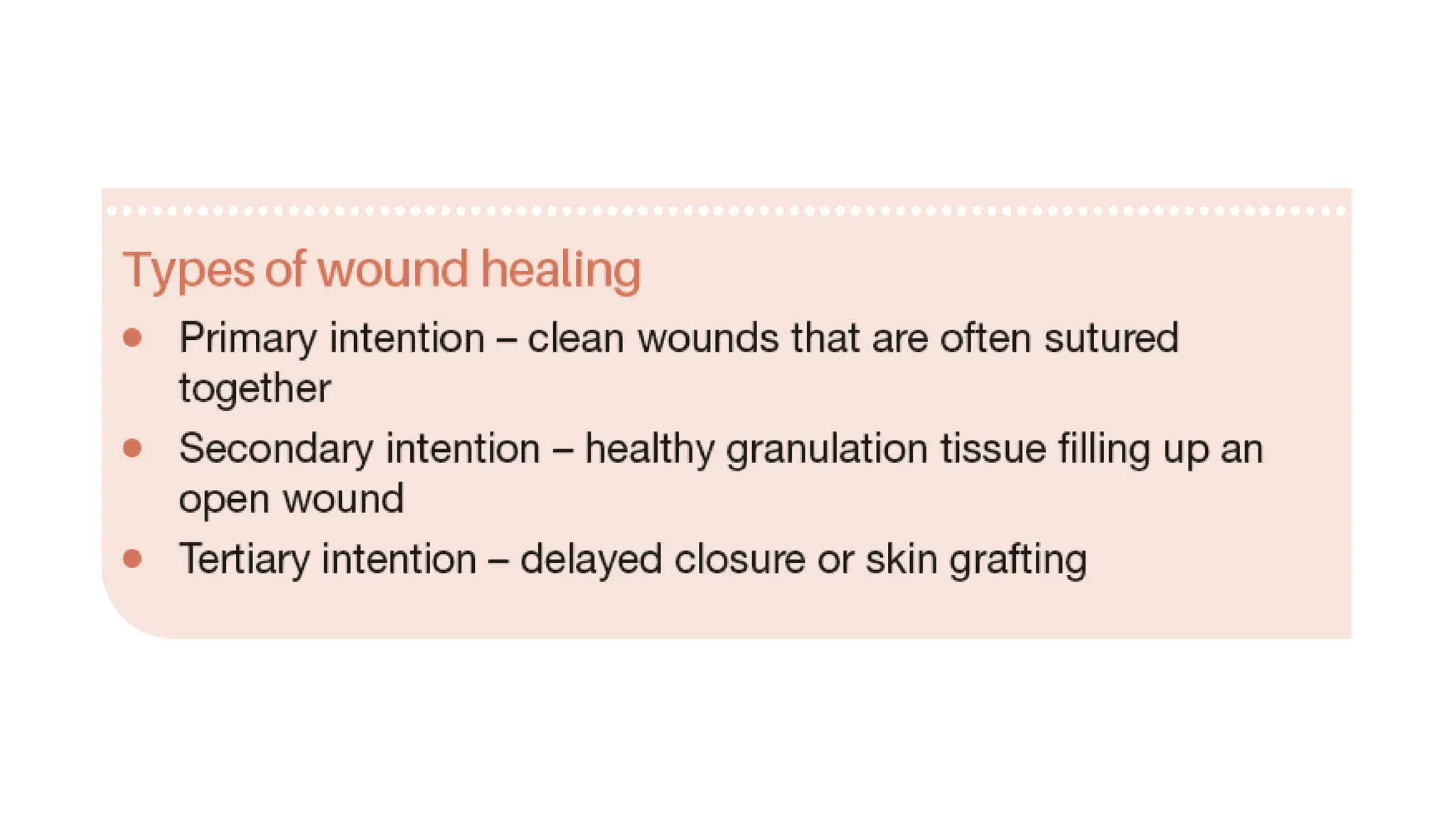
• Most wounds require skin closure of some kind. Most commonly, this
closure is done by suturing, as opposed to staples or surgical glues. A
closure is a means of primary repair of skin and deeper layers, to
promote wound healing. [1] [2]
1. Lloyd JD, Marque MJ, Kacprowicz RF. Closure techniques. Emerg Med Clin North Am. 2007 Feb;25(1):73-81.
2. Yag-Howard C. Sutures, needles, and tissue adhesives: a review for dermatologic surgery. Dermatol Surg. 2014 Sep;40 Suppl 9:S3-S15
• “Suturing offers advantages like low dehiscence rates and greater
tensile strength than other closure methods” [1] [2]
1. Lloyd JD, Marque MJ, Kacprowicz RF. Closure techniques. Emerg Med Clin North Am. 2007 Feb;25(1):73-81.
2. Yag-Howard C. Sutures, needles, and tissue adhesives: a review for dermatologic surgery. Dermatol Surg. 2014 Sep;40 Suppl 9:S3-S15
Historically
• Eyed needles, sometimes made of bone, were used to pass a suture
through wounds,
• Suture materials included hemp, flax, hair, linen, pig bristles, grass, reeds,
and other plants. [3]
• Sushruta described suturing with materials made of bark, tendon, hair, and
silk in 500 BCE so did Galen and antyllus
• Mouth of pincher ants was used to approximate wounds [3] [4]
3. Swanson NA, Tromovitch TA. Suture materials, 1980s: properties, uses, and abuses. Int J Dermatol. 1982 Sep;21(7):373-84.
4. Pillai CK, Sharma CP. Review paper: absorbable polymeric surgical sutures: chemistry, production, properties, biodegradability, and performance. J
Biomater Appl. 2010 Nov;25(4):291-366
In modern times
• innumerable options for sutures.
• Appropriate choice of suture type based on understanding of the
characteristics of different sutures.
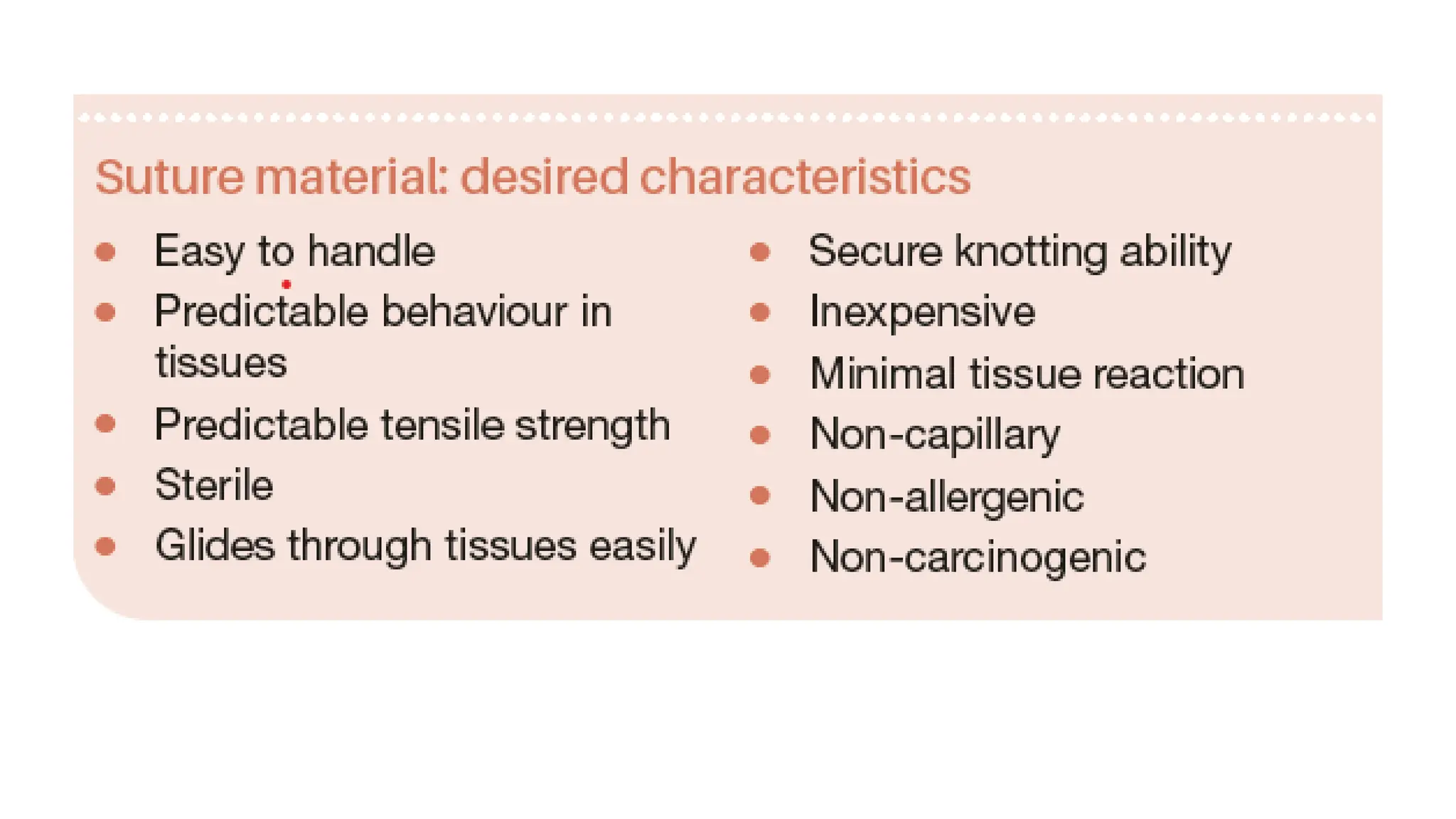
The ideal suture
• easy for the surgeon to handle,
• provide appropriate strength and secure knots,
• can tolerate wound changes like swelling and recoil,
• cause minimal inflammation or infection risk,
• easily visible,
• relatively inexpensive, [3][4]
3. Swanson NA, Tromovitch TA. Suture materials, 1980s: properties, uses, and abuses. Int J Dermatol. 1982 Sep;21(7):373-84.
4. Pillai CK, Sharma CP. Review paper: absorbable polymeric surgical sutures: chemistry, production, properties, biodegradability, and performance. J Biomater
Appl. 2010 Nov;25(4):291-366
Important definitions
• Knot strength-amount of force needed for knot to slip, related to the
friction and ability to stretch
• Elasticity- the ability of the suture to stretch and recoil
• Plasticity- when the suture stretches but does not recoil
• Memory- ability to return to its shape after it is manipulated, less
pliable
• Coefficient of friction- Suture’s relative resistance to being passed
through a tissue
• Tensile strength- suture’s ability to resist breakage
Suture characteristics
• Physical structure- monofilament or multifilament
• Monofilament sutures- Smooth, difficult to knot, easily damaged by gripping
with a needle holder
• Multifilament or braided- easier to knot, higher surface area than
monofilament and have capillary action and interstices for bacterial growth
• Strength-
• Depends on its constituent
materials, thickness and its
response
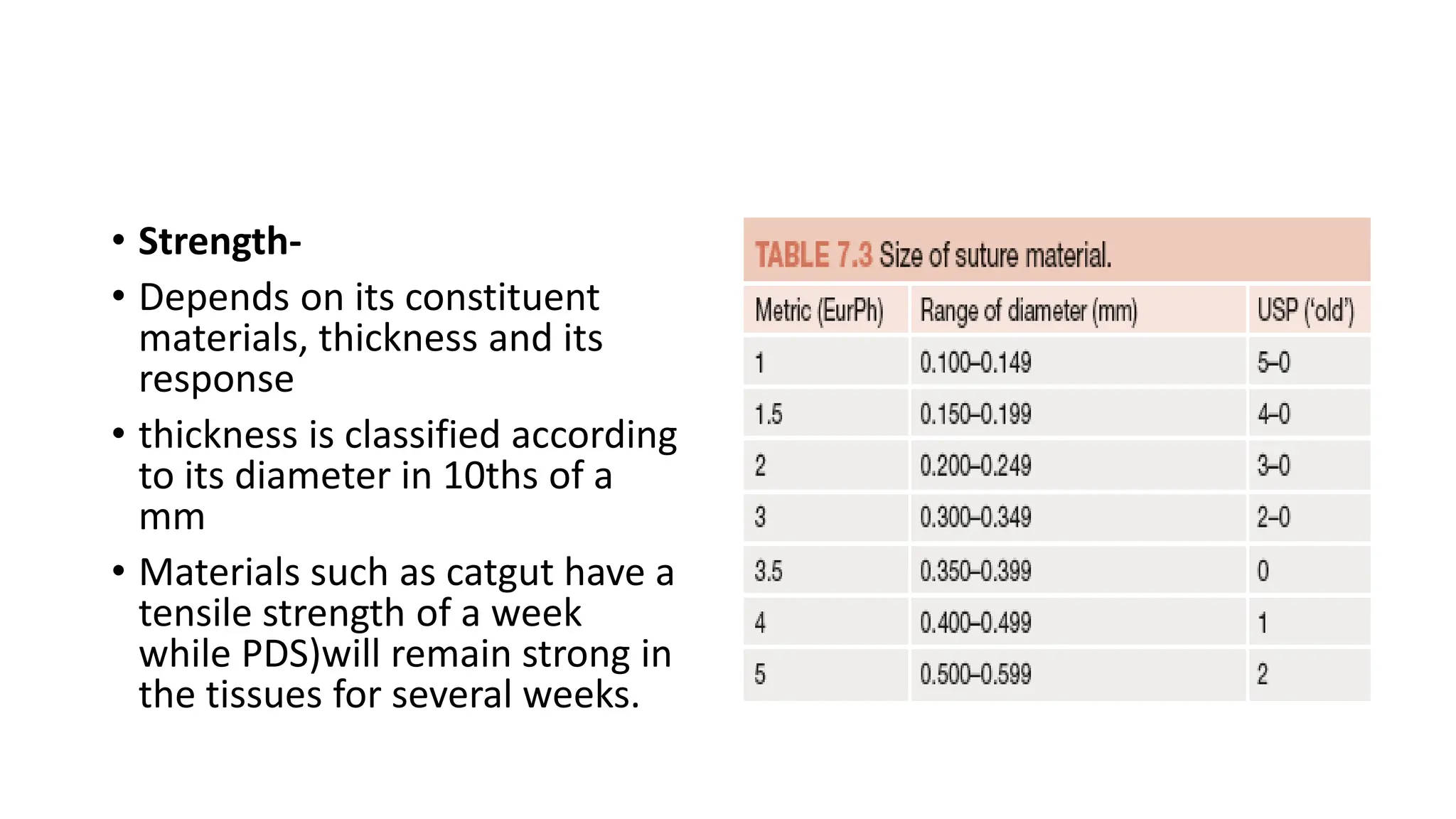
• thickness is classified according
to its diameter in 10ths of a
mm
• Materials such as catgut have a
tensile strength of a week
while PDS)will remain strong in
the tissues for several weeks.
• Tensile behavior-
• Behave differently based on their deformability and flexibility
• May be ‘elastic’ or ‘plastic’
• Many synthetic materials demonstrate ‘memory’
• Absorbabilty –
• suture materials may be non-absorbable or absorbable
• Biological behavior-
• its nature within the tissue depends upon its constituent materials
• Natural sutures (eg. Catgut) are proteolyzed so less predictable and
cause local irritation
• Synthetic sutures are hydrolyzed so their disappearance is more
predictable
Suture materials
• The main factors used to classify sutures types are:
• Absorbable vs. non-absorbable
• Synthetic vs. natural
• Monofilament vs. multifilament
Absorbable suture materials
• Catgut
• Chromic Catgut
• Polyglactin
• Polydioxanone (PDS)
• Polyglycaprone
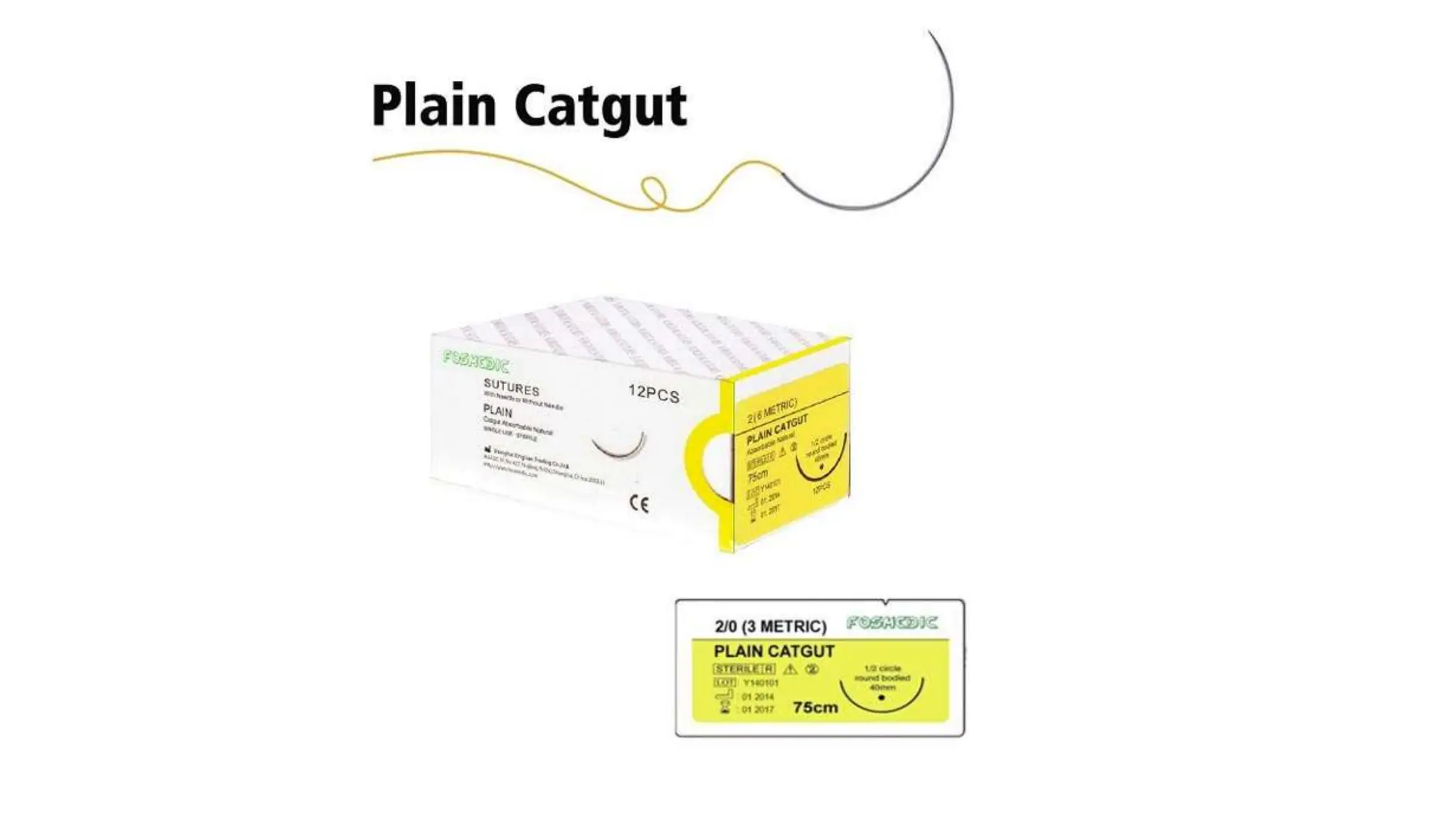
Catgut
• Made from collagen derived from healthy sheep or cattle
• Ligate superficial vessels, suture subcutaneous tissues. Stomas and
other tissues that heal rapidly
• Not for use in tissues that heal slowly and require prolonged support.
• High tissue reaction
• Degradation 7 – 10 days
• Tensile strength lost in 7-10 days
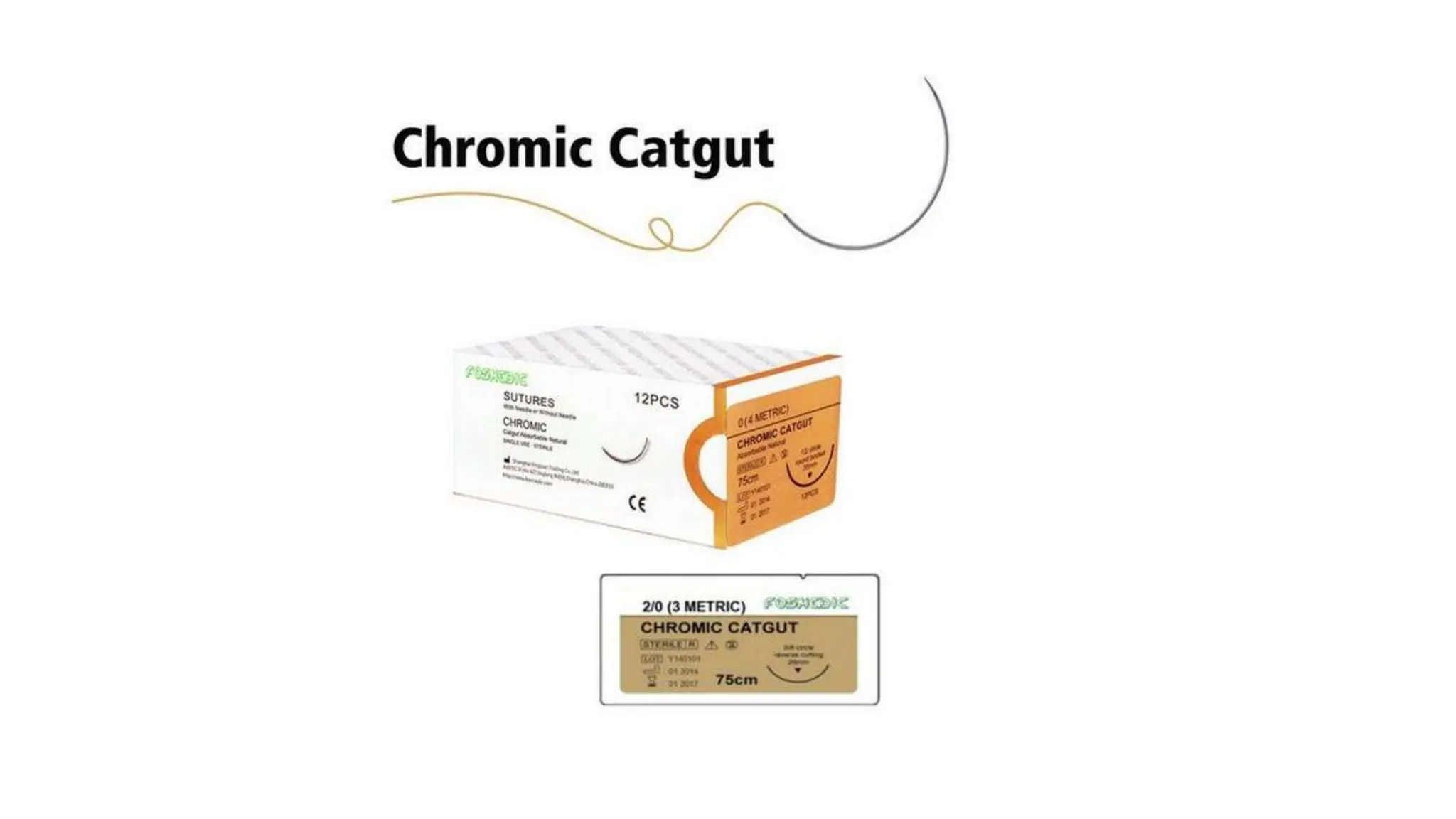
Chromic catgut
• Tanned in chromium salts to improve handling and resist degradation
• Use- same as catgut
• Contraindication same as catgut
• Moderate tissue reaction
• Phagocytosis and enzymatic degradation within 90 days
• Tensile strength retention lost within 21-28 days
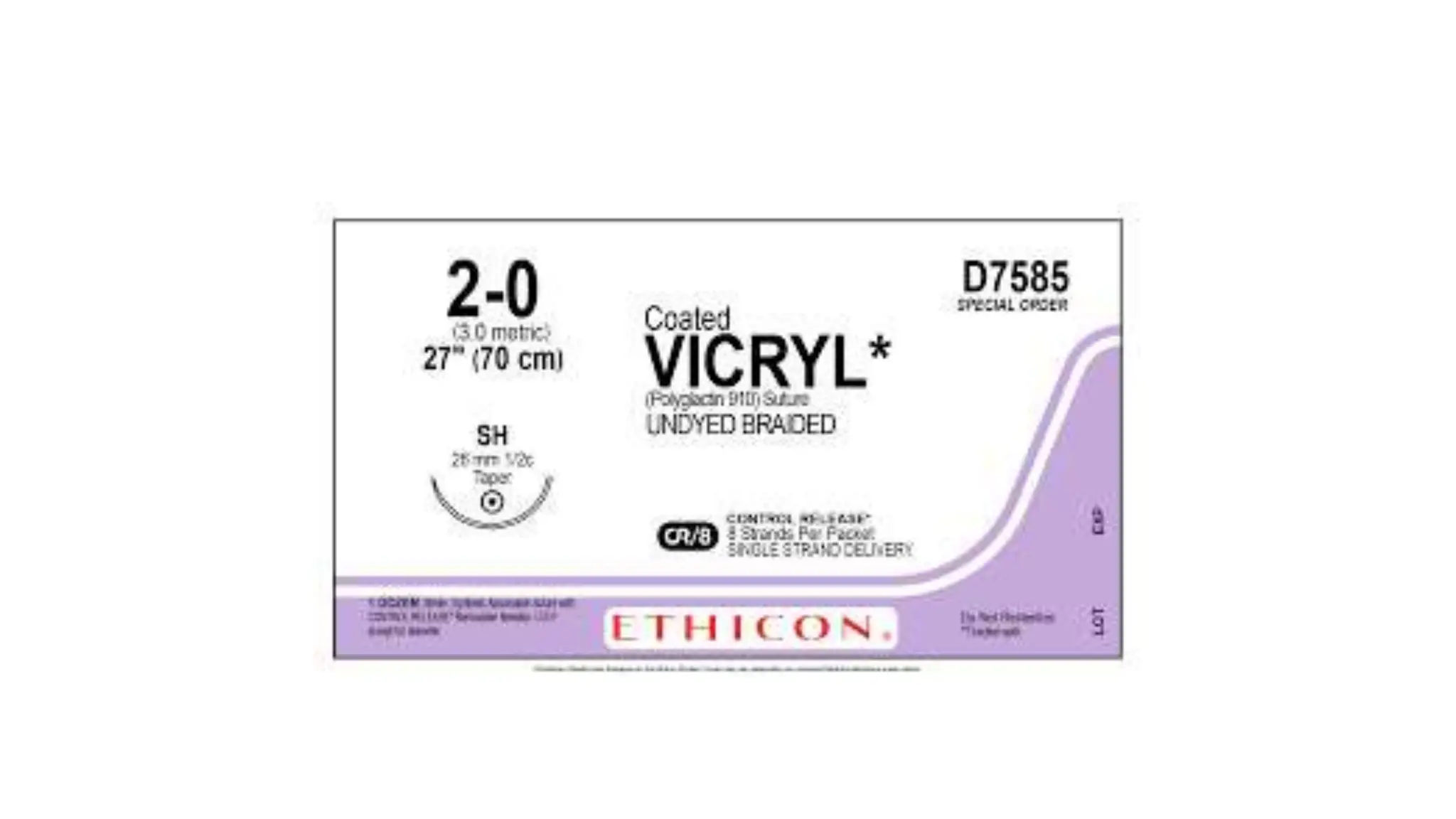
Polyglactin
• Copolymer of lactide and glycolide (90:10) coated with polyglactin
and calcium stereate
• Used in- gut anastomoses, vascular ligatures, ophthalmic surgery
• Not advised in tissues requiring prolonged approximation under
stress
• Mild tissue reaction
• Hydrolysis minimal upto 5-6 weeks , complete absorption in 60-90
days
• Tensile strength- 60% at 2 weeks, 30% at 3 weeks
• Braided multifilament
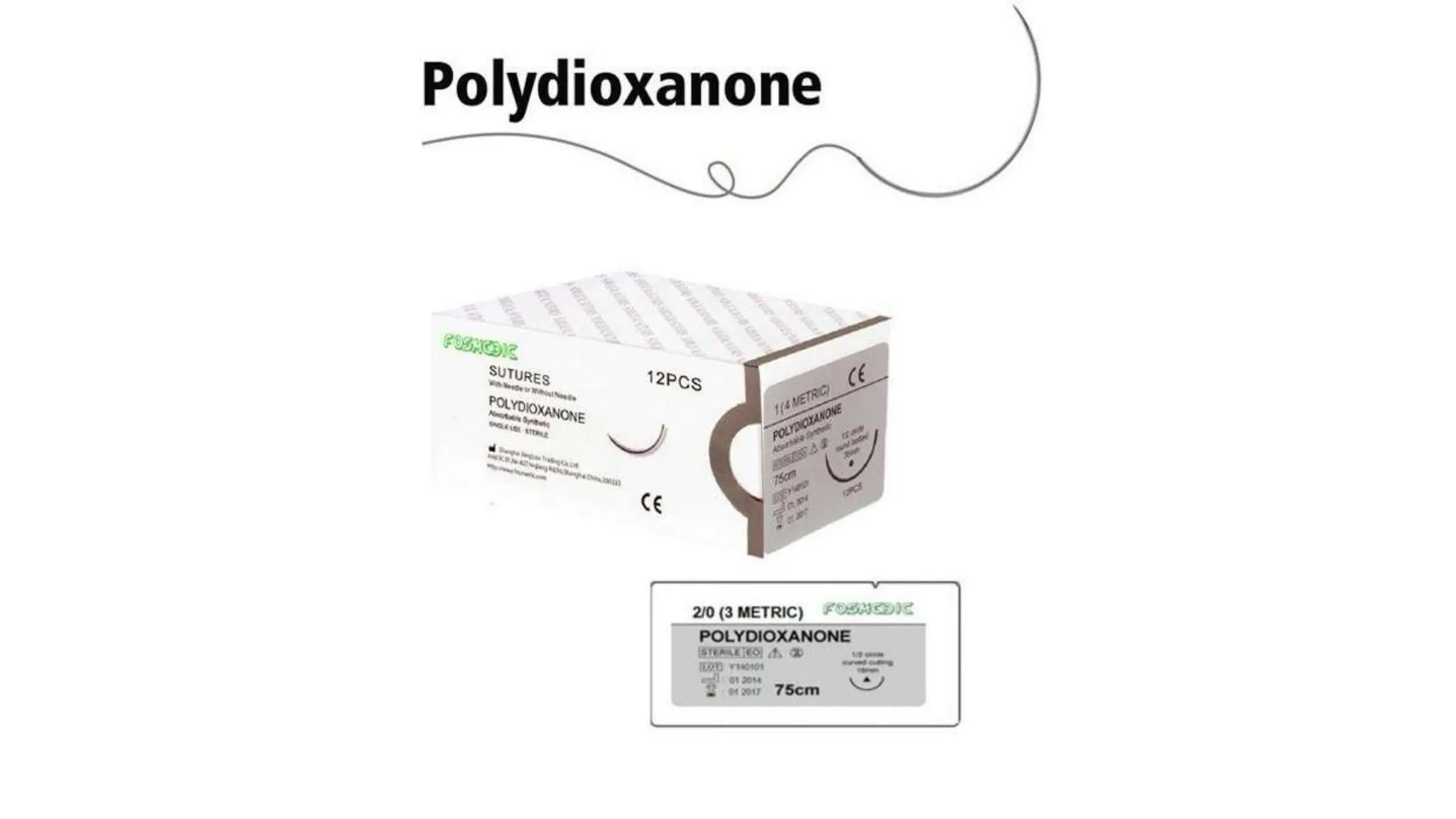
Polydioxanone
• Polyester polymer
• Used in particular where slightly longer wound support is required
• C/I- heart valves or synthetic grafts, prolonged approximation under
stress
• Mild tissue reaction
• Hydrolysis minimal at 90 days, complete at 180 days
• Strength- 70% at 2 weeks, 50% at 4 weeks ,14% at 8 weeks
• Monofilament, dyed or undyed
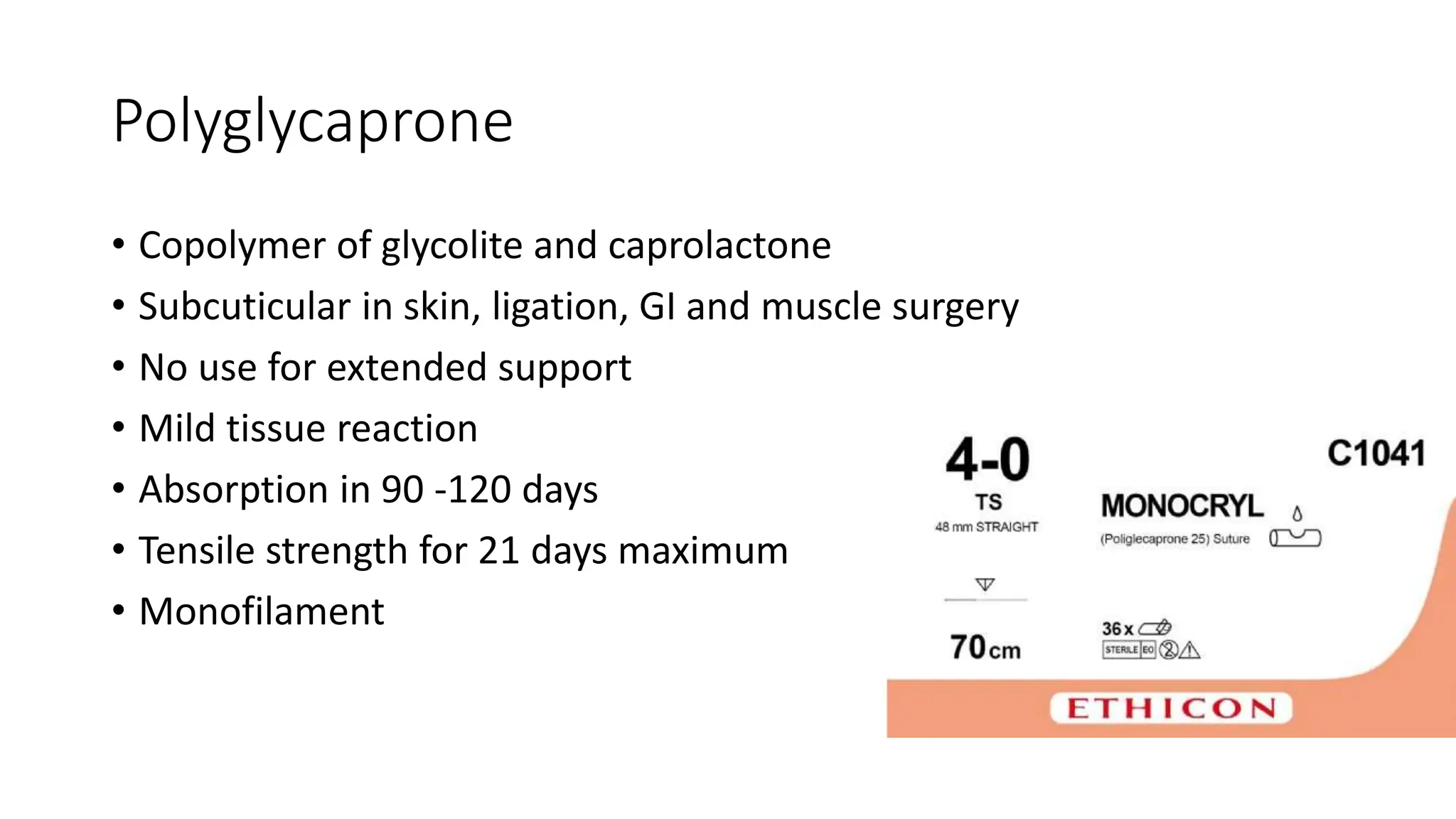
Polyglycaprone
• Copolymer of glycolite and caprolactone
• Subcuticular in skin, ligation, GI and muscle surgery
• No use for extended support
• Mild tissue reaction
• Absorption in 90 -120 days
• Tensile strength for 21 days maximum
• Monofilament
Non- absorbable
• Silk
• Linen
• Surgical steel
• Nylon
• Polyester
• Polypropylene
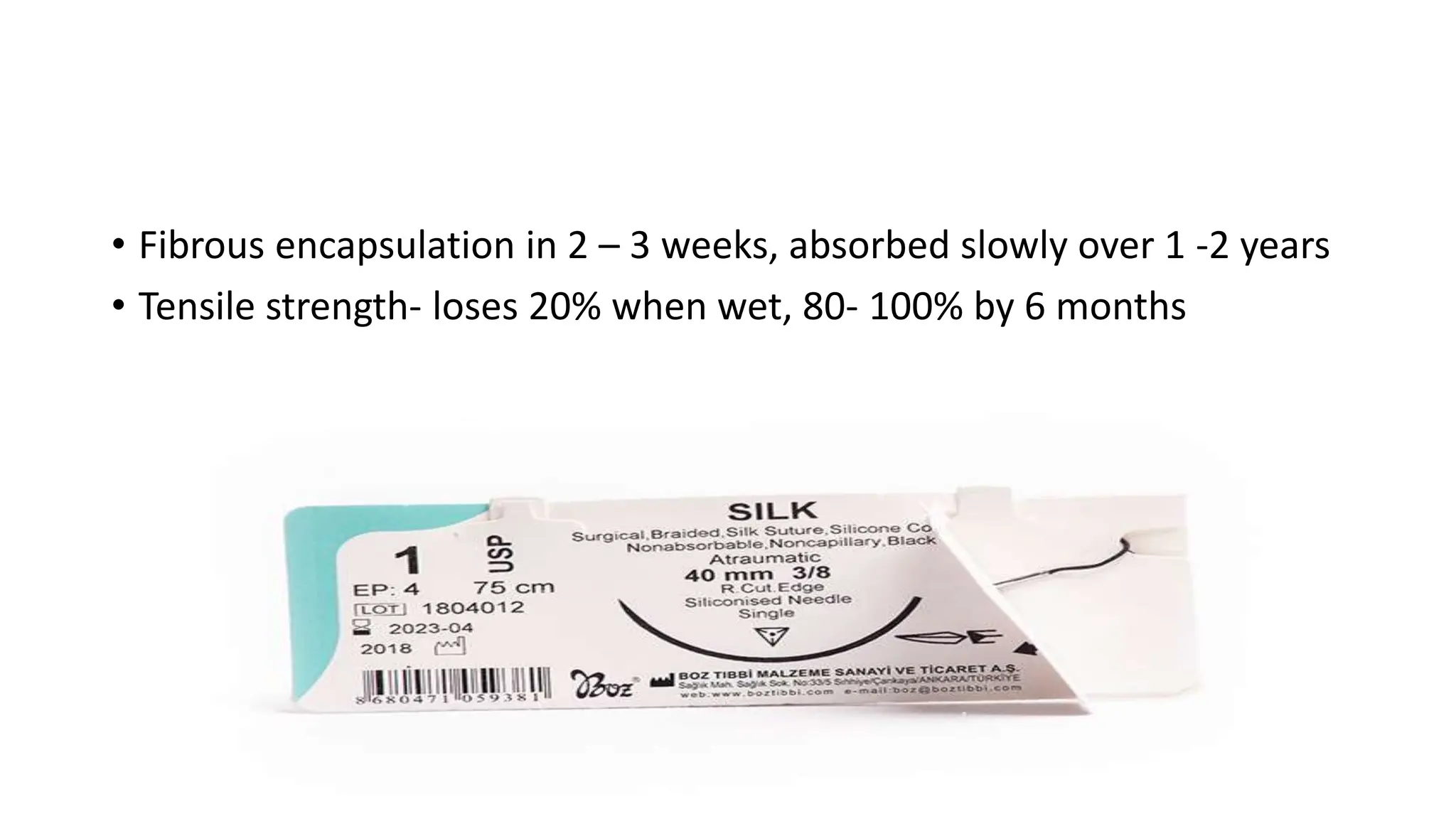
Silk
• Natural protein, raw silk from silkworm
• Braided or twisted multifilament, dyed or undyed ,coated or uncoated
• Use- ligation and suturing when long term support is necessary,
securing drains externally
• C/I- vascular prostheses, tissue requiring prolonged approximation
under stress, unsuitable for routine skin closure
• Moderate to high tissue reaction
• Fibrous encapsulation in 2 – 3 weeks, absorbed slowly over 1 -2 years
• Tensile strength- loses 20% when wet, 80- 100% by 6 months
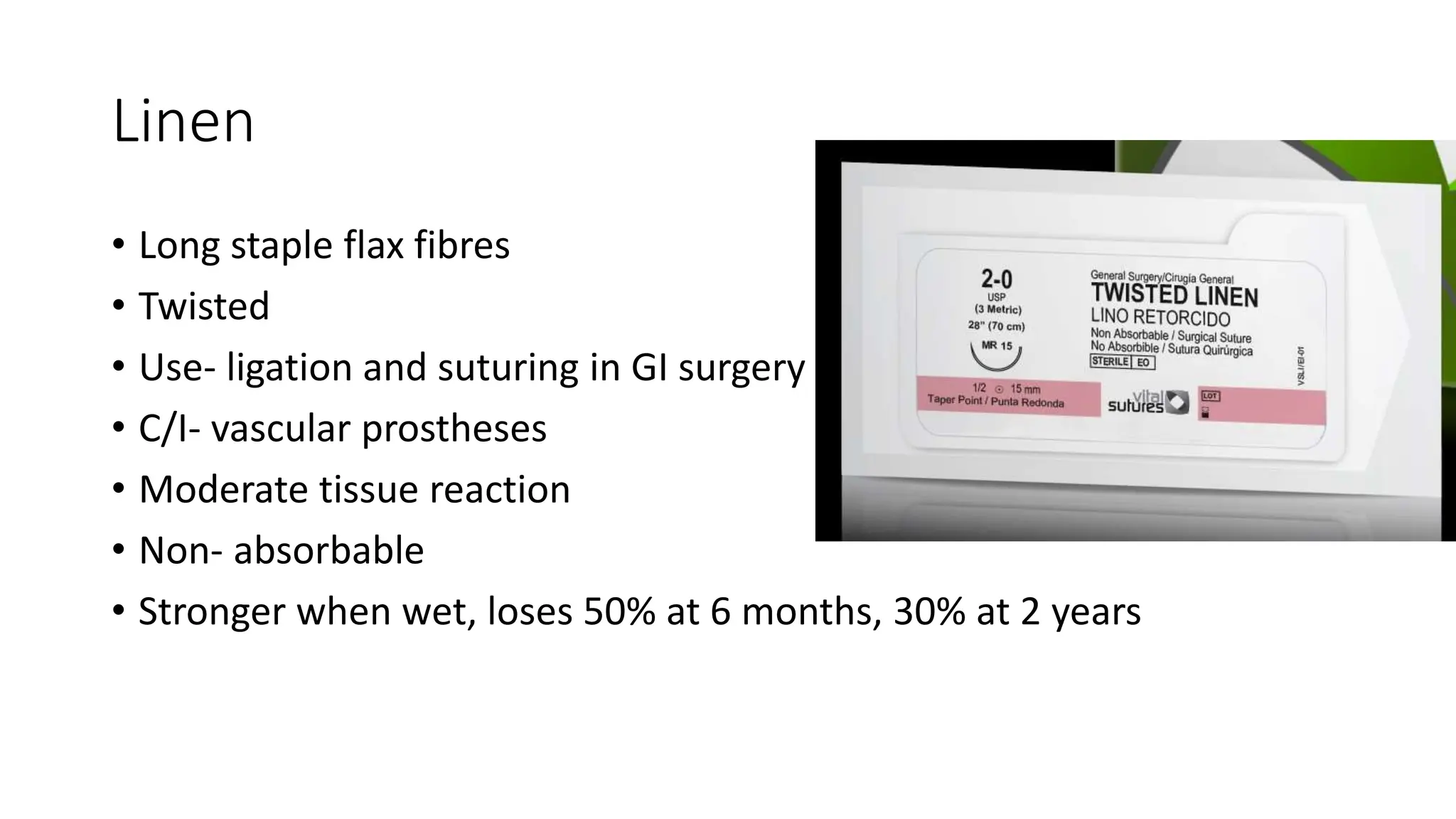
Linen
• Long staple flax fibres
• Twisted
• Use- ligation and suturing in GI surgery
• C/I- vascular prostheses
• Moderate tissue reaction
• Non- absorbable
• Stronger when wet, loses 50% at 6 months, 30% at 2 years
Surgical steel
• An alloy of iron, nickel and chromium
• Closure of sternotomy wounds
• Should not be used in conjunction with prosthesis of different metal
• Minimal tissue reaction
• Non absorbable
• Infinite tensile strength <1 year
Nylon
• Polyamide polymer
• General surgical use-e.g skin, abdominal wall mass closure, hernia
repair, plastic surgery, neurosurgery, microsurgery, ophthalmic
surgery
• No C/I
• Low tissue reaction
• Degrades at 15-20% /year
• Monofilament or braided multifilament, dyed or undyed
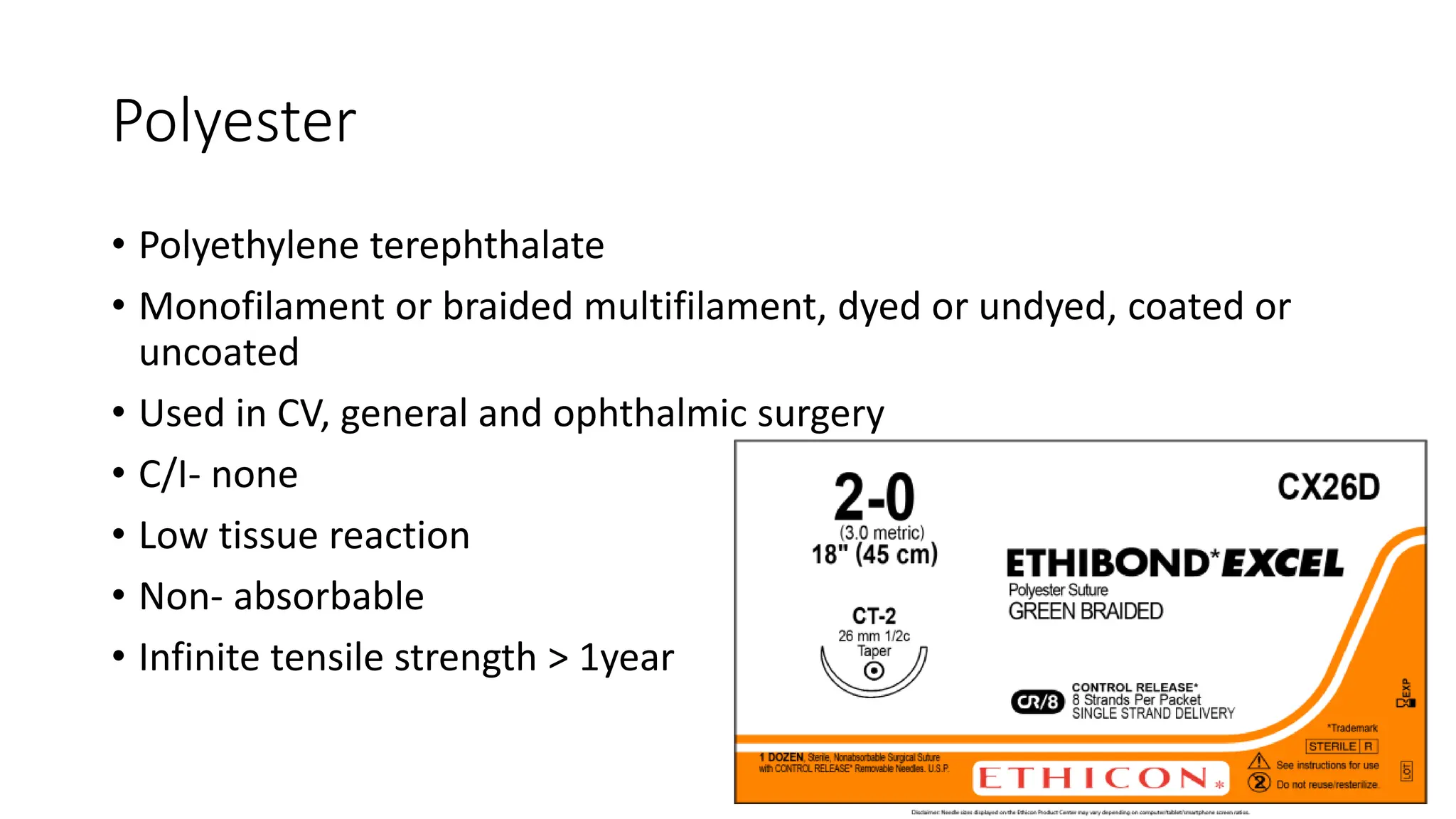
Polyester
• Polyethylene terephthalate
• Monofilament or braided multifilament, dyed or undyed, coated or
uncoated
• Used in CV, general and ophthalmic surgery
• C/I- none
• Low tissue reaction
• Non- absorbable
• Infinite tensile strength > 1year
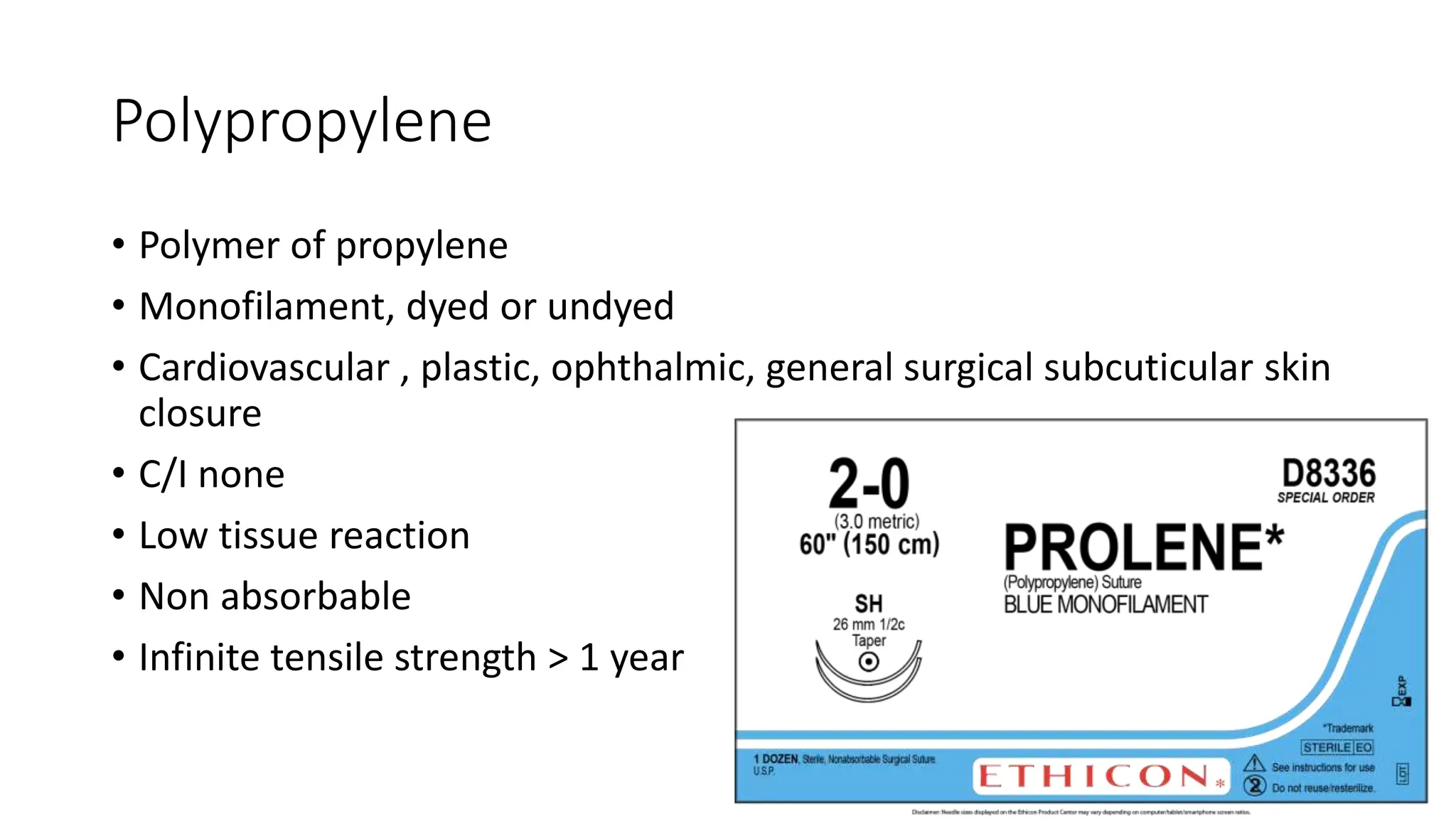
Polypropylene
• Polymer of propylene
• Monofilament, dyed or undyed
• Cardiovascular , plastic, ophthalmic, general surgical subcuticular skin
closure
• C/I none
• Low tissue reaction
• Non absorbable
• Infinite tensile strength > 1 year
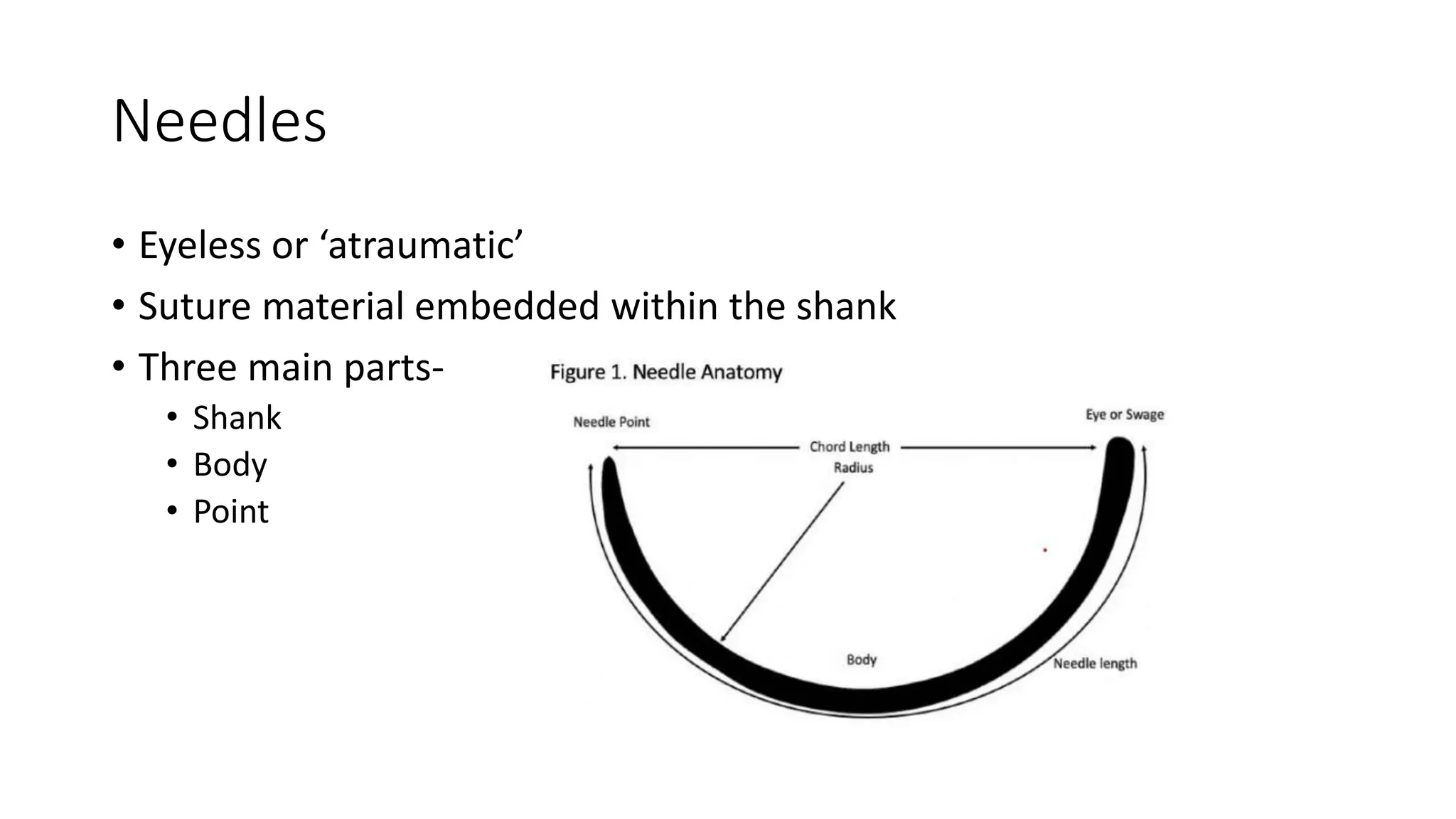
Needles
• Eyeless or ‘atraumatic’
• Suture material embedded within the shank
• Three main parts-
• Shank
• Body
• Point
Suture techniques
• Four frequently used suture technique-
• Interrupted suture
• Continuous suture
• Mattress suture
• Subcuticular suture
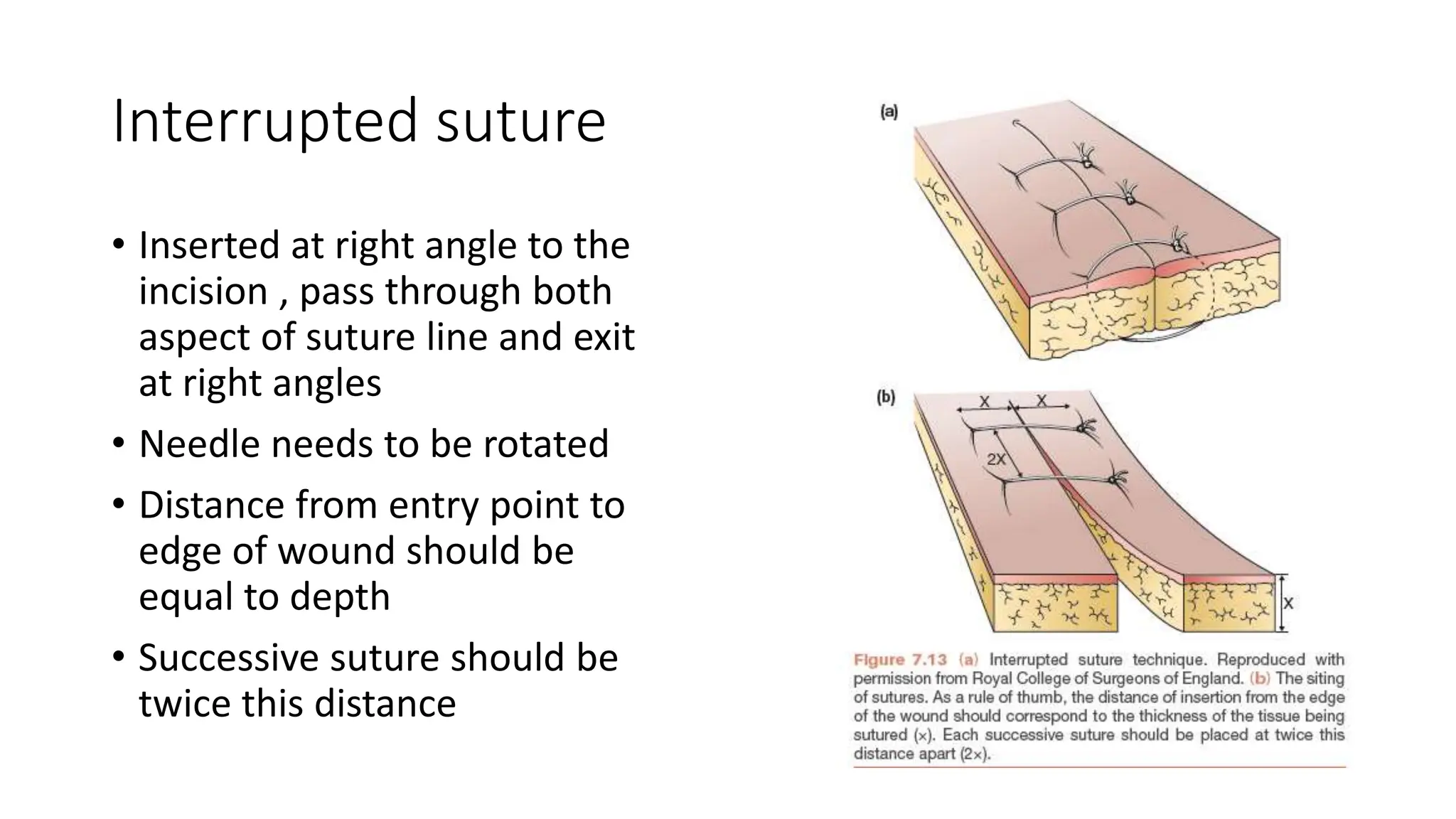
Interrupted suture
• Inserted at right angle to the
incision , pass through both
aspect of suture line and exit
at right angles
• Needle needs to be rotated
• Distance from entry point to
edge of wound should be
equal to depth
• Successive suture should be
twice this distance
Continuous Suture
• made with one continuous length of suture material
• close tissue layers which require close approximation
• edema during the wound healing process
• greater potential for malapproximation than with the interrupted
stitch
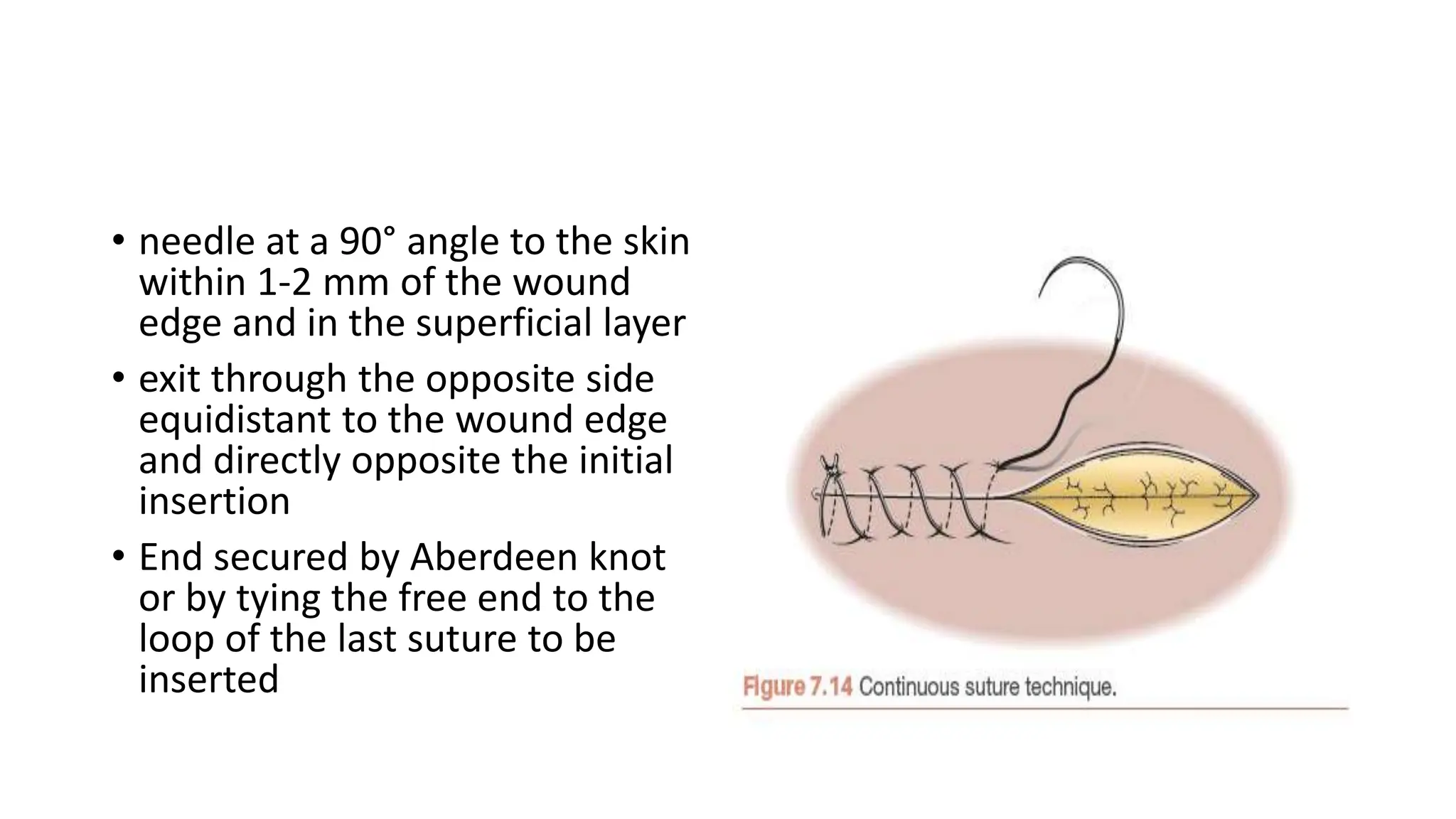
• needle at a 90° angle to the skin
within 1-2 mm of the wound
edge and in the superficial layer
• exit through the opposite side
equidistant to the wound edge
and directly opposite the initial
insertion
• End secured by Aberdeen knot
or by tying the free end to the
loop of the last suture to be
inserted
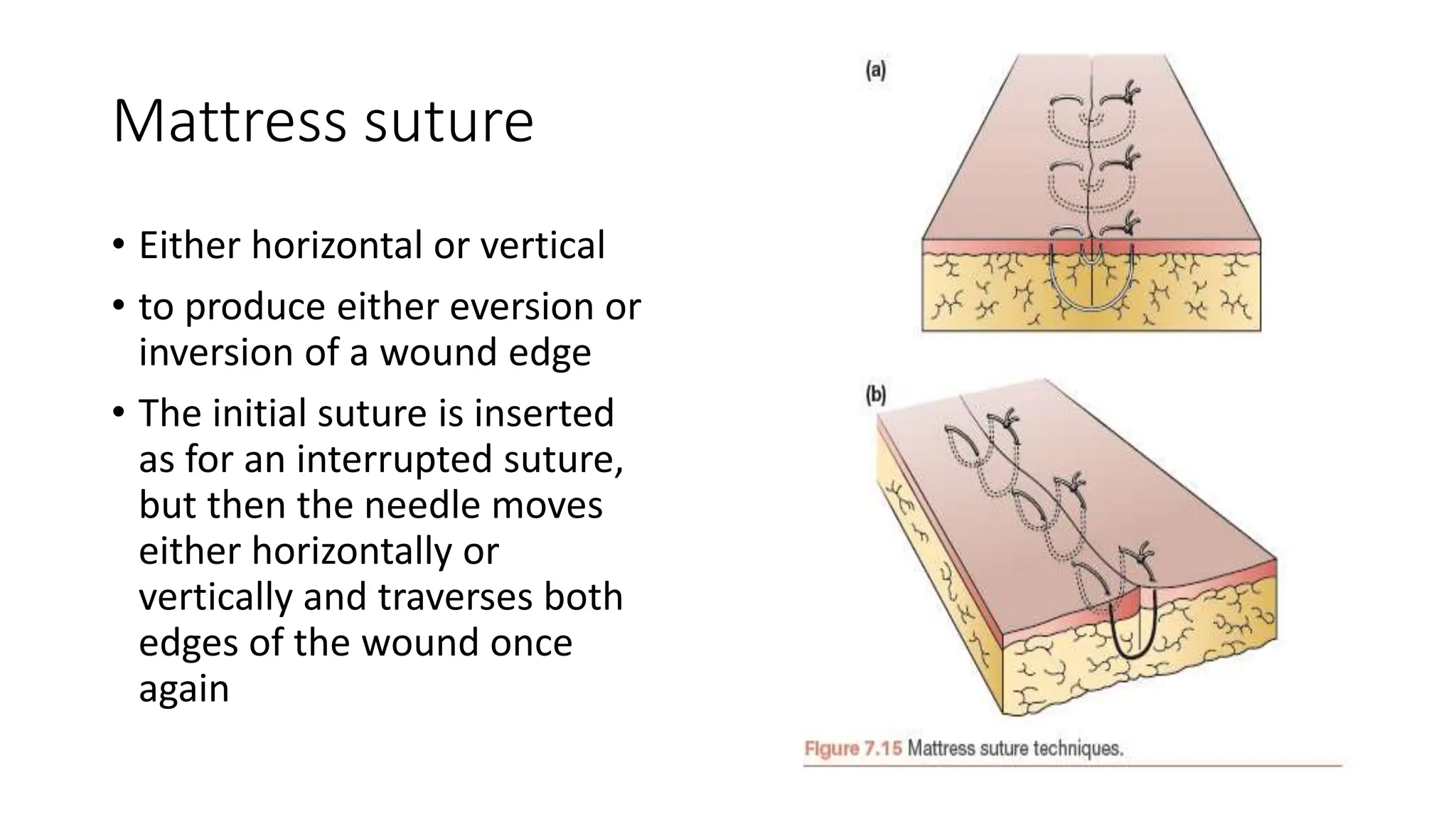
Mattress suture
• Either horizontal or vertical
• to produce either eversion or
inversion of a wound edge
• The initial suture is inserted
as for an interrupted suture,
but then the needle moves
either horizontally or
vertically and traverses both
edges of the wound once
again
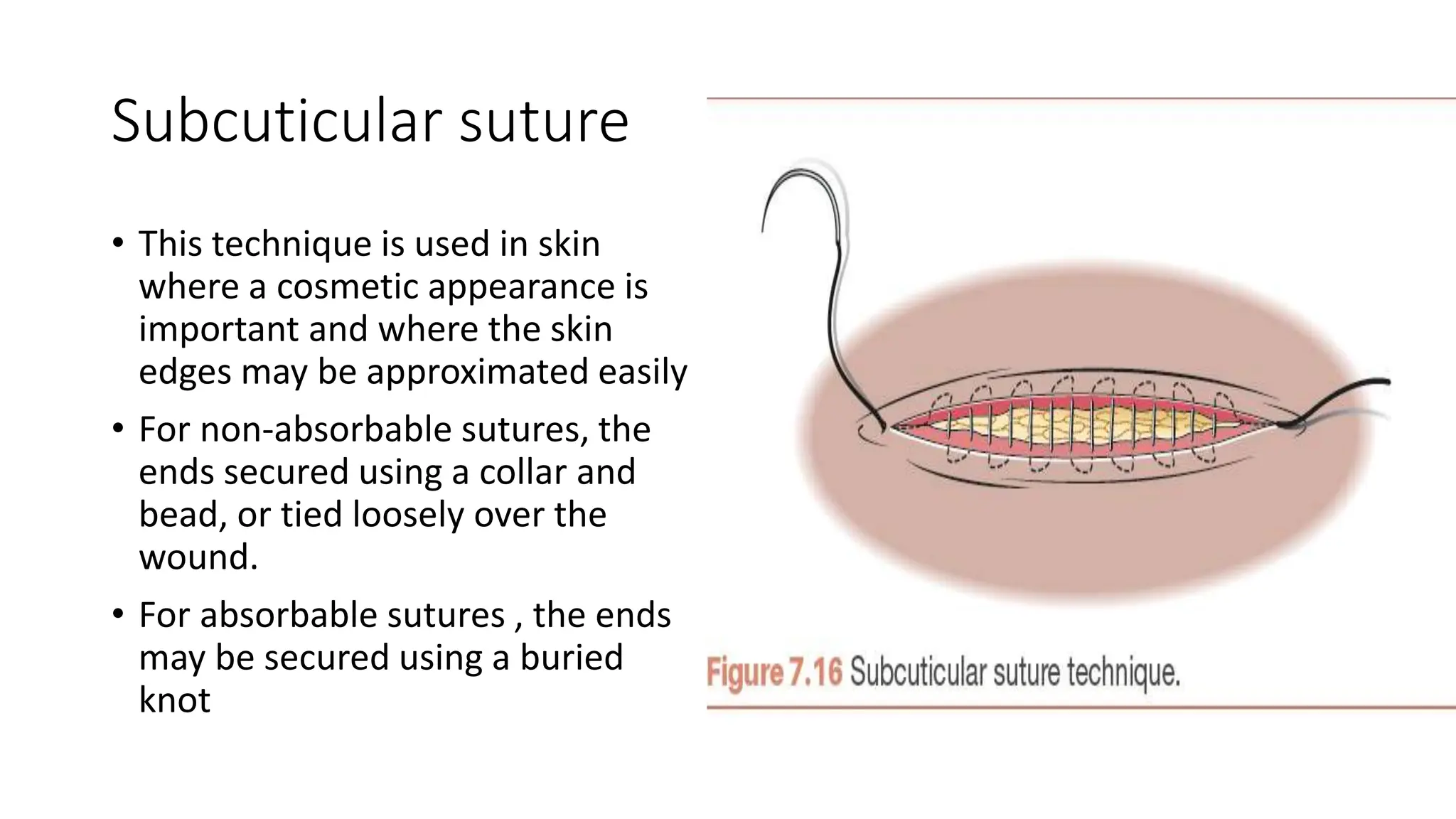
Subcuticular suture
• This technique is used in skin
where a cosmetic appearance is
important and where the skin
edges may be approximated easily
• For non-absorbable sutures, the
ends secured using a collar and
bead, or tied loosely over the
wound.
• For absorbable sutures , the ends
may be secured using a buried
knot
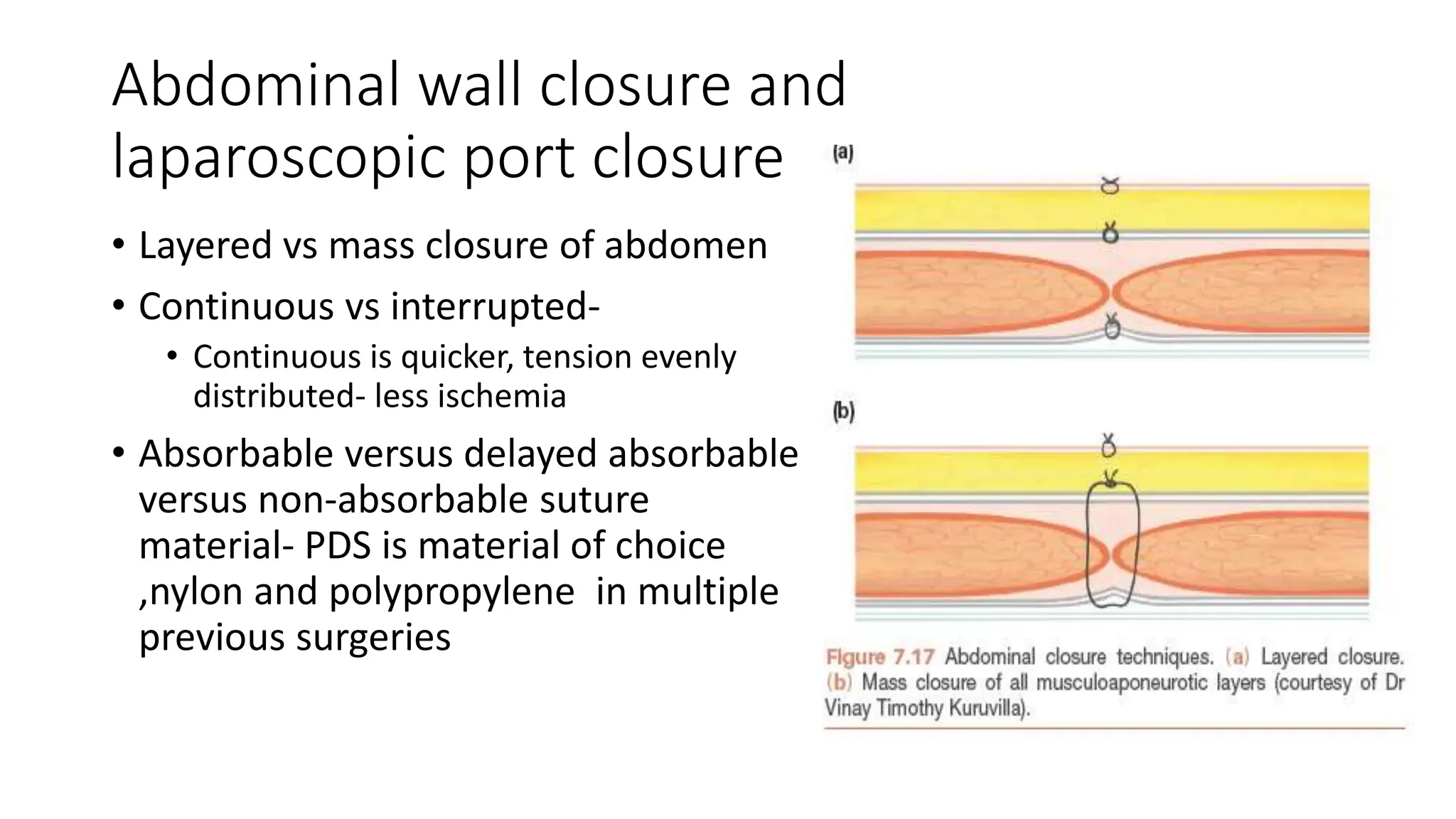
Abdominal wall closure and
laparoscopic port closure
• Layered vs mass closure of abdomen
• Continuous vs interrupted-
• Continuous is quicker, tension evenly
distributed- less ischemia
• Absorbable versus delayed absorbable
versus non-absorbable suture
material- PDS is material of choice
,nylon and polypropylene in multiple
previous surgeries
• Big bites, big needle versus small bites, small needle
• Recent studies have shown decreased incisional hernia when the interval
between sutures is reduced to 0.5 cm and performed using a smaller sized
needle (2.0 PDS as opposed to the much larger 1 PDS).
Alternatives
• Skin adhesive tapes
• Tissue glue- cyanoacrylate
• Staples
Suture removal
• facial sutures removed in 3–5 days,
• neck sutures in 5–7 days , Scalp 5 days
• and abdominal sutures between 10 and 14 days
• Arms or legs - 7 to 10 days and foot 10-14 days
‘early removal can minimise unsightly scars and prevent sutures from
being embedded in the skin, removing them prematurely can result in
wound dehiscence.’
REFERENCES
• Short practice of surgery, Bailey and Love, 28th edition
• Thank you

Suture material and techniques.pptx contains various suture material and suturing technniques used in surgery

  • 1.
    Suture materials and techniques DrSaujanya Jung Pandey General Surgery Resident KISTMCTH
  • 2.
    Introduction • Most woundsrequire skin closure of some kind. Most commonly, this closure is done by suturing, as opposed to staples or surgical glues. A closure is a means of primary repair of skin and deeper layers, to promote wound healing. [1] [2] 1. Lloyd JD, Marque MJ, Kacprowicz RF. Closure techniques. Emerg Med Clin North Am. 2007 Feb;25(1):73-81. 2. Yag-Howard C. Sutures, needles, and tissue adhesives: a review for dermatologic surgery. Dermatol Surg. 2014 Sep;40 Suppl 9:S3-S15
  • 3.
    • “Suturing offersadvantages like low dehiscence rates and greater tensile strength than other closure methods” [1] [2] 1. Lloyd JD, Marque MJ, Kacprowicz RF. Closure techniques. Emerg Med Clin North Am. 2007 Feb;25(1):73-81. 2. Yag-Howard C. Sutures, needles, and tissue adhesives: a review for dermatologic surgery. Dermatol Surg. 2014 Sep;40 Suppl 9:S3-S15
  • 4.
    Historically • Eyed needles,sometimes made of bone, were used to pass a suture through wounds, • Suture materials included hemp, flax, hair, linen, pig bristles, grass, reeds, and other plants. [3] • Sushruta described suturing with materials made of bark, tendon, hair, and silk in 500 BCE so did Galen and antyllus • Mouth of pincher ants was used to approximate wounds [3] [4] 3. Swanson NA, Tromovitch TA. Suture materials, 1980s: properties, uses, and abuses. Int J Dermatol. 1982 Sep;21(7):373-84. 4. Pillai CK, Sharma CP. Review paper: absorbable polymeric surgical sutures: chemistry, production, properties, biodegradability, and performance. J Biomater Appl. 2010 Nov;25(4):291-366
  • 5.
    In modern times •innumerable options for sutures. • Appropriate choice of suture type based on understanding of the characteristics of different sutures.
  • 6.
    The ideal suture •easy for the surgeon to handle, • provide appropriate strength and secure knots, • can tolerate wound changes like swelling and recoil, • cause minimal inflammation or infection risk, • easily visible, • relatively inexpensive, [3][4] 3. Swanson NA, Tromovitch TA. Suture materials, 1980s: properties, uses, and abuses. Int J Dermatol. 1982 Sep;21(7):373-84. 4. Pillai CK, Sharma CP. Review paper: absorbable polymeric surgical sutures: chemistry, production, properties, biodegradability, and performance. J Biomater Appl. 2010 Nov;25(4):291-366
  • 9.
    Important definitions • Knotstrength-amount of force needed for knot to slip, related to the friction and ability to stretch • Elasticity- the ability of the suture to stretch and recoil • Plasticity- when the suture stretches but does not recoil • Memory- ability to return to its shape after it is manipulated, less pliable • Coefficient of friction- Suture’s relative resistance to being passed through a tissue • Tensile strength- suture’s ability to resist breakage
  • 10.
    Suture characteristics • Physicalstructure- monofilament or multifilament • Monofilament sutures- Smooth, difficult to knot, easily damaged by gripping with a needle holder • Multifilament or braided- easier to knot, higher surface area than monofilament and have capillary action and interstices for bacterial growth
  • 11.
    • Strength- • Dependson its constituent materials, thickness and its response • thickness is classified according to its diameter in 10ths of a mm • Materials such as catgut have a tensile strength of a week while PDS)will remain strong in the tissues for several weeks.
  • 12.
    • Tensile behavior- •Behave differently based on their deformability and flexibility • May be ‘elastic’ or ‘plastic’ • Many synthetic materials demonstrate ‘memory’
  • 13.
    • Absorbabilty – •suture materials may be non-absorbable or absorbable
  • 14.
    • Biological behavior- •its nature within the tissue depends upon its constituent materials • Natural sutures (eg. Catgut) are proteolyzed so less predictable and cause local irritation • Synthetic sutures are hydrolyzed so their disappearance is more predictable
  • 15.
    Suture materials • Themain factors used to classify sutures types are: • Absorbable vs. non-absorbable • Synthetic vs. natural • Monofilament vs. multifilament
  • 16.
    Absorbable suture materials •Catgut • Chromic Catgut • Polyglactin • Polydioxanone (PDS) • Polyglycaprone
  • 17.
    Catgut • Made fromcollagen derived from healthy sheep or cattle • Ligate superficial vessels, suture subcutaneous tissues. Stomas and other tissues that heal rapidly • Not for use in tissues that heal slowly and require prolonged support. • High tissue reaction • Degradation 7 – 10 days • Tensile strength lost in 7-10 days
  • 19.
    Chromic catgut • Tannedin chromium salts to improve handling and resist degradation • Use- same as catgut • Contraindication same as catgut • Moderate tissue reaction • Phagocytosis and enzymatic degradation within 90 days • Tensile strength retention lost within 21-28 days
  • 21.
    Polyglactin • Copolymer oflactide and glycolide (90:10) coated with polyglactin and calcium stereate • Used in- gut anastomoses, vascular ligatures, ophthalmic surgery • Not advised in tissues requiring prolonged approximation under stress • Mild tissue reaction • Hydrolysis minimal upto 5-6 weeks , complete absorption in 60-90 days • Tensile strength- 60% at 2 weeks, 30% at 3 weeks • Braided multifilament
  • 23.
    Polydioxanone • Polyester polymer •Used in particular where slightly longer wound support is required • C/I- heart valves or synthetic grafts, prolonged approximation under stress • Mild tissue reaction • Hydrolysis minimal at 90 days, complete at 180 days • Strength- 70% at 2 weeks, 50% at 4 weeks ,14% at 8 weeks • Monofilament, dyed or undyed
  • 25.
    Polyglycaprone • Copolymer ofglycolite and caprolactone • Subcuticular in skin, ligation, GI and muscle surgery • No use for extended support • Mild tissue reaction • Absorption in 90 -120 days • Tensile strength for 21 days maximum • Monofilament
  • 26.
    Non- absorbable • Silk •Linen • Surgical steel • Nylon • Polyester • Polypropylene
  • 27.
    Silk • Natural protein,raw silk from silkworm • Braided or twisted multifilament, dyed or undyed ,coated or uncoated • Use- ligation and suturing when long term support is necessary, securing drains externally • C/I- vascular prostheses, tissue requiring prolonged approximation under stress, unsuitable for routine skin closure • Moderate to high tissue reaction
  • 28.
    • Fibrous encapsulationin 2 – 3 weeks, absorbed slowly over 1 -2 years • Tensile strength- loses 20% when wet, 80- 100% by 6 months
  • 29.
    Linen • Long stapleflax fibres • Twisted • Use- ligation and suturing in GI surgery • C/I- vascular prostheses • Moderate tissue reaction • Non- absorbable • Stronger when wet, loses 50% at 6 months, 30% at 2 years
  • 30.
    Surgical steel • Analloy of iron, nickel and chromium • Closure of sternotomy wounds • Should not be used in conjunction with prosthesis of different metal • Minimal tissue reaction • Non absorbable • Infinite tensile strength <1 year
  • 31.
    Nylon • Polyamide polymer •General surgical use-e.g skin, abdominal wall mass closure, hernia repair, plastic surgery, neurosurgery, microsurgery, ophthalmic surgery • No C/I • Low tissue reaction • Degrades at 15-20% /year • Monofilament or braided multifilament, dyed or undyed
  • 32.
    Polyester • Polyethylene terephthalate •Monofilament or braided multifilament, dyed or undyed, coated or uncoated • Used in CV, general and ophthalmic surgery • C/I- none • Low tissue reaction • Non- absorbable • Infinite tensile strength > 1year
  • 33.
    Polypropylene • Polymer ofpropylene • Monofilament, dyed or undyed • Cardiovascular , plastic, ophthalmic, general surgical subcuticular skin closure • C/I none • Low tissue reaction • Non absorbable • Infinite tensile strength > 1 year
  • 34.
    Needles • Eyeless or‘atraumatic’ • Suture material embedded within the shank • Three main parts- • Shank • Body • Point
  • 36.
    Suture techniques • Fourfrequently used suture technique- • Interrupted suture • Continuous suture • Mattress suture • Subcuticular suture
  • 37.
    Interrupted suture • Insertedat right angle to the incision , pass through both aspect of suture line and exit at right angles • Needle needs to be rotated • Distance from entry point to edge of wound should be equal to depth • Successive suture should be twice this distance
  • 38.
    Continuous Suture • madewith one continuous length of suture material • close tissue layers which require close approximation • edema during the wound healing process • greater potential for malapproximation than with the interrupted stitch
  • 39.
    • needle ata 90° angle to the skin within 1-2 mm of the wound edge and in the superficial layer • exit through the opposite side equidistant to the wound edge and directly opposite the initial insertion • End secured by Aberdeen knot or by tying the free end to the loop of the last suture to be inserted
  • 40.
    Mattress suture • Eitherhorizontal or vertical • to produce either eversion or inversion of a wound edge • The initial suture is inserted as for an interrupted suture, but then the needle moves either horizontally or vertically and traverses both edges of the wound once again
  • 41.
    Subcuticular suture • Thistechnique is used in skin where a cosmetic appearance is important and where the skin edges may be approximated easily • For non-absorbable sutures, the ends secured using a collar and bead, or tied loosely over the wound. • For absorbable sutures , the ends may be secured using a buried knot
  • 42.
    Abdominal wall closureand laparoscopic port closure • Layered vs mass closure of abdomen • Continuous vs interrupted- • Continuous is quicker, tension evenly distributed- less ischemia • Absorbable versus delayed absorbable versus non-absorbable suture material- PDS is material of choice ,nylon and polypropylene in multiple previous surgeries
  • 43.
    • Big bites,big needle versus small bites, small needle • Recent studies have shown decreased incisional hernia when the interval between sutures is reduced to 0.5 cm and performed using a smaller sized needle (2.0 PDS as opposed to the much larger 1 PDS).
  • 44.
    Alternatives • Skin adhesivetapes • Tissue glue- cyanoacrylate • Staples
  • 45.
    Suture removal • facialsutures removed in 3–5 days, • neck sutures in 5–7 days , Scalp 5 days • and abdominal sutures between 10 and 14 days • Arms or legs - 7 to 10 days and foot 10-14 days ‘early removal can minimise unsightly scars and prevent sutures from being embedded in the skin, removing them prematurely can result in wound dehiscence.’
  • 46.
    REFERENCES • Short practiceof surgery, Bailey and Love, 28th edition
  • 47.

Editor's Notes

  • #6 Presently, there are innumerable options for sutures. Therefore, to appropriately choose a suture type, it is necessary to understand the characteristics of different sutures.
  • #7 There is no ideal wound closure technique that would be appropriate for all situations, and the ideal suture has yet to be produced
  • #11  Monoflament sutures are smooth and tend to slide through tissues easily, but are more difcult to knot efectively. Such material can be easily damaged by gripping it with a needle holder and this can lead to fracture of the suture. ● Multiflament or braided sutures are much easier to knot but have a surface area of several thousand times that of monoflament sutures and thus have a capillary action and interstices where bacteria may lodge and be responsible for persistent infection or sinuses. To overcome some of these problems, certain materials are produced as a braided suture that is coated with silicone to make it smooth.
  • #13  suture materials behave differently depending upon their deformability and flexibility. Some may be ‘elastic’, in which case the material will return to its original length once any tension is released, while others may be ‘plastic’, in which case this phenomenon does not occur. Many synthetic materials demonstrate ‘memory’, which means they keep curling up in the shape that they adopted within the packaging. A sharp but gentle pull on the suture material helps to diminish this memory, but the more memory a suture material has, the less is the knot security.
  • #15  the biological behaviour of suture materials within the tissues depends upon the constituent raw material. Biological or natural sutures, such as catgut, are proteolysed, but this involves a process that is not entirely predictable and can cause local irritation; therefore, such materials are seldom used. Man-made synthetic polymers are hydrolysed and their disappearance in the tissues is more predictable. The presence of pus, urine or faeces infuences the fnal result and renders the outcome more unpredictable.
  • #33 Coated with Polybutylate or silicone
  • #35  The needle should be grasped by the needle holder approximately one-third of the way back from the rear of the needle, avoiding both the shank and the point
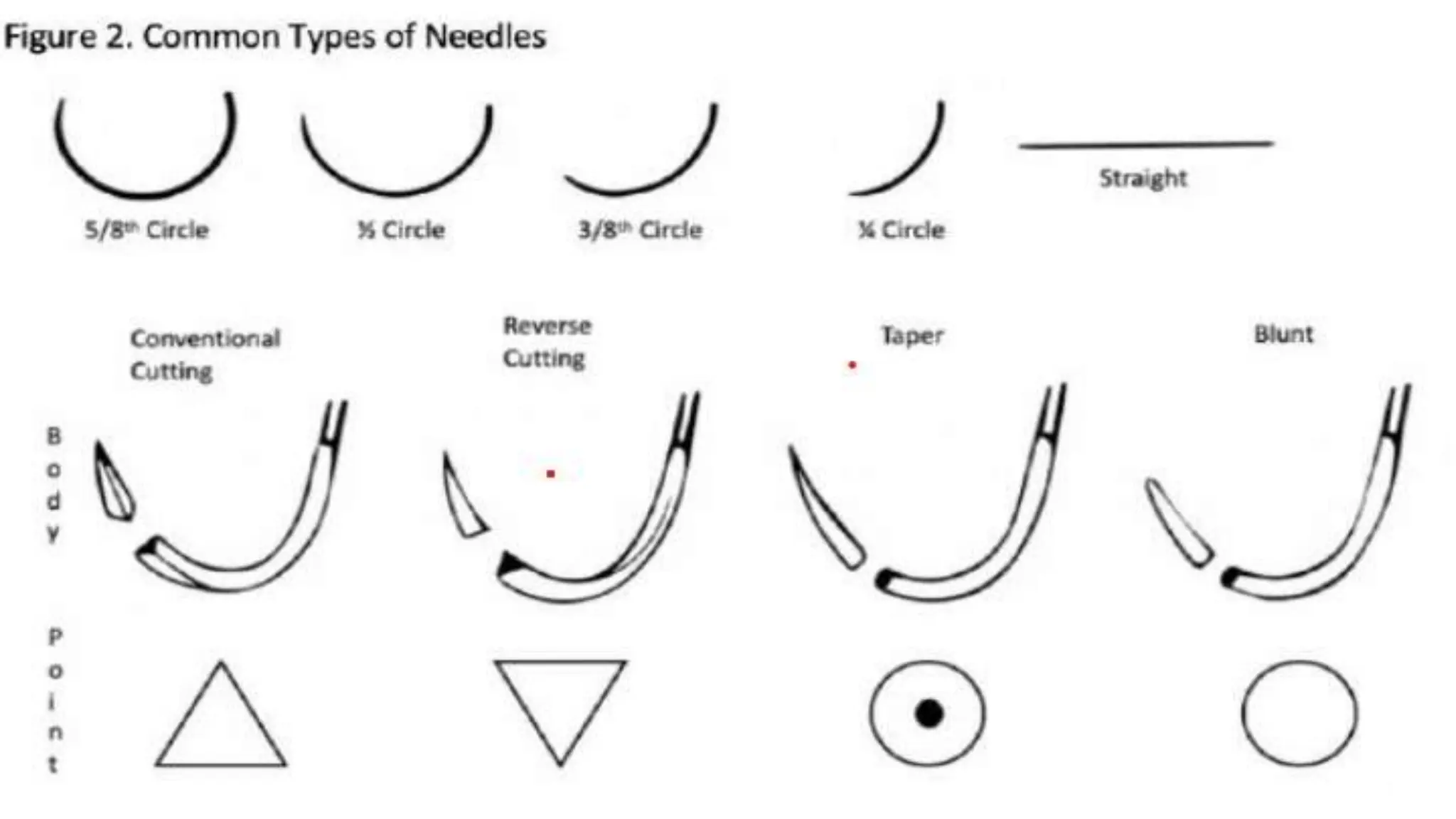
  • #36 Round-bodied needles gradually taper to a point, while triangular needles have cutting edges along all three sides. The point of the needle can be round with a tapered end, conventional cutting, which has the cutting edge facing the inside of the needle’s curvature, or reversed cutting, in which the cutting edge is on the outside. Round-bodied needles are designed to separate tissue fbres rather than cut through them and are commonly used in intestinal and cardiovascular surgery Cutting needles are used where tough or dense tissue needs to be sutured, such as skin and fascia. Blunt-ended needles are now being advocated in certain situations, such as the closure of the abdominal wall, to diminish the risk of needle-stick injuries in this era of virally transmitted disorders. Half-circle needles are commonly utilised in the gastrointestinal tract, while J-shaped needles, quarter-circle needles and compound curvature needles are used in special situations such as the laparoscopic port site closure, eye and oral cavity, respectively.
  • #41  Such sutures are very useful in producing an accurate approximation of wound edges, especially when the edges to be anastomosed are irregular in depth or disposition
  • #42  Small bites of the subcuticular tissues are taken on alternate sites of the wound and then gently pulled together, thus approximating the wound edges without the risk of the cross-hatched markings of interrupted sutures.
  • #43 Simple continuous sutures theoretically seem to be better than interrupted sutures as the tension is evenly distributed, resulting in less ischaemia; in addition, they are quicker to perform. The literature supporting this practice is, however, sparse.