
Case Study      Prepared by:
                  Group 4
                Amar Pal Singh
                Apoorv Kr. Sharma
                Arun Semwal
Idea Cellular   Gaurav Khatri
                Dipendra Raj Tomar
Introduction
•   Customer base of over 36 million.
•   Customer service and innovation.
•   Part of Aditya Birla Group.
•   Operates in more than 25 countries.
•   Over 100000 employees from 25+ nationalities.
•   Started with equal share of-
    – Tata
    – Birla
    – AT&T Wireless
Mission

“We will delight our customers while meeting their
individual communication needs anytime anywhere.
We survive because of our customers.”
SWOT Analysis
Strengths
• Attractive existing footprints in 11 circles out of 23
  circles in India.
• Original licensee in 7 of the established circles.
• Strong distribution channel and good relations with
  parent company.
• High quality network structure.
• Innovative strategies to attract customer attention.
Weaknesses
• The company’s debt to equity ratio is high.
• The company’s revenues are derived solely from
  mobile services.
• The PAT margin is decreased.
Opportunities
• Increasing number of subscribers.
• Opportunities of economies of scale and high
  customer value.
• The disposable income of middle class is increasing.
Threats
•   Intense competition.
•   Alternative technologies like Imax, VOIP ( Skype ).
•   Market demand may slow down.
•   Govt. rules and regulations.
Porters 5 Forces Analysis
•   Threat to new entrants
•   Suppliers bargaining power
•   Threat of substitutes
•   Customers bargaining power
•   Rivalry among existing competitors
Strategic Groups in Telecom Sector
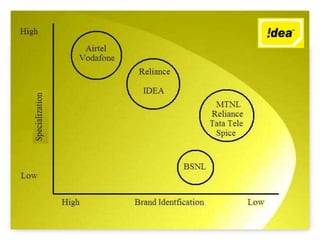
• Firms can be grouped on two parameters.
   – Brand Identification
   – Specialization
Idea’s Strategic Groups
• The bargaining power of strategic group against the
  customer is high.
• Ideas placed in mid specialization and mid brand
  category.
• The height of mobility barrier due to scale of
  economy is moderate.
Risk faced by Idea
• Risk of other firms entering its strategic group.
• Risk of factors reducing the mobility barrier of the
  Airtel’s strategic groups .
• Risk that accompany investment design to improve
  the firms position by increasing the mobility barrier.
Future Outlooks of IDEA
• Movement towards higher strategic group.
• Gaining access to large number of users.
• Tremendous potential exploitation.
Organic and Inorganic Growth
• Revenue increased both ways.
  – Organic growth, Inorganic growth.
  – First to launch GPRS & EDGE.
  – Acquisition of Escotel, RPG Cellular, Andhra
    Pradesh operations of TATA cellular.
  – Expanding in terms of geography.
  – Operates in more than 11 circles.
  – Growth and market share increment through
    innovative schemes.
  – Introduction of new value added services.
Acquisition History
•   2000 – Merger with TATA cellular.
•   2004 – Acquired RPG in Madhya Pradesh.
•   2004 – Acquired Escotel.
•   2008 – Acquired Spice (Punjab & Karnataka).
Functional Level Strategies
Marketing Strategies
• Focus on numbers.
• Use of celebrities.
• Aditya Birla Brand.
Operational level Strategies
• Choosing "Core competency” for working.
• Outsourcing rest of the work.
• Strategy partnership with companies
   – Infrastructure needs.
   – Software needs.
• Partnership with Companies
   – NOKIA SIEMENS
   – ERICSON
   – IBM
Conclusion
• Highly competitive market.
• Not lagging far behind in terms of brand and
  specialization.
Thank you…

Idea: case study

  • 1.
    Case Study Prepared by: Group 4 Amar Pal Singh Apoorv Kr. Sharma Arun Semwal Idea Cellular Gaurav Khatri Dipendra Raj Tomar
  • 2.
    Introduction • Customer base of over 36 million. • Customer service and innovation. • Part of Aditya Birla Group. • Operates in more than 25 countries. • Over 100000 employees from 25+ nationalities. • Started with equal share of- – Tata – Birla – AT&T Wireless
  • 3.
    Mission “We will delightour customers while meeting their individual communication needs anytime anywhere. We survive because of our customers.”
  • 4.
  • 5.
    Strengths • Attractive existingfootprints in 11 circles out of 23 circles in India. • Original licensee in 7 of the established circles. • Strong distribution channel and good relations with parent company. • High quality network structure. • Innovative strategies to attract customer attention.
  • 6.
    Weaknesses • The company’sdebt to equity ratio is high. • The company’s revenues are derived solely from mobile services. • The PAT margin is decreased.
  • 7.
    Opportunities • Increasing numberof subscribers. • Opportunities of economies of scale and high customer value. • The disposable income of middle class is increasing.
  • 8.
    Threats • Intense competition. • Alternative technologies like Imax, VOIP ( Skype ). • Market demand may slow down. • Govt. rules and regulations.
  • 9.
    Porters 5 ForcesAnalysis • Threat to new entrants • Suppliers bargaining power • Threat of substitutes • Customers bargaining power • Rivalry among existing competitors
  • 10.
    Strategic Groups inTelecom Sector • Firms can be grouped on two parameters. – Brand Identification – Specialization
  • 11.
    Idea’s Strategic Groups •The bargaining power of strategic group against the customer is high. • Ideas placed in mid specialization and mid brand category. • The height of mobility barrier due to scale of economy is moderate.
  • 12.
    Risk faced byIdea • Risk of other firms entering its strategic group. • Risk of factors reducing the mobility barrier of the Airtel’s strategic groups . • Risk that accompany investment design to improve the firms position by increasing the mobility barrier.
  • 13.
    Future Outlooks ofIDEA • Movement towards higher strategic group. • Gaining access to large number of users. • Tremendous potential exploitation.
  • 15.
    Organic and InorganicGrowth • Revenue increased both ways. – Organic growth, Inorganic growth. – First to launch GPRS & EDGE. – Acquisition of Escotel, RPG Cellular, Andhra Pradesh operations of TATA cellular. – Expanding in terms of geography. – Operates in more than 11 circles. – Growth and market share increment through innovative schemes. – Introduction of new value added services.
  • 16.
    Acquisition History • 2000 – Merger with TATA cellular. • 2004 – Acquired RPG in Madhya Pradesh. • 2004 – Acquired Escotel. • 2008 – Acquired Spice (Punjab & Karnataka).
  • 17.
  • 18.
    Marketing Strategies • Focuson numbers. • Use of celebrities. • Aditya Birla Brand.
  • 19.
    Operational level Strategies •Choosing "Core competency” for working. • Outsourcing rest of the work. • Strategy partnership with companies – Infrastructure needs. – Software needs. • Partnership with Companies – NOKIA SIEMENS – ERICSON – IBM
  • 20.
    Conclusion • Highly competitivemarket. • Not lagging far behind in terms of brand and specialization.
  • 21.