Made by- 
Ashima Padhiyal, 
Padma Pandey, 
RaniYadav
 ICTs are Computer based technology and internet to make 
information and communication services available to a wide range 
of users. 
 Information & Communication Technology (ICT) is used to refer to 
infrastructure and product development that facilitate the collecting, 
storing and analysis of information that may be transmitted 
electronically. 
 ICTs can acts as bridge between the traditional and modern 
knowledge system.
Any one can transfer 
Any information at 
Any time and at 
Any place to 
Any one
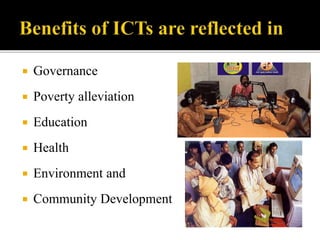
 Governance 
 Poverty alleviation 
 Education 
 Health 
 Environment and 
 Community Development
 Existing process implications to be eliminated, such as NO 
 loss of Time 
 loss of Income 
 loss of Opportunity 
 non-availability of Information in-time as per need, 
requirement to the rural livelihoods
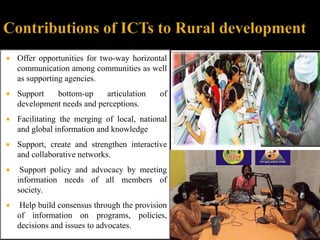
 Offer opportunities for two-way horizontal 
communication among communities as well 
as supporting agencies. 
 Support bottom-up articulation of 
development needs and perceptions. 
 Facilitating the merging of local, national 
and global information and knowledge 
 Support, create and strengthen interactive 
and collaborative networks. 
 Support policy and advocacy by meeting 
information needs of all members of 
society. 
 Help build consensus through the provision 
of information on programs, policies, 
decisions and issues to advocates.
 Milk Collection centres(AMUL) – Gujarat 
 Gyandoot- Madhya Pradesh 
 E-choupal 
 BHOOMI project – Karnataka 
 E-governance 
 EDUSAT
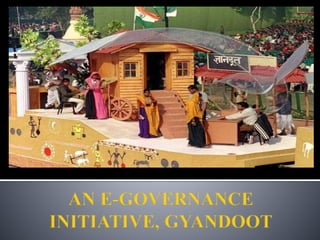
 Gyandoot is an Intranet based G2C (Government 2 citizen ) service 
delivery portal . 
 Implemented in Dhar district of MP in January 2000. 
 Gyandoot aims to create a cost-effective, replicable, economically 
self- reliant and financially viable model for taking the benefs ofit 
ICT to the rural masses. 
 Gyandoot is managed by a society called ‘Gyandoot Samiti’ registered 
under MP Societies Registration Act. The District Collector is President 
of the Samiti. 
 Can be accessed from any Gyandoot kiosk (soochanalay) by any 
citizen on payment of a nominal transaction fee. 
 Gyandoot worked as a catalyst for improving computer awareness 
in rural areas.
 To ensure equal access to emerging technologies for marginalized segments 
of the society. 
 To create a cost-effective, replicable, economically self-reliant and financially 
viable model for taking the benefits of IT to the rural masses. 
 To provide self-employment through entrepreneurship to local rural youth. 
 To improve the quality, speed and sensitivity of the state delivery apparatus. 
 To impact IT on the government-citizen interfaces as the thrust area, so that 
the benefits directly to reach the marginalized have-nots and know-nots. 
 Provide information on agricultural crop prices, online registration of 
applications for obtaining copies of land records, an online public grievance 
system, and a village auction site.
 The Gram Panchayat has provided the physical space, invested in 
hardware and other infrastructure like Computer, Modem, Printer, and 
intrruptable power supply, which is operated by a trained person, called 
the soochak. 
 A local entrepreneur who has applied and got registered as a soochanalaya 
owner, made all the investments (may have taken a loan from the 
government). Such Soochaks are expected to pay Rs.5000 to Gyandoot 
Samiti every year. This is known as the Entrepreneurial model. 
AWARDS 
•Gyandoot was also awarded CSI-TCS National IT award for the best IT 
usage, instituted by the Computer Society of India for the year 2000. 
•Sir Ratan Tata Trust Healthy Child Competition granted finance for 
children education.
The site has planning following services to offer in addition to the hope that it has 
generated by networking, the first district in the state of Madhya Pradesh : 
 Commodity/ Mandi Marketing 
Information System. 
 Income Certificate. 
 Domicile Certificate (mool niwasi ). 
 Caste Certificate. 
 Landholder's passbook of land rights 
and loans (Bhoo adhikar evam rin 
pustika). 
 Rural Hindi e-mail. 
 Public Grievance Redressal (Shikayat 
Nivaran) 
 Forms of Various Government 
Schemes. 
 Below Poverty Line Family List. 
 Employment news. 
 Rural matrimonial (Vivah Sambandh). 
 Rural Market (Gaon ka Bazaar). 
 Rural News Paper (Gram Samachar). 
 Advisory module (Salahkar) 
 E-education.
 Unresolved Grievances 
 Update of mandi prices not timely 
 Lack of English language skills 
 Delay in service delivery 
 Inefficiencies in service delivery 
 Soochanalay is too far. 
SUCCESS 
•GYANDOOT has fully succeeded in generating awareness. 
•Youth are excited about the new employment opportunities arising out of ICT. 
•Government officials feel that Gyandoot has improved their accountability 
•The revenue generated from the Gyandoot services is grossly inadequate to 
breakeven.
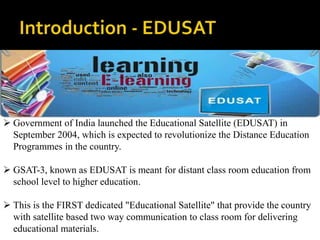
 Government of India launched the Educational Satellite (EDUSAT) in 
September 2004, which is expected to revolutionize the Distance Education 
Programmes in the country. 
 GSAT-3, known as EDUSAT is meant for distant class room education from 
school level to higher education. 
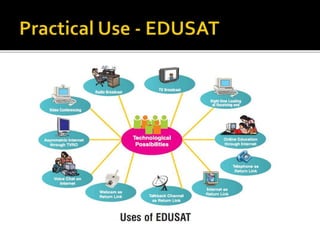
 This is the FIRST dedicated "Educational Satellite" that provide the country 
with satellite based two way communication to class room for delivering 
educational materials.
 Karnataka, Kerala, Madhya Pradesh and Maharashtra are the four States where 
EDUSAT programme are implemented in the current year. 
 In each of these States a particular target and area has been identified for utilization 
of EDUSAT. 
 Different agencies have been identified with the responsibility for the development 
of Software, Teacher Training, Monitoring & Evaluation and overall 
implementation of the project. 
 Indian Space Research Organization (ISRO), 
Serva Siksha Abhiyan (SSA) are also involved in the implementation the 
Programme.
 Started in the year 2000 (June) 
 Target area so far 38,000 village, 6500 kiosks, 9 states 
 Wholly owned by ICTs 
Designed to address the issues such as: 
 Fragmented farms 
 Weak institutions 
 Involvement of intermediaries 
 Information asymmetry
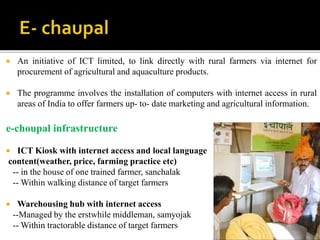
 An initiative of ICT limited, to link directly with rural farmers via internet for 
procurement of agricultural and aquaculture products. 
 The programme involves the installation of computers with internet access in rural 
areas of India to offer farmers up- to- date marketing and agricultural information. 
e-choupal infrastructure 
 ICT Kiosk with internet access and local language 
content(weather, price, farming practice etc) 
-- in the house of one trained farmer, sanchalak 
--Within walking distance of target farmers 
 Warehousing hub with internet access 
--Managed by the erstwhile middleman, samyojak 
--Within tractorable distance of target farmers
 Processed fruits(Mango, Guava, Papaya etc.) 
 Food grains (Rice, wheat and pulses) 
 Feed ingredients (Soya bean) 
 Edible nut (Groundnut) 
 Coffee and Spices 
 Marine Products (Shrimps and prawns )
 Customer centric 
 Used for many commodities and multiple transactions 
 Uses local talents and local people and develops local 
leaders 
 Extended to local as well as global procures 
 Nurtures local entrepreneurs
 Option of selling to Choupal or Mandies 
 In some crops, farmers earns 25% higher prices than selling to Mandies 
 Profit realization increased up to 60% 
 Availability of Loan facilities 
 Availability of brands/quality products at best prices 
 Exposure to latest information 
 Difference in net earning will be high if saving on commission to middle 
man & cost of transport are considered 
 Commitment to transparency and the respect and fairness with which both 
farmers and local partners are treated.
 Connecting the rural community to outside world 
for exchange of information 
 Demolish geographical boundaries 
 Can bring rural communities closer to global 
economic systems 
 Be of meaningful help to the underprivileged.
The use of ICTs in education aims to improve 
the quality of teaching and learning as well as 
democratize the access to education. 
 Smart room classes 
 Power point presentation 
 Access to internet
One use of ICTs is to provide on-line services 
for job placement through electronic labor 
exchanges in public employment service or 
other placement agencies.
Improved governance by using ICT can have 
direct impact in 
 Reducing poverty 
 Improving the environment 
 ICT can contribute in a large way in making 
government processes more efficient and 
transparent
Health care is one of the most promising areas 
for poverty alleviation. ICTs are being used in 
India 
 To facilitate remote consultation, 
 Diagnosis and treatment. 
 To address the critical medical needs of rural 
communities, especially those in remote 
locations and those that lack qualified medical 
personnel and services.
•Poor ICT awareness among agency 
•officials working in rural areas 
• local language issues
 Online services can be provided through the ICTs. 
 ICTs can provide a question and answer services where 
experts respond to the queries. 
 ICTs helps in providing up to date information services, 
to farmers. 
 ICTs also helps in providing services on disease, pest, early 
warming system, information regarding rural development 
programs and crop insurance. 
 ICTs can be helpful in providing the interaction among the 
researches, extension workers and farmers.

Ict final

  • 1.
    Made by- AshimaPadhiyal, Padma Pandey, RaniYadav
  • 2.
     ICTs areComputer based technology and internet to make information and communication services available to a wide range of users.  Information & Communication Technology (ICT) is used to refer to infrastructure and product development that facilitate the collecting, storing and analysis of information that may be transmitted electronically.  ICTs can acts as bridge between the traditional and modern knowledge system.
  • 3.
    Any one cantransfer Any information at Any time and at Any place to Any one
  • 4.
     Governance Poverty alleviation  Education  Health  Environment and  Community Development
  • 5.
     Existing processimplications to be eliminated, such as NO  loss of Time  loss of Income  loss of Opportunity  non-availability of Information in-time as per need, requirement to the rural livelihoods
  • 6.
     Offer opportunitiesfor two-way horizontal communication among communities as well as supporting agencies.  Support bottom-up articulation of development needs and perceptions.  Facilitating the merging of local, national and global information and knowledge  Support, create and strengthen interactive and collaborative networks.  Support policy and advocacy by meeting information needs of all members of society.  Help build consensus through the provision of information on programs, policies, decisions and issues to advocates.
  • 7.
     Milk Collectioncentres(AMUL) – Gujarat  Gyandoot- Madhya Pradesh  E-choupal  BHOOMI project – Karnataka  E-governance  EDUSAT
  • 9.
     Gyandoot isan Intranet based G2C (Government 2 citizen ) service delivery portal .  Implemented in Dhar district of MP in January 2000.  Gyandoot aims to create a cost-effective, replicable, economically self- reliant and financially viable model for taking the benefs ofit ICT to the rural masses.  Gyandoot is managed by a society called ‘Gyandoot Samiti’ registered under MP Societies Registration Act. The District Collector is President of the Samiti.  Can be accessed from any Gyandoot kiosk (soochanalay) by any citizen on payment of a nominal transaction fee.  Gyandoot worked as a catalyst for improving computer awareness in rural areas.
  • 10.
     To ensureequal access to emerging technologies for marginalized segments of the society.  To create a cost-effective, replicable, economically self-reliant and financially viable model for taking the benefits of IT to the rural masses.  To provide self-employment through entrepreneurship to local rural youth.  To improve the quality, speed and sensitivity of the state delivery apparatus.  To impact IT on the government-citizen interfaces as the thrust area, so that the benefits directly to reach the marginalized have-nots and know-nots.  Provide information on agricultural crop prices, online registration of applications for obtaining copies of land records, an online public grievance system, and a village auction site.
  • 11.
     The GramPanchayat has provided the physical space, invested in hardware and other infrastructure like Computer, Modem, Printer, and intrruptable power supply, which is operated by a trained person, called the soochak.  A local entrepreneur who has applied and got registered as a soochanalaya owner, made all the investments (may have taken a loan from the government). Such Soochaks are expected to pay Rs.5000 to Gyandoot Samiti every year. This is known as the Entrepreneurial model. AWARDS •Gyandoot was also awarded CSI-TCS National IT award for the best IT usage, instituted by the Computer Society of India for the year 2000. •Sir Ratan Tata Trust Healthy Child Competition granted finance for children education.
  • 12.
    The site hasplanning following services to offer in addition to the hope that it has generated by networking, the first district in the state of Madhya Pradesh :  Commodity/ Mandi Marketing Information System.  Income Certificate.  Domicile Certificate (mool niwasi ).  Caste Certificate.  Landholder's passbook of land rights and loans (Bhoo adhikar evam rin pustika).  Rural Hindi e-mail.  Public Grievance Redressal (Shikayat Nivaran)  Forms of Various Government Schemes.  Below Poverty Line Family List.  Employment news.  Rural matrimonial (Vivah Sambandh).  Rural Market (Gaon ka Bazaar).  Rural News Paper (Gram Samachar).  Advisory module (Salahkar)  E-education.
  • 13.
     Unresolved Grievances  Update of mandi prices not timely  Lack of English language skills  Delay in service delivery  Inefficiencies in service delivery  Soochanalay is too far. SUCCESS •GYANDOOT has fully succeeded in generating awareness. •Youth are excited about the new employment opportunities arising out of ICT. •Government officials feel that Gyandoot has improved their accountability •The revenue generated from the Gyandoot services is grossly inadequate to breakeven.
  • 14.
     Government ofIndia launched the Educational Satellite (EDUSAT) in September 2004, which is expected to revolutionize the Distance Education Programmes in the country.  GSAT-3, known as EDUSAT is meant for distant class room education from school level to higher education.  This is the FIRST dedicated "Educational Satellite" that provide the country with satellite based two way communication to class room for delivering educational materials.
  • 15.
     Karnataka, Kerala,Madhya Pradesh and Maharashtra are the four States where EDUSAT programme are implemented in the current year.  In each of these States a particular target and area has been identified for utilization of EDUSAT.  Different agencies have been identified with the responsibility for the development of Software, Teacher Training, Monitoring & Evaluation and overall implementation of the project.  Indian Space Research Organization (ISRO), Serva Siksha Abhiyan (SSA) are also involved in the implementation the Programme.
  • 17.
     Started inthe year 2000 (June)  Target area so far 38,000 village, 6500 kiosks, 9 states  Wholly owned by ICTs Designed to address the issues such as:  Fragmented farms  Weak institutions  Involvement of intermediaries  Information asymmetry
  • 18.
     An initiativeof ICT limited, to link directly with rural farmers via internet for procurement of agricultural and aquaculture products.  The programme involves the installation of computers with internet access in rural areas of India to offer farmers up- to- date marketing and agricultural information. e-choupal infrastructure  ICT Kiosk with internet access and local language content(weather, price, farming practice etc) -- in the house of one trained farmer, sanchalak --Within walking distance of target farmers  Warehousing hub with internet access --Managed by the erstwhile middleman, samyojak --Within tractorable distance of target farmers
  • 19.
     Processed fruits(Mango,Guava, Papaya etc.)  Food grains (Rice, wheat and pulses)  Feed ingredients (Soya bean)  Edible nut (Groundnut)  Coffee and Spices  Marine Products (Shrimps and prawns )
  • 20.
     Customer centric  Used for many commodities and multiple transactions  Uses local talents and local people and develops local leaders  Extended to local as well as global procures  Nurtures local entrepreneurs
  • 21.
     Option ofselling to Choupal or Mandies  In some crops, farmers earns 25% higher prices than selling to Mandies  Profit realization increased up to 60%  Availability of Loan facilities  Availability of brands/quality products at best prices  Exposure to latest information  Difference in net earning will be high if saving on commission to middle man & cost of transport are considered  Commitment to transparency and the respect and fairness with which both farmers and local partners are treated.
  • 23.
     Connecting therural community to outside world for exchange of information  Demolish geographical boundaries  Can bring rural communities closer to global economic systems  Be of meaningful help to the underprivileged.
  • 24.
    The use ofICTs in education aims to improve the quality of teaching and learning as well as democratize the access to education.  Smart room classes  Power point presentation  Access to internet
  • 25.
    One use ofICTs is to provide on-line services for job placement through electronic labor exchanges in public employment service or other placement agencies.
  • 26.
    Improved governance byusing ICT can have direct impact in  Reducing poverty  Improving the environment  ICT can contribute in a large way in making government processes more efficient and transparent
  • 27.
    Health care isone of the most promising areas for poverty alleviation. ICTs are being used in India  To facilitate remote consultation,  Diagnosis and treatment.  To address the critical medical needs of rural communities, especially those in remote locations and those that lack qualified medical personnel and services.
  • 28.
    •Poor ICT awarenessamong agency •officials working in rural areas • local language issues
  • 29.
     Online servicescan be provided through the ICTs.  ICTs can provide a question and answer services where experts respond to the queries.  ICTs helps in providing up to date information services, to farmers.  ICTs also helps in providing services on disease, pest, early warming system, information regarding rural development programs and crop insurance.  ICTs can be helpful in providing the interaction among the researches, extension workers and farmers.