


From Information Society to Knowledge SocietyFraming the conceptual links between ICT, Knowledge and Development
Information Society, origins of the concept and its impact
Network Society, how is it different from previous forms of social organizations?
Economic, technological, and ideological assumptions underlying the various terms
Implications for development discourse Overview2IDSB10H3
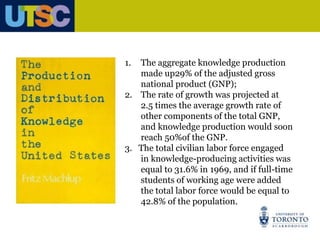
The aggregate knowledge production made up29% of the adjusted gross national product (GNP);The rate of growth was projected at 2.5 times the average growth rate of other components of the total GNP, and knowledge production would soon reach 50%of the GNP.3.   The total civilian labor force engaged in knowledge-producing activities was equal to 31.6% in 1969, and if full-time students of working age were added the total labor force would be equal to 42.8% of the population.
Machlup listed a number of reasons for studying the economics of knowledge, among them: Knowledge’s increasing share of the nation’s budget.Knowledge’s social benefits, which exceed private benefits.Knowledge as strongly associated with increases in productivity and economic growth. Knowledge’s linkages to new information and communication technologies. Shifts of demand from physical labour to brain workers.Improving and adjusting the national-income accounting in the US.
“producing knowledge will mean, in this book, not only discovering, inventing, designing and planning, but also disseminating and communicating”.
Knowledge as rational product of intellectual inquiry, using specific kinds of methodsThere are substantial costs associated with the production and distribution of knowledge but the return on investment is substantial MachlupIDSB10H36
Print paradigm and industrial mode of knowledge productionHigh production costHigh distribution costHigh barriers to entryStrict enforcement of copyrights to protect profitThe primary of firms and multinationalsIDSB10H37
"A post-industrial society is based on services. (…) What counts is not raw muscle power, or energy, but information. (…) A post industrial society is one in which the majority of those employed are not involved in the production of tangible goods”.IDSB10H38(1973)
From tangible goods to knowledge products and servicesIDSB10H39
But digital technology and the Internet completely disrupted the “industrial” mode of productionIDSB10H310
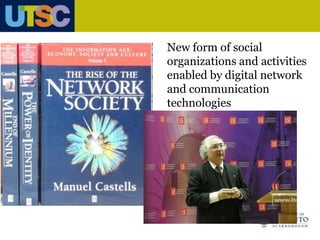
New form of social organizations and activities enabled by digital network and communication technologies
"As a historical trend, dominant functions and processes in the information age are increasingly organized around networks. Networks constitute the new social morphology of our societies, and the diffusion of networking logic substantially modifies the operations and outcomes in processes of production, experience of power and culture".Castells, M. (1996) The Rise of the Network Society.  Blackwell Publishing Ltd.: 469.IDSB10H312
What is NEW about the Network Society?	TechnologyBut“… new technology is not a sufficient but a necessary condition for the kind of society we live in, the network society”(Castells, 2000, 152)Manuel Castells13IDSB10H3
“Prevalence of Networks”But Networks are not new to human societyManuel CastellsIDSB10H314
Emergence of “global informational capitalism”Still follow the logic of the “market” and “rational self-interest”Manuel CastellsIDSB10H315
In the past, social networks were more limited in different spheres. Networks were more exclusive. The Internet changed the nature of networks by making them more inclusive and easy to participate.Manuel CastellsIDSB10H316
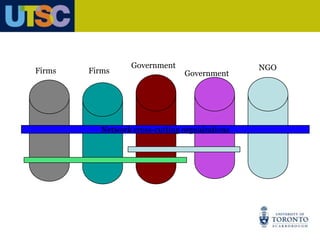
GovernmentNGOFirmsFirmsGovernmentNetwork cross-cutting organizations
Castells – emphasize access to ICT to close the digital divide 	Developing countries to participate in digital capitalismNetwork Society and DevelopmentIDSB10H318
How the Internet enable social innovation Global reachCommon and Open Standards not own by anyoneParticipation is simple“Narrowcasting”New forms of non-market, commons based peer production
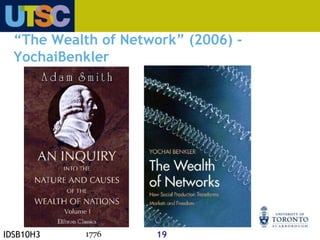
“The Wealth of Network” (2006) -YochaiBenklerIDSB10H3201776
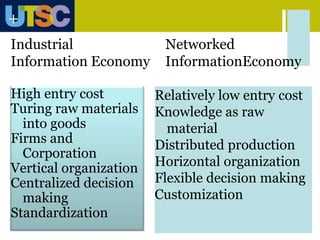
Industrial Information EconomyNetworked InformationEconomyHigh entry costTuring raw materials into goodsFirms and CorporationVertical organizationCentralized decision makingStandardizationRelatively low entry costKnowledge as raw materialDistributed productionHorizontal organizationFlexible decision makingCustomization

Idsb10 week2 network_society

  • 1.
    From Information Societyto Knowledge SocietyFraming the conceptual links between ICT, Knowledge and Development
  • 2.
    Information Society, originsof the concept and its impact
  • 3.
    Network Society, howis it different from previous forms of social organizations?
  • 4.
    Economic, technological, andideological assumptions underlying the various terms
  • 5.
    Implications for developmentdiscourse Overview2IDSB10H3
  • 6.
    The aggregate knowledgeproduction made up29% of the adjusted gross national product (GNP);The rate of growth was projected at 2.5 times the average growth rate of other components of the total GNP, and knowledge production would soon reach 50%of the GNP.3. The total civilian labor force engaged in knowledge-producing activities was equal to 31.6% in 1969, and if full-time students of working age were added the total labor force would be equal to 42.8% of the population.
  • 7.
    Machlup listed anumber of reasons for studying the economics of knowledge, among them: Knowledge’s increasing share of the nation’s budget.Knowledge’s social benefits, which exceed private benefits.Knowledge as strongly associated with increases in productivity and economic growth. Knowledge’s linkages to new information and communication technologies. Shifts of demand from physical labour to brain workers.Improving and adjusting the national-income accounting in the US.
  • 8.
    “producing knowledge willmean, in this book, not only discovering, inventing, designing and planning, but also disseminating and communicating”.
  • 9.
    Knowledge as rationalproduct of intellectual inquiry, using specific kinds of methodsThere are substantial costs associated with the production and distribution of knowledge but the return on investment is substantial MachlupIDSB10H36
  • 10.
    Print paradigm andindustrial mode of knowledge productionHigh production costHigh distribution costHigh barriers to entryStrict enforcement of copyrights to protect profitThe primary of firms and multinationalsIDSB10H37
  • 11.
    "A post-industrial societyis based on services. (…) What counts is not raw muscle power, or energy, but information. (…) A post industrial society is one in which the majority of those employed are not involved in the production of tangible goods”.IDSB10H38(1973)
  • 12.
    From tangible goodsto knowledge products and servicesIDSB10H39
  • 13.
    But digital technologyand the Internet completely disrupted the “industrial” mode of productionIDSB10H310
  • 14.
    New form ofsocial organizations and activities enabled by digital network and communication technologies
  • 15.
    "As a historicaltrend, dominant functions and processes in the information age are increasingly organized around networks. Networks constitute the new social morphology of our societies, and the diffusion of networking logic substantially modifies the operations and outcomes in processes of production, experience of power and culture".Castells, M. (1996) The Rise of the Network Society. Blackwell Publishing Ltd.: 469.IDSB10H312
  • 16.
    What is NEWabout the Network Society? TechnologyBut“… new technology is not a sufficient but a necessary condition for the kind of society we live in, the network society”(Castells, 2000, 152)Manuel Castells13IDSB10H3
  • 17.
    “Prevalence of Networks”ButNetworks are not new to human societyManuel CastellsIDSB10H314
  • 18.
    Emergence of “globalinformational capitalism”Still follow the logic of the “market” and “rational self-interest”Manuel CastellsIDSB10H315
  • 19.
    In the past,social networks were more limited in different spheres. Networks were more exclusive. The Internet changed the nature of networks by making them more inclusive and easy to participate.Manuel CastellsIDSB10H316
  • 20.
  • 21.
    Castells – emphasizeaccess to ICT to close the digital divide Developing countries to participate in digital capitalismNetwork Society and DevelopmentIDSB10H318
  • 22.
    How the Internetenable social innovation Global reachCommon and Open Standards not own by anyoneParticipation is simple“Narrowcasting”New forms of non-market, commons based peer production
  • 23.
    “The Wealth ofNetwork” (2006) -YochaiBenklerIDSB10H3201776
  • 24.
    Industrial Information EconomyNetworkedInformationEconomyHigh entry costTuring raw materials into goodsFirms and CorporationVertical organizationCentralized decision makingStandardizationRelatively low entry costKnowledge as raw materialDistributed productionHorizontal organizationFlexible decision makingCustomization

Editor's Notes

  • #3 Trace the concept of the "Information Society" from its inception in the discipline of economics through its development and its subsequent diffusion to the other areas of social sciences, information studies, and more recently into development studies.Similarly we would trace the origin of the term Network Society, and how it is being used in various contexts. We will look at the links between these two broad concepts, and see what assumptions they share, and what unique assumptions each rest on. It is important to make these assumptions explicit, because as in all areas of inquiry, the conceptual assumptions we clearly always colour the way we see, or not see the world. In other words, the world of social issues out there are not objective realities we can observe without bias. We always see the world through cultural and theoretical lens, and it is important to exam what lens we wear in order to account for possible biases. A lot of what we will be doing in this course will consist of questioning these biases, biases of what constitutes economic growth, social well being, and a host of other development indicators. In particular, we will be asking whether the information society and Network society will include people and knowledge from the developing world, or will we actually see a further division between the rich and poor countries, widely the so-called “Digital divide”
  • #13 In the network society economic activity, governance, exploitation, social and cultural activity, and struggles are increasingly organized through transnational digital networks
  • #17 Examples of exclusive networks, professional networks, government ministers. Networks tend to be hierarchical and mirror organizational arrangements, which tends to be stratified.