7M’s Resources
& Management
PREPARED BY:
DARSHAN KADIA
156050319017
DIPLOMA 5TH SEM.
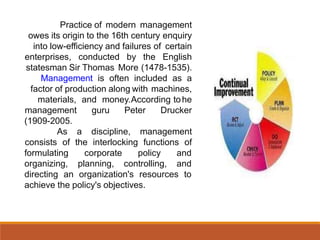
Practice of modern management
owes its origin to the 16th century enquiry
into low-efficiency and failures of certain
enterprises, conducted by the English
statesman Sir Thomas More (1478-1535).
Management is often included as a
factor of production along with machines,
materials, and money.According tohe
management guru Peter Drucker
(1909-2005.
As a discipline, management
consists of the interlocking functions of
formulating
organizing,
corporate
planning,
policy and
controlling, and
directing an organization's resources to
achieve the policy's objectives.
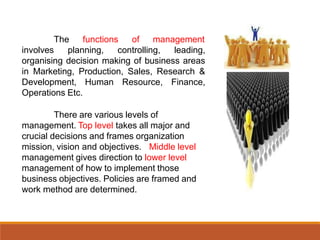
The functions of management
involves planning, controlling, leading,
organising decision making of business areas
in Marketing, Production, Sales, Research &
Development, Human Resource, Finance,
Operations Etc.
There are various levels of
management. Top level takes all major and
crucial decisions and frames organization
mission, vision and objectives. Middle level
management gives direction to lower level
management of how to implement those
business objectives. Policies are framed and
work method are determined.
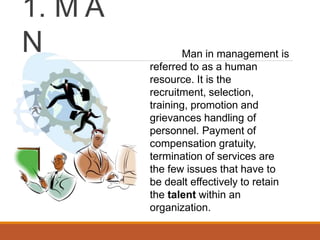
1. M A
N Man in management is
referred to as a human
resource. It is the
recruitment, selection,
training, promotion and
grievances handling of
personnel. Payment of
compensation gratuity,
termination of services are
the few issues that have to
be dealt effectively to retain
the talent within an
organization.
2.
MATERIAL
Material is a basic ingredient in
management be it a
industry or a product
service
industry.
Most of the industries locate them
self nearby to the availability of
material
Material is a basic ingredient in
management be it a
industry or a product
service
industry.
Most of the industries locate them
self nearby to the availability of
material
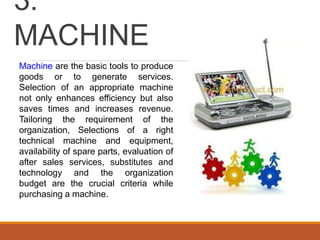
3.
MACHINE
Machine are the basic tools to produce
goods or to generate services.
Selection of an appropriate machine
not only enhances efficiency but also
saves times and increases revenue.
Tailoring the requirement of the
organization, Selections of a right
technical machine and equipment,
availability of spare parts, evaluation of
after sales services, substitutes and
technology and the organization
budget are the crucial criteria while
purchasing a machine.
Maintenance and overhauling
issues along with its life span
also cannot be overlooked. In
service Industry, Technology
matters a lot these days we are
having Computers & peripherals
as a major machine to serve
the service clients
Money
Management is done to meet
day to day business requirements and the
funds involved in meeting those
requirements are known as working
capital.
Every thing has a right way to
do and this right way is known as a
Method in management. In short it
means, an art of doing. A set of
procedures and instructions is
known as a method. The visible
methods of a company include:
Plans, Policies, Procedures, and
Data.
.
The less visible ones
include a company's norms
and its culture, and the
norms and culture of the
society around it and the
methods of its customers,
suppliers, associates, and
competitors.
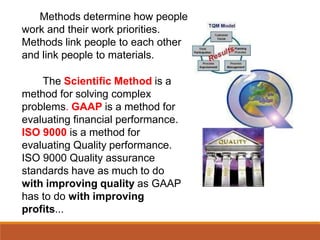
Methods determine how people
work and their work priorities.
Methods link people to each other
and link people to materials.
The Scientific Method is a
method for solving complex
problems. GAAP is a method for
evaluating financial performance.
ISO 9000 is a method for
evaluating Quality performance.
ISO 9000 Quality assurance
standards have as much to do
with improving quality as GAAP
has to do with improving
profits...
A popular method of management is
what is referred to as 'management by
objectives'. This involves setting objectives
and targets for different aspects of the
organisation.
The managers job is then to make sure that
these objectives are achieved given an
allocated amount of resources.
The objectives will either
fallen
be achieved,
of requiringexceeded, or
remedial action
short
where appropriate.
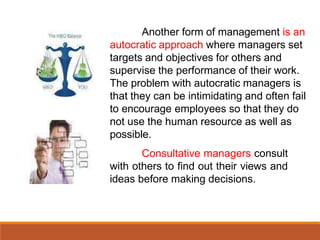
Another form of management is an
autocratic approach where managers set
targets and objectives for others and
supervise the performance of their work.
The problem with autocratic managers is
that they can be intimidating and often fail
to encourage employees so that they do
not use the human resource as well as
possible.
Consultative managers consult
with others to find out their views and
ideas before making decisions.
Democratic managers encourage
others to make decisions for
themselves. Self managing teams are
ones where management is devolved to
members of a team, which does not
have to wait for instructions from above.
The style of management that is
most appropriate is often dependent on
the situation e.g. the nature of the
industry, the speed with which
decisions need to be made, the
familiarity of managers and others with
the management style etc.
Measurements are
quantified observations of
some aspect or attribute of
a process, product or
Measurements
our ability to
things not
project.
enhance
understand
accessible to our native
abilities and intelligence.
Measurements are
quantified observations of
some aspect or attribute of
a process, product or
project. Measurements
enhance our ability to
understand things not
accessible to our native
abilities and intelligence.
Ten Precepts of
Measurement
•Measure what the customer cares
about. Measurements should have
focus, based on goals and models.
However, in most organizations there is
little agreement or knowledge of what
goals should be. Goals must relate to
customer satisfaction. Ultimately, the
customer is the only arbiter of success.
2. Measure the process, not the
person. The goal of a
measurement program must
be improvement, never
evaluation. Measurement
must support continuous
process improvement. Over
eighty per cent of quality
problems can be corrected by
concentrating on the process.
3. Set goals. Know what the
results of measures should be,
before you
measure. Know what you desire.
Benchmark against your competitors
and against “world class” organizations.
Setting goals for quality measures
ensures that the organization remains
focused on the key items important from
the customer’s point of view. Goals
must be ambitious. Goals should always
be quantified and expressed in actual
numbers, not percentages.
4. Know what to do about the
results you get. Use measures
to manage effort more
successfully. Measures must
be a basis for judgment or
action. When measures are
not achieving goals or are not
moving in the right direction,
know what intervention to take.
You must also know how your
intervention will affect
measures, both short term and
long term.
5. Anticipate the results of your
intervention. Get feedback, from all
participants. Establish the
effectiveness of your measurement
program by measuring how measures
are actually used. Are you getting the
results you want? It is more important
to know this if you are achieving
positive results than if you are getting
negative ones. How will you sustain
progress if you don’t know for certain
what is causing it?
6. The process itself should yield measures.
Don’t create a separate system to gather
measures, they should be a natural
byproduct of performing the process.
Measurement should not be additional
overhead or burden upon the people
collecting the measures. Automate the
collection of measures where possible.
This will become easier as the organization
becomes more sophisticated in stabilizing
and automating its processes. An
automated measure is better than a manual
one, but a manual measure is better than
none. As an example, an automated
project control system can be used to
measure the number of tasks completed
on schedule.
7. Measures should be numerical and
objective. Measurement is not done
well subjectively. As stated earlier,
measurements enhance our ability to
sense things not accessible to our
native abilities and intelligence.
Subjectivity contradicts this. It also
makes measures open to
interpretation, and no two persons
will interpret them in the same way.
8. Publish and publicize measurement
results. Provide feedback to the
source, both of measures to be taken
and the results of those
measurements. Make sure everyone
involved understands the purpose of
the measurement program. Measures
must be beneficial to the persons
collecting the data and performing the
process measured.
9. Ensure comparability of measures. Without
stable processes and standards, measures
are meaningless. In systems development
work, individual performance has always
been the largest variable. This work must
be converted from an individual art form to a
repeatable process before it can be
effectively measured and controlled.
Encourage the use of the best practices by
all your staff, bring everyone up to the level
or your best people.
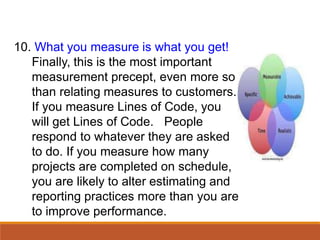
10. What you measure is what you get!
Finally, this is the most important
measurement precept, even more so
than relating measures to customers.
If you measure Lines of Code, you
will get Lines of Code. People
respond to whatever they are asked
to do. If you measure how many
projects are completed on schedule,
you are likely to alter estimating and
reporting practices more than you are
to improve performance.
“Marketing Management is the process
allocating the resources of the organization
toward marketing activities.” Thus, a marketing
manager is someone who is responsible for
directing expenditures of marketing funds.
Related to the term ‘management’ is the term
‘strategy.’
The Marketing Management Cycle
The planning cycle is composed of four basi steps. First,
Planning is the process of examining and understanding the
surroundings within which th organization functions starting with
environmental scanning” as the process of studying and making sense
of all the things that might impact the firm’s operation that are
external to the firm.
This would include studying and gaining an understanding of
such things as: competition, legislation and regulation, social and
cultural trends, and technology. Both present and developing trends
in each of these areas must be identified and monitored. The
planning stage also includes creating documents that outline the
organization’s intended response to these environmental (external)
variables.
c
e
Second, Implementation is the process of
putting plans that have been made into
action. It is the transition from expected
reality to existing reality.
Third, Monitoring is the process of tracking
plans and identifying how plans related to
changes that take place during program
operation when more information is
acquired. Correction is the stage in which
we take action to return our plan to the
desired state based on feedback obtained
in the monitoring stage. If we find that
return to the planned state is not
practicable, we may adjust our planning
outcomes.
Thus, Monitoring and Correction
may be considered two stages because
after plans are put into action, one must
continually monitor performance and
make adjustments to the plan based on
the feedback gathered through these
monitoring activities. In summary, the
marketing management cycle is
composed of planning, implementing,
monitoring, and correcting.

7msofmanagement 111022094859-phpapp02

  • 1.
    7M’s Resources & Management PREPAREDBY: DARSHAN KADIA 156050319017 DIPLOMA 5TH SEM.
  • 2.
    Practice of modernmanagement owes its origin to the 16th century enquiry into low-efficiency and failures of certain enterprises, conducted by the English statesman Sir Thomas More (1478-1535). Management is often included as a factor of production along with machines, materials, and money.According tohe management guru Peter Drucker (1909-2005. As a discipline, management consists of the interlocking functions of formulating organizing, corporate planning, policy and controlling, and directing an organization's resources to achieve the policy's objectives.
  • 3.
    The functions ofmanagement involves planning, controlling, leading, organising decision making of business areas in Marketing, Production, Sales, Research & Development, Human Resource, Finance, Operations Etc. There are various levels of management. Top level takes all major and crucial decisions and frames organization mission, vision and objectives. Middle level management gives direction to lower level management of how to implement those business objectives. Policies are framed and work method are determined.
  • 4.
    1. M A NMan in management is referred to as a human resource. It is the recruitment, selection, training, promotion and grievances handling of personnel. Payment of compensation gratuity, termination of services are the few issues that have to be dealt effectively to retain the talent within an organization.
  • 5.
    2. MATERIAL Material is abasic ingredient in management be it a industry or a product service industry. Most of the industries locate them self nearby to the availability of material
  • 6.
    Material is abasic ingredient in management be it a industry or a product service industry. Most of the industries locate them self nearby to the availability of material
  • 7.
    3. MACHINE Machine are thebasic tools to produce goods or to generate services. Selection of an appropriate machine not only enhances efficiency but also saves times and increases revenue. Tailoring the requirement of the organization, Selections of a right technical machine and equipment, availability of spare parts, evaluation of after sales services, substitutes and technology and the organization budget are the crucial criteria while purchasing a machine.
  • 8.
    Maintenance and overhauling issuesalong with its life span also cannot be overlooked. In service Industry, Technology matters a lot these days we are having Computers & peripherals as a major machine to serve the service clients
  • 10.
    Money Management is doneto meet day to day business requirements and the funds involved in meeting those requirements are known as working capital.
  • 11.
    Every thing hasa right way to do and this right way is known as a Method in management. In short it means, an art of doing. A set of procedures and instructions is known as a method. The visible methods of a company include: Plans, Policies, Procedures, and Data.
  • 12.
    . The less visibleones include a company's norms and its culture, and the norms and culture of the society around it and the methods of its customers, suppliers, associates, and competitors.
  • 13.
    Methods determine howpeople work and their work priorities. Methods link people to each other and link people to materials. The Scientific Method is a method for solving complex problems. GAAP is a method for evaluating financial performance. ISO 9000 is a method for evaluating Quality performance. ISO 9000 Quality assurance standards have as much to do with improving quality as GAAP has to do with improving profits...
  • 14.
    A popular methodof management is what is referred to as 'management by objectives'. This involves setting objectives and targets for different aspects of the organisation. The managers job is then to make sure that these objectives are achieved given an allocated amount of resources. The objectives will either fallen be achieved, of requiringexceeded, or remedial action short where appropriate.
  • 15.
    Another form ofmanagement is an autocratic approach where managers set targets and objectives for others and supervise the performance of their work. The problem with autocratic managers is that they can be intimidating and often fail to encourage employees so that they do not use the human resource as well as possible. Consultative managers consult with others to find out their views and ideas before making decisions.
  • 16.
    Democratic managers encourage othersto make decisions for themselves. Self managing teams are ones where management is devolved to members of a team, which does not have to wait for instructions from above. The style of management that is most appropriate is often dependent on the situation e.g. the nature of the industry, the speed with which decisions need to be made, the familiarity of managers and others with the management style etc.
  • 17.
    Measurements are quantified observationsof some aspect or attribute of a process, product or Measurements our ability to things not project. enhance understand accessible to our native abilities and intelligence.
  • 18.
    Measurements are quantified observationsof some aspect or attribute of a process, product or project. Measurements enhance our ability to understand things not accessible to our native abilities and intelligence.
  • 19.
    Ten Precepts of Measurement •Measurewhat the customer cares about. Measurements should have focus, based on goals and models. However, in most organizations there is little agreement or knowledge of what goals should be. Goals must relate to customer satisfaction. Ultimately, the customer is the only arbiter of success.
  • 20.
    2. Measure theprocess, not the person. The goal of a measurement program must be improvement, never evaluation. Measurement must support continuous process improvement. Over eighty per cent of quality problems can be corrected by concentrating on the process.
  • 21.
    3. Set goals.Know what the results of measures should be, before you measure. Know what you desire. Benchmark against your competitors and against “world class” organizations. Setting goals for quality measures ensures that the organization remains focused on the key items important from the customer’s point of view. Goals must be ambitious. Goals should always be quantified and expressed in actual numbers, not percentages.
  • 22.
    4. Know whatto do about the results you get. Use measures to manage effort more successfully. Measures must be a basis for judgment or action. When measures are not achieving goals or are not moving in the right direction, know what intervention to take. You must also know how your intervention will affect measures, both short term and long term.
  • 23.
    5. Anticipate theresults of your intervention. Get feedback, from all participants. Establish the effectiveness of your measurement program by measuring how measures are actually used. Are you getting the results you want? It is more important to know this if you are achieving positive results than if you are getting negative ones. How will you sustain progress if you don’t know for certain what is causing it?
  • 24.
    6. The processitself should yield measures. Don’t create a separate system to gather measures, they should be a natural byproduct of performing the process. Measurement should not be additional overhead or burden upon the people collecting the measures. Automate the collection of measures where possible. This will become easier as the organization becomes more sophisticated in stabilizing and automating its processes. An automated measure is better than a manual one, but a manual measure is better than none. As an example, an automated project control system can be used to measure the number of tasks completed on schedule.
  • 25.
    7. Measures shouldbe numerical and objective. Measurement is not done well subjectively. As stated earlier, measurements enhance our ability to sense things not accessible to our native abilities and intelligence. Subjectivity contradicts this. It also makes measures open to interpretation, and no two persons will interpret them in the same way.
  • 26.
    8. Publish andpublicize measurement results. Provide feedback to the source, both of measures to be taken and the results of those measurements. Make sure everyone involved understands the purpose of the measurement program. Measures must be beneficial to the persons collecting the data and performing the process measured.
  • 27.
    9. Ensure comparabilityof measures. Without stable processes and standards, measures are meaningless. In systems development work, individual performance has always been the largest variable. This work must be converted from an individual art form to a repeatable process before it can be effectively measured and controlled. Encourage the use of the best practices by all your staff, bring everyone up to the level or your best people.
  • 28.
    10. What youmeasure is what you get! Finally, this is the most important measurement precept, even more so than relating measures to customers. If you measure Lines of Code, you will get Lines of Code. People respond to whatever they are asked to do. If you measure how many projects are completed on schedule, you are likely to alter estimating and reporting practices more than you are to improve performance.
  • 29.
    “Marketing Management isthe process allocating the resources of the organization toward marketing activities.” Thus, a marketing manager is someone who is responsible for directing expenditures of marketing funds. Related to the term ‘management’ is the term ‘strategy.’
  • 30.
    The Marketing ManagementCycle The planning cycle is composed of four basi steps. First, Planning is the process of examining and understanding the surroundings within which th organization functions starting with environmental scanning” as the process of studying and making sense of all the things that might impact the firm’s operation that are external to the firm. This would include studying and gaining an understanding of such things as: competition, legislation and regulation, social and cultural trends, and technology. Both present and developing trends in each of these areas must be identified and monitored. The planning stage also includes creating documents that outline the organization’s intended response to these environmental (external) variables. c e
  • 31.
    Second, Implementation isthe process of putting plans that have been made into action. It is the transition from expected reality to existing reality. Third, Monitoring is the process of tracking plans and identifying how plans related to changes that take place during program operation when more information is acquired. Correction is the stage in which we take action to return our plan to the desired state based on feedback obtained in the monitoring stage. If we find that return to the planned state is not practicable, we may adjust our planning outcomes.
  • 32.
    Thus, Monitoring andCorrection may be considered two stages because after plans are put into action, one must continually monitor performance and make adjustments to the plan based on the feedback gathered through these monitoring activities. In summary, the marketing management cycle is composed of planning, implementing, monitoring, and correcting.