Presented by- Jaskiran Kaur
Guided by- Dr . Vijayakumar M.R.
Department of Pharmaceautical Sciences
Babasaheb Bhimrao Ambedkar University
Lucknow
1
CONTENTS
1. Introduction
2. Mission
3. History
4. Objectives
5. Organisation of ICH
6. ICH Guidelines
7. Quality Guidelines –Q1
8. Quality Guidelines –Q2
2
INTRODUCTION
• International Conference on Harmonisation (ICH) was created in 1990
• Agreement between the EU, Japan and the USA to harmonize different
regional requirements for registration of pharmaceutical drug products
• Unique because joint effort by regulators and associated pharmaceutical
industry trade associations
• ICH is the “International Conference on Harmonization of Technical
Requirements for Registration of Pharmaceuticals for Human Use”.
• ICH is a joint initiative involving both regulators and research-based industry
representatives of the EU, Japan and the US in scientific and technical
discussions of the testing procedures required to asses and ensure the safety,
quality and efficacy of medicines.
• The ICH Secretariat is based in Geneva. The biennial meetings and
conferences of the ICH Steering Committee rotate between the EU, Japan,
and the USA.
3
4
HISTORY
Need to harmonise?
Industry becoming global –
Duplicate test procedures
• Time consuming
• Expensive
Increasing R&D costs
Meeting public demand
5
Initiation of ICH -
1980s: European Community
1989: WHO conference on Drug Regulatory Authorities, Paris
1990: Birth of ICH, Brussels
• Europe
• Japan
• US
 Topics for harmonisation divided into: Safety, Efficacy and Quality
6
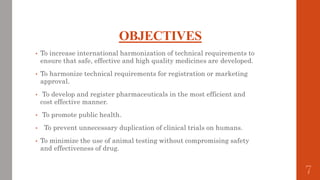
OBJECTIVES
• To increase international harmonization of technical requirements to
ensure that safe, effective and high quality medicines are developed.
• To harmonize technical requirements for registration or marketing
approval.
• To develop and register pharmaceuticals in the most efficient and
cost effective manner.
• To promote public health.
• To prevent unnecessary duplication of clinical trials on humans.
• To minimize the use of animal testing without compromising safety
and effectiveness of drug.
7
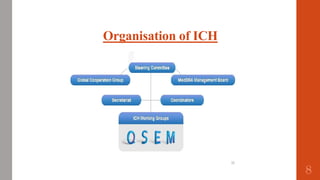
Organisation of ICH
8
9
10
11
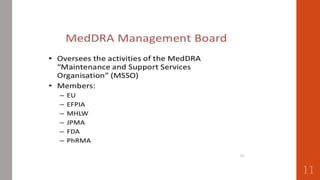
• In Japan, the members are the Ministry of Health, Labour and Welfare
(MHLW), and the Japan Pharmaceutical Manufacturers Association
(JPMA).
• In Europe, the members are the European Union (EU), and the European
Federation of Pharmaceutical Industries and Associations (EFPIA).
• In the USA, the members are the Food and Drug Administration (FDA),
and the Pharmaceutical Research and Manufacturers of America
(PhRMA).
12
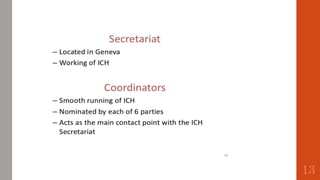
13
ICH Guidelines
14
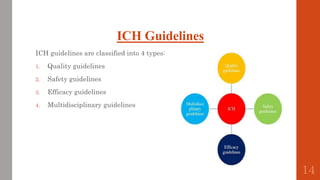
ICH guidelines are classified into 4 types:
1. Quality guidelines
2. Safety guidelines
3. Efficacy guidelines
4. Multidisciplinary guidelines
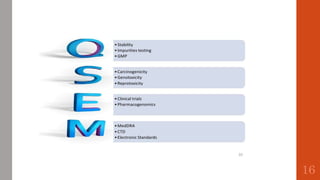
• “Quality” Topics, i.e., those relating to chemical and pharmaceutical
Quality Assurance (Stability Testing, Impurity Testing, etc.)
• “Efficacy" Topics, i.e., those relating to clinical studies in human
subject (Dose Response Studies, Good Clinical Practices, etc.)
• “Safety” Topics, i.e., those relating to in vitro and in vivo pre-clinical
studies (Carcinogenicity Testing, Genotoxicity Testing, etc.)
• “Multidisciplinary” Topics, i.e., cross-cutting Topics which do not fit
uniquely into one of the above categories.
15
16
List of Quality Guidelines
 Q1 - Stability
Q2 - Analytical validation
 Q3 - Impurities
 Q4 - Pharmacopoeia
 Q5 - Quality of biotechnological products
 Q6 - Specifications
 Q7 - GMP
 Q8 - Pharmaceutical development
 Q9 - QRM
 Q10 – Pharmaceutical Quality system
17
Q1 Guidelines
• These are the stability guidelines.
• The purpose of stability testing is to provide evidence on how the
quality of a drug substance or drug product varies with time under
the influence of a variety of environmental factors such as
temperature, humidity, and light, and to establish a re-test period for
the drug substance or a shelf life for the drug product.
18
Types of stabilities
19
Chemical
Physical
Microbial
Therapeautical
Toxicological
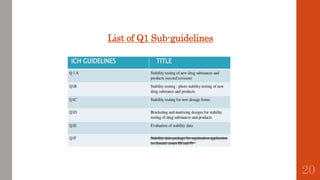
List of Q1 Sub-guidelines
20
Q1 A(R2): stability testing of new drug
substances and products
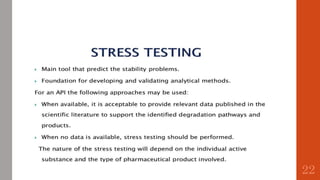
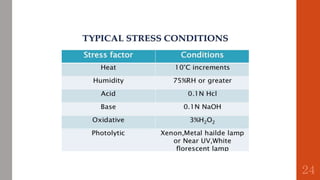
Test for APIs
• General
• Stress Testing
• Selection of Batches
• Container Closure System
• Specification
• Testing Frequency
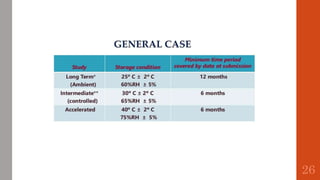
• Storage Conditions
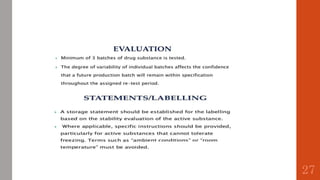
• Evaluation
• Statements/Labelling
21
22
1
23
24
25
26
27
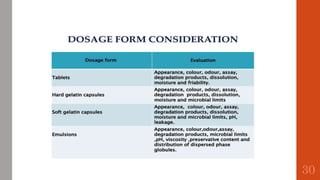
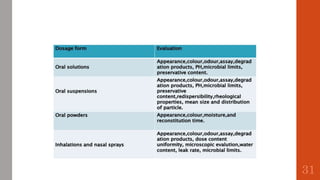
Stability testing of drug products
28
29
30
31
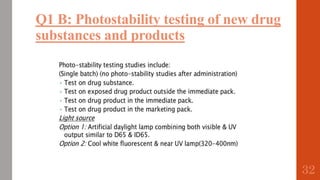
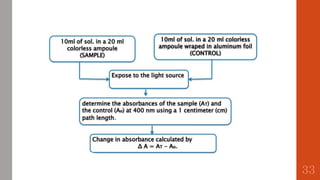
Q1 B: Photostability testing of new drug
substances and products
32
33
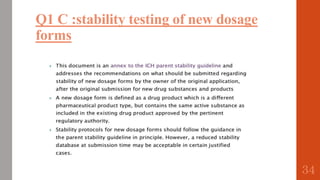
Q1 C :stability testing of new dosage
forms
34
Q1 D :Bracketting and matrix design
35
36
Q1 E :Evaluation of the stability data
37
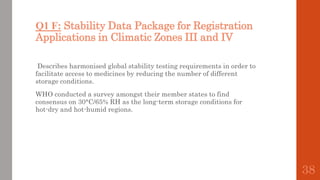
Q1 F: Stability Data Package for Registration
Applications in Climatic Zones III and IV
Describes harmonised global stability testing requirements in order to
facilitate access to medicines by reducing the number of different
storage conditions.
WHO conducted a survey amongst their member states to find
consensus on 30°C/65% RH as the long-term storage conditions for
hot-dry and hot-humid regions.
38
39
Q2 Guidelines- Analytical validation
• Validation of Analytical Procedures: Text and Methodology
• The objective of validation of an analytical procedure is to
demonstrate that it is suitable for its intended purpose
• Gives validation parameters needed for a variety of analytical
methods.
• It also discusses the characteristics that must be considered
during the validation of the analytical procedures
40
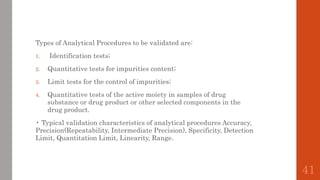
Types of Analytical Procedures to be validated are:
1. Identification tests;
2. Quantitative tests for impurities content;
3. Limit tests for the control of impurities;
4. Quantitative tests of the active moiety in samples of drug
substance or drug product or other selected components in the
drug product.
• Typical validation characteristics of analytical procedures Accuracy,
Precision(Repeatability, Intermediate Precision), Specificity, Detection
Limit, Quantitation Limit, Linearity, Range.

41
42
Thank You!

ICH- Objectives and stability guidelines

  • 1.
    Presented by- JaskiranKaur Guided by- Dr . Vijayakumar M.R. Department of Pharmaceautical Sciences Babasaheb Bhimrao Ambedkar University Lucknow 1
  • 2.
    CONTENTS 1. Introduction 2. Mission 3.History 4. Objectives 5. Organisation of ICH 6. ICH Guidelines 7. Quality Guidelines –Q1 8. Quality Guidelines –Q2 2
  • 3.
    INTRODUCTION • International Conferenceon Harmonisation (ICH) was created in 1990 • Agreement between the EU, Japan and the USA to harmonize different regional requirements for registration of pharmaceutical drug products • Unique because joint effort by regulators and associated pharmaceutical industry trade associations • ICH is the “International Conference on Harmonization of Technical Requirements for Registration of Pharmaceuticals for Human Use”. • ICH is a joint initiative involving both regulators and research-based industry representatives of the EU, Japan and the US in scientific and technical discussions of the testing procedures required to asses and ensure the safety, quality and efficacy of medicines. • The ICH Secretariat is based in Geneva. The biennial meetings and conferences of the ICH Steering Committee rotate between the EU, Japan, and the USA. 3
  • 4.
  • 5.
    HISTORY Need to harmonise? Industrybecoming global – Duplicate test procedures • Time consuming • Expensive Increasing R&D costs Meeting public demand 5
  • 6.
    Initiation of ICH- 1980s: European Community 1989: WHO conference on Drug Regulatory Authorities, Paris 1990: Birth of ICH, Brussels • Europe • Japan • US  Topics for harmonisation divided into: Safety, Efficacy and Quality 6
  • 7.
    OBJECTIVES • To increaseinternational harmonization of technical requirements to ensure that safe, effective and high quality medicines are developed. • To harmonize technical requirements for registration or marketing approval. • To develop and register pharmaceuticals in the most efficient and cost effective manner. • To promote public health. • To prevent unnecessary duplication of clinical trials on humans. • To minimize the use of animal testing without compromising safety and effectiveness of drug. 7
  • 8.
  • 9.
  • 10.
  • 11.
  • 12.
    • In Japan,the members are the Ministry of Health, Labour and Welfare (MHLW), and the Japan Pharmaceutical Manufacturers Association (JPMA). • In Europe, the members are the European Union (EU), and the European Federation of Pharmaceutical Industries and Associations (EFPIA). • In the USA, the members are the Food and Drug Administration (FDA), and the Pharmaceutical Research and Manufacturers of America (PhRMA). 12
  • 13.
  • 14.
    ICH Guidelines 14 ICH guidelinesare classified into 4 types: 1. Quality guidelines 2. Safety guidelines 3. Efficacy guidelines 4. Multidisciplinary guidelines
  • 15.
    • “Quality” Topics,i.e., those relating to chemical and pharmaceutical Quality Assurance (Stability Testing, Impurity Testing, etc.) • “Efficacy" Topics, i.e., those relating to clinical studies in human subject (Dose Response Studies, Good Clinical Practices, etc.) • “Safety” Topics, i.e., those relating to in vitro and in vivo pre-clinical studies (Carcinogenicity Testing, Genotoxicity Testing, etc.) • “Multidisciplinary” Topics, i.e., cross-cutting Topics which do not fit uniquely into one of the above categories. 15
  • 16.
  • 17.
    List of QualityGuidelines  Q1 - Stability Q2 - Analytical validation  Q3 - Impurities  Q4 - Pharmacopoeia  Q5 - Quality of biotechnological products  Q6 - Specifications  Q7 - GMP  Q8 - Pharmaceutical development  Q9 - QRM  Q10 – Pharmaceutical Quality system 17
  • 18.
    Q1 Guidelines • Theseare the stability guidelines. • The purpose of stability testing is to provide evidence on how the quality of a drug substance or drug product varies with time under the influence of a variety of environmental factors such as temperature, humidity, and light, and to establish a re-test period for the drug substance or a shelf life for the drug product. 18
  • 19.
  • 20.
    List of Q1Sub-guidelines 20
  • 21.
    Q1 A(R2): stabilitytesting of new drug substances and products Test for APIs • General • Stress Testing • Selection of Batches • Container Closure System • Specification • Testing Frequency • Storage Conditions • Evaluation • Statements/Labelling 21
  • 22.
  • 23.
  • 24.
  • 25.
  • 26.
  • 27.
  • 28.
    Stability testing ofdrug products 28
  • 29.
  • 30.
  • 31.
  • 32.
    Q1 B: Photostabilitytesting of new drug substances and products 32
  • 33.
  • 34.
    Q1 C :stabilitytesting of new dosage forms 34
  • 35.
    Q1 D :Brackettingand matrix design 35
  • 36.
  • 37.
    Q1 E :Evaluationof the stability data 37
  • 38.
    Q1 F: StabilityData Package for Registration Applications in Climatic Zones III and IV Describes harmonised global stability testing requirements in order to facilitate access to medicines by reducing the number of different storage conditions. WHO conducted a survey amongst their member states to find consensus on 30°C/65% RH as the long-term storage conditions for hot-dry and hot-humid regions. 38
  • 39.
  • 40.
    Q2 Guidelines- Analyticalvalidation • Validation of Analytical Procedures: Text and Methodology • The objective of validation of an analytical procedure is to demonstrate that it is suitable for its intended purpose • Gives validation parameters needed for a variety of analytical methods. • It also discusses the characteristics that must be considered during the validation of the analytical procedures 40
  • 41.
    Types of AnalyticalProcedures to be validated are: 1. Identification tests; 2. Quantitative tests for impurities content; 3. Limit tests for the control of impurities; 4. Quantitative tests of the active moiety in samples of drug substance or drug product or other selected components in the drug product. • Typical validation characteristics of analytical procedures Accuracy, Precision(Repeatability, Intermediate Precision), Specificity, Detection Limit, Quantitation Limit, Linearity, Range. 41
  • 42.