ICH
GUIDELINES
1
 ICH is the “International Conference on
Harmonization of Technical Requirements for
Registration of Pharmaceuticals for Human Use”.
 ICH is a joint initiative involving both regulators and
research-based industry representatives of the EU,
Japan and the US in scientific and technical
discussions of the testing procedures required to
assess and ensure the safety, quality and efficacy of
medicines.
2
Objectives of ICH
 To increase international harmonization of technical
requirements to ensure that safe, effective and high quality
medicines are developed.
 To harmonize technical requirements for registration or
marketing approval.
 To develop and register pharmaceuticals in the most efficient and
cost effective manner.
 To promote public health.
 To prevent unnecessary duplication of clinical trials on humans.
 To minimize the use of animal testing without compromising
safety and effectiveness of drug.
3
ICH location
The ICH Secretariat is based in Geneva. The biennial
meetings and conferences of the ICH Steering
Committee rotate between the EU, Japan, and the USA.
4
Goal of ICH
 To promote international harmonization by bringing
together representatives from the three ICH regions
(EU, Japan and USA)
 To discuss and establish common guidelines.
 To make information available on ICH, ICH activities
and ICH guidelines to any country or company that
requests the information
 To promote a mutual understanding of regional
initiatives in order to facilitate harmonization processes
related to ICH guidelines regionally and globally
 To strengthen the capacity of drug regulatory
authorities and industry to utilize them.
5
Members of ICH
 ICH is comprised of representatives from six parties that
represent the regulatory bodies and research-based industry in
the European Union, Japan and the USA.
 In Japan, the members are the Ministry of Health, Labour and
Welfare (MHLW), and the Japan Pharmaceutical Manufacturers
Association (JPMA).
 In Europe, the members are the European Union (EU), and the
European Federation of Pharmaceutical Industries and
Associations (EFPIA).
 In the USA, the members are the Food and Drug Administration
(FDA), and the Pharmaceutical Research and Manufacturers of
America (PhRMA).
 Additional members include Observers from the World Health
Organization (WHO), European Free Trade Association (EFTA),
and Canada. The Observers represent non-ICH countries and
regions.
6
ICH structure
 The ICH structure consists of the ICH Steering Committee,
ICH Coordinators, ICH Secretariat and ICH Working
Groups.
 ICH Steering Committee: The Steering Committee is the
body that governs the ICH, determines the policies and
procedures for ICH, selects topics for harmonization and
monitors the progress of harmonization initiatives.
 Each of the six ICH parties has two seats on the ICH
Steering Committee.
 ICH Coordinators: The Coordinators are fundamental to the
smooth running of the ICH and are nominated by each of the
six parties.
 An ICH Coordinator acts as the main contact point with the
ICH Secretariat.
7
 ICH Secretariat: The Secretariat is primarily concerned
with preparations for, and documentation of, meetings of
the Steering Committee as well as coordination of
preparations for Working Group and Discussion Group
meetings.
 Information on ICH Guidelines and the general ICH
process can be obtained from the ICH Secretariat.
 ICH Working Group: Depending on the type of
harmonization activity needed, the Steering Committee
will endorse the establishment of one of three types of
working group i.e., Expert Working Group (EWG),
Implementation Working Group (IWG) or Informal
Working Group.
8
ICH OPERATION
 ICH operates through ICH Steering Committee with
administrative support from ICH Secretariat and ICH
Coordinators.
 The Steering Committee meets at least twice a year .
 During these meetings, new topics will be considered for
adoption, reports are received on the progress of existing
topics, and maintenance and implementation of the
guidelines are discussed.
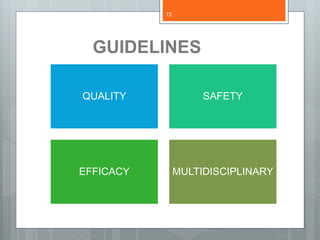
 The topics identified for harmonization by the Steering
Committee are selected from Safety, Quality, Efficacy, and
Multidisciplinary matters.
9
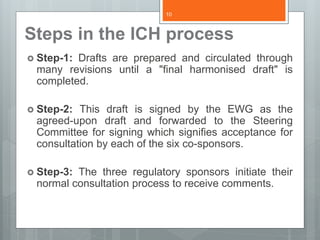
Steps in the ICH process
 Step-1: Drafts are prepared and circulated through
many revisions until a "final harmonised draft" is
completed.
 Step-2: This draft is signed by the EWG as the
agreed-upon draft and forwarded to the Steering
Committee for signing which signifies acceptance for
consultation by each of the six co-sponsors.
 Step-3: The three regulatory sponsors initiate their
normal consultation process to receive comments.
10
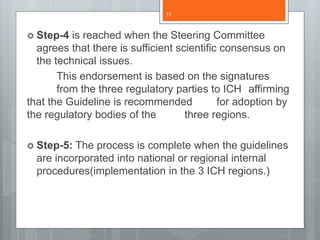
 Step-4 is reached when the Steering Committee
agrees that there is sufficient scientific consensus on
the technical issues.

This endorsement is based on the signatures
from the three regulatory parties to ICH affirming
that the Guideline is recommended for adoption by
the regulatory bodies of the three regions.
 Step-5: The process is complete when the guidelines
are incorporated into national or regional internal
procedures(implementation in the 3 ICH regions.)
11
GUIDELINES
QUALITY SAFETY
EFFICACY MULTIDISCIPLINARY
12
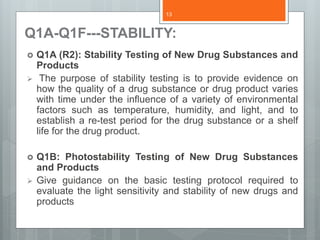
Q1A-Q1F---STABILITY:
 Q1A (R2): Stability Testing of New Drug Substances and
Products
 The purpose of stability testing is to provide evidence on
how the quality of a drug substance or drug product varies
with time under the influence of a variety of environmental
factors such as temperature, humidity, and light, and to
establish a re-test period for the drug substance or a shelf
life for the drug product.
 Q1B: Photostability Testing of New Drug Substances
and Products
 Give guidance on the basic testing protocol required to
evaluate the light sensitivity and stability of new drugs and
products
13
 Q1C: Stability Testing for New Dosage Forms
 Gives guidelines for new formulations of already approved
medicines and defines the circumstances under which
reduced stability data can be accepted.
 Q1D: Bracketing and Matrixing Designs for Stability
Testing of New Drug Substances and Products
 Q1E: Evaluation of Stability Data
 This guideline addresses the evaluation of stability data
that should be submitted in registration applications for new
molecular entities and associated drug products.
 The guideline provides recommendations on establishing
shelf lives for drug substances and drug products intended
for storage at or below “room temperature”.
14
 Q1F: Stability Data Package for Registration
Applications in Climatic Zones III and IV
 Describes harmonised global stability testing
requirements in order to facilitate access to
medicines by reducing the number of different
storage conditions.
 WHO conducted a survey amongst their member
states to find consensus on 30°C/65% RH as the
long-term storage conditions for hot-dry and hot-
humid regions.
15
Q2-Analytical validation
 Q2(R1): Validation of Analytical Procedures: Text
and Methodology
 The objective of validation of an analytical procedure
is to demonstrate that it is suitable for its intended
purpose
 Gives validation parameters needed for a variety of
analytical methods.
 It also discusses the characteristics that must be
considered during the validation of the analytical
procedures
16
Types of Analytical Procedures to be
validated are:
 Identification tests
 Quantitative tests for impurities content
 Limit tests for the control of impurities
 Quantitative tests of the active moiety in samples of
drug substance or drug product or other selected
components in the drug product.
 Typical validation characteristics of analytical
procedures Accuracy, Precision(Repeatability,
Intermediate Precision), Specificity, Detection Limit,
Quantitation Limit, Linearity, Range.
17
Q3A- Q3D----Impurities
 Q3A(R2): Impurities in New Drug Substances
 The guideline addresses the chemistry and safety
aspects of impurities, including the listing of impurities,
threshold limit, identification and quantification.
 Classification of Impurities: are of 3 types
1. Organic impurities (process- and drug-related)
2. Inorganic impurities
3. Residual solvents
18
 Q3B(R2): Impurities in New Drug Products
 Q3C(R4): Impurities: Guideline for Residual Solvents
1. Benzene 2ppm
2. Carbon tetrachloride 4ppm
3. Dichloromethane 5ppm
4. Dichloroethane 8ppm
5. Acetonitrile 410ppm
6. Chloroform 60ppm
7. Chlorobenzene 360ppm
8. Formamide, Hexane 290ppm
9. Toulene 890ppm
10. Pyridine 200pm
11. Nitromethane 50ppm
12. Methanol 3000ppm
19
Q4: Pharmacopoeias
 Q4A: Pharmacopoeial Harmonisation
 Q4B: Evaluation and Recommendation of
Pharmacopoeial Texts for Use in the ICH Regions
 This document describes a process for the evaluation
and recommendation given by the Q4B Expert Working
Group (EWG) for selecting pharmacopoeial texts to
facilitate their recognition by regulatory authorities for
use, interchangeable in the ICH regions.
20
Q4B
 Annex 1: Evaluation and Recommendation of Pharmacopoeial Texts for Use in the ICH
Regions on Residue on Ignition/Sulphated Ash
 Annex 2:Test for Extractable Volume of Parenteral Preparations
 Annex 3: Test for Particulate Contamination: Sub-Visible Particles
 Annex 4A: Microbiological Examination of Non-Sterile Products: Microbial Enumeration Tests
 Annex 4B: Microbiological Examination of Non-Sterile Products: Tests for Specified Micro-
organisms
 Annex 4C: Microbiological Examination of Non-Sterile Products: Acceptance Criteria for
Pharmaceutical Preparations and Substances for Pharmaceutical Use
 Annex 5:Disintegration Test
 Annex 6: Uniformity of Dosage Units
 Annex 7: Dissolution Test
 Annex 8: Sterility Test
 Annex 9: Tablet Friability
 Annex 10: Polyacrylamide Gel Electrophoresis
 Annex 11: Capillary Electrophoresis
 Annex 12: Analytical Sieving
 Annex 13: Bulk Density and Tapped Density of Powders
 Annex14 :Bacterial Endotoxins Test
21
Q5A-Q5E---Quality of biotechnological products
 Q5A(R1): Viral Safety Evaluation of Biotechnology
Products Derived from Cell Lines of Human or
Animal Origin
 This document is concerned with testing and
evaluation of the viral safety of biotechnology products
derived from cell lines of human or animal origin (i.e.,
mammalian, avian, insect)
 The objective is to provide a general framework for
virus testing experiments for the evaluation of virus
clearance and the design of viral tests and clearance
evaluation studies.
22
 Three principal, complementary approaches have
evolved to control the potential viral contamination of
biotechnology products:
a) selecting and testing cell lines and other raw
materials, including media components, for the
absence of undesirable viruses which may be
infectious and/or pathogenic for humans;
b) Testing the capacity of the processes to clear
infectious viruses;
c) testing the product at appropriate steps for absence
of contaminating infectious viruses.
23
 Q5B: Quality of Biotechnological Products : Analysis
of the Expression Construct in Cells Used for
Production of r-DNA Derived Protein Products
 This document presents guidance regarding the
characterization of the expression construct for the
production of recombinant DNA protein products in
eukaryotic and prokaryotic cells.
 Q5C: Quality of Biotechnological Products
 Stability Testing of Biotechnological/Biological Products
 Q5D: Derivation and Characterisation of Cell
Substrates Used for Production of
Biotechnological/Biological Products •
 The objective of this guideline is to provide broad guidance
on appropriate standards for cell substrates.
24
 Q5E: Comparability of Biotechnological/ Biological
Products Subject to Changes in Their
Manufacturing Process
 The objective of this document is to provide principles for
assessing the comparability of biotechnological/ biological
products before and after changes are made in the manufacturing
process for the drug substance or drug product.
 Therefore, this guideline is intended to assist in the collection of
relevant technical information which serves as evidence that the
manufacturing process changes will not have an adverse impact
on the quality, safety and efficacy of the drug product.
25
Q6 : Specifications for New Drug
Substances and Products
 Bulk drug substance and final product specifications
are key parts of the core documentation for world-
wide product license applications.
 This leads to conflicting standards for the same
product, increased expenses and opportunities for
error as well as a potential cause for interruption of
product supply.
26
Q6A: Specifications : Test Procedures and Acceptance Criteria
for New Drug Substances and New Drug Products : Chemical
Substances
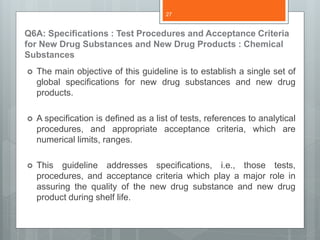
 The main objective of this guideline is to establish a single set of
global specifications for new drug substances and new drug
products.
 A specification is defined as a list of tests, references to analytical
procedures, and appropriate acceptance criteria, which are
numerical limits, ranges.
 This guideline addresses specifications, i.e., those tests,
procedures, and acceptance criteria which play a major role in
assuring the quality of the new drug substance and new drug
product during shelf life.
27
Universal Tests:
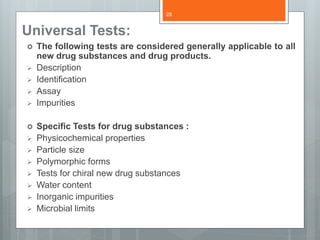
 The following tests are considered generally applicable to all
new drug substances and drug products.
 Description
 Identification
 Assay
 Impurities
 Specific Tests for drug substances :
 Physicochemical properties
 Particle size
 Polymorphic forms
 Tests for chiral new drug substances
 Water content
 Inorganic impurities
 Microbial limits
28
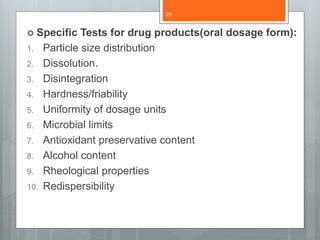
 Specific Tests for drug products(oral dosage form):
1. Particle size distribution
2. Dissolution.
3. Disintegration
4. Hardness/friability
5. Uniformity of dosage units
6. Microbial limits
7. Antioxidant preservative content
8. Alcohol content
9. Rheological properties
10. Redispersibility
29
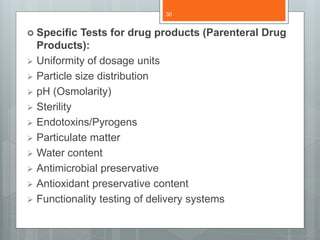
 Specific Tests for drug products (Parenteral Drug
Products):
 Uniformity of dosage units
 Particle size distribution
 pH (Osmolarity)
 Sterility
 Endotoxins/Pyrogens
 Particulate matter
 Water content
 Antimicrobial preservative
 Antioxidant preservative content
 Functionality testing of delivery systems
30
Q6B: Specifications : Test Procedures and Acceptance
Criteria for Biotechnological/Biological Products
 This document provides guidance on justifying and setting
specifications for proteins and polypeptides which are derived from
recombinant or non-recombinant cell cultures.
 A valid biological assay to measure the biological activity should be
provided by the manufacturer.
 Examples of procedures used to measure biological activity include:
1. Animal-based biological assays, which measure an organism's
biological response to the product;
2. Cell culture-based biological assays, which measure biochemical
or physiological response at the cellular level;
3. Biochemical assays, which measure biological activities such as
enzymatic reaction rates or biological responses induced by
immunological interactions.
31
Q7: Good Manufacturing Practice Guide for
API
 The main objective of this guideline is that to maintain
the quality of the active pharmaceutical ingredients
 Personnel
 Buildings and Facilities
 Process equipment
 Documentation and Records
32
Q8(R2): Pharmaceutical Development
 This guideline is intended to provide guidance on the
contents of Pharmaceutical Development of drug
products
 The aim of pharmaceutical development is to design a
quality product and its manufacturing process to
consistently deliver the intended performance of the
product.
 The Pharmaceutical Development section also
describe the type of dosage form and the formulation
that are suitable for the intended use.
 Q8 gives information about Drug Substance,
Excipients, Container Closure System.
33
Q9: Quality Risk Management
 The purpose of this document is to offer a systematic
approach to quality risk management.
 This guideline provides principles and tools for quality
risk management that can be applied to all aspects of
pharmaceutical quality including development,
manufacturing, distribution; and the inspection and
submission/review processes throughout the lifecycle
of drug substances and drug (medicinal) products,
biological and biotechnological products, including the
use of raw materials, solvents, excipients, packaging
and labeling materials.
34
PRINCIPLES OF QUALITY RISK
MANAGEMENT
 Two primary principles of quality risk management are:
1. The evaluation of the risk to quality should be based
on scientific knowledge and ultimately link to the
protection of the patient; and
2. The level of effort and documentation of the quality
risk management process should be commensurate
with the level of risk.
35
Q10: Pharmaceutical Quality System
 This document establishes a new ICH tripartite
guideline describing a model for an effective quality
management system for the pharmaceutical industry,
referred to as the Pharmaceutical Quality System.
 Comprehensive model for an effective pharmaceutical
quality system is based on International Standards
Organization (ISO) quality concepts, includes
applicable Good Manufacturing Practice (GMP)
regulations
36
Safety: S1A-S1C---- Carcinogenicity studies:
 S1A: Guideline on the Need for Carcinogenicity
Studies of Pharmaceuticals
 Carcinogenicity studies should be performed for any
pharmaceutical whose expected clinical use is
continuous for at least 6 months.
 This document provides a consistent definition of the
circumstances under which it is necessary to
undertake carcinogenicity studies on new drugs.
 These recommendations take into account the known
risk factors as well as the intended indications and
duration of exposure.
37
The objectives of carcinogenicity studies are to identify a
tumorigenic potential in animals and to assess the relevant
risk in humans.
 S1B: Testing for Carcinogenicity of Pharmaceuticals
 This document provides guidance on the need to carry out
carcinogenicity studies in both mice and rats, and guidance
is also given on alternative testing procedures which may be
applied without jeopardizing safety.
 S1C(R2): Dose Selection for Carcinogenicity Studies of
Pharmaceuticals
 This document addresses the criteria for the selection of the
high dose to be used in carcinogenicity studies on new
therapeutic agents to harmonize current practices and
improve the design of studies.
38
S2– Genotoxicity:
 S2(R1): Guidance on Genotoxicity Testing and Data
Interpretation for Pharmaceuticals Intended for
Human Use
 This guidance is a combination of ICH S2A and S2B
guidelines
 S2A: Guidance on Specific Aspects of Regulatory
Genotoxicity Tests for Pharmaceuticals;
 This document provided specific guidance and
recommendations for in vitro and in vivo tests and on
the evaluation of test results.
 It includes terms related to genotoxicity tests to
improve consistency in applications.
39
S2B: Genotoxicity
 A Standard Battery for Genotoxicity Testing for Pharmaceuticals
 This document addresses two fundamental areas of genotoxicity
testing: the identification of a standard set of assays to be conducted
for registration, and the extent of confirmatory experimentation in any
particular genotoxicity assay in the standard battery.
 Registration of pharmaceuticals requires a comprehensive
assessment of their genotoxic potential. It is clear that no single test is
capable of detecting all relevant genotoxic agents.
 Therefore, the usual approach should be to carry out a battery of in
vitro and in vivo tests for genotoxicity
 The purpose of this guideline is to optimize the standard genetic
toxicology battery for prediction of potential human risks, and for
interpretation of results, with the ultimate goal of improving risk
characterization for carcinogenic effects that have their basis in
changes in the genetic material.
40
S3A –S3B--- Toxicokinetics and Pharmacokinetics:
 S3A: Note for Guidance on Toxicokinetics: The Assessment of
Systemic Exposure in Toxicity Studies
 ICH guidelines do not require toxicokinetic studies to be conducted,
except in pregnant, lactating animals, before initiating reproductive
studies.
 In this context, toxicokinetics is defined as the generation of
pharmacokinetic data, either as an integral component in the conduct
of non-clinical toxicity studies or in specially designed supportive
studies, in order to assess systemic exposure.
 This document gives guidance on developing test strategies in
toxicokinetics and the need to integrate these pharmacokinetics into
toxicity testing, in order to aid in the interpretation of the toxicology
findings and and their relevance to clinical safety issues
 The primary objective of toxicokinetics is: to describe the systemic
exposure achieved in animals and its relationship to dose level and
the time course of the toxicity study.
41
S3B: Pharmacokinetics: Guidance for Repeated
Dose Tissue Distribution Studies
 Tissue distribution studies are essential in providing
information on distribution and accumulation of the
compound and/or metabolites, especially in relation to
potential sites of action; this information may be useful
for designing toxicology and pharmacology studies and
for interpreting the results of these experiments.
 This document gives guidance, when the repeated dose
tissue distribution studies should be considered (i.e.,
when appropriate data cannot be derived from other
sources).
 It also gives recommendations on the conduct of such
studies
42
S4: Duration of Chronic Toxicity Testing in Animals
 The objective of this guidance is to set out the considerations that
apply to chronic toxicity testing in rodents and non rodents as part
of the safety evaluation of a medicinal product
 Rodents(a study of 6 months duration)
 Non-rodents(a study of nine months duration).
S5: Detection of Toxicity to Reproduction for Medicinal Products
& Toxicity to Male Fertility
• This document provides guidance on tests for reproductive
toxicity.
• It defines the periods of treatment to be used in animals to better
reflect human exposure to medical products and allow more
specific identification of stages at risk.
• It should encourage the full assessment on the safety of chemicals
on the development of the offspring.
43
S6: Preclinical Safety Evaluation of Biotechnology-
Derived Pharmaceuticals
 This document covers the pre-clinical safety testing requirements
for biotechnological products.
 It addresses the use of animal models of disease, determination of
when genotoxicity assays and carcinogenicity studies should be
performed, and the impact of antibody formation on duration of
toxicology studies.
 The primary goals of preclinical safety evaluation are:
1) to identify an initial safe dose and subsequent dose in humans;
2) to identify potential target organs for toxicity and for the study of
whether such toxicity is reversible;
3) to identify safety parameters for clinical monitoring.
44
S7A: Safety Pharmacology Studies for Human
Pharmaceuticals
 This guideline was developed to protect clinical trial participants
and patients receiving marketed products from potential adverse
effects of pharmaceuticals
 This document addresses the definition, objectives and scope of
safety pharmacology studies.
 It also addresses which studies are needed before initiation of
Phase 1 clinical studies as well as information needed for
marketing
S7B : The Nonclinical Evaluation of the Potential for Delayed
Ventricular Repolarization (QT Interval Prolongation) By Human
Pharmaceuticals
 This guideline describes a non-clinical testing strategy for assessing the
potential of a test substance to delay ventricular repolarization.
 This guideline includes information concerning non-clinical assays and
integrated risk assessments.
45
S8 : Immunotoxicity Studies for Human Pharmaceuticals
 This guideline addresses the recommendations on
nonclinical testing for immunosuppressant.
 The guideline might also apply to drugs in which
clinical signs of immunosuppressant are observed
during clinical trials and following approval to market.
 The term immunotoxicity in this guideline will primarily
refer to immunosuppressant, i.e. a state of increased
susceptibility to infections or the development of
tumors.
46
S9: Nonclinical Evaluation for Anticancer
Pharmaceuticals
 This guideline provides information for pharmaceuticals that are
only intended to treat cancer in patients with late stage or
advanced disease regardless of the route of administration,
including both small molecule and biotechnology-derived
pharmaceuticals.
 It describes the type and timing of nonclinical studies in relation to
the development of anticancer pharmaceuticals and references
other guidance as appropriate.
 This guideline aims to facilitate and accelerate the development
of anticancer pharmaceuticals and to protect patients from
unnecessary adverse effects, while avoiding unnecessary use of
animals and other resources
47
48
Efficacy Guidelines those relating to clinical studies in
human subject
 E1-E2F---CLINICAL SAFETY:
 E1: The Extent of Population Exposure to Assess
Clinical Safety for Drugs Intended for Long- Term
Treatment of Non-Life-Threatening Conditions
 This document gives recommendations on the number
of patients and duration of exposure for the safety
evaluation of drugs intended for the long-term
treatment of non-life-threatening conditions
 This guidelines gives information on duration of drug
exposure and its relationship to both time and
magnitude of occurrence of adverse events
49
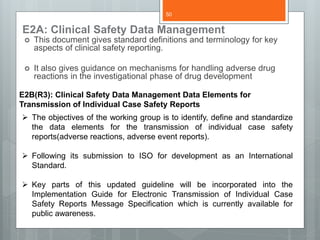
E2A: Clinical Safety Data Management
 This document gives standard definitions and terminology for key
aspects of clinical safety reporting.
 It also gives guidance on mechanisms for handling adverse drug
reactions in the investigational phase of drug development
E2B(R3): Clinical Safety Data Management Data Elements for
Transmission of Individual Case Safety Reports
 The objectives of the working group is to identify, define and standardize
the data elements for the transmission of individual case safety
reports(adverse reactions, adverse event reports).
 Following its submission to ISO for development as an International
Standard.
 Key parts of this updated guideline will be incorporated into the
Implementation Guide for Electronic Transmission of Individual Case
Safety Reports Message Specification which is currently available for
public awareness.
50
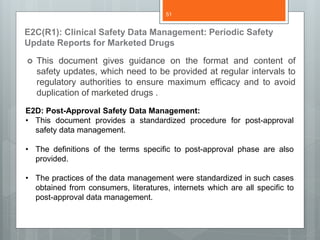
E2C(R1): Clinical Safety Data Management: Periodic Safety
Update Reports for Marketed Drugs
 This document gives guidance on the format and content of
safety updates, which need to be provided at regular intervals to
regulatory authorities to ensure maximum efficacy and to avoid
duplication of marketed drugs .
E2D: Post-Approval Safety Data Management:
• This document provides a standardized procedure for post-approval
safety data management.
• The definitions of the terms specific to post-approval phase are also
provided.
• The practices of the data management were standardized in such cases
obtained from consumers, literatures, internets which are all specific to
post-approval data management.
51
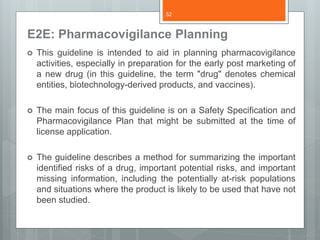
E2E: Pharmacovigilance Planning
 This guideline is intended to aid in planning pharmacovigilance
activities, especially in preparation for the early post marketing of
a new drug (in this guideline, the term "drug" denotes chemical
entities, biotechnology-derived products, and vaccines).
 The main focus of this guideline is on a Safety Specification and
Pharmacovigilance Plan that might be submitted at the time of
license application.
 The guideline describes a method for summarizing the important
identified risks of a drug, important potential risks, and important
missing information, including the potentially at-risk populations
and situations where the product is likely to be used that have not
been studied.
52
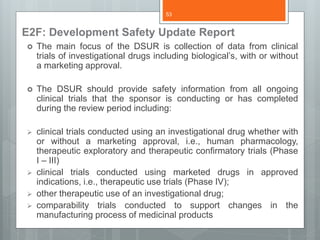
E2F: Development Safety Update Report
 The main focus of the DSUR is collection of data from clinical
trials of investigational drugs including biological’s, with or without
a marketing approval.
 The DSUR should provide safety information from all ongoing
clinical trials that the sponsor is conducting or has completed
during the review period including:
 clinical trials conducted using an investigational drug whether with
or without a marketing approval, i.e., human pharmacology,
therapeutic exploratory and therapeutic confirmatory trials (Phase
I – III)
 clinical trials conducted using marketed drugs in approved
indications, i.e., therapeutic use trials (Phase IV);
 other therapeutic use of an investigational drug;
 comparability trials conducted to support changes in the
manufacturing process of medicinal products
53
E3: Structure and Content of Clinical Study Reports
 This document describes the format and content of a study report
that will be acceptable in all three ICH regions.
 It consists of a core report suitable for all submissions and
appendices.
 The clinical study report described in this guideline is an
integrated full report of an individual study of any therapeutic,
prophylactic or diagnostic agent (referred to herein as drug or
treatment) conducted in patients.
 The guideline is intended to assist sponsors for the development
of a report that is complete, free from ambiguity, well organized
and easy to review
54
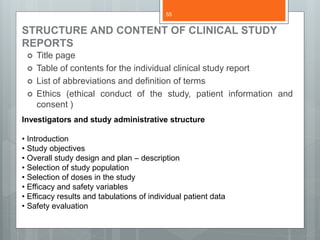
STRUCTURE AND CONTENT OF CLINICAL STUDY
REPORTS
 Title page
 Table of contents for the individual clinical study report
 List of abbreviations and definition of terms
 Ethics (ethical conduct of the study, patient information and
consent )
Investigators and study administrative structure
• Introduction
• Study objectives
• Overall study design and plan – description
• Selection of study population
• Selection of doses in the study
• Efficacy and safety variables
• Efficacy results and tabulations of individual patient data
• Safety evaluation
55
E4: Dose-Response Information to Support Drug
Registration
 This document gives recommendations on the design and conduct of
studies to assess the relationship between doses, blood levels and
clinical response throughout the clinical development of a new drug.
 This information can help in identifying an appropriate starting dose, to
adjust dosage to the needs of a particular patient, and a dose beyond
which unacceptable side effects are seen.
E5(R1): Ethnic Factors in the Acceptability of Foreign Clinical Data
• The purpose of this guidance is to facilitate the registration of medicines
among ICH regions.
• This document addresses the intrinsic characteristics of the drug recipient
and extrinsic characteristics associated with environment and culture that
could affect the results of clinical studies carried out in regions
• Describes the concept of the "bridging study" that a new region may
request to determine whether data from another region are applicable to its
population.
56
E6(R1): Good Clinical Practice : Consolidated
Guideline
 Good Clinical Practice (GCP) is an international ethical and
scientific quality standard for designing, conducting, recording
and reporting trials that involve the participation of human
subjects.
 This Good Clinical Practices document describes the
responsibilities and expectations of all participants in the conduct
of clinical trials, including investigators, monitors, sponsors .
 GCPs cover aspects of monitoring, reporting and achieving of
clinical trials and incorporating these into Essential Documents
and on the Investigator's Brochure.
57
E7-E11----CLINICAL TRIALS:
 E7: Studies in Support of Special Populations :
Geriatrics
 This document provides recommendations on the special
considerations which apply in the design and conduct of clinical
trials of medicines that are likely to have significant use in the
elderly.
 E.g.: New Molecular Entities that are likely to have significant use
in the elderly, because the disease intended to be treated is
characteristically a disease of ageing ( e.g., Alzheimer's disease)
58
E8: General Considerations for Clinical Trials
 This document sets out the general scientific principles for the
conduct, performance and control of clinical trials.
 The guideline addresses a wide range of subjects in the design
and execution of clinical trials.
 The ICH document "General Considerations for Clinical Trials" is
intended to:
 (a)describe internationally accepted principles and practices in the
conduct of both individual clinical trials and overall development
strategy for new medicinal products
 (b) facilitate the evaluation and acceptance of foreign clinical trial
data by promoting common understanding of general principles
 c) present an overview of the ICH clinical safety and efficacy
documents and facilitate the user's access to guidance
 (d) provide a separate glossary of terms used in the ICH clinical
safety and efficacy related documents that pertain to clinical trials
59
E9: Statistical Principles for Clinical
Trials
 This biostatistical guideline describes essential considerations on
the design and analysis of clinical trials, especially the
"confirmatory" (hypothesis-testing) trials that are the basis for
demonstrating effectiveness.
E10: Choice of Control Group and Related Issues in Clinical
Trials
• This document addresses the choice of control groups in clinical trials.
• Control groups in clinical trials can be classified on the basis of two critical
attributes:
(1) the type of treatment used and
(2) the method of determining who will be in the control group. •
The type of control treatment may be any of the following four:
(1) placebo, (2) no treatment,
(3) different dose or regimen of the study treatment,
or (4) a different active treatment.
60
E11: Clinical Investigation of Medicinal Products in the
Pediatric Population
 This document addresses the conduct of clinical trials of medicines
in pediatric populations.
 This document will facilitate the development of safe and effective
use of medicinal product in pediatrics.
 Specific clinical study include:
(1) timing of initiation of pediatric studies during medicinal product
development;
(2) types of studies (pharmacokinetic, pharmacokinetic/
pharmacodynamic (PK/PD), efficacy, safety);
(3) age categories;
(4) ethics of pediatric clinical investigation.
61
E12-Guidelines for Clinical Evaluation by Therapeutic
Category
The ICH Efficacy Guidelines are applicable to all therapeutic classes
of drugs, but there are some therapeutic classes which need
individual drug evaluation guidelines among the three regions.
E13: Principles for Clinical Evaluation of New Antihypertensive Drugs
• This document provides general principles for the clinical
evaluation of new anti-hypertensive drugs.
• It describes core principles for the evaluation of antihypertensives
that are accepted in the three ICH regions, but some region-
specific differences remain, therefore this document should be
considered an "ICH Principle Document" rather than an "ICH
Guideline".
62
 E14: The Clinical Evaluation of QT/QTc Interval
Prolongation and Pro-Arrhythmic Potential for Non-
Antiarrhythmic Drugs
 This document provides recommendations to sponsors
concerning the design, conduct, analysis, and interpretation of
clinical studies to assess the potential of a drug to delay cardiac
repolarization.
 This assessment should include testing the effects of new agents
on the QT/QTc interval as well as the collection of cardiovascular
adverse events.
 The investigational approach used for a particular drug should be
individualized, depending on the pharmacodynamic,
pharmacokinetic, and safety characteristics of the product, as well
as on its proposed clinical use.
63
 E15: Definitions for Genomic Biomarkers,
Pharmacogenomics, Pharmacogenetics, Genomic
Data and Sample Coding Categories
 In order to develop harmonised approaches to drug regulation, it is
important to ensure that consistent definitions of terminology are
being applied across all constituents of the ICH.
 An agreement on definitions will facilitate the harmonization in the
discipline of pharmacogenomics and pharmacogenetics for global
drug development and approval processes.
64
 E16: Genomic Biomarkers Related to Drug
Response: Context, Structure and Format of
Qualification Submissions
 The guideline describes recommendations regarding context,
structure, and format of regulatory submissions for qualification of
genomic biomarkers(E15).
 clinical and non-clinical genomic biomarkers related to drug
response including pharmacokinetics, pharmacodynamics,
efficacy and safety aspects.
65
Multidisciplinary Guidelines "Multidisciplinary" Topics, i.e.,
Topics which do not fit uniquely into one of the above
categories (MedDRA, ESTRI, M3, CTD, M5)
 M1 Medical Terminology
 New Medical Dictionary for Regulatory Activities Terminology
(MedDRA) was developed by the working group of ICH and is
owned by the International Federation of Pharmaceutical
Manufacturers and Associations (IFPMA) acting as trustee for the
ICH steering committee.
 It provides an international medical dictionary applicable to all
phases of product development.
 Its goal is to provide a comprehensive and specific terminology to
help standardize, facilitate and simplify regulatory processes.
66
M2 Electronic Standards for Transmission of
Regulatory Information (ESTRI)
 Facilitate international electronic communication by
evaluating and recommending the specifications
 The first Specification developed by the M2 EWG was the
Individual Case Safety Report (ICSR), created as the
electronic message for the ICH E2B(R2)
 The second Specification developed by the M2 EWG was
the Electronic Common Technical Document (eCTD) created
as the electronic message for the Common Technical
Document developed by the ICH M4.
 ICH M2 has initiated the development of the Next Major
Version of the eCTD (eCTD NMV) to improve robustness,
flexibility and long term stability of the message.
67
M3(R2): Guidance on Non-Clinical Safety Studies for the
Conduct of Human Clinical Trials and Marketing Authorization
for Pharmaceuticals
 The present guidance represents the consensus that exists
regarding the type and duration of nonclinical safety studies and
their timing to support the conduct of human clinical trials and
marketing authorization for pharmaceuticals.
 The nonclinical safety assessment for marketing approval of a
pharmaceutical usually includes pharmacology studies, general
toxicity studies, toxicokinetic and nonclinical pharmacokinetic
studies, reproduction toxicity studies, genotoxicity studies and, for
drugs that have special cause for concern or are intended for a
long duration of use
68
• The goals of the nonclinical safety evaluation generally include a
characterisation of toxic effects with respect to target organs, dose
dependence, relationship to exposure, and, when
appropriate,potential reversibility.
• This information is used to estimate an initial safe starting dose
and dose range for the human trials and to identify parameters for
clinical monitoring for potential adverse effects.
69
M4:The Common Technical Document (CTD)
 The CTD provides a harmonised structure and format for new
product applications.
 The CTD was agreed upon in November 2000 in San Diego, USA.
 This CTD is divided into four separate sections.
 The four sections address the application organisation (M4
organise), the Quality section (M4Q), the Safety section (M4S)
and the Efficacy section (M4E) of the harmonised application.
 An electronic version of the CTD (eCTD) developed by the eCTD
Implementation Working Group.
 The eCTD allows for the electronic submission of the Common
Technical Document by an applicant to regulator
70
M5: Data Elements and Standards for Drug
Dictionaries
 This document provides guidance on the harmonized standards
related to core sets of medicinal product information and medicinal
product terminology.
 Facilitate the exchange and practical use of medicinal product
data by regulators and pharmaceutical industry.
71

ICH GUIDELINES.REGULATORY AFFAIRS...pptx

  • 1.
  • 2.
     ICH isthe “International Conference on Harmonization of Technical Requirements for Registration of Pharmaceuticals for Human Use”.  ICH is a joint initiative involving both regulators and research-based industry representatives of the EU, Japan and the US in scientific and technical discussions of the testing procedures required to assess and ensure the safety, quality and efficacy of medicines. 2
  • 3.
    Objectives of ICH To increase international harmonization of technical requirements to ensure that safe, effective and high quality medicines are developed.  To harmonize technical requirements for registration or marketing approval.  To develop and register pharmaceuticals in the most efficient and cost effective manner.  To promote public health.  To prevent unnecessary duplication of clinical trials on humans.  To minimize the use of animal testing without compromising safety and effectiveness of drug. 3
  • 4.
    ICH location The ICHSecretariat is based in Geneva. The biennial meetings and conferences of the ICH Steering Committee rotate between the EU, Japan, and the USA. 4
  • 5.
    Goal of ICH To promote international harmonization by bringing together representatives from the three ICH regions (EU, Japan and USA)  To discuss and establish common guidelines.  To make information available on ICH, ICH activities and ICH guidelines to any country or company that requests the information  To promote a mutual understanding of regional initiatives in order to facilitate harmonization processes related to ICH guidelines regionally and globally  To strengthen the capacity of drug regulatory authorities and industry to utilize them. 5
  • 6.
    Members of ICH ICH is comprised of representatives from six parties that represent the regulatory bodies and research-based industry in the European Union, Japan and the USA.  In Japan, the members are the Ministry of Health, Labour and Welfare (MHLW), and the Japan Pharmaceutical Manufacturers Association (JPMA).  In Europe, the members are the European Union (EU), and the European Federation of Pharmaceutical Industries and Associations (EFPIA).  In the USA, the members are the Food and Drug Administration (FDA), and the Pharmaceutical Research and Manufacturers of America (PhRMA).  Additional members include Observers from the World Health Organization (WHO), European Free Trade Association (EFTA), and Canada. The Observers represent non-ICH countries and regions. 6
  • 7.
    ICH structure  TheICH structure consists of the ICH Steering Committee, ICH Coordinators, ICH Secretariat and ICH Working Groups.  ICH Steering Committee: The Steering Committee is the body that governs the ICH, determines the policies and procedures for ICH, selects topics for harmonization and monitors the progress of harmonization initiatives.  Each of the six ICH parties has two seats on the ICH Steering Committee.  ICH Coordinators: The Coordinators are fundamental to the smooth running of the ICH and are nominated by each of the six parties.  An ICH Coordinator acts as the main contact point with the ICH Secretariat. 7
  • 8.
     ICH Secretariat:The Secretariat is primarily concerned with preparations for, and documentation of, meetings of the Steering Committee as well as coordination of preparations for Working Group and Discussion Group meetings.  Information on ICH Guidelines and the general ICH process can be obtained from the ICH Secretariat.  ICH Working Group: Depending on the type of harmonization activity needed, the Steering Committee will endorse the establishment of one of three types of working group i.e., Expert Working Group (EWG), Implementation Working Group (IWG) or Informal Working Group. 8
  • 9.
    ICH OPERATION  ICHoperates through ICH Steering Committee with administrative support from ICH Secretariat and ICH Coordinators.  The Steering Committee meets at least twice a year .  During these meetings, new topics will be considered for adoption, reports are received on the progress of existing topics, and maintenance and implementation of the guidelines are discussed.  The topics identified for harmonization by the Steering Committee are selected from Safety, Quality, Efficacy, and Multidisciplinary matters. 9
  • 10.
    Steps in theICH process  Step-1: Drafts are prepared and circulated through many revisions until a "final harmonised draft" is completed.  Step-2: This draft is signed by the EWG as the agreed-upon draft and forwarded to the Steering Committee for signing which signifies acceptance for consultation by each of the six co-sponsors.  Step-3: The three regulatory sponsors initiate their normal consultation process to receive comments. 10
  • 11.
     Step-4 isreached when the Steering Committee agrees that there is sufficient scientific consensus on the technical issues. This endorsement is based on the signatures from the three regulatory parties to ICH affirming that the Guideline is recommended for adoption by the regulatory bodies of the three regions.  Step-5: The process is complete when the guidelines are incorporated into national or regional internal procedures(implementation in the 3 ICH regions.) 11
  • 12.
  • 13.
    Q1A-Q1F---STABILITY:  Q1A (R2):Stability Testing of New Drug Substances and Products  The purpose of stability testing is to provide evidence on how the quality of a drug substance or drug product varies with time under the influence of a variety of environmental factors such as temperature, humidity, and light, and to establish a re-test period for the drug substance or a shelf life for the drug product.  Q1B: Photostability Testing of New Drug Substances and Products  Give guidance on the basic testing protocol required to evaluate the light sensitivity and stability of new drugs and products 13
  • 14.
     Q1C: StabilityTesting for New Dosage Forms  Gives guidelines for new formulations of already approved medicines and defines the circumstances under which reduced stability data can be accepted.  Q1D: Bracketing and Matrixing Designs for Stability Testing of New Drug Substances and Products  Q1E: Evaluation of Stability Data  This guideline addresses the evaluation of stability data that should be submitted in registration applications for new molecular entities and associated drug products.  The guideline provides recommendations on establishing shelf lives for drug substances and drug products intended for storage at or below “room temperature”. 14
  • 15.
     Q1F: StabilityData Package for Registration Applications in Climatic Zones III and IV  Describes harmonised global stability testing requirements in order to facilitate access to medicines by reducing the number of different storage conditions.  WHO conducted a survey amongst their member states to find consensus on 30°C/65% RH as the long-term storage conditions for hot-dry and hot- humid regions. 15
  • 16.
    Q2-Analytical validation  Q2(R1):Validation of Analytical Procedures: Text and Methodology  The objective of validation of an analytical procedure is to demonstrate that it is suitable for its intended purpose  Gives validation parameters needed for a variety of analytical methods.  It also discusses the characteristics that must be considered during the validation of the analytical procedures 16
  • 17.
    Types of AnalyticalProcedures to be validated are:  Identification tests  Quantitative tests for impurities content  Limit tests for the control of impurities  Quantitative tests of the active moiety in samples of drug substance or drug product or other selected components in the drug product.  Typical validation characteristics of analytical procedures Accuracy, Precision(Repeatability, Intermediate Precision), Specificity, Detection Limit, Quantitation Limit, Linearity, Range. 17
  • 18.
    Q3A- Q3D----Impurities  Q3A(R2):Impurities in New Drug Substances  The guideline addresses the chemistry and safety aspects of impurities, including the listing of impurities, threshold limit, identification and quantification.  Classification of Impurities: are of 3 types 1. Organic impurities (process- and drug-related) 2. Inorganic impurities 3. Residual solvents 18
  • 19.
     Q3B(R2): Impuritiesin New Drug Products  Q3C(R4): Impurities: Guideline for Residual Solvents 1. Benzene 2ppm 2. Carbon tetrachloride 4ppm 3. Dichloromethane 5ppm 4. Dichloroethane 8ppm 5. Acetonitrile 410ppm 6. Chloroform 60ppm 7. Chlorobenzene 360ppm 8. Formamide, Hexane 290ppm 9. Toulene 890ppm 10. Pyridine 200pm 11. Nitromethane 50ppm 12. Methanol 3000ppm 19
  • 20.
    Q4: Pharmacopoeias  Q4A:Pharmacopoeial Harmonisation  Q4B: Evaluation and Recommendation of Pharmacopoeial Texts for Use in the ICH Regions  This document describes a process for the evaluation and recommendation given by the Q4B Expert Working Group (EWG) for selecting pharmacopoeial texts to facilitate their recognition by regulatory authorities for use, interchangeable in the ICH regions. 20
  • 21.
    Q4B  Annex 1:Evaluation and Recommendation of Pharmacopoeial Texts for Use in the ICH Regions on Residue on Ignition/Sulphated Ash  Annex 2:Test for Extractable Volume of Parenteral Preparations  Annex 3: Test for Particulate Contamination: Sub-Visible Particles  Annex 4A: Microbiological Examination of Non-Sterile Products: Microbial Enumeration Tests  Annex 4B: Microbiological Examination of Non-Sterile Products: Tests for Specified Micro- organisms  Annex 4C: Microbiological Examination of Non-Sterile Products: Acceptance Criteria for Pharmaceutical Preparations and Substances for Pharmaceutical Use  Annex 5:Disintegration Test  Annex 6: Uniformity of Dosage Units  Annex 7: Dissolution Test  Annex 8: Sterility Test  Annex 9: Tablet Friability  Annex 10: Polyacrylamide Gel Electrophoresis  Annex 11: Capillary Electrophoresis  Annex 12: Analytical Sieving  Annex 13: Bulk Density and Tapped Density of Powders  Annex14 :Bacterial Endotoxins Test 21
  • 22.
    Q5A-Q5E---Quality of biotechnologicalproducts  Q5A(R1): Viral Safety Evaluation of Biotechnology Products Derived from Cell Lines of Human or Animal Origin  This document is concerned with testing and evaluation of the viral safety of biotechnology products derived from cell lines of human or animal origin (i.e., mammalian, avian, insect)  The objective is to provide a general framework for virus testing experiments for the evaluation of virus clearance and the design of viral tests and clearance evaluation studies. 22
  • 23.
     Three principal,complementary approaches have evolved to control the potential viral contamination of biotechnology products: a) selecting and testing cell lines and other raw materials, including media components, for the absence of undesirable viruses which may be infectious and/or pathogenic for humans; b) Testing the capacity of the processes to clear infectious viruses; c) testing the product at appropriate steps for absence of contaminating infectious viruses. 23
  • 24.
     Q5B: Qualityof Biotechnological Products : Analysis of the Expression Construct in Cells Used for Production of r-DNA Derived Protein Products  This document presents guidance regarding the characterization of the expression construct for the production of recombinant DNA protein products in eukaryotic and prokaryotic cells.  Q5C: Quality of Biotechnological Products  Stability Testing of Biotechnological/Biological Products  Q5D: Derivation and Characterisation of Cell Substrates Used for Production of Biotechnological/Biological Products •  The objective of this guideline is to provide broad guidance on appropriate standards for cell substrates. 24
  • 25.
     Q5E: Comparabilityof Biotechnological/ Biological Products Subject to Changes in Their Manufacturing Process  The objective of this document is to provide principles for assessing the comparability of biotechnological/ biological products before and after changes are made in the manufacturing process for the drug substance or drug product.  Therefore, this guideline is intended to assist in the collection of relevant technical information which serves as evidence that the manufacturing process changes will not have an adverse impact on the quality, safety and efficacy of the drug product. 25
  • 26.
    Q6 : Specificationsfor New Drug Substances and Products  Bulk drug substance and final product specifications are key parts of the core documentation for world- wide product license applications.  This leads to conflicting standards for the same product, increased expenses and opportunities for error as well as a potential cause for interruption of product supply. 26
  • 27.
    Q6A: Specifications :Test Procedures and Acceptance Criteria for New Drug Substances and New Drug Products : Chemical Substances  The main objective of this guideline is to establish a single set of global specifications for new drug substances and new drug products.  A specification is defined as a list of tests, references to analytical procedures, and appropriate acceptance criteria, which are numerical limits, ranges.  This guideline addresses specifications, i.e., those tests, procedures, and acceptance criteria which play a major role in assuring the quality of the new drug substance and new drug product during shelf life. 27
  • 28.
    Universal Tests:  Thefollowing tests are considered generally applicable to all new drug substances and drug products.  Description  Identification  Assay  Impurities  Specific Tests for drug substances :  Physicochemical properties  Particle size  Polymorphic forms  Tests for chiral new drug substances  Water content  Inorganic impurities  Microbial limits 28
  • 29.
     Specific Testsfor drug products(oral dosage form): 1. Particle size distribution 2. Dissolution. 3. Disintegration 4. Hardness/friability 5. Uniformity of dosage units 6. Microbial limits 7. Antioxidant preservative content 8. Alcohol content 9. Rheological properties 10. Redispersibility 29
  • 30.
     Specific Testsfor drug products (Parenteral Drug Products):  Uniformity of dosage units  Particle size distribution  pH (Osmolarity)  Sterility  Endotoxins/Pyrogens  Particulate matter  Water content  Antimicrobial preservative  Antioxidant preservative content  Functionality testing of delivery systems 30
  • 31.
    Q6B: Specifications :Test Procedures and Acceptance Criteria for Biotechnological/Biological Products  This document provides guidance on justifying and setting specifications for proteins and polypeptides which are derived from recombinant or non-recombinant cell cultures.  A valid biological assay to measure the biological activity should be provided by the manufacturer.  Examples of procedures used to measure biological activity include: 1. Animal-based biological assays, which measure an organism's biological response to the product; 2. Cell culture-based biological assays, which measure biochemical or physiological response at the cellular level; 3. Biochemical assays, which measure biological activities such as enzymatic reaction rates or biological responses induced by immunological interactions. 31
  • 32.
    Q7: Good ManufacturingPractice Guide for API  The main objective of this guideline is that to maintain the quality of the active pharmaceutical ingredients  Personnel  Buildings and Facilities  Process equipment  Documentation and Records 32
  • 33.
    Q8(R2): Pharmaceutical Development This guideline is intended to provide guidance on the contents of Pharmaceutical Development of drug products  The aim of pharmaceutical development is to design a quality product and its manufacturing process to consistently deliver the intended performance of the product.  The Pharmaceutical Development section also describe the type of dosage form and the formulation that are suitable for the intended use.  Q8 gives information about Drug Substance, Excipients, Container Closure System. 33
  • 34.
    Q9: Quality RiskManagement  The purpose of this document is to offer a systematic approach to quality risk management.  This guideline provides principles and tools for quality risk management that can be applied to all aspects of pharmaceutical quality including development, manufacturing, distribution; and the inspection and submission/review processes throughout the lifecycle of drug substances and drug (medicinal) products, biological and biotechnological products, including the use of raw materials, solvents, excipients, packaging and labeling materials. 34
  • 35.
    PRINCIPLES OF QUALITYRISK MANAGEMENT  Two primary principles of quality risk management are: 1. The evaluation of the risk to quality should be based on scientific knowledge and ultimately link to the protection of the patient; and 2. The level of effort and documentation of the quality risk management process should be commensurate with the level of risk. 35
  • 36.
    Q10: Pharmaceutical QualitySystem  This document establishes a new ICH tripartite guideline describing a model for an effective quality management system for the pharmaceutical industry, referred to as the Pharmaceutical Quality System.  Comprehensive model for an effective pharmaceutical quality system is based on International Standards Organization (ISO) quality concepts, includes applicable Good Manufacturing Practice (GMP) regulations 36
  • 37.
    Safety: S1A-S1C---- Carcinogenicitystudies:  S1A: Guideline on the Need for Carcinogenicity Studies of Pharmaceuticals  Carcinogenicity studies should be performed for any pharmaceutical whose expected clinical use is continuous for at least 6 months.  This document provides a consistent definition of the circumstances under which it is necessary to undertake carcinogenicity studies on new drugs.  These recommendations take into account the known risk factors as well as the intended indications and duration of exposure. 37
  • 38.
    The objectives ofcarcinogenicity studies are to identify a tumorigenic potential in animals and to assess the relevant risk in humans.  S1B: Testing for Carcinogenicity of Pharmaceuticals  This document provides guidance on the need to carry out carcinogenicity studies in both mice and rats, and guidance is also given on alternative testing procedures which may be applied without jeopardizing safety.  S1C(R2): Dose Selection for Carcinogenicity Studies of Pharmaceuticals  This document addresses the criteria for the selection of the high dose to be used in carcinogenicity studies on new therapeutic agents to harmonize current practices and improve the design of studies. 38
  • 39.
    S2– Genotoxicity:  S2(R1):Guidance on Genotoxicity Testing and Data Interpretation for Pharmaceuticals Intended for Human Use  This guidance is a combination of ICH S2A and S2B guidelines  S2A: Guidance on Specific Aspects of Regulatory Genotoxicity Tests for Pharmaceuticals;  This document provided specific guidance and recommendations for in vitro and in vivo tests and on the evaluation of test results.  It includes terms related to genotoxicity tests to improve consistency in applications. 39
  • 40.
    S2B: Genotoxicity  AStandard Battery for Genotoxicity Testing for Pharmaceuticals  This document addresses two fundamental areas of genotoxicity testing: the identification of a standard set of assays to be conducted for registration, and the extent of confirmatory experimentation in any particular genotoxicity assay in the standard battery.  Registration of pharmaceuticals requires a comprehensive assessment of their genotoxic potential. It is clear that no single test is capable of detecting all relevant genotoxic agents.  Therefore, the usual approach should be to carry out a battery of in vitro and in vivo tests for genotoxicity  The purpose of this guideline is to optimize the standard genetic toxicology battery for prediction of potential human risks, and for interpretation of results, with the ultimate goal of improving risk characterization for carcinogenic effects that have their basis in changes in the genetic material. 40
  • 41.
    S3A –S3B--- Toxicokineticsand Pharmacokinetics:  S3A: Note for Guidance on Toxicokinetics: The Assessment of Systemic Exposure in Toxicity Studies  ICH guidelines do not require toxicokinetic studies to be conducted, except in pregnant, lactating animals, before initiating reproductive studies.  In this context, toxicokinetics is defined as the generation of pharmacokinetic data, either as an integral component in the conduct of non-clinical toxicity studies or in specially designed supportive studies, in order to assess systemic exposure.  This document gives guidance on developing test strategies in toxicokinetics and the need to integrate these pharmacokinetics into toxicity testing, in order to aid in the interpretation of the toxicology findings and and their relevance to clinical safety issues  The primary objective of toxicokinetics is: to describe the systemic exposure achieved in animals and its relationship to dose level and the time course of the toxicity study. 41
  • 42.
    S3B: Pharmacokinetics: Guidancefor Repeated Dose Tissue Distribution Studies  Tissue distribution studies are essential in providing information on distribution and accumulation of the compound and/or metabolites, especially in relation to potential sites of action; this information may be useful for designing toxicology and pharmacology studies and for interpreting the results of these experiments.  This document gives guidance, when the repeated dose tissue distribution studies should be considered (i.e., when appropriate data cannot be derived from other sources).  It also gives recommendations on the conduct of such studies 42
  • 43.
    S4: Duration ofChronic Toxicity Testing in Animals  The objective of this guidance is to set out the considerations that apply to chronic toxicity testing in rodents and non rodents as part of the safety evaluation of a medicinal product  Rodents(a study of 6 months duration)  Non-rodents(a study of nine months duration). S5: Detection of Toxicity to Reproduction for Medicinal Products & Toxicity to Male Fertility • This document provides guidance on tests for reproductive toxicity. • It defines the periods of treatment to be used in animals to better reflect human exposure to medical products and allow more specific identification of stages at risk. • It should encourage the full assessment on the safety of chemicals on the development of the offspring. 43
  • 44.
    S6: Preclinical SafetyEvaluation of Biotechnology- Derived Pharmaceuticals  This document covers the pre-clinical safety testing requirements for biotechnological products.  It addresses the use of animal models of disease, determination of when genotoxicity assays and carcinogenicity studies should be performed, and the impact of antibody formation on duration of toxicology studies.  The primary goals of preclinical safety evaluation are: 1) to identify an initial safe dose and subsequent dose in humans; 2) to identify potential target organs for toxicity and for the study of whether such toxicity is reversible; 3) to identify safety parameters for clinical monitoring. 44
  • 45.
    S7A: Safety PharmacologyStudies for Human Pharmaceuticals  This guideline was developed to protect clinical trial participants and patients receiving marketed products from potential adverse effects of pharmaceuticals  This document addresses the definition, objectives and scope of safety pharmacology studies.  It also addresses which studies are needed before initiation of Phase 1 clinical studies as well as information needed for marketing S7B : The Nonclinical Evaluation of the Potential for Delayed Ventricular Repolarization (QT Interval Prolongation) By Human Pharmaceuticals  This guideline describes a non-clinical testing strategy for assessing the potential of a test substance to delay ventricular repolarization.  This guideline includes information concerning non-clinical assays and integrated risk assessments. 45
  • 46.
    S8 : ImmunotoxicityStudies for Human Pharmaceuticals  This guideline addresses the recommendations on nonclinical testing for immunosuppressant.  The guideline might also apply to drugs in which clinical signs of immunosuppressant are observed during clinical trials and following approval to market.  The term immunotoxicity in this guideline will primarily refer to immunosuppressant, i.e. a state of increased susceptibility to infections or the development of tumors. 46
  • 47.
    S9: Nonclinical Evaluationfor Anticancer Pharmaceuticals  This guideline provides information for pharmaceuticals that are only intended to treat cancer in patients with late stage or advanced disease regardless of the route of administration, including both small molecule and biotechnology-derived pharmaceuticals.  It describes the type and timing of nonclinical studies in relation to the development of anticancer pharmaceuticals and references other guidance as appropriate.  This guideline aims to facilitate and accelerate the development of anticancer pharmaceuticals and to protect patients from unnecessary adverse effects, while avoiding unnecessary use of animals and other resources 47
  • 48.
  • 49.
    Efficacy Guidelines thoserelating to clinical studies in human subject  E1-E2F---CLINICAL SAFETY:  E1: The Extent of Population Exposure to Assess Clinical Safety for Drugs Intended for Long- Term Treatment of Non-Life-Threatening Conditions  This document gives recommendations on the number of patients and duration of exposure for the safety evaluation of drugs intended for the long-term treatment of non-life-threatening conditions  This guidelines gives information on duration of drug exposure and its relationship to both time and magnitude of occurrence of adverse events 49
  • 50.
    E2A: Clinical SafetyData Management  This document gives standard definitions and terminology for key aspects of clinical safety reporting.  It also gives guidance on mechanisms for handling adverse drug reactions in the investigational phase of drug development E2B(R3): Clinical Safety Data Management Data Elements for Transmission of Individual Case Safety Reports  The objectives of the working group is to identify, define and standardize the data elements for the transmission of individual case safety reports(adverse reactions, adverse event reports).  Following its submission to ISO for development as an International Standard.  Key parts of this updated guideline will be incorporated into the Implementation Guide for Electronic Transmission of Individual Case Safety Reports Message Specification which is currently available for public awareness. 50
  • 51.
    E2C(R1): Clinical SafetyData Management: Periodic Safety Update Reports for Marketed Drugs  This document gives guidance on the format and content of safety updates, which need to be provided at regular intervals to regulatory authorities to ensure maximum efficacy and to avoid duplication of marketed drugs . E2D: Post-Approval Safety Data Management: • This document provides a standardized procedure for post-approval safety data management. • The definitions of the terms specific to post-approval phase are also provided. • The practices of the data management were standardized in such cases obtained from consumers, literatures, internets which are all specific to post-approval data management. 51
  • 52.
    E2E: Pharmacovigilance Planning This guideline is intended to aid in planning pharmacovigilance activities, especially in preparation for the early post marketing of a new drug (in this guideline, the term "drug" denotes chemical entities, biotechnology-derived products, and vaccines).  The main focus of this guideline is on a Safety Specification and Pharmacovigilance Plan that might be submitted at the time of license application.  The guideline describes a method for summarizing the important identified risks of a drug, important potential risks, and important missing information, including the potentially at-risk populations and situations where the product is likely to be used that have not been studied. 52
  • 53.
    E2F: Development SafetyUpdate Report  The main focus of the DSUR is collection of data from clinical trials of investigational drugs including biological’s, with or without a marketing approval.  The DSUR should provide safety information from all ongoing clinical trials that the sponsor is conducting or has completed during the review period including:  clinical trials conducted using an investigational drug whether with or without a marketing approval, i.e., human pharmacology, therapeutic exploratory and therapeutic confirmatory trials (Phase I – III)  clinical trials conducted using marketed drugs in approved indications, i.e., therapeutic use trials (Phase IV);  other therapeutic use of an investigational drug;  comparability trials conducted to support changes in the manufacturing process of medicinal products 53
  • 54.
    E3: Structure andContent of Clinical Study Reports  This document describes the format and content of a study report that will be acceptable in all three ICH regions.  It consists of a core report suitable for all submissions and appendices.  The clinical study report described in this guideline is an integrated full report of an individual study of any therapeutic, prophylactic or diagnostic agent (referred to herein as drug or treatment) conducted in patients.  The guideline is intended to assist sponsors for the development of a report that is complete, free from ambiguity, well organized and easy to review 54
  • 55.
    STRUCTURE AND CONTENTOF CLINICAL STUDY REPORTS  Title page  Table of contents for the individual clinical study report  List of abbreviations and definition of terms  Ethics (ethical conduct of the study, patient information and consent ) Investigators and study administrative structure • Introduction • Study objectives • Overall study design and plan – description • Selection of study population • Selection of doses in the study • Efficacy and safety variables • Efficacy results and tabulations of individual patient data • Safety evaluation 55
  • 56.
    E4: Dose-Response Informationto Support Drug Registration  This document gives recommendations on the design and conduct of studies to assess the relationship between doses, blood levels and clinical response throughout the clinical development of a new drug.  This information can help in identifying an appropriate starting dose, to adjust dosage to the needs of a particular patient, and a dose beyond which unacceptable side effects are seen. E5(R1): Ethnic Factors in the Acceptability of Foreign Clinical Data • The purpose of this guidance is to facilitate the registration of medicines among ICH regions. • This document addresses the intrinsic characteristics of the drug recipient and extrinsic characteristics associated with environment and culture that could affect the results of clinical studies carried out in regions • Describes the concept of the "bridging study" that a new region may request to determine whether data from another region are applicable to its population. 56
  • 57.
    E6(R1): Good ClinicalPractice : Consolidated Guideline  Good Clinical Practice (GCP) is an international ethical and scientific quality standard for designing, conducting, recording and reporting trials that involve the participation of human subjects.  This Good Clinical Practices document describes the responsibilities and expectations of all participants in the conduct of clinical trials, including investigators, monitors, sponsors .  GCPs cover aspects of monitoring, reporting and achieving of clinical trials and incorporating these into Essential Documents and on the Investigator's Brochure. 57
  • 58.
    E7-E11----CLINICAL TRIALS:  E7:Studies in Support of Special Populations : Geriatrics  This document provides recommendations on the special considerations which apply in the design and conduct of clinical trials of medicines that are likely to have significant use in the elderly.  E.g.: New Molecular Entities that are likely to have significant use in the elderly, because the disease intended to be treated is characteristically a disease of ageing ( e.g., Alzheimer's disease) 58
  • 59.
    E8: General Considerationsfor Clinical Trials  This document sets out the general scientific principles for the conduct, performance and control of clinical trials.  The guideline addresses a wide range of subjects in the design and execution of clinical trials.  The ICH document "General Considerations for Clinical Trials" is intended to:  (a)describe internationally accepted principles and practices in the conduct of both individual clinical trials and overall development strategy for new medicinal products  (b) facilitate the evaluation and acceptance of foreign clinical trial data by promoting common understanding of general principles  c) present an overview of the ICH clinical safety and efficacy documents and facilitate the user's access to guidance  (d) provide a separate glossary of terms used in the ICH clinical safety and efficacy related documents that pertain to clinical trials 59
  • 60.
    E9: Statistical Principlesfor Clinical Trials  This biostatistical guideline describes essential considerations on the design and analysis of clinical trials, especially the "confirmatory" (hypothesis-testing) trials that are the basis for demonstrating effectiveness. E10: Choice of Control Group and Related Issues in Clinical Trials • This document addresses the choice of control groups in clinical trials. • Control groups in clinical trials can be classified on the basis of two critical attributes: (1) the type of treatment used and (2) the method of determining who will be in the control group. • The type of control treatment may be any of the following four: (1) placebo, (2) no treatment, (3) different dose or regimen of the study treatment, or (4) a different active treatment. 60
  • 61.
    E11: Clinical Investigationof Medicinal Products in the Pediatric Population  This document addresses the conduct of clinical trials of medicines in pediatric populations.  This document will facilitate the development of safe and effective use of medicinal product in pediatrics.  Specific clinical study include: (1) timing of initiation of pediatric studies during medicinal product development; (2) types of studies (pharmacokinetic, pharmacokinetic/ pharmacodynamic (PK/PD), efficacy, safety); (3) age categories; (4) ethics of pediatric clinical investigation. 61
  • 62.
    E12-Guidelines for ClinicalEvaluation by Therapeutic Category The ICH Efficacy Guidelines are applicable to all therapeutic classes of drugs, but there are some therapeutic classes which need individual drug evaluation guidelines among the three regions. E13: Principles for Clinical Evaluation of New Antihypertensive Drugs • This document provides general principles for the clinical evaluation of new anti-hypertensive drugs. • It describes core principles for the evaluation of antihypertensives that are accepted in the three ICH regions, but some region- specific differences remain, therefore this document should be considered an "ICH Principle Document" rather than an "ICH Guideline". 62
  • 63.
     E14: TheClinical Evaluation of QT/QTc Interval Prolongation and Pro-Arrhythmic Potential for Non- Antiarrhythmic Drugs  This document provides recommendations to sponsors concerning the design, conduct, analysis, and interpretation of clinical studies to assess the potential of a drug to delay cardiac repolarization.  This assessment should include testing the effects of new agents on the QT/QTc interval as well as the collection of cardiovascular adverse events.  The investigational approach used for a particular drug should be individualized, depending on the pharmacodynamic, pharmacokinetic, and safety characteristics of the product, as well as on its proposed clinical use. 63
  • 64.
     E15: Definitionsfor Genomic Biomarkers, Pharmacogenomics, Pharmacogenetics, Genomic Data and Sample Coding Categories  In order to develop harmonised approaches to drug regulation, it is important to ensure that consistent definitions of terminology are being applied across all constituents of the ICH.  An agreement on definitions will facilitate the harmonization in the discipline of pharmacogenomics and pharmacogenetics for global drug development and approval processes. 64
  • 65.
     E16: GenomicBiomarkers Related to Drug Response: Context, Structure and Format of Qualification Submissions  The guideline describes recommendations regarding context, structure, and format of regulatory submissions for qualification of genomic biomarkers(E15).  clinical and non-clinical genomic biomarkers related to drug response including pharmacokinetics, pharmacodynamics, efficacy and safety aspects. 65
  • 66.
    Multidisciplinary Guidelines "Multidisciplinary"Topics, i.e., Topics which do not fit uniquely into one of the above categories (MedDRA, ESTRI, M3, CTD, M5)  M1 Medical Terminology  New Medical Dictionary for Regulatory Activities Terminology (MedDRA) was developed by the working group of ICH and is owned by the International Federation of Pharmaceutical Manufacturers and Associations (IFPMA) acting as trustee for the ICH steering committee.  It provides an international medical dictionary applicable to all phases of product development.  Its goal is to provide a comprehensive and specific terminology to help standardize, facilitate and simplify regulatory processes. 66
  • 67.
    M2 Electronic Standardsfor Transmission of Regulatory Information (ESTRI)  Facilitate international electronic communication by evaluating and recommending the specifications  The first Specification developed by the M2 EWG was the Individual Case Safety Report (ICSR), created as the electronic message for the ICH E2B(R2)  The second Specification developed by the M2 EWG was the Electronic Common Technical Document (eCTD) created as the electronic message for the Common Technical Document developed by the ICH M4.  ICH M2 has initiated the development of the Next Major Version of the eCTD (eCTD NMV) to improve robustness, flexibility and long term stability of the message. 67
  • 68.
    M3(R2): Guidance onNon-Clinical Safety Studies for the Conduct of Human Clinical Trials and Marketing Authorization for Pharmaceuticals  The present guidance represents the consensus that exists regarding the type and duration of nonclinical safety studies and their timing to support the conduct of human clinical trials and marketing authorization for pharmaceuticals.  The nonclinical safety assessment for marketing approval of a pharmaceutical usually includes pharmacology studies, general toxicity studies, toxicokinetic and nonclinical pharmacokinetic studies, reproduction toxicity studies, genotoxicity studies and, for drugs that have special cause for concern or are intended for a long duration of use 68
  • 69.
    • The goalsof the nonclinical safety evaluation generally include a characterisation of toxic effects with respect to target organs, dose dependence, relationship to exposure, and, when appropriate,potential reversibility. • This information is used to estimate an initial safe starting dose and dose range for the human trials and to identify parameters for clinical monitoring for potential adverse effects. 69
  • 70.
    M4:The Common TechnicalDocument (CTD)  The CTD provides a harmonised structure and format for new product applications.  The CTD was agreed upon in November 2000 in San Diego, USA.  This CTD is divided into four separate sections.  The four sections address the application organisation (M4 organise), the Quality section (M4Q), the Safety section (M4S) and the Efficacy section (M4E) of the harmonised application.  An electronic version of the CTD (eCTD) developed by the eCTD Implementation Working Group.  The eCTD allows for the electronic submission of the Common Technical Document by an applicant to regulator 70
  • 71.
    M5: Data Elementsand Standards for Drug Dictionaries  This document provides guidance on the harmonized standards related to core sets of medicinal product information and medicinal product terminology.  Facilitate the exchange and practical use of medicinal product data by regulators and pharmaceutical industry. 71