1
VACCINES AND ITS TYPES
Presented by- Jaskiran Kaur
2
Contents
Introduction
to Vaccines
Historical
Events
Generation of an
immune response to a
vaccine
Types of Vaccines
Introduction to
Vaccines
• A vaccine is a biological product that can be used to
safely induce an immune response that
confers protection against infection and/or disease on
subsequent exposure to a pathogen.
• To achieve this, the vaccine must contain antigens that
are either derived from the pathogen or produced
synthetically to represent components of the pathogen.
• Vaccines exploit the extraordinary ability of the highly
evolved human immune system to respond to, and
remember, encounters with pathogen antigens.
• Vaccination is possible because of adaptive immunity,
with the capacity to “remember” and respond to
specific pathogens and creates active (acquired)
immunity.
3
4
A sneak peek into the Historical events
 Vaccinology, a method of preventing smallpox, has its roots in the work of both Edward Jenner and
Benjamin Jesty. He observed that milkmaids who contracted cowpox did not contract smallpox, even after
close contact with infected individuals.
 In 1774, he inoculated his family with cowpox pustule material, the first recorded vaccination.
 Jenner, the "father of vaccinology," developed a series of experiments involving cowpox pustules,
demonstrating the protective capacity of this method.
 His work led to the formulation of the vaccine concept, which originated from the phrase "variolae
vaccinae" meaning smallpox of cows.
 Louis Pasteur, a French chemist, in 1864, proposed the “Germ Theory of Disease”, postulating that
infectious diseases were caused by microorganisms
 Pasteur achieved another breakthrough in vaccinology by developing the rabies vaccine.
The generation of an
immune response to
a vaccine
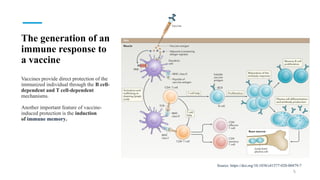
Vaccines provide direct protection of the
immunized individual through the B cell-
dependent and T cell-dependent
mechanisms.
Another important feature of vaccine-
induced protection is the induction
of immune memory.
5
Source: https://doi.org/10.1038/s41577-020-00479-7
Types of Vaccines
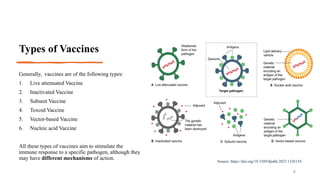
Generally, vaccines are of the following types:
1. Live attenuated Vaccine
2. Inactivated Vaccine
3. Subunit Vaccine
4. Toxoid Vaccine
5. Vector-based Vaccine
6. Nucleic acid Vaccine
All these types of vaccines aim to stimulate the
immune response to a specific pathogen, although they
may have different mechanisms of action.
6
Source: https://doi.org/10.3389/fpubh.2023.1326154
Live attenuated Vaccine
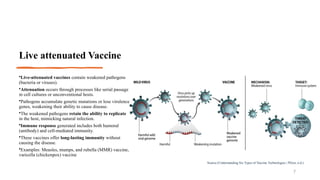
•Live-attenuated vaccines contain weakened pathogens
(bacteria or viruses).
•Attenuation occurs through processes like serial passage
in cell cultures or unconventional hosts.
•Pathogens accumulate genetic mutations or lose virulence
genes, weakening their ability to cause disease.
•The weakened pathogens retain the ability to replicate
in the host, mimicking natural infection.
•Immune response generated includes both humoral
(antibody) and cell-mediated immunity.
•These vaccines offer long-lasting immunity without
causing the disease.
•Examples: Measles, mumps, and rubella (MMR) vaccine,
varicella (chickenpox) vaccine
7
Source:(Understanding Six Types of Vaccine Technologies | Pfizer, n.d.)
Inactivated Vaccine
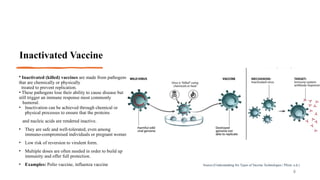
• Inactivated (killed) vaccines are made from pathogens
that are chemically or physically
treated to prevent replication.
• These pathogens lose their ability to cause disease but
still trigger an immune response most commonly
humoral.
• Inactivation can be achieved through chemical or
physical processes to ensure that the proteins
and nucleic acids are rendered inactive.
• They are safe and well-tolerated, even among
immuno-compromised individuals or pregnant women
• Low risk of reversion to virulent form.
• Multiple doses are often needed in order to build up
immunity and offer full protection.
• Examples: Polio vaccine, influenza vaccine
8
Source:(Understanding Six Types of Vaccine Technologies | Pfizer, n.d.)
Subunit Vaccine
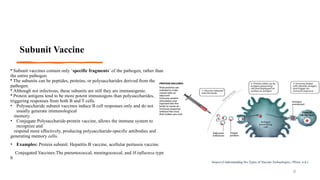
• Subunit vaccines contain only ‘specific fragments’ of the pathogen, rather than
the entire pathogen.
• The subunits can be peptides, proteins, or polysaccharides derived from the
pathogen.
• Although not infectious, these subunits are still they are immunogenic.
• Protein antigens tend to be more potent immunogens than polysaccharides,
triggering responses from both B and T cells.
• Polysaccharide subunit vaccines induce B cell responses only and do not
usually generate immunological
memory.
• Conjugate Polysaccharide-protein vaccine, allows the immune system to
recognize and
respond more effectively, producing polysaccharide-specific antibodies and
generating memory cells.
• Examples: Protein subunit: Hepatitis B vaccine, acellular pertussis vaccine
Conjugated Vaccines:The pneumococcal, meningococcal, and H.influenza type
b
9
Source:(Understanding Six Types of Vaccine Technologies | Pfizer, n.d.)
Toxoid Vaccine
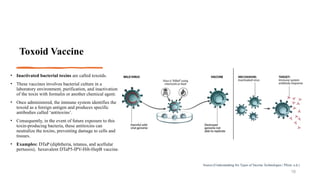
• Inactivated bacterial toxins are called toxoids.
• These vaccines involves bacterial culture in a
laboratory environment, purification, and inactivation
of the toxin with formalin or another chemical agent.
• Once administered, the immune system identifies the
toxoid as a foreign antigen and produces specific
antibodies called ‘antitoxins’.
• Consequently, in the event of future exposure to this
toxin-producing bacteria, these antitoxins can
neutralize the toxins, preventing damage to cells and
tissues.
• Examples: DTaP (diphtheria, tetanus, and acellular
pertussis), hexavalent DTaP5-IPV-Hib-HepB vaccine.
10
Source:(Understanding Six Types of Vaccine Technologies | Pfizer, n.d.)
Vector-based vaccines
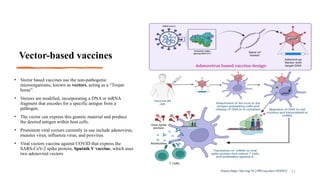
• Vector based vaccines use the non-pathogenic
microorganisms, known as vectors, acting as a “Trojan
horse”.
• Vectors are modified, incorporating a DNA or mRNA
fragment that encodes for a specific antigen from a
pathogen.
• The vector can express this genetic material and produce
the desired antigen within host cells.
• Prominent viral vectors currently in use include adenovirus,
measles virus, influenza virus, and poxvirus.
• Viral vectors vaccine against COVID that express the
SARS-CoV-2 spike protein, Sputnik V vaccine, which uses
two adenoviral vectors
11
Source:https://doi.org/10.3390/vaccines11020432
Nucleic acid vaccines
• Nucleic acid-based vaccines, including DNA (as
plasmids) and RNA [as messenger RNA (mRNA)]
encode for pathogen-specific antigenic proteins.
• DNA vaccines are generated by inserting a gene
encoding antigens into a bacteria-derived plasmid.
• DNA vaccines, after internalization, the DNA is
transferred to the nucleus for transcription and then
translated in the cytoplasm.
• Unlike DNA vaccines, RNA vaccines allow direct
translation of the antigen within the cytoplasm.
• RNA vaccines can effectively carry antigen-encoding
mRNA to APCs directly in vivo ( via nanocarriers).
• Examples: Against COVID-19 : Comirnaty® (Pfizer-
BioNTech vaccine). Spikevax® (Moderna vaccine)
12
Source: https://doi.org/10.1038/s41573-021-00283-5
13
THANK YOU!

Introduction to Vaccines and it's classification

  • 1.
    1 VACCINES AND ITSTYPES Presented by- Jaskiran Kaur
  • 2.
    2 Contents Introduction to Vaccines Historical Events Generation ofan immune response to a vaccine Types of Vaccines
  • 3.
    Introduction to Vaccines • Avaccine is a biological product that can be used to safely induce an immune response that confers protection against infection and/or disease on subsequent exposure to a pathogen. • To achieve this, the vaccine must contain antigens that are either derived from the pathogen or produced synthetically to represent components of the pathogen. • Vaccines exploit the extraordinary ability of the highly evolved human immune system to respond to, and remember, encounters with pathogen antigens. • Vaccination is possible because of adaptive immunity, with the capacity to “remember” and respond to specific pathogens and creates active (acquired) immunity. 3
  • 4.
    4 A sneak peekinto the Historical events  Vaccinology, a method of preventing smallpox, has its roots in the work of both Edward Jenner and Benjamin Jesty. He observed that milkmaids who contracted cowpox did not contract smallpox, even after close contact with infected individuals.  In 1774, he inoculated his family with cowpox pustule material, the first recorded vaccination.  Jenner, the "father of vaccinology," developed a series of experiments involving cowpox pustules, demonstrating the protective capacity of this method.  His work led to the formulation of the vaccine concept, which originated from the phrase "variolae vaccinae" meaning smallpox of cows.  Louis Pasteur, a French chemist, in 1864, proposed the “Germ Theory of Disease”, postulating that infectious diseases were caused by microorganisms  Pasteur achieved another breakthrough in vaccinology by developing the rabies vaccine.
  • 5.
    The generation ofan immune response to a vaccine Vaccines provide direct protection of the immunized individual through the B cell- dependent and T cell-dependent mechanisms. Another important feature of vaccine- induced protection is the induction of immune memory. 5 Source: https://doi.org/10.1038/s41577-020-00479-7
  • 6.
    Types of Vaccines Generally,vaccines are of the following types: 1. Live attenuated Vaccine 2. Inactivated Vaccine 3. Subunit Vaccine 4. Toxoid Vaccine 5. Vector-based Vaccine 6. Nucleic acid Vaccine All these types of vaccines aim to stimulate the immune response to a specific pathogen, although they may have different mechanisms of action. 6 Source: https://doi.org/10.3389/fpubh.2023.1326154
  • 7.
    Live attenuated Vaccine •Live-attenuatedvaccines contain weakened pathogens (bacteria or viruses). •Attenuation occurs through processes like serial passage in cell cultures or unconventional hosts. •Pathogens accumulate genetic mutations or lose virulence genes, weakening their ability to cause disease. •The weakened pathogens retain the ability to replicate in the host, mimicking natural infection. •Immune response generated includes both humoral (antibody) and cell-mediated immunity. •These vaccines offer long-lasting immunity without causing the disease. •Examples: Measles, mumps, and rubella (MMR) vaccine, varicella (chickenpox) vaccine 7 Source:(Understanding Six Types of Vaccine Technologies | Pfizer, n.d.)
  • 8.
    Inactivated Vaccine • Inactivated(killed) vaccines are made from pathogens that are chemically or physically treated to prevent replication. • These pathogens lose their ability to cause disease but still trigger an immune response most commonly humoral. • Inactivation can be achieved through chemical or physical processes to ensure that the proteins and nucleic acids are rendered inactive. • They are safe and well-tolerated, even among immuno-compromised individuals or pregnant women • Low risk of reversion to virulent form. • Multiple doses are often needed in order to build up immunity and offer full protection. • Examples: Polio vaccine, influenza vaccine 8 Source:(Understanding Six Types of Vaccine Technologies | Pfizer, n.d.)
  • 9.
    Subunit Vaccine • Subunitvaccines contain only ‘specific fragments’ of the pathogen, rather than the entire pathogen. • The subunits can be peptides, proteins, or polysaccharides derived from the pathogen. • Although not infectious, these subunits are still they are immunogenic. • Protein antigens tend to be more potent immunogens than polysaccharides, triggering responses from both B and T cells. • Polysaccharide subunit vaccines induce B cell responses only and do not usually generate immunological memory. • Conjugate Polysaccharide-protein vaccine, allows the immune system to recognize and respond more effectively, producing polysaccharide-specific antibodies and generating memory cells. • Examples: Protein subunit: Hepatitis B vaccine, acellular pertussis vaccine Conjugated Vaccines:The pneumococcal, meningococcal, and H.influenza type b 9 Source:(Understanding Six Types of Vaccine Technologies | Pfizer, n.d.)
  • 10.
    Toxoid Vaccine • Inactivatedbacterial toxins are called toxoids. • These vaccines involves bacterial culture in a laboratory environment, purification, and inactivation of the toxin with formalin or another chemical agent. • Once administered, the immune system identifies the toxoid as a foreign antigen and produces specific antibodies called ‘antitoxins’. • Consequently, in the event of future exposure to this toxin-producing bacteria, these antitoxins can neutralize the toxins, preventing damage to cells and tissues. • Examples: DTaP (diphtheria, tetanus, and acellular pertussis), hexavalent DTaP5-IPV-Hib-HepB vaccine. 10 Source:(Understanding Six Types of Vaccine Technologies | Pfizer, n.d.)
  • 11.
    Vector-based vaccines • Vectorbased vaccines use the non-pathogenic microorganisms, known as vectors, acting as a “Trojan horse”. • Vectors are modified, incorporating a DNA or mRNA fragment that encodes for a specific antigen from a pathogen. • The vector can express this genetic material and produce the desired antigen within host cells. • Prominent viral vectors currently in use include adenovirus, measles virus, influenza virus, and poxvirus. • Viral vectors vaccine against COVID that express the SARS-CoV-2 spike protein, Sputnik V vaccine, which uses two adenoviral vectors 11 Source:https://doi.org/10.3390/vaccines11020432
  • 12.
    Nucleic acid vaccines •Nucleic acid-based vaccines, including DNA (as plasmids) and RNA [as messenger RNA (mRNA)] encode for pathogen-specific antigenic proteins. • DNA vaccines are generated by inserting a gene encoding antigens into a bacteria-derived plasmid. • DNA vaccines, after internalization, the DNA is transferred to the nucleus for transcription and then translated in the cytoplasm. • Unlike DNA vaccines, RNA vaccines allow direct translation of the antigen within the cytoplasm. • RNA vaccines can effectively carry antigen-encoding mRNA to APCs directly in vivo ( via nanocarriers). • Examples: Against COVID-19 : Comirnaty® (Pfizer- BioNTech vaccine). Spikevax® (Moderna vaccine) 12 Source: https://doi.org/10.1038/s41573-021-00283-5
  • 13.