ICH GUIDELINES
NAME : REEYA
REGISTRATION NO: 241410005
NEED TO HARMONISE
The realisation that it was important to have an independent evaluation of medicinal products
before they are allowed on the market was reached at different times in different regions.
However in many cases the realisation was driven by tragedies, such as that with thalidomide in
Europe in the 1960s.
For most countries, whether or not they had initiated product registration controls earlier, the
1960s and 1970s saw a rapid increase in laws, regulations and guidelines for reporting and
evaluating the data on safety, quality and efficacy of new medicinal products. The industry, at
the time, was becoming more international and seeking new global markets; however the
divergence in technical requirements from country to country was such that industry found it
necessary
International Council for
Harmonisation(ICH)
Harmonization is the act of making something compactible or consistent.
The International Council for Harmonisation of Technical Requirements for Pharmaceuticals for
Human Use (ICH) is unique in bringing together the regulatory authorities and pharmaceutical
industry to discuss scientific and technical aspects of drug registration. ICH's mission is to
achieve greater harmonisation worldwide to ensure that safe, effective, and high quality
medicines are developed and registered in the most resource-efficient manner.
FOUNDING MEMBER OF ICH
Founding Regulatory Members
EUROPEAN COMMISSION (EU)
FDA, United States
MINISTRY OF HEALTH LABOUR AND WELFARE, Japan
Founding Industry Members
EFPIA(EUROPEAN FEDERATION OF PHARMACEUTICAL INDUSTRIES AND ASSOCIATIONS)
JPMA (JAPAN PHARMACEUTICAL MANUFACTURE ASSOCIATION)
PhRMA (PHARMACEUTICAL RESEARCH AND MANUFACTURE OF AMERICA)
Quality Guidelines
Q1A-Q1F 9(STABILITY)
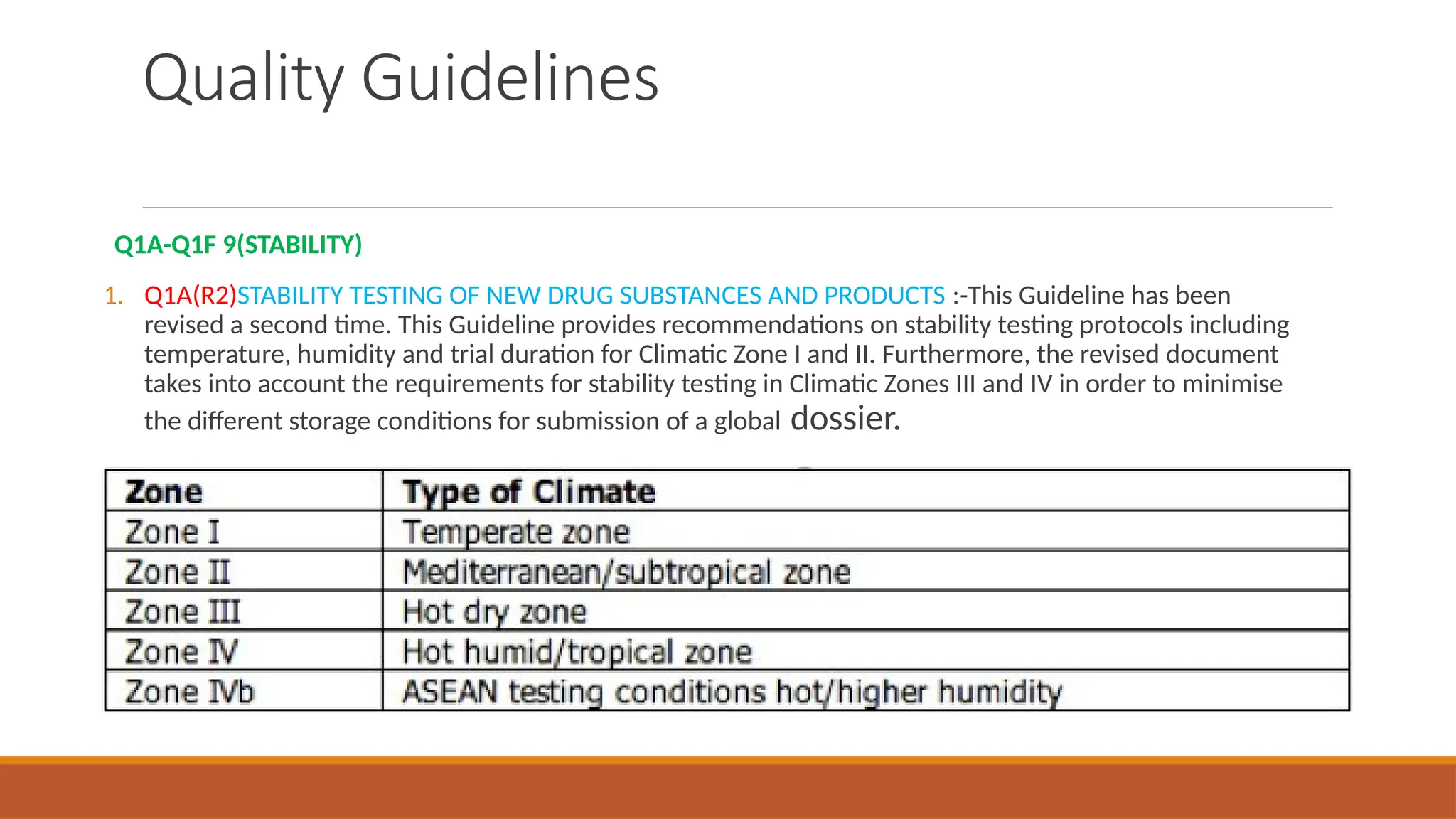
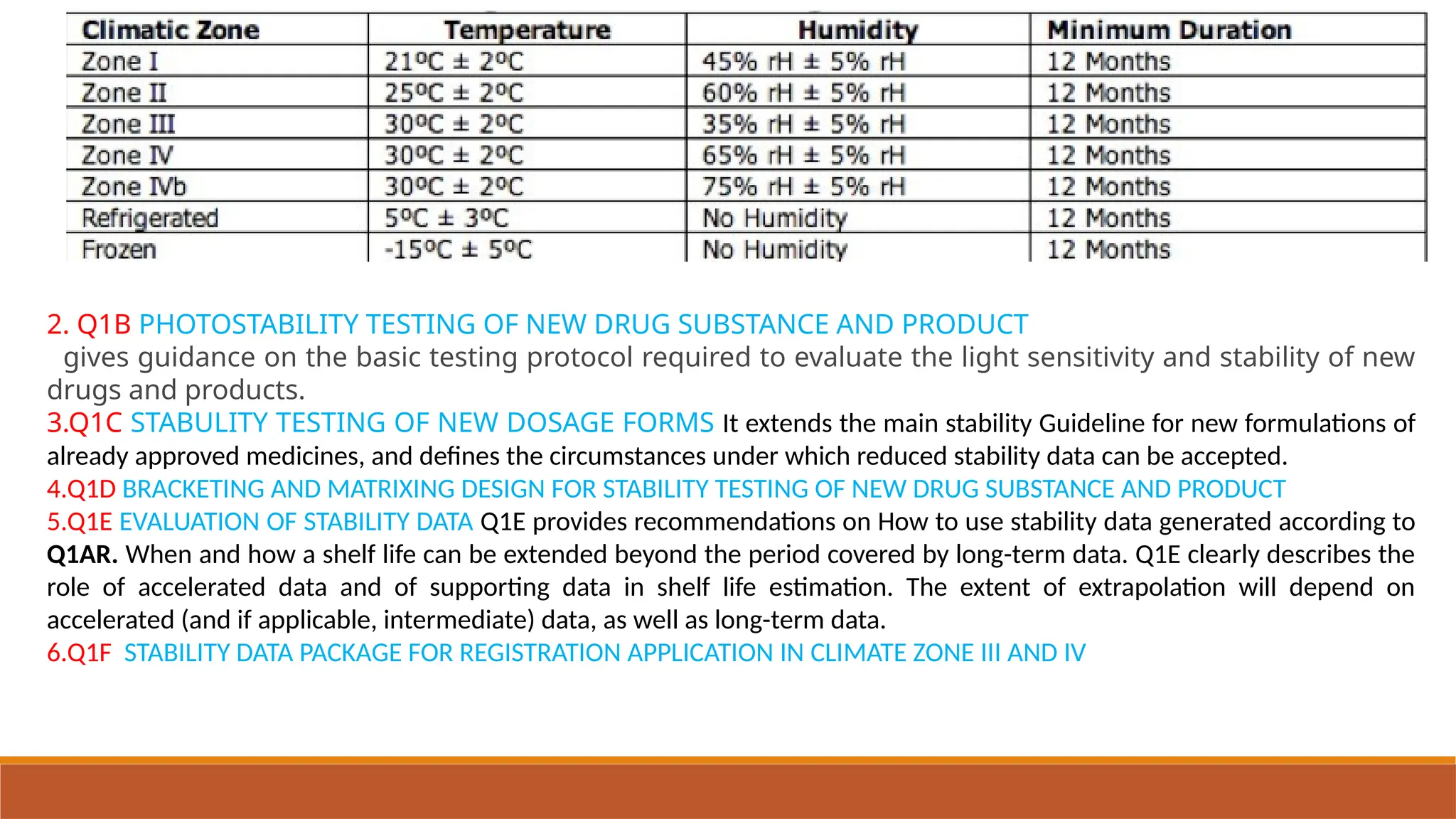
1. Q1A(R2)STABILITY TESTING OF NEW DRUG SUBSTANCES AND PRODUCTS :-This Guideline has been
revised a second time. This Guideline provides recommendations on stability testing protocols including
temperature, humidity and trial duration for Climatic Zone I and II. Furthermore, the revised document
takes into account the requirements for stability testing in Climatic Zones III and IV in order to minimise
the different storage conditions for submission of a global dossier.
2. Q1B PHOTOSTABILITY TESTING OF NEW DRUG SUBSTANCE AND PRODUCT
gives guidance on the basic testing protocol required to evaluate the light sensitivity and stability of new
drugs and products.
3.Q1C STABULITY TESTING OF NEW DOSAGE FORMS It extends the main stability Guideline for new formulations of
already approved medicines, and defines the circumstances under which reduced stability data can be accepted.
4.Q1D BRACKETING AND MATRIXING DESIGN FOR STABILITY TESTING OF NEW DRUG SUBSTANCE AND PRODUCT
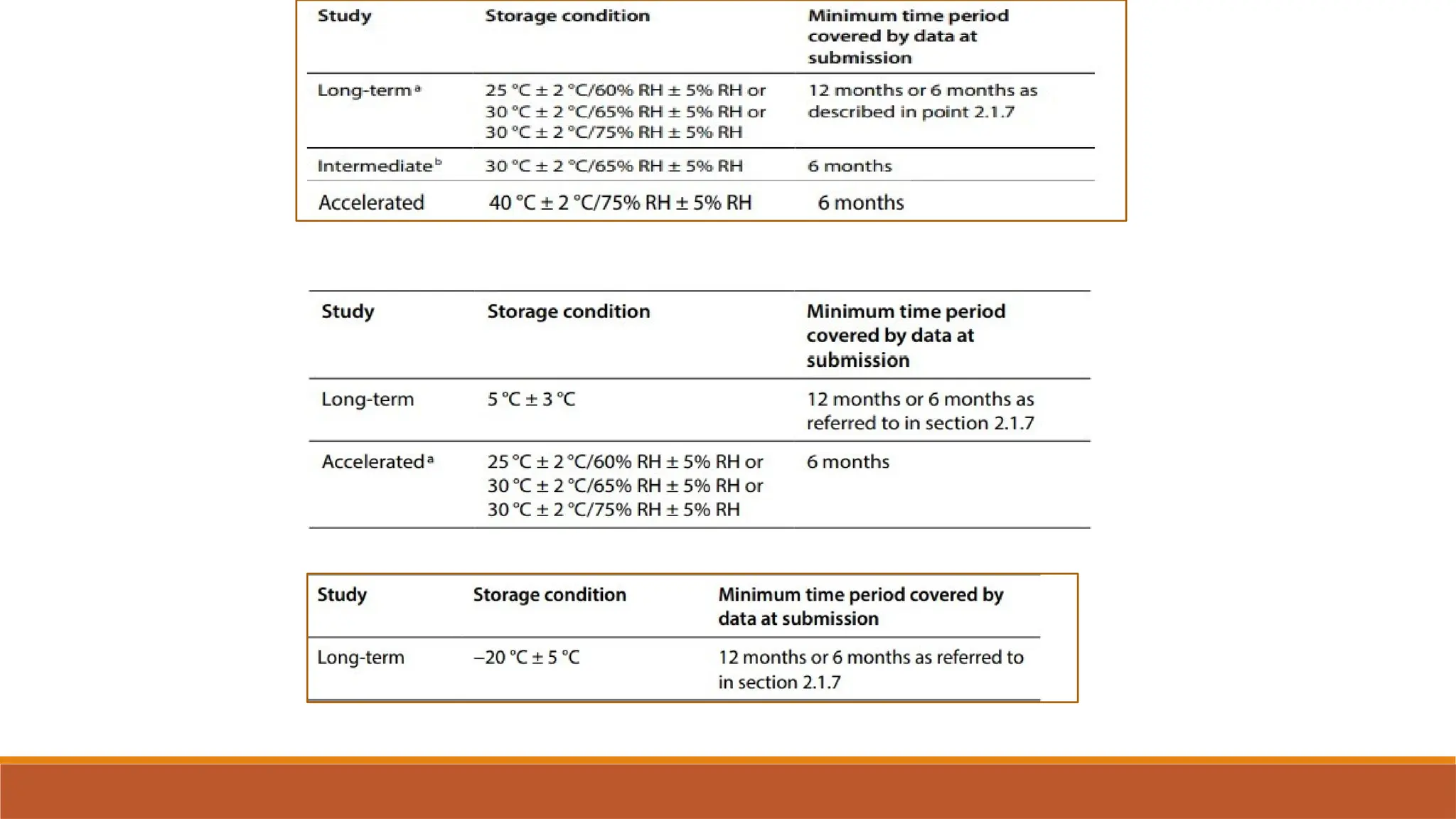
5.Q1E EVALUATION OF STABILITY DATA Q1E provides recommendations on How to use stability data generated according to
Q1AR. When and how a shelf life can be extended beyond the period covered by long-term data. Q1E clearly describes the
role of accelerated data and of supporting data in shelf life estimation. The extent of extrapolation will depend on
accelerated (and if applicable, intermediate) data, as well as long-term data.
6.Q1F STABILITY DATA PACKAGE FOR REGISTRATION APPLICATION IN CLIMATE ZONE III AND IV
Q2 ANALYTICAL VALIDATION
1. Q2(R2) REVISION OF Q2(R1) ANALYTICAL VALIDATION. he Q2(R2) EWG revised the ICH Q2(R1) Guideline on Validation of Analytical
Procedures. The scope of the revision of ICH Q2(R1) includes validation principles that cover analytical use of spectroscopic or
spectrometry data (e.g., NIR, Raman, NMR or MS) some of which often require multivariate statistical analyses.
2. Q2(R2)/Q14 IWG TRAINING ON VALIDATION OF ANALYTICAL PROCEDURE AND Q14: ANALYTICAL PROCEDURE DEVELOPMENT the
Q2(R2)/Q14 IWG was established to prepare and deliver training materials which will facilitate an aligned interpretation and a harmonised
implementation of Q2(R2) “Validation of Analytical” Procedures and Q14 “Analytical Procedure Development”
Q3A-Q3E IMPURITIES
1.Q3A(R2) IMPURITIES IN NEW DRUG SUBSTANCE
Impurities can be classified into the following categories:
Organic impurities (process- and drug-related) Starting materials , By-products , Intermediates ,Degradation products ,Reagents, ligands and
catalysts
Inorganic impurities Reagents, ligands and catalysts , Heavy metals or other residual metals , Inorganic salts Other materials (e.g., filter aids,
charcoal)
Residual solvents
2.Q3B(R2) IMPURITIES IN NEW DRUG PRODUCTcomplements the Guideline on impurities in new drug substances and provides
advice in regard to impurities in products containing new, chemically synthesized drug substances. The Guideline specifically
deals with those impurities which might arise as degradation products of the drug substance, or arising from interactions
between drug substance and excipients or components of primary packaging materials. The Guideline sets out a rationale for
the reporting, identification and qualification of such impurities based on a scientific appraisal of likely and actual impurities
observed, and of the safety implications,
3.Q3C(R9) GUIDELINES FOR RESIDUAL SOLVENT providing recommendations on the use of less toxic solvents in the manufacture of drug
substances and dosage forms, and setting pharmaceutical limits for residual solvents (organic volatile impurities) in drug products
4.Q3D(R2) GUIDELINE FOR ELEMENTAL IMPURITIES Guideline for Elemental Impurities is a quality guideline for the control of elemental
impurities ( Ag,Au, Ni) in new drug products (medicinal products), and it establishes Permitted Daily Exposures (PDEs) for 24 Elemental
Impurities (EIs) for drug products administered by the oral, parenteral and inhalation routes of administration.
Q4A-Q4B PHARMACOPOEIAS
1.Q4A PHARMACOPOEIAL HARMONISATION pharmacopoeial authorities, working together through the Pharmacopoeial Discussion
Group (PDG), have been closely involved with the work of ICH since the outset and harmonisation between the major pharmacopoeias.
2.Q4BEVALUATION AND RECOMMENDATION OF PHARMACOPEIAL TEXTS FOR USE IN THE ICH REGION
Q5A-Q5E QUALITY OF BIOTECHNOLOGICAL PRODUCT
1.Q5A(R2) VIRAL SAFETY EVALUATION OF BIOTECH PRDT DERIVED FROM CELL LINES OF HUMAN OR ANIMAL ORIGINestablished and
complementary approaches to control the potential viral contamination of biotechnology products and describes the evaluation of the
viral safety of biotechnology products including viral clearance and testing, and outlines what data should be submitted in marketing
applications for those products.
2. Q5B Analysis of the expression construct in cell lines used for production of rDNA-derived protein products
- Scientific guideline
This document is intended to describe the types of information that are considered valuable in assessing
the structure of the expression construct used to produce recombinant DNA derived proteins.
ICH Q5C Stability testing of biotechnological/biological products – Scientific guideline
Q6A-Q6B specifications
1.ICH Q6A: test procedures and acceptance criteria for new drug substances and new drug products:
chemical substances - Scientific guideline
This document provides guidance on the setting and justification of acceptance criteria and the selection
of test procedures for new drug substances of synthetic chemical origin, and new drug products
produced from them, which have not been registered previously in the ICH regions.
2.ICH Q6B Specification: test procedures and acceptance criteria for biotechnological/biological products
- Scientific guideline This document provides general principles on the setting and justification of a
uniform set of international specifications for proteins and polypeptides which are produced from
recombinant or non-recombinant cell-culture expression systems
ICH Q7 Good manufacturing practice for active pharmaceutical ingredients
Good Manufacturing Practice (GMP) for the manufacturing of Active Pharmaceutical Ingredients (APIs) under an
appropriate system for managing quality. It is also intended to help ensure that APIs meet the requirements for
quality and purity that they purport or are represented to possess.
ICH Q8 (R2) Pharmaceutical development
ICH Q9 Quality risk management
guidance on the principles and examples of tools for quality risk management that can be applied to different
aspects of pharmaceutical quality and make limited and specific adjustments to specific chapters and annexes of the
current ICH Q9 Guideline on Quality Risk Management (QRM).
ICH Q10 Pharmaceutical quality system
This Guideline applies to the systems supporting the development and manufacture of pharmaceutical drug
substances and drug products, including biotechnology and biological products, throughout the product lifecycle.
The elements of Q10 should be applied in a manner that is appropriate and proportionate to each of the product
lifecycle stages, recognising the differences among, and the different goals of each stage.
ICH Q11 Development and manufacture of drug substances (chemical entities and
biotechnological/biological entities) - Scientific guidelineThis Guideline describes
approaches to developing and understanding the manufacturing process. It addresses aspects of
development and manufacture that pertain to drug substance, including the presence of steps designed
to reduce impurities.
Q12 LIFECYCLE MANAGEMENT
TECHNICAL AND REGULATORY CONSIDERATION FOR PHARMACEUTICAL PRODUCTS LIFECYCLE MANAGEMENT
This new Guideline is proposed to provide a framework to facilitate the management of post-approval Chemistry,
Manufacturing and Controls (CMC) changes in a more predictable and efficient manner across the product lifecycle
ICH Q13 Guideline on continuous manufacturing of drug substances and drug
products
Builds on existing ICH Quality Guidelines, provides clarification on continuous manufacturing (CM) concepts,
describes scientific approaches, and presents regulatory considerations specific to CM of drug substances and drug
products;
Describes scientific and regulatory considerations for the development, implementation, operation, and lifecycle
management of CM.
Q14 ANALYTICAL PROCEDURE DEVELOPMENTThis new guideline intends to improve regulatory
communication between industry and regulators and facilitate more efficient, sound scientific and risk-based
approval as well as post-approval change management of analytical procedures.
THANK YOU

INTERNATIONAL COUNCIL FOR HARMONIZATIONQUALITY GUIDELINE

  • 1.
    ICH GUIDELINES NAME :REEYA REGISTRATION NO: 241410005
  • 2.
    NEED TO HARMONISE Therealisation that it was important to have an independent evaluation of medicinal products before they are allowed on the market was reached at different times in different regions. However in many cases the realisation was driven by tragedies, such as that with thalidomide in Europe in the 1960s. For most countries, whether or not they had initiated product registration controls earlier, the 1960s and 1970s saw a rapid increase in laws, regulations and guidelines for reporting and evaluating the data on safety, quality and efficacy of new medicinal products. The industry, at the time, was becoming more international and seeking new global markets; however the divergence in technical requirements from country to country was such that industry found it necessary
  • 3.
    International Council for Harmonisation(ICH) Harmonizationis the act of making something compactible or consistent. The International Council for Harmonisation of Technical Requirements for Pharmaceuticals for Human Use (ICH) is unique in bringing together the regulatory authorities and pharmaceutical industry to discuss scientific and technical aspects of drug registration. ICH's mission is to achieve greater harmonisation worldwide to ensure that safe, effective, and high quality medicines are developed and registered in the most resource-efficient manner.
  • 4.
    FOUNDING MEMBER OFICH Founding Regulatory Members EUROPEAN COMMISSION (EU) FDA, United States MINISTRY OF HEALTH LABOUR AND WELFARE, Japan Founding Industry Members EFPIA(EUROPEAN FEDERATION OF PHARMACEUTICAL INDUSTRIES AND ASSOCIATIONS) JPMA (JAPAN PHARMACEUTICAL MANUFACTURE ASSOCIATION) PhRMA (PHARMACEUTICAL RESEARCH AND MANUFACTURE OF AMERICA)
  • 5.
    Quality Guidelines Q1A-Q1F 9(STABILITY) 1.Q1A(R2)STABILITY TESTING OF NEW DRUG SUBSTANCES AND PRODUCTS :-This Guideline has been revised a second time. This Guideline provides recommendations on stability testing protocols including temperature, humidity and trial duration for Climatic Zone I and II. Furthermore, the revised document takes into account the requirements for stability testing in Climatic Zones III and IV in order to minimise the different storage conditions for submission of a global dossier.
  • 6.
    2. Q1B PHOTOSTABILITYTESTING OF NEW DRUG SUBSTANCE AND PRODUCT gives guidance on the basic testing protocol required to evaluate the light sensitivity and stability of new drugs and products. 3.Q1C STABULITY TESTING OF NEW DOSAGE FORMS It extends the main stability Guideline for new formulations of already approved medicines, and defines the circumstances under which reduced stability data can be accepted. 4.Q1D BRACKETING AND MATRIXING DESIGN FOR STABILITY TESTING OF NEW DRUG SUBSTANCE AND PRODUCT 5.Q1E EVALUATION OF STABILITY DATA Q1E provides recommendations on How to use stability data generated according to Q1AR. When and how a shelf life can be extended beyond the period covered by long-term data. Q1E clearly describes the role of accelerated data and of supporting data in shelf life estimation. The extent of extrapolation will depend on accelerated (and if applicable, intermediate) data, as well as long-term data. 6.Q1F STABILITY DATA PACKAGE FOR REGISTRATION APPLICATION IN CLIMATE ZONE III AND IV
  • 8.
    Q2 ANALYTICAL VALIDATION 1.Q2(R2) REVISION OF Q2(R1) ANALYTICAL VALIDATION. he Q2(R2) EWG revised the ICH Q2(R1) Guideline on Validation of Analytical Procedures. The scope of the revision of ICH Q2(R1) includes validation principles that cover analytical use of spectroscopic or spectrometry data (e.g., NIR, Raman, NMR or MS) some of which often require multivariate statistical analyses. 2. Q2(R2)/Q14 IWG TRAINING ON VALIDATION OF ANALYTICAL PROCEDURE AND Q14: ANALYTICAL PROCEDURE DEVELOPMENT the Q2(R2)/Q14 IWG was established to prepare and deliver training materials which will facilitate an aligned interpretation and a harmonised implementation of Q2(R2) “Validation of Analytical” Procedures and Q14 “Analytical Procedure Development” Q3A-Q3E IMPURITIES 1.Q3A(R2) IMPURITIES IN NEW DRUG SUBSTANCE Impurities can be classified into the following categories: Organic impurities (process- and drug-related) Starting materials , By-products , Intermediates ,Degradation products ,Reagents, ligands and catalysts Inorganic impurities Reagents, ligands and catalysts , Heavy metals or other residual metals , Inorganic salts Other materials (e.g., filter aids, charcoal) Residual solvents 2.Q3B(R2) IMPURITIES IN NEW DRUG PRODUCTcomplements the Guideline on impurities in new drug substances and provides advice in regard to impurities in products containing new, chemically synthesized drug substances. The Guideline specifically deals with those impurities which might arise as degradation products of the drug substance, or arising from interactions between drug substance and excipients or components of primary packaging materials. The Guideline sets out a rationale for the reporting, identification and qualification of such impurities based on a scientific appraisal of likely and actual impurities observed, and of the safety implications,
  • 9.
    3.Q3C(R9) GUIDELINES FORRESIDUAL SOLVENT providing recommendations on the use of less toxic solvents in the manufacture of drug substances and dosage forms, and setting pharmaceutical limits for residual solvents (organic volatile impurities) in drug products 4.Q3D(R2) GUIDELINE FOR ELEMENTAL IMPURITIES Guideline for Elemental Impurities is a quality guideline for the control of elemental impurities ( Ag,Au, Ni) in new drug products (medicinal products), and it establishes Permitted Daily Exposures (PDEs) for 24 Elemental Impurities (EIs) for drug products administered by the oral, parenteral and inhalation routes of administration. Q4A-Q4B PHARMACOPOEIAS 1.Q4A PHARMACOPOEIAL HARMONISATION pharmacopoeial authorities, working together through the Pharmacopoeial Discussion Group (PDG), have been closely involved with the work of ICH since the outset and harmonisation between the major pharmacopoeias. 2.Q4BEVALUATION AND RECOMMENDATION OF PHARMACOPEIAL TEXTS FOR USE IN THE ICH REGION Q5A-Q5E QUALITY OF BIOTECHNOLOGICAL PRODUCT 1.Q5A(R2) VIRAL SAFETY EVALUATION OF BIOTECH PRDT DERIVED FROM CELL LINES OF HUMAN OR ANIMAL ORIGINestablished and complementary approaches to control the potential viral contamination of biotechnology products and describes the evaluation of the viral safety of biotechnology products including viral clearance and testing, and outlines what data should be submitted in marketing applications for those products.
  • 10.
    2. Q5B Analysisof the expression construct in cell lines used for production of rDNA-derived protein products - Scientific guideline This document is intended to describe the types of information that are considered valuable in assessing the structure of the expression construct used to produce recombinant DNA derived proteins. ICH Q5C Stability testing of biotechnological/biological products – Scientific guideline Q6A-Q6B specifications 1.ICH Q6A: test procedures and acceptance criteria for new drug substances and new drug products: chemical substances - Scientific guideline This document provides guidance on the setting and justification of acceptance criteria and the selection of test procedures for new drug substances of synthetic chemical origin, and new drug products produced from them, which have not been registered previously in the ICH regions. 2.ICH Q6B Specification: test procedures and acceptance criteria for biotechnological/biological products - Scientific guideline This document provides general principles on the setting and justification of a uniform set of international specifications for proteins and polypeptides which are produced from recombinant or non-recombinant cell-culture expression systems
  • 11.
    ICH Q7 Goodmanufacturing practice for active pharmaceutical ingredients Good Manufacturing Practice (GMP) for the manufacturing of Active Pharmaceutical Ingredients (APIs) under an appropriate system for managing quality. It is also intended to help ensure that APIs meet the requirements for quality and purity that they purport or are represented to possess. ICH Q8 (R2) Pharmaceutical development ICH Q9 Quality risk management guidance on the principles and examples of tools for quality risk management that can be applied to different aspects of pharmaceutical quality and make limited and specific adjustments to specific chapters and annexes of the current ICH Q9 Guideline on Quality Risk Management (QRM). ICH Q10 Pharmaceutical quality system This Guideline applies to the systems supporting the development and manufacture of pharmaceutical drug substances and drug products, including biotechnology and biological products, throughout the product lifecycle. The elements of Q10 should be applied in a manner that is appropriate and proportionate to each of the product lifecycle stages, recognising the differences among, and the different goals of each stage. ICH Q11 Development and manufacture of drug substances (chemical entities and biotechnological/biological entities) - Scientific guidelineThis Guideline describes approaches to developing and understanding the manufacturing process. It addresses aspects of development and manufacture that pertain to drug substance, including the presence of steps designed to reduce impurities.
  • 12.
    Q12 LIFECYCLE MANAGEMENT TECHNICALAND REGULATORY CONSIDERATION FOR PHARMACEUTICAL PRODUCTS LIFECYCLE MANAGEMENT This new Guideline is proposed to provide a framework to facilitate the management of post-approval Chemistry, Manufacturing and Controls (CMC) changes in a more predictable and efficient manner across the product lifecycle ICH Q13 Guideline on continuous manufacturing of drug substances and drug products Builds on existing ICH Quality Guidelines, provides clarification on continuous manufacturing (CM) concepts, describes scientific approaches, and presents regulatory considerations specific to CM of drug substances and drug products; Describes scientific and regulatory considerations for the development, implementation, operation, and lifecycle management of CM. Q14 ANALYTICAL PROCEDURE DEVELOPMENTThis new guideline intends to improve regulatory communication between industry and regulators and facilitate more efficient, sound scientific and risk-based approval as well as post-approval change management of analytical procedures.
  • 13.