ICH Q3D
Risk evaluation for
elemental impurities
GUIDELINE FOR ELEMENTAL IMPURITIES
INTRODUCTION
• Substances non-intentional added with a therapeutical purpose.
• Impurities could be organic molecules, residual solvents or inorganic compounds.
• Impurities don’t have a therapeutical effect and they are potentially toxic
> Their presence must be limited.
> Their levels must be managed within aceptable limits for health.
• Inorganic elements.
• Elemental impurities are commonly called “heavy metals” and they are to be
considered for the risk evaluation.
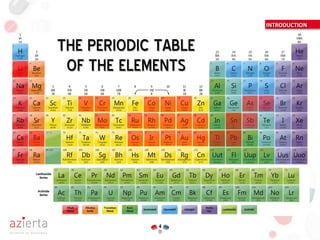
Which elemental impurities do we have to take into account?
ELEMENTAL
IMPURITIES INTRODUCTION
4
INTRODUCTION
5
INTRODUCTION
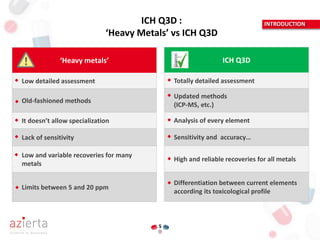
‘Heavy metals’
Low detailed assessment
Old-fashioned methods
It doesn’t allow specialization
Lack of sensitivity
Low and variable recoveries for many
metals
Limits between 5 and 20 ppm
ICH Q3D :
‘Heavy Metals’ vs ICH Q3D
ICH Q3D
Totally detailed assessment
Updated methods
(ICP-MS, etc.)
Analysis of every element
Sensitivity and accuracy…
High and reliable recoveries for all metals
Differentiation between current elements
according its toxicological profile
IMPLEMENTATION
7
IMPLEMENTATION
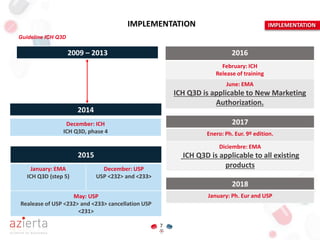
Guideline ICH Q3D
December: ICH
ICH Q3D, phase 4
2015
January: EMA
ICH Q3D (step 5)
December: USP
USP <232> and <233>
May: USP
Realease of USP <232> and <233> cancellation USP
<231>
2016
February: ICH
Release of training
June: EMA
ICH Q3D is applicable to New Marketing
Authorization.
2017
Enero: Ph. Eur. 9º edition.
Diciembre: EMA
ICH Q3D is applicable to all existing
products
2018
January: Ph. Eur and USP
2009 – 2013
2014
IMPLEMENTATION
ICH Q3D
9
ICH Q3D is steered to limit the presence of
elemental impurities, potentially toxic, in
human use medicines
ICH Q3D
10
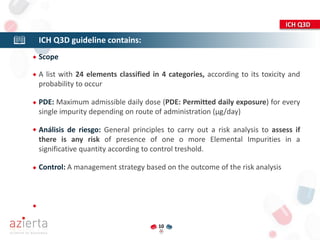
ICH Q3D guideline contains:
Scope
A list with 24 elements classified in 4 categories, according to its toxicity and
probability to occur
PDE: Maximum admissible daily dose (PDE: Permitted daily exposure) for every
single impurity depending on route of administration (µg/day)
Análisis de riesgo: General principles to carry out a risk analysis to assess if
there is any risk of presence of one o more Elemental Impurities in a
significative quantity according to control treshold.
Control: A management strategy based on the outcome of the risk analysis
ICH Q3D
ICHQ3D
PDEPDEs for any elemental impurity
We design and develop tailored made action plans to implement this guideline
Azierta is corporate member of EUROTOX and comprised by a multidisciplinar
team of qualified toxicologists and acreditted by EUROTOX and
Competitive prices Experience
(More than 1000
reports)
Available database
of 1500 APIs and
Excipients
Integral service
(End-to-end
solution)
VISIT US ON:
Azierta Toxicological Experts
CONTACT US ON:
toxreports@azierta.eu

Ich q3d for elemental impurities risk evaluation

  • 1.
    ICH Q3D Risk evaluationfor elemental impurities GUIDELINE FOR ELEMENTAL IMPURITIES
  • 2.
  • 3.
    • Substances non-intentionaladded with a therapeutical purpose. • Impurities could be organic molecules, residual solvents or inorganic compounds. • Impurities don’t have a therapeutical effect and they are potentially toxic > Their presence must be limited. > Their levels must be managed within aceptable limits for health. • Inorganic elements. • Elemental impurities are commonly called “heavy metals” and they are to be considered for the risk evaluation. Which elemental impurities do we have to take into account? ELEMENTAL IMPURITIES INTRODUCTION
  • 4.
  • 5.
    5 INTRODUCTION ‘Heavy metals’ Low detailedassessment Old-fashioned methods It doesn’t allow specialization Lack of sensitivity Low and variable recoveries for many metals Limits between 5 and 20 ppm ICH Q3D : ‘Heavy Metals’ vs ICH Q3D ICH Q3D Totally detailed assessment Updated methods (ICP-MS, etc.) Analysis of every element Sensitivity and accuracy… High and reliable recoveries for all metals Differentiation between current elements according its toxicological profile
  • 6.
  • 7.
    7 IMPLEMENTATION Guideline ICH Q3D December:ICH ICH Q3D, phase 4 2015 January: EMA ICH Q3D (step 5) December: USP USP <232> and <233> May: USP Realease of USP <232> and <233> cancellation USP <231> 2016 February: ICH Release of training June: EMA ICH Q3D is applicable to New Marketing Authorization. 2017 Enero: Ph. Eur. 9º edition. Diciembre: EMA ICH Q3D is applicable to all existing products 2018 January: Ph. Eur and USP 2009 – 2013 2014 IMPLEMENTATION
  • 8.
  • 9.
    9 ICH Q3D issteered to limit the presence of elemental impurities, potentially toxic, in human use medicines ICH Q3D
  • 10.
    10 ICH Q3D guidelinecontains: Scope A list with 24 elements classified in 4 categories, according to its toxicity and probability to occur PDE: Maximum admissible daily dose (PDE: Permitted daily exposure) for every single impurity depending on route of administration (µg/day) Análisis de riesgo: General principles to carry out a risk analysis to assess if there is any risk of presence of one o more Elemental Impurities in a significative quantity according to control treshold. Control: A management strategy based on the outcome of the risk analysis ICH Q3D
  • 11.
    ICHQ3D PDEPDEs for anyelemental impurity
  • 12.
    We design anddevelop tailored made action plans to implement this guideline Azierta is corporate member of EUROTOX and comprised by a multidisciplinar team of qualified toxicologists and acreditted by EUROTOX and Competitive prices Experience (More than 1000 reports) Available database of 1500 APIs and Excipients Integral service (End-to-end solution) VISIT US ON: Azierta Toxicological Experts CONTACT US ON: toxreports@azierta.eu