ICH Q3ImpurItIes
1
2
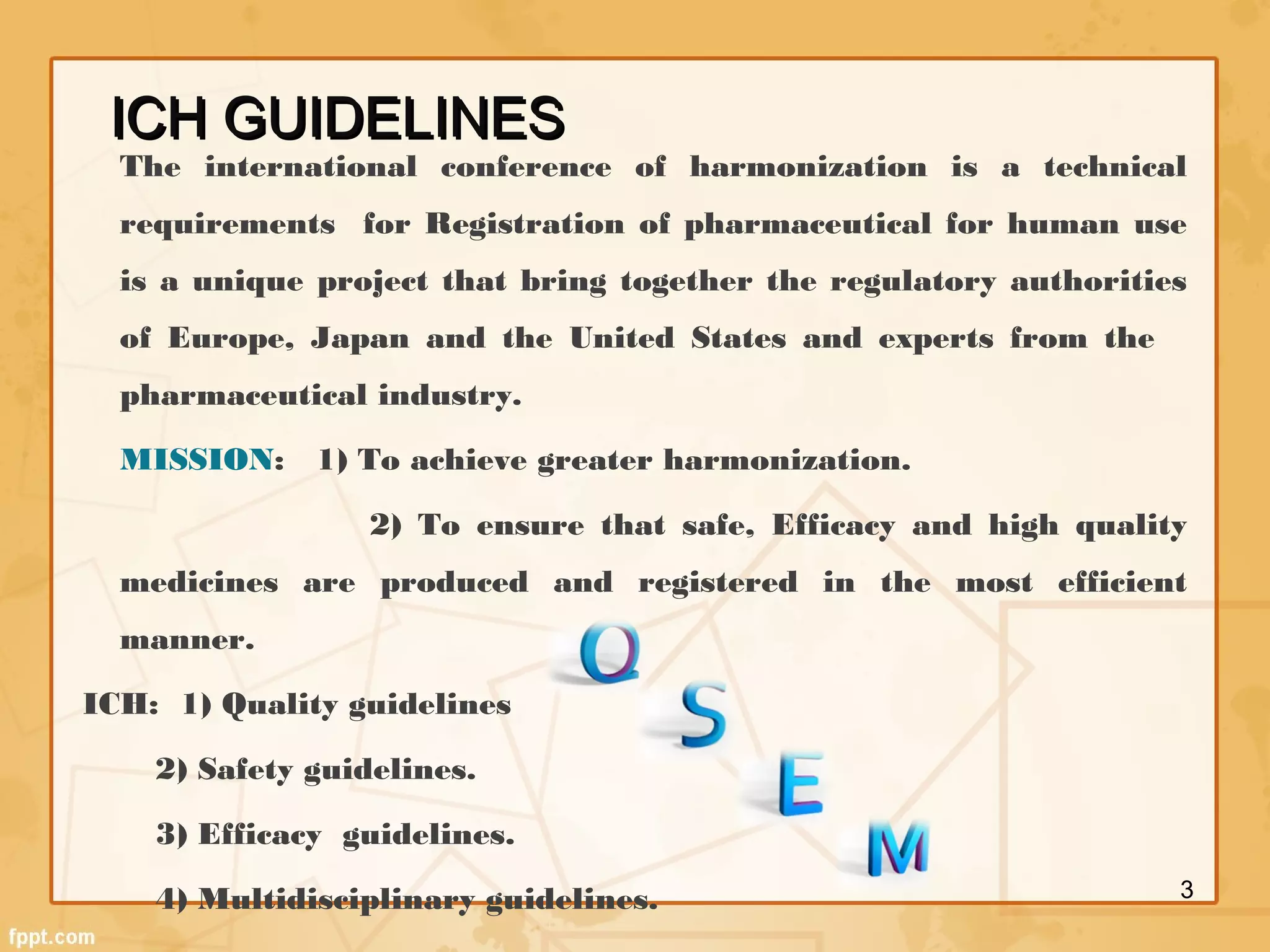
ICH GUIDELINESICH GUIDELINES
The international conference of harmonization is a technical
requirements for Registration of pharmaceutical for human use
is a unique project that bring together the regulatory authorities
of Europe, Japan and the United States and experts from the
pharmaceutical industry.
MISSION: 1) To achieve greater harmonization.
2) To ensure that safe, Efficacy and high quality
medicines are produced and registered in the most efficient
manner.
ICH: 1) Quality guidelines
2) Safety guidelines.
3) Efficacy guidelines.
4) Multidisciplinary guidelines. 3
Impurities:
A set of three guidelines addressing the chemistry and safety aspects
of impurities, including the listing of impurities in specifications.
Defines the thresholds for reporting, identification and qualification of
impurities in API and finished product. Specific guideline on residual
solvents.
Objective :
The objective of the Guideline makes recommendation to applicant
on reporting, identifying and qualifying information on impurities in
new drug substance.
IntroductionIntroduction
4
5
Classification of impurities
Impurity is a component of New Drug Substance that is Not a
chemical entity defined as New drug substance.
ICH Q3 is divided into following types:ICH Q3 is divided into following types:
ICH Q3 A R2 - Impurities in New Drug Substance
ICH Q3 B R2 - Impurities in New Drug products
ICH Q3 C R6 - Impurities in Residual Solvents
ICH Q3 D - Guidelines on Elemental Impurities
6
ICH Q3 A R2
Impurities in New Drug Substance that is impurities
from API or Bulk drug Products.
ICH Q3 B R2
Impurities in New Drug products that is impurities
from any Formulations Products.
ICH Q3 C R6
Impurities in Residual Solvents that is impurities
from Intermediate Chemicals (or) solvents used in manufacturing process.
7
Organic impurities
 Organic impurities can arise during manufacturing process
 They can be identified or unidentified.
 They may be volatile or non-volatile.
 They are process related impurities
 Starting materials
 By-products
 Intermediates
 Degradation products 8
Inorganic impurities:
Inorganic impurities can result from the bulk drug
manufacturing process.
They are normally known and identified and include:
 Reagents, ligands, catalysts
 Heavy metals or other residual metals
 Inorganic salts
 Other impurities, e.g. filter aids, charcoal…
9
Residual solvents
Solvents are in organic or organic liquids used as vehicles
for the preparation of solutions or suspensions in the
synthesis of a new drug substance.
Residual solvents in pharmaceuticals are defined as
organic volatile chemicals that are used or produced in the
manufacture of drug substances.
 
10
Impurity Profile
Is a description of all the identified & unidentified impurities present
in the New Drug Substance.
Potential impurity
Any impurity that theoretically can arise during manufacture or
storage.
Identified impurity
Any impurity for which structural characterization has been done
that identification of structure by Qualitative & Quantitative by
Analytical methods.
Un Identified impurity
structural characterization not done. 11
Specified Impurity:
An impurity that is individually listed and limited with specific
acceptance criterion in the new drug substance specification. A
specified impurity can be either identified or unidentified.
 
Unspecified Impurity:
An impurity that is limited by a general acceptance criterion, but not
individually listed with its own specific acceptance criterion, in the new
drug substance specification.
 
12
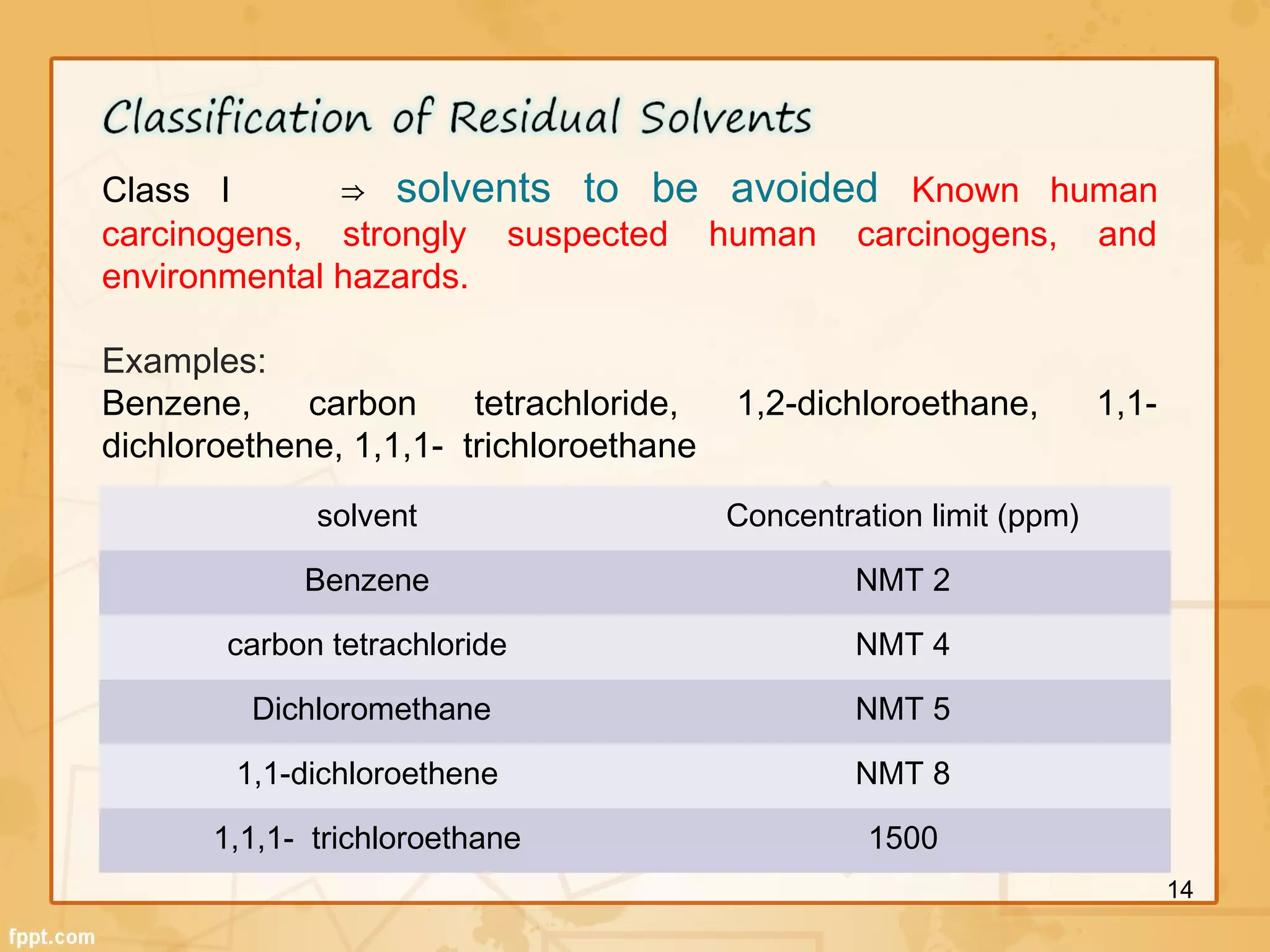
Class I ⇒ solvents to be avoided Known human
carcinogens, strongly suspected human carcinogens, and
environmental hazards.
Examples:
Benzene, carbon tetrachloride, 1,2-dichloroethane, 1,1-
dichloroethene, 1,1,1- trichloroethane
solvent Concentration limit (ppm)
Benzene NMT 2
carbon tetrachloride NMT 4
Dichloromethane NMT 5
1,1-dichloroethene NMT 8
1,1,1- trichloroethane 1500
14
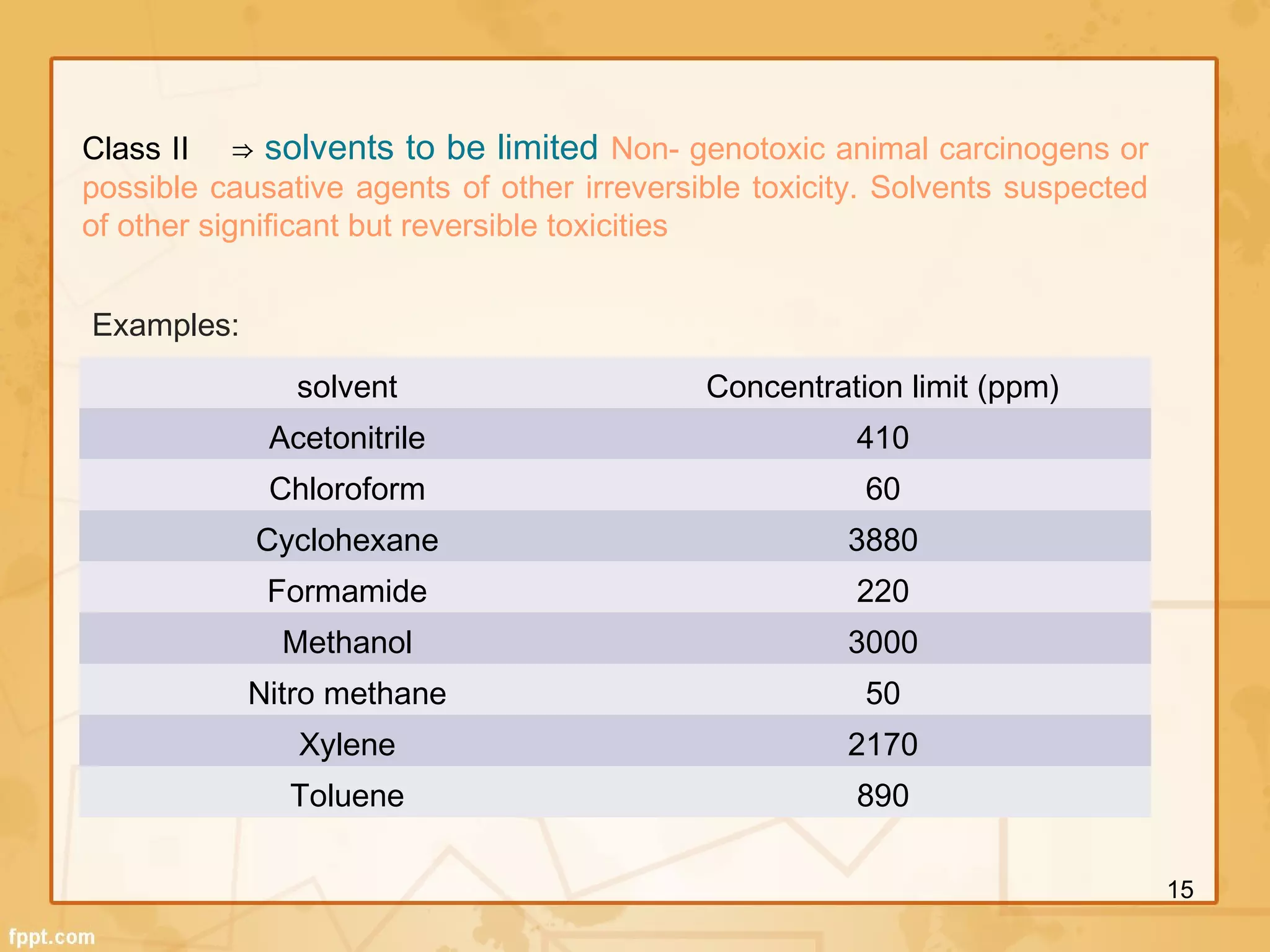
Class II ⇒ solvents to be limited Non- genotoxic animal carcinogens or
possible causative agents of other irreversible toxicity. Solvents suspected
of other significant but reversible toxicities
solvent Concentration limit (ppm)
Acetonitrile 410
Chloroform 60
Cyclohexane 3880
Formamide 220
Methanol 3000
Nitro methane 50
Xylene 2170
Toluene 890
Examples:
15
Class III⇒ solvents with low toxic potential Solvents with low
toxic potential to man; no health based exposure limit is needed.
Examples:
Acetone, butanol, butyl acetate, DMSO, ethanol, ethyl acetate, ethyl
ether, heptane, isopropanol, methylethyl ketone,
16
17
18
Maximum
Daily Dose
Reporting
Threshold
Identification
Threshold
Qualification
Threshold
≤ 2 g/day 0.05 % 0.10 % or
1.0 mg/day
0.15 % or
1.0mg/day
> 2 g/day 0.03 % 0.05 % 0.05 %
19
Reporting Threshold:
Is the limit above which an impurity should be Reported.
Identification Threshold:
The limit above the Identification Threshold should be Identified.
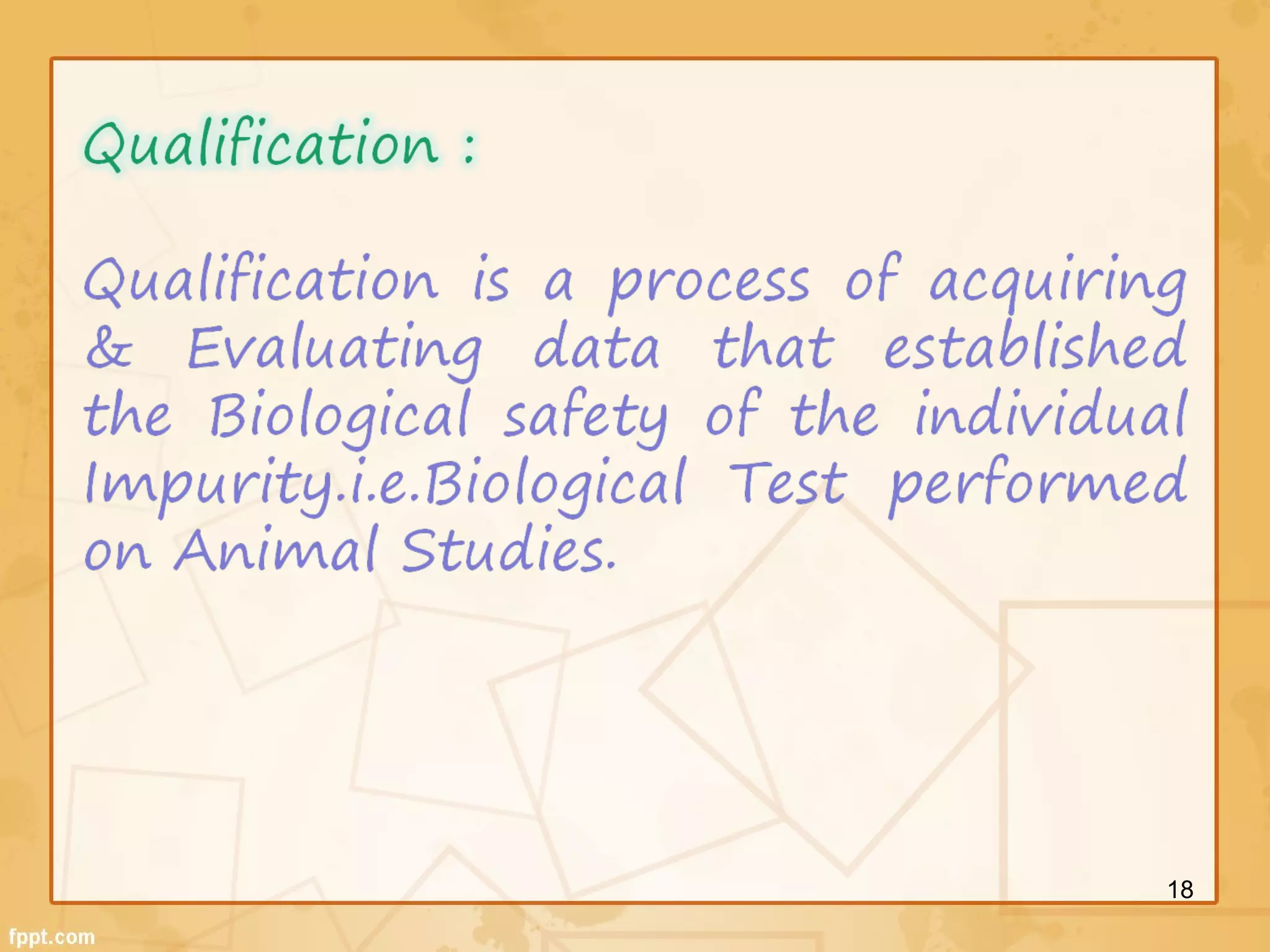
Qualification Threshold:
The limit greater than Identification Threshold should be Identified.
20
Is impurity limit greater than
identification threshold
Yes
No
Ye
s
Ye
s
Yes Ye
s
YesStructure
identified
Reduce to
NMT(≤)
identification
threshold
Conduct
genotoxiccity
for 14-19 days
No further
action
Any Known human
relevant risk ?
Reduce to NMT(≤)
Qualification
threshold
Checking whether
impurity Greater
than Qualification
threshold
Reduce to
safe level
No actionNo
No action
No
No
Identified Impurity
Un Identified
Impurity
Check for chemical
relevant side effects
Yes No action
No side effect
It is Qualified
Ye
s
The Impurity
reduced to safe
level
No
21
ICH official web site .www.ich.com
ICHGuidelines-Q3A(R2) : Impurities in New Drug Substances
ICHGuidelines-Q3B(R2) : Impurities in New Drug Products
ICHGuidelines-Q3C(R5) : Impurities: Guidelines for Residual
Solvents
CPMP/ICH/2737/99 : Impurities in New Drug
Substances
CPMP/ICH/283/95 : Impurities : Guidelines for
Residual Solvents 22
23

ICH Q3Impurities

  • 1.
  • 2.
  • 3.
    ICH GUIDELINESICH GUIDELINES Theinternational conference of harmonization is a technical requirements for Registration of pharmaceutical for human use is a unique project that bring together the regulatory authorities of Europe, Japan and the United States and experts from the pharmaceutical industry. MISSION: 1) To achieve greater harmonization. 2) To ensure that safe, Efficacy and high quality medicines are produced and registered in the most efficient manner. ICH: 1) Quality guidelines 2) Safety guidelines. 3) Efficacy guidelines. 4) Multidisciplinary guidelines. 3
  • 4.
    Impurities: A set ofthree guidelines addressing the chemistry and safety aspects of impurities, including the listing of impurities in specifications. Defines the thresholds for reporting, identification and qualification of impurities in API and finished product. Specific guideline on residual solvents. Objective : The objective of the Guideline makes recommendation to applicant on reporting, identifying and qualifying information on impurities in new drug substance. IntroductionIntroduction 4
  • 5.
  • 6.
    Classification of impurities Impurityis a component of New Drug Substance that is Not a chemical entity defined as New drug substance. ICH Q3 is divided into following types:ICH Q3 is divided into following types: ICH Q3 A R2 - Impurities in New Drug Substance ICH Q3 B R2 - Impurities in New Drug products ICH Q3 C R6 - Impurities in Residual Solvents ICH Q3 D - Guidelines on Elemental Impurities 6
  • 7.
    ICH Q3 AR2 Impurities in New Drug Substance that is impurities from API or Bulk drug Products. ICH Q3 B R2 Impurities in New Drug products that is impurities from any Formulations Products. ICH Q3 C R6 Impurities in Residual Solvents that is impurities from Intermediate Chemicals (or) solvents used in manufacturing process. 7
  • 8.
    Organic impurities  Organicimpurities can arise during manufacturing process  They can be identified or unidentified.  They may be volatile or non-volatile.  They are process related impurities  Starting materials  By-products  Intermediates  Degradation products 8
  • 9.
    Inorganic impurities: Inorganic impuritiescan result from the bulk drug manufacturing process. They are normally known and identified and include:  Reagents, ligands, catalysts  Heavy metals or other residual metals  Inorganic salts  Other impurities, e.g. filter aids, charcoal… 9
  • 10.
    Residual solvents Solvents arein organic or organic liquids used as vehicles for the preparation of solutions or suspensions in the synthesis of a new drug substance. Residual solvents in pharmaceuticals are defined as organic volatile chemicals that are used or produced in the manufacture of drug substances.   10
  • 11.
    Impurity Profile Is adescription of all the identified & unidentified impurities present in the New Drug Substance. Potential impurity Any impurity that theoretically can arise during manufacture or storage. Identified impurity Any impurity for which structural characterization has been done that identification of structure by Qualitative & Quantitative by Analytical methods. Un Identified impurity structural characterization not done. 11
  • 12.
    Specified Impurity: An impuritythat is individually listed and limited with specific acceptance criterion in the new drug substance specification. A specified impurity can be either identified or unidentified.   Unspecified Impurity: An impurity that is limited by a general acceptance criterion, but not individually listed with its own specific acceptance criterion, in the new drug substance specification.   12
  • 13.
    Class I ⇒solvents to be avoided Known human carcinogens, strongly suspected human carcinogens, and environmental hazards. Examples: Benzene, carbon tetrachloride, 1,2-dichloroethane, 1,1- dichloroethene, 1,1,1- trichloroethane solvent Concentration limit (ppm) Benzene NMT 2 carbon tetrachloride NMT 4 Dichloromethane NMT 5 1,1-dichloroethene NMT 8 1,1,1- trichloroethane 1500 14
  • 14.
    Class II ⇒solvents to be limited Non- genotoxic animal carcinogens or possible causative agents of other irreversible toxicity. Solvents suspected of other significant but reversible toxicities solvent Concentration limit (ppm) Acetonitrile 410 Chloroform 60 Cyclohexane 3880 Formamide 220 Methanol 3000 Nitro methane 50 Xylene 2170 Toluene 890 Examples: 15
  • 15.
    Class III⇒ solventswith low toxic potential Solvents with low toxic potential to man; no health based exposure limit is needed. Examples: Acetone, butanol, butyl acetate, DMSO, ethanol, ethyl acetate, ethyl ether, heptane, isopropanol, methylethyl ketone, 16
  • 16.
  • 17.
  • 18.
    Maximum Daily Dose Reporting Threshold Identification Threshold Qualification Threshold ≤ 2g/day 0.05 % 0.10 % or 1.0 mg/day 0.15 % or 1.0mg/day > 2 g/day 0.03 % 0.05 % 0.05 % 19
  • 19.
    Reporting Threshold: Is thelimit above which an impurity should be Reported. Identification Threshold: The limit above the Identification Threshold should be Identified. Qualification Threshold: The limit greater than Identification Threshold should be Identified. 20
  • 20.
    Is impurity limitgreater than identification threshold Yes No Ye s Ye s Yes Ye s YesStructure identified Reduce to NMT(≤) identification threshold Conduct genotoxiccity for 14-19 days No further action Any Known human relevant risk ? Reduce to NMT(≤) Qualification threshold Checking whether impurity Greater than Qualification threshold Reduce to safe level No actionNo No action No No Identified Impurity Un Identified Impurity Check for chemical relevant side effects Yes No action No side effect It is Qualified Ye s The Impurity reduced to safe level No 21
  • 21.
    ICH official website .www.ich.com ICHGuidelines-Q3A(R2) : Impurities in New Drug Substances ICHGuidelines-Q3B(R2) : Impurities in New Drug Products ICHGuidelines-Q3C(R5) : Impurities: Guidelines for Residual Solvents CPMP/ICH/2737/99 : Impurities in New Drug Substances CPMP/ICH/283/95 : Impurities : Guidelines for Residual Solvents 22
  • 22.