Advance Pharmaceutical Analysis
(MPA102T)
Topic
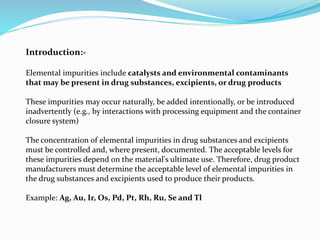
Introduction:-
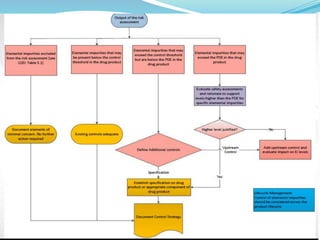
Elemental impurities include catalysts and environmental contaminants
that may be present in drug substances, excipients, or drug products
These impurities may occur naturally, be added intentionally, or be introduced
inadvertently (e.g., by interactions with processing equipment and the container
closure system)
The concentration of elemental impurities in drug substances and excipients
must be controlled and, where present, documented. The acceptable levels for
these impurities depend on the material's ultimate use. Therefore, drug product
manufacturers must determine the acceptable level of elemental impurities in
the drug substances and excipients used to produce their products.
Example: Ag, Au, Ir, Os, Pd, Pt, Rh, Ru, Se and Tl
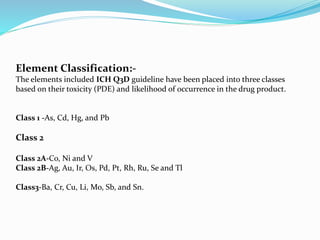
Element Classification:-
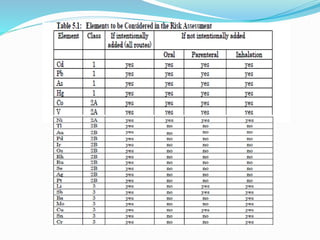
The elements included ICH Q3D guideline have been placed into three classes
based on their toxicity (PDE) and likelihood of occurrence in the drug product.
Class 1 -As, Cd, Hg, and Pb
Class 2
Class 2A-Co, Ni and V
Class 2B-Ag, Au, Ir, Os, Pd, Pt, Rh, Ru, Se and Tl
Class3-Ba, Cr, Cu, Li, Mo, Sb, and Sn.
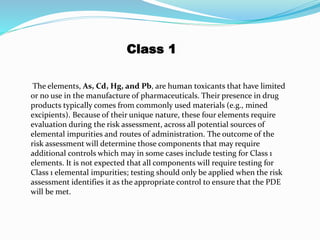
Class 1
The elements, As, Cd, Hg, and Pb, are human toxicants that have limited
or no use in the manufacture of pharmaceuticals. Their presence in drug
products typically comes from commonly used materials (e.g., mined
excipients). Because of their unique nature, these four elements require
evaluation during the risk assessment, across all potential sources of
elemental impurities and routes of administration. The outcome of the
risk assessment will determine those components that may require
additional controls which may in some cases include testing for Class 1
elements. It is not expected that all components will require testing for
Class 1 elemental impurities; testing should only be applied when the risk
assessment identifies it as the appropriate control to ensure that the PDE
will be met.
Class 2
Elements in this class are generally considered as route-dependent human
toxicants. Class 2 elements are further divided in sub-classes 2A and 2B based on
their relative likelihood of occurrence in the drug product.
Class 2A
Elements have relatively high probability of occurrence in the drug product and
thus require risk assessment across all potential sources of elemental impurities
and routes of administration (as indicated).
The class 2A elements are: Co, Ni and V.
Class 2B
elements have a reduced probability of occurrence in the drug product
related to their low abundance and low potential to be co-isolated with
other materials.
As a result, they may be excluded from the risk assessment unless they are
intentionally added during the manufacture of drug substances, excipients
or other components of the drug product.
The elemental impurities in class 2B include: Ag, Au, Ir, Os, Pd, Pt, Rh,
Ru, Se and Tl.
Class 3
The elements in this class have relatively low toxicities by the oral
route of administration (high PDEs, generally > 500 µg/day) but may
require consideration in the risk assessment for inhalation and
parenteral routes.
For oral routes of administration, unless these elements are
intentionally added, they do not need to be considered during the
risk assessment.
For parenteral and inhalation products, the potential for inclusion of
these elemental impurities should be evaluated during the risk
assessment, unless the route specific PDE is above 500 µg/day.
The elements in this class include: Ba, Cr, Cu, Li, Mo, Sb, and Sn
Other elements
Some elemental impurities for which PDEs have not been established
due to their low inherent toxicity and/or differences in regional
regulations are not addressed in this guideline.
If these elemental impurities are present or included in the drug
product they are addressed by other guidelines and/or regional
regulations and practices that may be applicable for particular elements
(e.g., Al for compromised renal function; Mn and Zn for patients with
compromised hepatic function), or quality considerations (e.g.,
presence of impurities in therapeutic proteins) for the final drug
product.
Some of the elements considered include: Al, B, Ca, Fe, K, Mg, Mn,
Na, W and Zn.
Referances:-
•https://www.ema.europa.eu/en/documents/scientific-
guideline/international-conference-harmonisation-technical-requirements-
registration-pharmaceuticals-human-use_en-32.pdf
•https://chemicalsolutionsltd.com/wp-content/uploads/2016/11/Module-6-
Controls-on-Elemental-Impurities.pdf

elemental classification & control of elemental impurities.pptx

  • 1.
  • 2.
    Introduction:- Elemental impurities includecatalysts and environmental contaminants that may be present in drug substances, excipients, or drug products These impurities may occur naturally, be added intentionally, or be introduced inadvertently (e.g., by interactions with processing equipment and the container closure system) The concentration of elemental impurities in drug substances and excipients must be controlled and, where present, documented. The acceptable levels for these impurities depend on the material's ultimate use. Therefore, drug product manufacturers must determine the acceptable level of elemental impurities in the drug substances and excipients used to produce their products. Example: Ag, Au, Ir, Os, Pd, Pt, Rh, Ru, Se and Tl
  • 3.
    Element Classification:- The elementsincluded ICH Q3D guideline have been placed into three classes based on their toxicity (PDE) and likelihood of occurrence in the drug product. Class 1 -As, Cd, Hg, and Pb Class 2 Class 2A-Co, Ni and V Class 2B-Ag, Au, Ir, Os, Pd, Pt, Rh, Ru, Se and Tl Class3-Ba, Cr, Cu, Li, Mo, Sb, and Sn.
  • 4.
    Class 1 The elements,As, Cd, Hg, and Pb, are human toxicants that have limited or no use in the manufacture of pharmaceuticals. Their presence in drug products typically comes from commonly used materials (e.g., mined excipients). Because of their unique nature, these four elements require evaluation during the risk assessment, across all potential sources of elemental impurities and routes of administration. The outcome of the risk assessment will determine those components that may require additional controls which may in some cases include testing for Class 1 elements. It is not expected that all components will require testing for Class 1 elemental impurities; testing should only be applied when the risk assessment identifies it as the appropriate control to ensure that the PDE will be met.
  • 5.
    Class 2 Elements inthis class are generally considered as route-dependent human toxicants. Class 2 elements are further divided in sub-classes 2A and 2B based on their relative likelihood of occurrence in the drug product. Class 2A Elements have relatively high probability of occurrence in the drug product and thus require risk assessment across all potential sources of elemental impurities and routes of administration (as indicated). The class 2A elements are: Co, Ni and V.
  • 6.
    Class 2B elements havea reduced probability of occurrence in the drug product related to their low abundance and low potential to be co-isolated with other materials. As a result, they may be excluded from the risk assessment unless they are intentionally added during the manufacture of drug substances, excipients or other components of the drug product. The elemental impurities in class 2B include: Ag, Au, Ir, Os, Pd, Pt, Rh, Ru, Se and Tl.
  • 7.
    Class 3 The elementsin this class have relatively low toxicities by the oral route of administration (high PDEs, generally > 500 µg/day) but may require consideration in the risk assessment for inhalation and parenteral routes. For oral routes of administration, unless these elements are intentionally added, they do not need to be considered during the risk assessment. For parenteral and inhalation products, the potential for inclusion of these elemental impurities should be evaluated during the risk assessment, unless the route specific PDE is above 500 µg/day. The elements in this class include: Ba, Cr, Cu, Li, Mo, Sb, and Sn
  • 8.
    Other elements Some elementalimpurities for which PDEs have not been established due to their low inherent toxicity and/or differences in regional regulations are not addressed in this guideline. If these elemental impurities are present or included in the drug product they are addressed by other guidelines and/or regional regulations and practices that may be applicable for particular elements (e.g., Al for compromised renal function; Mn and Zn for patients with compromised hepatic function), or quality considerations (e.g., presence of impurities in therapeutic proteins) for the final drug product. Some of the elements considered include: Al, B, Ca, Fe, K, Mg, Mn, Na, W and Zn.
  • 20.