ICH
HARMONISATION FOR BETTER HEALTH
ICH
International Council for Harmonisation of
Technical Requirement for Pharmaceutical for
Human Use.
Since-1990
HISTORY
The International Conference on Harmonisation (ICH) on 23
October 2015 establishing ICH as an international association, a
legal entry under Swiss Law.
The step built upon a 25 – Year track record of successful
delivery of harmonized guideline for global pharmaceutical
development as well as their regulation, and a longer standing
recognition of the need to harmonise.
MISSION
ICH is unique in bringing together the regulatory authorities
and pharmaceutical industry to discus scientific and technical
aspects of drug registration.
ICH’s mission is to achieve greater harmonisation worldwide to
ensure that safe, effective and high quality medicines are developed
and registered in the most resource – efficient manner.
MEMBERS & OBSERVERS
(AS of June 2019)
• EC, Europe
• FDA, United State
• MHLW/PMDA,
Japan
Founding
Regulatory
Members
• EFPIA
• JPMA
• PhRMA
Founding
Industry
Members
• Health Canada,
Canada
• Swissmedic,
Switzerland
Standing
Regulatory
Members
•ANVISA, Brazil
•HSA, Singapore
•MFDS, Republic of Korea
•NMPA, China
•TFDA, Chinese Taipei
Regulatory
Members
• BIO
• Global Self-Care
Federation
• IGBA
Industry
Members
• IFPMA
• WHO
Standing
Observers
•APEC
•ASEAN
•EAC
•GHC
•PANDRH
•SADC
Regional
Harmonisation
Initiatives
• APIC
International
Pharmaceutical
Industry Organization
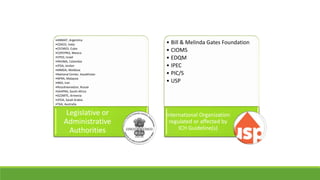
•ANMAT, Argentina
•CDSCO, India
•CECMED, Cuba
•COFEPRIS, Mexico
•CPED, Israel
•INVIMA, Colombia
•JFDA, Jordan
•MMDA, Moldova
•National Center, Kazakhstan
•NPRA, Malaysia
•NRA, Iran
•Roszdravnadzor, Russia
•SAHPRA, South Africa
•SCDMTE, Armenia
•SFDA, Saudi Arabia
•TGA, Australia
•TITCK, Turkey
Legislative or
Administrative
Authorities
• Bill & Melinda Gates Foundation
• CIOMS
• EDQM
• IPEC
• PIC/S
• USP
International Organization
regulated or affected by
ICH Guideline(s)
Process of Harmonisation
ICH harmonisation activities fall into 4 categories :
1) Formal ICH Procedure
2) Q & A Procedure
3) Revision Procedure
4) Maintenance Procedure
Each harmonisation activity is initiated by a Concept Paper
which is a short summary of the proposal.
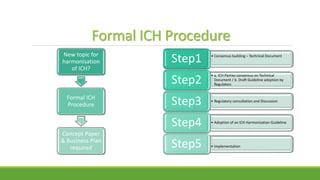
Formal ICH Procedure
New topic for
harmonisation
of ICH?
Formal ICH
Procedure
Concept Paper
& Business Plan
required
• Consensus building – Technical Document
Step1
• a. ICH Parties consensus on Technical
Document / b. Draft Guideline adoption by
RegulatorsStep2
• Regulatory consultation and Discussion
Step3
• Adoption of an ICH Harmonisation Guideline
Step4
• ImplementationStep5
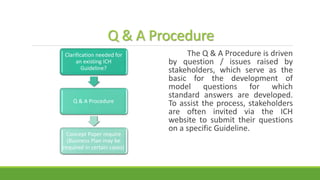
Q & A Procedure
The Q & A Procedure is driven
by question / issues raised by
stakeholders, which serve as the
basic for the development of
model questions for which
standard answers are developed.
To assist the process, stakeholders
are often invited via the ICH
website to submit their questions
on a specific Guideline.
Clarification needed for
an existing ICH
Guideline?
Q & A Procedure
Concept Paper require
(Business Plan may be
required in certain cases)
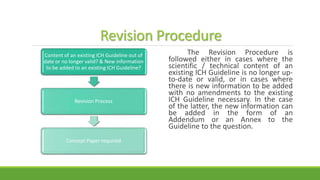
Revision Procedure
The Revision Procedure is
followed either in cases where the
scientific / technical content of an
existing ICH Guideline is no longer up-
to-date or valid, or in cases where
there is new information to be added
with no amendments to the existing
ICH Guideline necessary. In the case
of the latter, the new information can
be added in the form of an
Addendum or an Annex to the
Guideline to the question.
Content of an existing ICH Guideline out of
date or no longer valid? & New information
to be added to an existing ICH Guideline?
Revision Process
Concept Paper required
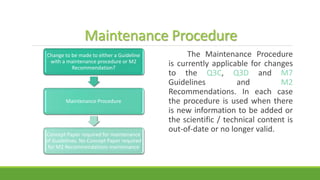
Maintenance Procedure
Change to be made to elther a Guideline
with a maintenance procedure or M2
Recommendation?
Maintenance Procedure
Concept Paper required for maintenance
of Guidelines. No Concept Paper required
for M2 Recommendations maintenance
The Maintenance Procedure
is currently applicable for changes
to the Q3C, Q3D and M7
Guidelines and M2
Recommendations. In each case
the procedure is used when there
is new information to be added or
the scientific / technical content is
out-of-date or no longer valid.
Public Consultation
You are intended to provide comments on any of the draft step
2b ICH Guideline.
Note that stakeholders from ICH Member Countries / Regions
are encouraged to submit their comments to their respective
Regulatory Authorities, noting the deadline for comments indicated
beneath each draft Guideline.
Stakeholders can also provide their comments by e-mailing the
ICH Secretariat at step2comments@ich.org.
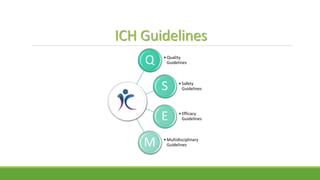
ICH Guidelines
Q •Quality
Guidelines
S •Safety
Guidelines
E •Efficacy
Guidelines
M •Multidisciplinary
Guidelines
Quality Guidelines
Harmonisation achievements in the Quality
area include pivotal milestones such as the
conduct of stability studies, defining relevant
thresholds for impurities testing and a more
flexible approach to pharmaceutical quality
based on Good Manufacturing Practice (GMP)
risk management.
Safety Guidelines
ICH has produced a comprehensive set of safety Guidelines
to uncover Potential risk like carcinogenicity, genotoxicity and
reprotoxicity. A recent breakthrough has been anon-clinical
testing strategy for assessing the QT interval prolongation
liability: the single most important cause of drug withdrawals in
recent years.
Stakeholders are invited to report Safety Guideline issue at
safety@ich.org.
Efficacy Guidelines
The work carried out by ICH under the
Efficacy heading is concerned with the design,
conduct, safety and reporting of clinical trials. It
also covers novel types of medicines derived
from biotechnological processes and the use of
pharmacogenomics techniques to produce
better targeted medicines.
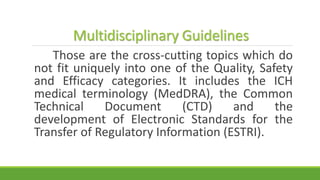
Multidisciplinary Guidelines
Those are the cross-cutting topics which do
not fit uniquely into one of the Quality, Safety
and Efficacy categories. It includes the ICH
medical terminology (MedDRA), the Common
Technical Document (CTD) and the
development of Electronic Standards for the
Transfer of Regulatory Information (ESTRI).
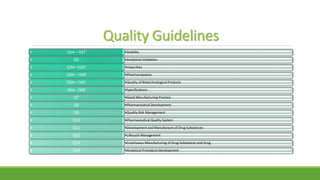
Quality Guidelines
•StabilityQ1A – Q1F
•Analytical ValidationQ2
•ImpuritiesQ3A –Q3D
•PharmacopoeiasQ4A – Q4B
•Quality of Biotechnological ProductsQ5A – Q5E
•SpecificationsQ6A –Q6B
•Good Manufacturing PracticeQ7
•Pharmaceutical DevelopmentQ8
•Quality Risk ManagementQ9
•Pharmaceutical Quality SystemQ10
•Development and Manufacture of Drug SubstancesQ11
•Lifecycle ManagementQ12
•Continuous Manufacturing of Drug Substances and DrugQ13
•Analytical Procedure DevelopmentQ14
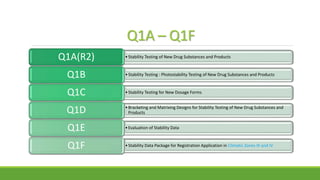
Q1A – Q1F
•Stability Testing of New Drug Substances and ProductsQ1A(R2)
•Stability Testing : Photostability Testing of New Drug Substances and ProductsQ1B
•Stability Testing for New Dosage FormsQ1C
•Bracketing and Matrixing Designs for Stability Testing of New Drug Substances and
ProductsQ1D
•Evaluation of Stability DataQ1E
•Stability Data Package for Registration Application in Climatic Zones III and IVQ1F
Climatic Zones for Stability studies
The climate is different in all
the countries in the world. Stability
studies of the pharmaceutical drug
should be done according to the
climatic conditions of the country.
According to the ICH Guidelines for
stability studies, the climate of the
world is divided into five different
Zone.
ZONE Types of Climate
Zone I Temperate zone
Zone II Mediterranean/ Subtropical
zone
Zone III Hot dry zone
Zone IVa Hot humid/ tropical zone
Zone IVb Hot/ higher humidity
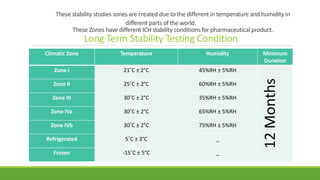
These stability studies zones are created due to the different in temperature and humidity in
different parts of the world.
These Zones have different ICH stability conditions for pharmaceutical product.
Long Term Stability Testing Condition
Climatic Zone Temperature Humidity Minimum
Duration
Zone I 21˚C ± 2°C 45%RH ± 5%RH
12Months
Zone II 25˚C ± 2°C 60%RH ± 5%RH
Zone III 30˚C ± 2°C 35%RH ± 5%RH
Zone IVa 30˚C ± 2°C 65%RH ± 5%RH
Zone IVb 30˚C ± 2°C 75%RH ± 5%RH
Refrigerated 5˚C ± 3°C _
Frozen -15˚C ± 5°C _
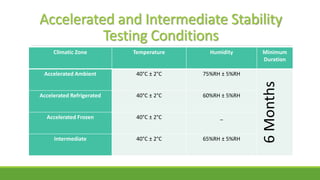
Accelerated and Intermediate Stability
Testing Conditions
Climatic Zone Temperature Humidity Minimum
Duration
Accelerated Ambient 40°C ± 2°C 75%RH ± 5%RH
6Months
Accelerated Refrigerated 40°C ± 2°C 60%RH ± 5%RH
Accelerated Frozen 40°C ± 2°C _
Intermediate 40°C ± 2°C 65%RH ± 5%RH
PRESENTATION
DESIGNED BY
Md Mostafijur Rahman
CONTENT FROM
Ich.org
Pharmaguideline.com
THANK YOU

ICH & It's Guidelines

  • 1.
  • 2.
    ICH International Council forHarmonisation of Technical Requirement for Pharmaceutical for Human Use. Since-1990
  • 3.
    HISTORY The International Conferenceon Harmonisation (ICH) on 23 October 2015 establishing ICH as an international association, a legal entry under Swiss Law. The step built upon a 25 – Year track record of successful delivery of harmonized guideline for global pharmaceutical development as well as their regulation, and a longer standing recognition of the need to harmonise.
  • 4.
    MISSION ICH is uniquein bringing together the regulatory authorities and pharmaceutical industry to discus scientific and technical aspects of drug registration. ICH’s mission is to achieve greater harmonisation worldwide to ensure that safe, effective and high quality medicines are developed and registered in the most resource – efficient manner.
  • 5.
    MEMBERS & OBSERVERS (ASof June 2019) • EC, Europe • FDA, United State • MHLW/PMDA, Japan Founding Regulatory Members • EFPIA • JPMA • PhRMA Founding Industry Members • Health Canada, Canada • Swissmedic, Switzerland Standing Regulatory Members •ANVISA, Brazil •HSA, Singapore •MFDS, Republic of Korea •NMPA, China •TFDA, Chinese Taipei Regulatory Members • BIO • Global Self-Care Federation • IGBA Industry Members • IFPMA • WHO Standing Observers •APEC •ASEAN •EAC •GHC •PANDRH •SADC Regional Harmonisation Initiatives • APIC International Pharmaceutical Industry Organization
  • 6.
    •ANMAT, Argentina •CDSCO, India •CECMED,Cuba •COFEPRIS, Mexico •CPED, Israel •INVIMA, Colombia •JFDA, Jordan •MMDA, Moldova •National Center, Kazakhstan •NPRA, Malaysia •NRA, Iran •Roszdravnadzor, Russia •SAHPRA, South Africa •SCDMTE, Armenia •SFDA, Saudi Arabia •TGA, Australia •TITCK, Turkey Legislative or Administrative Authorities • Bill & Melinda Gates Foundation • CIOMS • EDQM • IPEC • PIC/S • USP International Organization regulated or affected by ICH Guideline(s)
  • 7.
    Process of Harmonisation ICHharmonisation activities fall into 4 categories : 1) Formal ICH Procedure 2) Q & A Procedure 3) Revision Procedure 4) Maintenance Procedure Each harmonisation activity is initiated by a Concept Paper which is a short summary of the proposal.
  • 8.
    Formal ICH Procedure Newtopic for harmonisation of ICH? Formal ICH Procedure Concept Paper & Business Plan required • Consensus building – Technical Document Step1 • a. ICH Parties consensus on Technical Document / b. Draft Guideline adoption by RegulatorsStep2 • Regulatory consultation and Discussion Step3 • Adoption of an ICH Harmonisation Guideline Step4 • ImplementationStep5
  • 9.
    Q & AProcedure The Q & A Procedure is driven by question / issues raised by stakeholders, which serve as the basic for the development of model questions for which standard answers are developed. To assist the process, stakeholders are often invited via the ICH website to submit their questions on a specific Guideline. Clarification needed for an existing ICH Guideline? Q & A Procedure Concept Paper require (Business Plan may be required in certain cases)
  • 10.
    Revision Procedure The RevisionProcedure is followed either in cases where the scientific / technical content of an existing ICH Guideline is no longer up- to-date or valid, or in cases where there is new information to be added with no amendments to the existing ICH Guideline necessary. In the case of the latter, the new information can be added in the form of an Addendum or an Annex to the Guideline to the question. Content of an existing ICH Guideline out of date or no longer valid? & New information to be added to an existing ICH Guideline? Revision Process Concept Paper required
  • 11.
    Maintenance Procedure Change tobe made to elther a Guideline with a maintenance procedure or M2 Recommendation? Maintenance Procedure Concept Paper required for maintenance of Guidelines. No Concept Paper required for M2 Recommendations maintenance The Maintenance Procedure is currently applicable for changes to the Q3C, Q3D and M7 Guidelines and M2 Recommendations. In each case the procedure is used when there is new information to be added or the scientific / technical content is out-of-date or no longer valid.
  • 12.
    Public Consultation You areintended to provide comments on any of the draft step 2b ICH Guideline. Note that stakeholders from ICH Member Countries / Regions are encouraged to submit their comments to their respective Regulatory Authorities, noting the deadline for comments indicated beneath each draft Guideline. Stakeholders can also provide their comments by e-mailing the ICH Secretariat at step2comments@ich.org.
  • 13.
    ICH Guidelines Q •Quality Guidelines S•Safety Guidelines E •Efficacy Guidelines M •Multidisciplinary Guidelines
  • 14.
    Quality Guidelines Harmonisation achievementsin the Quality area include pivotal milestones such as the conduct of stability studies, defining relevant thresholds for impurities testing and a more flexible approach to pharmaceutical quality based on Good Manufacturing Practice (GMP) risk management.
  • 15.
    Safety Guidelines ICH hasproduced a comprehensive set of safety Guidelines to uncover Potential risk like carcinogenicity, genotoxicity and reprotoxicity. A recent breakthrough has been anon-clinical testing strategy for assessing the QT interval prolongation liability: the single most important cause of drug withdrawals in recent years. Stakeholders are invited to report Safety Guideline issue at safety@ich.org.
  • 16.
    Efficacy Guidelines The workcarried out by ICH under the Efficacy heading is concerned with the design, conduct, safety and reporting of clinical trials. It also covers novel types of medicines derived from biotechnological processes and the use of pharmacogenomics techniques to produce better targeted medicines.
  • 17.
    Multidisciplinary Guidelines Those arethe cross-cutting topics which do not fit uniquely into one of the Quality, Safety and Efficacy categories. It includes the ICH medical terminology (MedDRA), the Common Technical Document (CTD) and the development of Electronic Standards for the Transfer of Regulatory Information (ESTRI).
  • 18.
    Quality Guidelines •StabilityQ1A –Q1F •Analytical ValidationQ2 •ImpuritiesQ3A –Q3D •PharmacopoeiasQ4A – Q4B •Quality of Biotechnological ProductsQ5A – Q5E •SpecificationsQ6A –Q6B •Good Manufacturing PracticeQ7 •Pharmaceutical DevelopmentQ8 •Quality Risk ManagementQ9 •Pharmaceutical Quality SystemQ10 •Development and Manufacture of Drug SubstancesQ11 •Lifecycle ManagementQ12 •Continuous Manufacturing of Drug Substances and DrugQ13 •Analytical Procedure DevelopmentQ14
  • 19.
    Q1A – Q1F •StabilityTesting of New Drug Substances and ProductsQ1A(R2) •Stability Testing : Photostability Testing of New Drug Substances and ProductsQ1B •Stability Testing for New Dosage FormsQ1C •Bracketing and Matrixing Designs for Stability Testing of New Drug Substances and ProductsQ1D •Evaluation of Stability DataQ1E •Stability Data Package for Registration Application in Climatic Zones III and IVQ1F
  • 20.
    Climatic Zones forStability studies The climate is different in all the countries in the world. Stability studies of the pharmaceutical drug should be done according to the climatic conditions of the country. According to the ICH Guidelines for stability studies, the climate of the world is divided into five different Zone. ZONE Types of Climate Zone I Temperate zone Zone II Mediterranean/ Subtropical zone Zone III Hot dry zone Zone IVa Hot humid/ tropical zone Zone IVb Hot/ higher humidity
  • 21.
    These stability studieszones are created due to the different in temperature and humidity in different parts of the world. These Zones have different ICH stability conditions for pharmaceutical product. Long Term Stability Testing Condition Climatic Zone Temperature Humidity Minimum Duration Zone I 21˚C ± 2°C 45%RH ± 5%RH 12Months Zone II 25˚C ± 2°C 60%RH ± 5%RH Zone III 30˚C ± 2°C 35%RH ± 5%RH Zone IVa 30˚C ± 2°C 65%RH ± 5%RH Zone IVb 30˚C ± 2°C 75%RH ± 5%RH Refrigerated 5˚C ± 3°C _ Frozen -15˚C ± 5°C _
  • 22.
    Accelerated and IntermediateStability Testing Conditions Climatic Zone Temperature Humidity Minimum Duration Accelerated Ambient 40°C ± 2°C 75%RH ± 5%RH 6Months Accelerated Refrigerated 40°C ± 2°C 60%RH ± 5%RH Accelerated Frozen 40°C ± 2°C _ Intermediate 40°C ± 2°C 65%RH ± 5%RH
  • 23.
    PRESENTATION DESIGNED BY Md MostafijurRahman CONTENT FROM Ich.org Pharmaguideline.com THANK YOU