DRUG STABILITY: ICH
GUIDELINES
For Stability Testing of Drug
Substances And Drug Products
MANSI NARENDRASINH CHAUHAN
TOPIC: DRUG STABILITY: ICH GUIDELINES FOR
STABILITY TESTING OF DRUG SUBSTANCES AND DRUG
PRODUCTS
COURSE NAME: QUALITY MANAGEMENT SYSTEM
COURSE CODE: MQA102T
Presented By:
Mansi Narendrasinh Chauhan
1st Semester, Master of Pharmacy
Pharmaceutical Quality Assurance
Guided By:
Dr. Dulendra P. Damahe
Associate Professor
Smt. B.N.B Swaminarayan Pharmacy College, Salvav-Vapi
Department of Pharmaceutical Quality Assurance
CONTENTS
• DRUG STABILITY
1. Introduction
oTypes of Stability
o Physical Stability
o Chemical Stability
o Micro-biological Stability
o Factors Affecting Drug Stability
2. Mechanism of Drug Degradation
3/28/2022
MANSICHAUHAN SMT. B.N.B SPC Salvav-Vapi 3
CONTENTS
3. Stability study
o Accelerated stability studies
oLong-term stability studies
4. Stability testing
o Stability-indicating assay methods
oAnalytical method validation
• STABILITY TESTING OF NEW DRUG SUBSTANCES AND
PRODUCTS
5. Objectives
3/28/2022
MANSICHAUHAN SMT. B.N.B SPC Salvav-Vapi 4
CONTENTS
6. Scope
7. General Principles
• ICH Q1A(R2): GUIDELINES FOR DRUG SUBSTANCES &
PRODUCTS
8. General
9. Stress Testing
10. Selection Of Batches
11. Container Closure System
12. Specification
13. Testing Frequency
3/28/2022
MANSICHAUHAN SMT. B.N.B SPC Salvav-Vapi 5
CONTENTS
14. Storage Condition
15. Stability Commitment
16. Evaluation
17. Statement/Labeling
• QUESTIONS
• REFERENCES
3/28/2022
MANSICHAUHAN SMT. B.N.B SPC Salvav-Vapi 6
DRUG STABILITY
3/28/2022
MANSICHAUHAN SMT. B.N.B SPC Salvav-Vapi 7
1. INTRODUCTION
• Stability of A drug is defined as “the capacity of A drug substance or drug
product to remain within established specifications to maintain its identity,
strength, quality, and purity throughout the retest or expiration dating period”.
• Instability of a drug may cause undesired change in its performance or leads to
its failure. Given the fact that drug can degrade over time into A toxic substance,
it is important along with measuring how much of the drug is lost to always
identify the degradant. E.g.: Tetracycline was found to degrade into epianhydro
tetracycline which can cause Fanconi syndrome.
3/28/2022
MANSICHAUHAN SMT. B.N.B SPC Salvav-Vapi 8
3/28/2022
MANSICHAUHAN SMT. B.N.B SPC Salvav-Vapi 9
1. INTRODUCTION
Types Of Stability
1. INTRODUCTION
• Physical stability:
This implies that the drug product remains unchanged throughout its shelf life with
no alteration in its physical properties that include its appearance, organoleptic
properties, hardness, brittleness, and particle size. This stability is essential to
ensure drug efficacy and safety and should be maintained during all the stages of
the drug product formulation, manufacturing, packaging and storage and closely
monitored and evaluated via special tests that are decided according to the property
of interest.
3/28/2022
MANSICHAUHAN SMT. B.N.B SPC Salvav-Vapi 10
Types Of Stability
1. INTRODUCTION
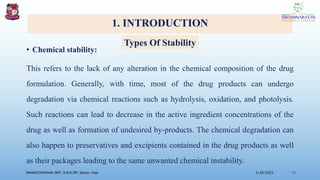
• Chemical stability:
This refers to the lack of any alteration in the chemical composition of the drug
formulation. Generally, with time, most of the drug products can undergo
degradation via chemical reactions such as hydrolysis, oxidation, and photolysis.
Such reactions can lead to decrease in the active ingredient concentrations of the
drug as well as formation of undesired by-products. The chemical degradation can
also happen to preservatives and excipients contained in the drug products as well
as their packages leading to the same unwanted chemical instability.
3/28/2022
MANSICHAUHAN SMT. B.N.B SPC Salvav-Vapi 11
Types Of Stability
1. INTRODUCTION
• Microbiological stability:
This refers to the sterility of the drug formulation and lack of contamination by
different types of microorganisms (e.g., Fungi and bacteria). Microbial growth in a
drug product can compromise its safety and lead to serious effects. Because of their
high moisture content, solutions and water based semi-solids drugs are more liable
to suffer from microbial contamination. This makes addition of antimicrobial
preservatives to those drug dosage forms essential to ensure their sterility.
3/28/2022
MANSICHAUHAN SMT. B.N.B SPC Salvav-Vapi 12
Types Of Stability
1. INTRODUCTION
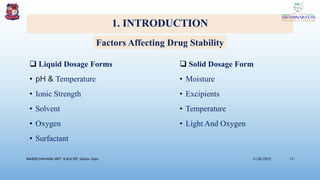
 Liquid Dosage Forms
• pH & Temperature
• Ionic Strength
• Solvent
• Oxygen
• Surfactant
 Solid Dosage Form
• Moisture
• Excipients
• Temperature
• Light And Oxygen
3/28/2022
MANSICHAUHAN SMT. B.N.B SPC Salvav-Vapi 13
Factors Affecting Drug Stability
2. MECHANISM OF DRUG DEGRADATION
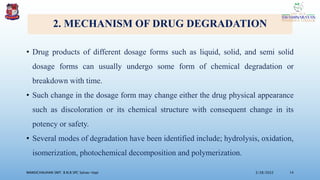
• Drug products of different dosage forms such as liquid, solid, and semi solid
dosage forms can usually undergo some form of chemical degradation or
breakdown with time.
• Such change in the dosage form may change either the drug physical appearance
such as discoloration or its chemical structure with consequent change in its
potency or safety.
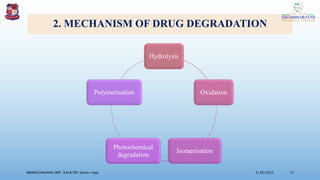
• Several modes of degradation have been identified include; hydrolysis, oxidation,
isomerization, photochemical decomposition and polymerization.
3/28/2022
MANSICHAUHAN SMT. B.N.B SPC Salvav-Vapi 14
2. MECHANISM OF DRUG DEGRADATION
Hydrolysis
Oxidation
Isomerisation
Photochemical
degradation
Polymerisation
3/28/2022
MANSICHAUHAN SMT. B.N.B SPC Salvav-Vapi 15
3. STABILITY STUDY
• Drug stability studies are conducted by drug companies to ensure that a drug can
meet the approved specification prior to its expiration date printed on the
package. Such studies are designed to define the degradation of drug product
over time and its shelf life based on the degradation curves.
• Generally, drug stability studies consist of a random sample of dosage units from
a given batch or several batches placed in a storage room with controlled
temperature and humidity conditions.
• Degradation is measured at fixed intervals such as 0, 3, 6, 12, 18, 24 months and
yearly afterwards, up to 5 years.
3/28/2022
MANSICHAUHAN SMT. B.N.B SPC Salvav-Vapi 16
3. STABILITY STUDY
• Short term studies or stress testing, Practical and economic approach as it speeds
up the rate of chemical or physical degradation of the drug product.
• High level of special temperature (e.g., 50, and 75°C) and relative humility
conditions (e.g., 75% or greater).
• Estimate essential kinetic parameters, establish the relationship between
decomposition and storage conditions, and to establish a tentative drug shelf life
for preparation and design of a long term stability study.
• Arrhenius regression model.
3/28/2022
MANSICHAUHAN SMT. B.N.B SPC Salvav-Vapi 17
Accelerated Stability Studies
3. STABILITY STUDY
• Carried out over a minimum of 12 months duration on at least three batches at
the time of submission and should be continued for a period of time that is
equivalent to the presumed shelf life.
• The drug product is stored at a room temperature, and humidity conditions, and
stability testing is performed under regular environmental conditions.
• There is usually a batch to batch variation leading to variation in the estimated
shelf life of different batches. For this reason, to estimate a single shelf life of the
drug, combining data from different batches is preferred.
3/28/2022
MANSICHAUHAN SMT. B.N.B SPC Salvav-Vapi 18
Long-Term Stability Studies
3. STABILITY STUDY
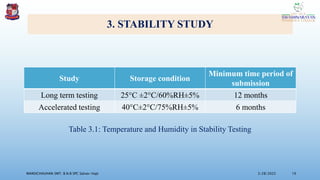
Study Storage condition
Minimum time period of
submission
Long term testing 25°C ±2°C/60%RH±5% 12 months
Accelerated testing 40°C±2°C/75%RH±5% 6 months
3/28/2022
MANSICHAUHAN SMT. B.N.B SPC Salvav-Vapi 19
Table 3.1: Temperature and Humidity in Stability Testing
4. STABILITY TESTING
• Stability testing as a requirement by regulatory agencies is developed to
determine the active ingredients of every newly made drug product in order to
evaluate and provide assurance on detection of changes in its identity, strength,
quality, potency and purity.
Techniques of stability-indicating assay
a) Titrimetric and spectrophotometric
b) Chromatographic
c) Miscellaneous
3/28/2022
MANSICHAUHAN SMT. B.N.B SPC Salvav-Vapi 20
Stability-indicating Assay Methods
Analytical Method Validation
STABILITY TESTING OF
NEW DRUG SUBSTANCES
AND PRODUCTS
3/28/2022
MANSICHAUHAN SMT. B.N.B SPC Salvav-Vapi 21
5. OBJECTIVES
• The ICH Q1A guideline and defines the stability data package for a new drug
substance or drug product that is sufficient for a registration application within
the three regions of the EC, Japan, and the united states.
• The guideline seeks to exemplify the core stability data package for new drug
substances and products but leaves sufficient flexibility to encompass the variety
of different practical situations that may be encountered due to specific scientific
considerations and characteristics of the materials being evaluated.
3/28/2022
MANSICHAUHAN SMT. B.N.B SPC Salvav-Vapi 22
6. SCOPE
• The guideline addresses the information to be submitted in registration
applications for new molecular entities and associated drug products.
• This guideline does not currently seek to cover the information to be submitted
for abbreviated or abridged applications, variations, clinical trial applications,
etc.
3/28/2022
MANSICHAUHAN SMT. B.N.B SPC Salvav-Vapi 23
7. GENERAL PRINCIPLES
• The purpose of stability testing is to provide evidence on how the quality of a
drug substance or drug product varies with time under the influence of a variety
of environmental factors such as temperature, humidity, and light, and to
establish a re-test period for the drug substance or a shelf life for the drug
product and recommended storage conditions.
• The choice of test conditions defined in this guideline is based on an analysis of
the effects of climatic conditions in the three regions of the EC, Japan and the
united states.
3/28/2022
MANSICHAUHAN SMT. B.N.B SPC Salvav-Vapi 24
7. GENERAL PRINCIPLES
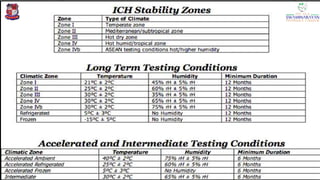
• The mean kinetic temperature in any part of the world can be derived from
climatic data, and the world can be divided into four climatic zones, I-IV.
• This guideline addresses climatic zones i and ii.
• The principle has been established that stability information generated in any one
of the three regions of the EC, Japan and the united states would be mutually
acceptable to the other two regions, provided the information is consistent with
this guideline and the labeling is in accord with national/regional requirements.
3/28/2022
MANSICHAUHAN SMT. B.N.B SPC Salvav-Vapi 25
ICH Q1A(R2): GUIDELINES
FOR DRUG SUBSTANCES &
PRODUCTS
3/28/2022
MANSICHAUHAN SMT. B.N.B SPC Salvav-Vapi 26
8. GENERAL
• Information on the stability of the drug substance is an integral part of the
systematic approach to stability evaluation.
• The design of the formal stability studies for the drug product should be based
on knowledge of the behavior and properties of the drug substance and from
stability studies on the drug substance and on experience gained from clinical
formulation studies. The likely changes on storage and the rationale for the
selection of attributes to be tested in the formal stability studies should be stated.
3/28/2022
MANSICHAUHAN SMT. B.N.B SPC Salvav-Vapi 27
9. STRESS TESTING
• Stress testing of the drug substance can help identify the likely degradation
products, which can in turn help establish the degradation pathways and the
intrinsic stability of the molecule and validate the stability indicating power of
the analytical procedures used.
• Stress testing is likely to be carried out on a single batch of the drug substance. It
should include the effect of temperatures (in 10°C increments (e.g., 50°C, 60°C,
etc.) Above that for accelerated testing), humidity (e.g., 75% RH or greater)
where appropriate, oxidation, and photolysis on the drug substance.
3/28/2022
MANSICHAUHAN SMT. B.N.B SPC Salvav-Vapi 28
9. STRESS TESTING
• The testing should also evaluate the susceptibility of the drug substance to
hydrolysis across a wide range of pH values when in solution or suspension.
• Photostability testing should be an integral part of stress testing. (ICH Q1b)
• Examining degradation products under stress conditions is useful in establishing
degradation pathways and developing and validating suitable analytical
procedures.
3/28/2022
MANSICHAUHAN SMT. B.N.B SPC Salvav-Vapi 29
10. SELECTION OF BATCHES
• Data from formal stability studies should be provided on at least three primary
batches of the drug substance manufactured.
• The batches should be manufactured to a minimum of pilot scale by the same
synthetic route as, and using a method of manufacture and procedure that
simulates the final process to be used for, production batches.
• The overall quality of the batches of drug substance placed on formal stability
studies should be representative of the quality of the material to be made on a
production scale.
3/28/2022
MANSICHAUHAN SMT. B.N.B SPC Salvav-Vapi 30
10. SELECTION OF BATCHES
• Data from stability studies should be provided on at least three primary batches
of the drug product.
• The primary batches should be of the same formulation and packaged in the same
container closure system as proposed for marketing.
• The manufacturing process used for primary batches should simulate that to be
applied to production batches and should provide product of the same quality and
meeting the same specification as that intended for marketing.
• Two of the three batches should be at least pilot scale batches and the third one
can be smaller, if justified.
3/28/2022
MANSICHAUHAN SMT. B.N.B SPC Salvav-Vapi 31
11. CONTAINER CLOSURE SYSTEM
• The stability studies should be conducted on the drug substance packaged in a
container closure system that is the same as or simulates the packaging proposed
for storage and distribution.
• Stability testing should be conducted on the dosage form packaged in the
container closure system proposed for marketing (including, as appropriate, any
secondary packaging and container label). Any available studies carried out on
the drug product outside its immediate container or in other packaging materials
can form a useful part of the stress testing of the dosage form or can be
considered as supporting information, respectively.
3/28/2022
MANSICHAUHAN SMT. B.N.B SPC Salvav-Vapi 32
12. SPECIFICATION
• Specification, which is a list of tests, reference to analytical procedures, and
proposed acceptance criteria, is addressed in ICH Q6A and Q6B. In addition,
specification for degradation products in a drug substance is discussed in Q3A.
• Stability studies should include testing of those attributes of the drug substance
that are susceptible to change during storage and are likely to influence quality,
safety, and/or efficacy.
• The testing should cover, as appropriate, the physical, chemical, biological, and
microbiological attributes. Validated stability-indicating analytical procedures
should be applied.
3/28/2022
MANSICHAUHAN SMT. B.N.B SPC Salvav-Vapi 33
12. SPECIFICATION
• Shelf life acceptance criteria should be derived from consideration of all
available stability information. It may be appropriate to have justifiable
differences between the shelf life and release acceptance criteria based on the
stability evaluation and the changes observed on storage.
• A single primary stability batch of the drug product should be tested for
antimicrobial preservative effectiveness at the proposed shelf life for verification
purposes, regardless of whether there is a difference between the release and
shelf life acceptance criteria for preservative content.
3/28/2022
MANSICHAUHAN SMT. B.N.B SPC Salvav-Vapi 34
13. TESTING FREQUENCY
• For long term studies, for drug substances with a proposed re-test period of at
least 12 months, the frequency of testing at the long term storage condition
should normally be every 3 months over the first year, every 6 months over the
second year, and annually thereafter through the proposed re-test period.
• At the accelerated storage condition, a minimum of three time points, including
the initial and final time points (e.g., 0, 3, and 6 months), from a 6-month study is
recommended.
3/28/2022
MANSICHAUHAN SMT. B.N.B SPC Salvav-Vapi 35
13. TESTING FREQUENCY
• Where an expectation exists that results from accelerated studies are likely to
approach significant change criteria, increased testing should be conducted either
by adding samples at the final time point or by including a fourth time point in
the study design.
• When testing at the intermediate storage condition is called for as a result of
significant change at the accelerated storage condition, a minimum of four time
points, including the initial and final time points (e.g., 0, 6, 9, 12 months), from a
12- month study is recommended.
3/28/2022
MANSICHAUHAN SMT. B.N.B SPC Salvav-Vapi 36
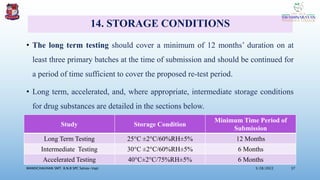
14. STORAGE CONDITIONS
• The long term testing should cover a minimum of 12 months’ duration on at
least three primary batches at the time of submission and should be continued for
a period of time sufficient to cover the proposed re-test period.
• Long term, accelerated, and, where appropriate, intermediate storage conditions
for drug substances are detailed in the sections below.
3/28/2022
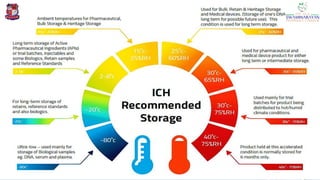
MANSICHAUHAN SMT. B.N.B SPC Salvav-Vapi 37
Study Storage Condition
Minimum Time Period of
Submission
Long Term Testing 25°C ±2°C/60%RH±5% 12 Months
Intermediate Testing 30°C ±2°C/60%RH±5% 6 Months
Accelerated Testing 40°C±2°C/75%RH±5% 6 Months
14. STORAGE CONDITIONS
• If long-term studies are conducted at 25°C ± 2°C/60% RH ± 5% RH and
“significant change” occurs at any time during 6 months’ testing at the
accelerated storage condition, additional testing at the intermediate storage
condition should be conducted and evaluated against significant change criteria.
• If significant change occurs within the first 3 months’ testing at the accelerated
storage condition, a discussion should be provided to address the effect of short
term excursions outside the label storage condition.
• Testing at the intermediate storage condition should The initial application
should include a minimum of 6 months’ data from a 12-month
3/28/2022
MANSICHAUHAN SMT. B.N.B SPC Salvav-Vapi 38
14. STORAGE CONDITIONS
• Data from refrigerated storage If significant change occurs between 3 and 6
months’ testing at the accelerated storage condition, the proposed re-test period
should be based on the real time data available at the long term storage condition.
• For drug substances intended for storage in a freezer, the re-test period should
be based on the real time data obtained at the long term storage condition.
• In the absence of an accelerated storage condition for drug substances intended to
be stored in a freezer, testing on a single batch at an elevated temperature (e.g.,
5°C ± 3°C or 25°C ± 2°C) for an appropriate time period should be conducted.
3/28/2022
MANSICHAUHAN SMT. B.N.B SPC Salvav-Vapi 39
3/28/2022
MANSICHAUHAN SMT. B.N.B SPC Salvav-Vapi 40
3/28/2022
MANSICHAUHAN SMT. B.N.B SPC Salvav-Vapi 41
15. STABILITY COMMITMENT
• When available long term stability data on primary batches do not cover the
proposed re-test period granted at the time of approval, a commitment should be
made to continue the stability studies post approval in order to firmly establish
the re-test period.
1. If the submission includes data from stability studies on at least three
production batches, a commitment should be made to continue these studies
through the proposed re-test period.
3/28/2022
MANSICHAUHAN SMT. B.N.B SPC Salvav-Vapi 42
15. STABILITY COMMITMENT
2. If the submission includes data from stability studies on fewer than three
production batches, a commitment should be made to continue these studies
through the proposed re-test period and to place additional production batches, to a
total of at least three, on long term stability studies through the proposed retest
period.
3. If the submission does not include stability data on production batches, a
commitment should be made to place the first three production batches on long
term stability studies through the proposed re-test period.
3/28/2022
MANSICHAUHAN SMT. B.N.B SPC Salvav-Vapi 43
16. EVALUATION
• The purpose of the stability study is to establish, the degree of variability of
individual batches affects the confidence that a future production batch will
remain within specification throughout the assigned re-test period.
• The data may show so little degradation and so little variability that it is apparent
from looking at the data that the requested re-test period. If analysis shows that
the batch-to-batch variability is small, it is advantageous to combine the data into
one overall estimate.
3/28/2022
MANSICHAUHAN SMT. B.N.B SPC Salvav-Vapi 44
16. EVALUATION
• This can be done by first applying appropriate statistical tests (e.g., P values for
level of significance of rejection of more than 0.25) to the slopes of the
regression lines and zero time intercepts for the individual batches.
• The nature of any degradation relationship will determine whether the data
should be transformed for linear regression analysis. Usually the relationship can
be represented by a linear, quadratic, or cubic function on an arithmetic or
logarithmic scale.
3/28/2022
MANSICHAUHAN SMT. B.N.B SPC Salvav-Vapi 45
16. EVALUATION
• Limited extrapolation of the real time data from the long term storage condition
beyond the observed range to extend the re-test period can be undertaken at
approval time, if justified. This justification should be based on what is known
about the mechanism of degradation, the results of testing under accelerated
conditions, the goodness of fit of any mathematical model, batch size, existence
of supporting stability data, etc.
• However, this extrapolation assumes that the same degradation relationship will
continue to apply beyond the observed data. Any evaluation should cover not
only the assay, but also the levels of degradation products and other appropriate
attributes.
3/28/2022
MANSICHAUHAN SMT. B.N.B SPC Salvav-Vapi 46
17. STATEMENTS/LABELLING
• A storage statement should be established for the labeling in accordance with
relevant national/regional requirements. The statement should be based on the
stability evaluation of the drug substance. Where applicable, specific instructions
should be provided, particularly for drug substances that cannot tolerate freezing.
Terms such as “ambient conditions” or “room temperature” should be avoided. A
re-test period should be derived from the stability information, and a retest date
should be displayed on the container label if appropriate.
3/28/2022
MANSICHAUHAN SMT. B.N.B SPC Salvav-Vapi 47
QUESTIONS
1) Enumerate ICH stability testing guidelines for new drug substances and
product. Briefly describe the following with respect to guidelines – climatic
zones, stress testing, storage conditions, evaluation of stability. (8M)
2) Discuss ICH stability testing guidelines for new drug substances and
product. (6M)(4R)
3/28/2022
MANSICHAUHAN SMT. B.N.B SPC Salvav-Vapi 48
18. REFERENCES
1. Wong, Anissa W., and Aruna Datla. "Assay and stability testing." Separation
science and technology. Vol. 6. Academic Press, 2005. pp 335-358.
2. Huynh-Ba K., Zahn M. Understanding ICH Guidelines Applicable to Stability
Testing. In: Huynh-Ba K. (eds) Handbook of Stability Testing in
Pharmaceutical Development. Springer, New York, NY, 2009.
3. Bakshi, Monika, and Saranjit Singh, "Development of validated stability-
indicating assay methods—critical review." Journal of pharmaceutical and
biomedical analysis. 28.6, 2002, 1011-1040.
3/28/2022
MANSICHAUHAN SMT. B.N.B SPC Salvav-Vapi 49
18. REFERENCES
4. Khalifa, Nagwa. “Empirical and kinetic models for the determination of
pharmaceutical product stability.” MS thesis. University of Waterloo, 2011.
5. ICH Q1A(R2): “Stability Testing Of New Drug Substances And Products.”
2003 https://database.ich.org/sites/default/files/Q1A%28R2%29%20Guideline.pdf
Accessed 02/12/2021; 23:43 pm
3/28/2022
MANSICHAUHAN SMT. B.N.B SPC Salvav-Vapi 50
3/28/2022
MANSICHAUHAN SMT. B.N.B SPC Salvav-Vapi 51

ICH Guidelines on Drug Stability .pptx

  • 1.
    DRUG STABILITY: ICH GUIDELINES ForStability Testing of Drug Substances And Drug Products MANSI NARENDRASINH CHAUHAN
  • 2.
    TOPIC: DRUG STABILITY:ICH GUIDELINES FOR STABILITY TESTING OF DRUG SUBSTANCES AND DRUG PRODUCTS COURSE NAME: QUALITY MANAGEMENT SYSTEM COURSE CODE: MQA102T Presented By: Mansi Narendrasinh Chauhan 1st Semester, Master of Pharmacy Pharmaceutical Quality Assurance Guided By: Dr. Dulendra P. Damahe Associate Professor Smt. B.N.B Swaminarayan Pharmacy College, Salvav-Vapi Department of Pharmaceutical Quality Assurance
  • 3.
    CONTENTS • DRUG STABILITY 1.Introduction oTypes of Stability o Physical Stability o Chemical Stability o Micro-biological Stability o Factors Affecting Drug Stability 2. Mechanism of Drug Degradation 3/28/2022 MANSICHAUHAN SMT. B.N.B SPC Salvav-Vapi 3
  • 4.
    CONTENTS 3. Stability study oAccelerated stability studies oLong-term stability studies 4. Stability testing o Stability-indicating assay methods oAnalytical method validation • STABILITY TESTING OF NEW DRUG SUBSTANCES AND PRODUCTS 5. Objectives 3/28/2022 MANSICHAUHAN SMT. B.N.B SPC Salvav-Vapi 4
  • 5.
    CONTENTS 6. Scope 7. GeneralPrinciples • ICH Q1A(R2): GUIDELINES FOR DRUG SUBSTANCES & PRODUCTS 8. General 9. Stress Testing 10. Selection Of Batches 11. Container Closure System 12. Specification 13. Testing Frequency 3/28/2022 MANSICHAUHAN SMT. B.N.B SPC Salvav-Vapi 5
  • 6.
    CONTENTS 14. Storage Condition 15.Stability Commitment 16. Evaluation 17. Statement/Labeling • QUESTIONS • REFERENCES 3/28/2022 MANSICHAUHAN SMT. B.N.B SPC Salvav-Vapi 6
  • 7.
  • 8.
    1. INTRODUCTION • Stabilityof A drug is defined as “the capacity of A drug substance or drug product to remain within established specifications to maintain its identity, strength, quality, and purity throughout the retest or expiration dating period”. • Instability of a drug may cause undesired change in its performance or leads to its failure. Given the fact that drug can degrade over time into A toxic substance, it is important along with measuring how much of the drug is lost to always identify the degradant. E.g.: Tetracycline was found to degrade into epianhydro tetracycline which can cause Fanconi syndrome. 3/28/2022 MANSICHAUHAN SMT. B.N.B SPC Salvav-Vapi 8
  • 9.
    3/28/2022 MANSICHAUHAN SMT. B.N.BSPC Salvav-Vapi 9 1. INTRODUCTION Types Of Stability
  • 10.
    1. INTRODUCTION • Physicalstability: This implies that the drug product remains unchanged throughout its shelf life with no alteration in its physical properties that include its appearance, organoleptic properties, hardness, brittleness, and particle size. This stability is essential to ensure drug efficacy and safety and should be maintained during all the stages of the drug product formulation, manufacturing, packaging and storage and closely monitored and evaluated via special tests that are decided according to the property of interest. 3/28/2022 MANSICHAUHAN SMT. B.N.B SPC Salvav-Vapi 10 Types Of Stability
  • 11.
    1. INTRODUCTION • Chemicalstability: This refers to the lack of any alteration in the chemical composition of the drug formulation. Generally, with time, most of the drug products can undergo degradation via chemical reactions such as hydrolysis, oxidation, and photolysis. Such reactions can lead to decrease in the active ingredient concentrations of the drug as well as formation of undesired by-products. The chemical degradation can also happen to preservatives and excipients contained in the drug products as well as their packages leading to the same unwanted chemical instability. 3/28/2022 MANSICHAUHAN SMT. B.N.B SPC Salvav-Vapi 11 Types Of Stability
  • 12.
    1. INTRODUCTION • Microbiologicalstability: This refers to the sterility of the drug formulation and lack of contamination by different types of microorganisms (e.g., Fungi and bacteria). Microbial growth in a drug product can compromise its safety and lead to serious effects. Because of their high moisture content, solutions and water based semi-solids drugs are more liable to suffer from microbial contamination. This makes addition of antimicrobial preservatives to those drug dosage forms essential to ensure their sterility. 3/28/2022 MANSICHAUHAN SMT. B.N.B SPC Salvav-Vapi 12 Types Of Stability
  • 13.
    1. INTRODUCTION  LiquidDosage Forms • pH & Temperature • Ionic Strength • Solvent • Oxygen • Surfactant  Solid Dosage Form • Moisture • Excipients • Temperature • Light And Oxygen 3/28/2022 MANSICHAUHAN SMT. B.N.B SPC Salvav-Vapi 13 Factors Affecting Drug Stability
  • 14.
    2. MECHANISM OFDRUG DEGRADATION • Drug products of different dosage forms such as liquid, solid, and semi solid dosage forms can usually undergo some form of chemical degradation or breakdown with time. • Such change in the dosage form may change either the drug physical appearance such as discoloration or its chemical structure with consequent change in its potency or safety. • Several modes of degradation have been identified include; hydrolysis, oxidation, isomerization, photochemical decomposition and polymerization. 3/28/2022 MANSICHAUHAN SMT. B.N.B SPC Salvav-Vapi 14
  • 15.
    2. MECHANISM OFDRUG DEGRADATION Hydrolysis Oxidation Isomerisation Photochemical degradation Polymerisation 3/28/2022 MANSICHAUHAN SMT. B.N.B SPC Salvav-Vapi 15
  • 16.
    3. STABILITY STUDY •Drug stability studies are conducted by drug companies to ensure that a drug can meet the approved specification prior to its expiration date printed on the package. Such studies are designed to define the degradation of drug product over time and its shelf life based on the degradation curves. • Generally, drug stability studies consist of a random sample of dosage units from a given batch or several batches placed in a storage room with controlled temperature and humidity conditions. • Degradation is measured at fixed intervals such as 0, 3, 6, 12, 18, 24 months and yearly afterwards, up to 5 years. 3/28/2022 MANSICHAUHAN SMT. B.N.B SPC Salvav-Vapi 16
  • 17.
    3. STABILITY STUDY •Short term studies or stress testing, Practical and economic approach as it speeds up the rate of chemical or physical degradation of the drug product. • High level of special temperature (e.g., 50, and 75°C) and relative humility conditions (e.g., 75% or greater). • Estimate essential kinetic parameters, establish the relationship between decomposition and storage conditions, and to establish a tentative drug shelf life for preparation and design of a long term stability study. • Arrhenius regression model. 3/28/2022 MANSICHAUHAN SMT. B.N.B SPC Salvav-Vapi 17 Accelerated Stability Studies
  • 18.
    3. STABILITY STUDY •Carried out over a minimum of 12 months duration on at least three batches at the time of submission and should be continued for a period of time that is equivalent to the presumed shelf life. • The drug product is stored at a room temperature, and humidity conditions, and stability testing is performed under regular environmental conditions. • There is usually a batch to batch variation leading to variation in the estimated shelf life of different batches. For this reason, to estimate a single shelf life of the drug, combining data from different batches is preferred. 3/28/2022 MANSICHAUHAN SMT. B.N.B SPC Salvav-Vapi 18 Long-Term Stability Studies
  • 19.
    3. STABILITY STUDY StudyStorage condition Minimum time period of submission Long term testing 25°C ±2°C/60%RH±5% 12 months Accelerated testing 40°C±2°C/75%RH±5% 6 months 3/28/2022 MANSICHAUHAN SMT. B.N.B SPC Salvav-Vapi 19 Table 3.1: Temperature and Humidity in Stability Testing
  • 20.
    4. STABILITY TESTING •Stability testing as a requirement by regulatory agencies is developed to determine the active ingredients of every newly made drug product in order to evaluate and provide assurance on detection of changes in its identity, strength, quality, potency and purity. Techniques of stability-indicating assay a) Titrimetric and spectrophotometric b) Chromatographic c) Miscellaneous 3/28/2022 MANSICHAUHAN SMT. B.N.B SPC Salvav-Vapi 20 Stability-indicating Assay Methods Analytical Method Validation
  • 21.
    STABILITY TESTING OF NEWDRUG SUBSTANCES AND PRODUCTS 3/28/2022 MANSICHAUHAN SMT. B.N.B SPC Salvav-Vapi 21
  • 22.
    5. OBJECTIVES • TheICH Q1A guideline and defines the stability data package for a new drug substance or drug product that is sufficient for a registration application within the three regions of the EC, Japan, and the united states. • The guideline seeks to exemplify the core stability data package for new drug substances and products but leaves sufficient flexibility to encompass the variety of different practical situations that may be encountered due to specific scientific considerations and characteristics of the materials being evaluated. 3/28/2022 MANSICHAUHAN SMT. B.N.B SPC Salvav-Vapi 22
  • 23.
    6. SCOPE • Theguideline addresses the information to be submitted in registration applications for new molecular entities and associated drug products. • This guideline does not currently seek to cover the information to be submitted for abbreviated or abridged applications, variations, clinical trial applications, etc. 3/28/2022 MANSICHAUHAN SMT. B.N.B SPC Salvav-Vapi 23
  • 24.
    7. GENERAL PRINCIPLES •The purpose of stability testing is to provide evidence on how the quality of a drug substance or drug product varies with time under the influence of a variety of environmental factors such as temperature, humidity, and light, and to establish a re-test period for the drug substance or a shelf life for the drug product and recommended storage conditions. • The choice of test conditions defined in this guideline is based on an analysis of the effects of climatic conditions in the three regions of the EC, Japan and the united states. 3/28/2022 MANSICHAUHAN SMT. B.N.B SPC Salvav-Vapi 24
  • 25.
    7. GENERAL PRINCIPLES •The mean kinetic temperature in any part of the world can be derived from climatic data, and the world can be divided into four climatic zones, I-IV. • This guideline addresses climatic zones i and ii. • The principle has been established that stability information generated in any one of the three regions of the EC, Japan and the united states would be mutually acceptable to the other two regions, provided the information is consistent with this guideline and the labeling is in accord with national/regional requirements. 3/28/2022 MANSICHAUHAN SMT. B.N.B SPC Salvav-Vapi 25
  • 26.
    ICH Q1A(R2): GUIDELINES FORDRUG SUBSTANCES & PRODUCTS 3/28/2022 MANSICHAUHAN SMT. B.N.B SPC Salvav-Vapi 26
  • 27.
    8. GENERAL • Informationon the stability of the drug substance is an integral part of the systematic approach to stability evaluation. • The design of the formal stability studies for the drug product should be based on knowledge of the behavior and properties of the drug substance and from stability studies on the drug substance and on experience gained from clinical formulation studies. The likely changes on storage and the rationale for the selection of attributes to be tested in the formal stability studies should be stated. 3/28/2022 MANSICHAUHAN SMT. B.N.B SPC Salvav-Vapi 27
  • 28.
    9. STRESS TESTING •Stress testing of the drug substance can help identify the likely degradation products, which can in turn help establish the degradation pathways and the intrinsic stability of the molecule and validate the stability indicating power of the analytical procedures used. • Stress testing is likely to be carried out on a single batch of the drug substance. It should include the effect of temperatures (in 10°C increments (e.g., 50°C, 60°C, etc.) Above that for accelerated testing), humidity (e.g., 75% RH or greater) where appropriate, oxidation, and photolysis on the drug substance. 3/28/2022 MANSICHAUHAN SMT. B.N.B SPC Salvav-Vapi 28
  • 29.
    9. STRESS TESTING •The testing should also evaluate the susceptibility of the drug substance to hydrolysis across a wide range of pH values when in solution or suspension. • Photostability testing should be an integral part of stress testing. (ICH Q1b) • Examining degradation products under stress conditions is useful in establishing degradation pathways and developing and validating suitable analytical procedures. 3/28/2022 MANSICHAUHAN SMT. B.N.B SPC Salvav-Vapi 29
  • 30.
    10. SELECTION OFBATCHES • Data from formal stability studies should be provided on at least three primary batches of the drug substance manufactured. • The batches should be manufactured to a minimum of pilot scale by the same synthetic route as, and using a method of manufacture and procedure that simulates the final process to be used for, production batches. • The overall quality of the batches of drug substance placed on formal stability studies should be representative of the quality of the material to be made on a production scale. 3/28/2022 MANSICHAUHAN SMT. B.N.B SPC Salvav-Vapi 30
  • 31.
    10. SELECTION OFBATCHES • Data from stability studies should be provided on at least three primary batches of the drug product. • The primary batches should be of the same formulation and packaged in the same container closure system as proposed for marketing. • The manufacturing process used for primary batches should simulate that to be applied to production batches and should provide product of the same quality and meeting the same specification as that intended for marketing. • Two of the three batches should be at least pilot scale batches and the third one can be smaller, if justified. 3/28/2022 MANSICHAUHAN SMT. B.N.B SPC Salvav-Vapi 31
  • 32.
    11. CONTAINER CLOSURESYSTEM • The stability studies should be conducted on the drug substance packaged in a container closure system that is the same as or simulates the packaging proposed for storage and distribution. • Stability testing should be conducted on the dosage form packaged in the container closure system proposed for marketing (including, as appropriate, any secondary packaging and container label). Any available studies carried out on the drug product outside its immediate container or in other packaging materials can form a useful part of the stress testing of the dosage form or can be considered as supporting information, respectively. 3/28/2022 MANSICHAUHAN SMT. B.N.B SPC Salvav-Vapi 32
  • 33.
    12. SPECIFICATION • Specification,which is a list of tests, reference to analytical procedures, and proposed acceptance criteria, is addressed in ICH Q6A and Q6B. In addition, specification for degradation products in a drug substance is discussed in Q3A. • Stability studies should include testing of those attributes of the drug substance that are susceptible to change during storage and are likely to influence quality, safety, and/or efficacy. • The testing should cover, as appropriate, the physical, chemical, biological, and microbiological attributes. Validated stability-indicating analytical procedures should be applied. 3/28/2022 MANSICHAUHAN SMT. B.N.B SPC Salvav-Vapi 33
  • 34.
    12. SPECIFICATION • Shelflife acceptance criteria should be derived from consideration of all available stability information. It may be appropriate to have justifiable differences between the shelf life and release acceptance criteria based on the stability evaluation and the changes observed on storage. • A single primary stability batch of the drug product should be tested for antimicrobial preservative effectiveness at the proposed shelf life for verification purposes, regardless of whether there is a difference between the release and shelf life acceptance criteria for preservative content. 3/28/2022 MANSICHAUHAN SMT. B.N.B SPC Salvav-Vapi 34
  • 35.
    13. TESTING FREQUENCY •For long term studies, for drug substances with a proposed re-test period of at least 12 months, the frequency of testing at the long term storage condition should normally be every 3 months over the first year, every 6 months over the second year, and annually thereafter through the proposed re-test period. • At the accelerated storage condition, a minimum of three time points, including the initial and final time points (e.g., 0, 3, and 6 months), from a 6-month study is recommended. 3/28/2022 MANSICHAUHAN SMT. B.N.B SPC Salvav-Vapi 35
  • 36.
    13. TESTING FREQUENCY •Where an expectation exists that results from accelerated studies are likely to approach significant change criteria, increased testing should be conducted either by adding samples at the final time point or by including a fourth time point in the study design. • When testing at the intermediate storage condition is called for as a result of significant change at the accelerated storage condition, a minimum of four time points, including the initial and final time points (e.g., 0, 6, 9, 12 months), from a 12- month study is recommended. 3/28/2022 MANSICHAUHAN SMT. B.N.B SPC Salvav-Vapi 36
  • 37.
    14. STORAGE CONDITIONS •The long term testing should cover a minimum of 12 months’ duration on at least three primary batches at the time of submission and should be continued for a period of time sufficient to cover the proposed re-test period. • Long term, accelerated, and, where appropriate, intermediate storage conditions for drug substances are detailed in the sections below. 3/28/2022 MANSICHAUHAN SMT. B.N.B SPC Salvav-Vapi 37 Study Storage Condition Minimum Time Period of Submission Long Term Testing 25°C ±2°C/60%RH±5% 12 Months Intermediate Testing 30°C ±2°C/60%RH±5% 6 Months Accelerated Testing 40°C±2°C/75%RH±5% 6 Months
  • 38.
    14. STORAGE CONDITIONS •If long-term studies are conducted at 25°C ± 2°C/60% RH ± 5% RH and “significant change” occurs at any time during 6 months’ testing at the accelerated storage condition, additional testing at the intermediate storage condition should be conducted and evaluated against significant change criteria. • If significant change occurs within the first 3 months’ testing at the accelerated storage condition, a discussion should be provided to address the effect of short term excursions outside the label storage condition. • Testing at the intermediate storage condition should The initial application should include a minimum of 6 months’ data from a 12-month 3/28/2022 MANSICHAUHAN SMT. B.N.B SPC Salvav-Vapi 38
  • 39.
    14. STORAGE CONDITIONS •Data from refrigerated storage If significant change occurs between 3 and 6 months’ testing at the accelerated storage condition, the proposed re-test period should be based on the real time data available at the long term storage condition. • For drug substances intended for storage in a freezer, the re-test period should be based on the real time data obtained at the long term storage condition. • In the absence of an accelerated storage condition for drug substances intended to be stored in a freezer, testing on a single batch at an elevated temperature (e.g., 5°C ± 3°C or 25°C ± 2°C) for an appropriate time period should be conducted. 3/28/2022 MANSICHAUHAN SMT. B.N.B SPC Salvav-Vapi 39
  • 40.
  • 41.
  • 42.
    15. STABILITY COMMITMENT •When available long term stability data on primary batches do not cover the proposed re-test period granted at the time of approval, a commitment should be made to continue the stability studies post approval in order to firmly establish the re-test period. 1. If the submission includes data from stability studies on at least three production batches, a commitment should be made to continue these studies through the proposed re-test period. 3/28/2022 MANSICHAUHAN SMT. B.N.B SPC Salvav-Vapi 42
  • 43.
    15. STABILITY COMMITMENT 2.If the submission includes data from stability studies on fewer than three production batches, a commitment should be made to continue these studies through the proposed re-test period and to place additional production batches, to a total of at least three, on long term stability studies through the proposed retest period. 3. If the submission does not include stability data on production batches, a commitment should be made to place the first three production batches on long term stability studies through the proposed re-test period. 3/28/2022 MANSICHAUHAN SMT. B.N.B SPC Salvav-Vapi 43
  • 44.
    16. EVALUATION • Thepurpose of the stability study is to establish, the degree of variability of individual batches affects the confidence that a future production batch will remain within specification throughout the assigned re-test period. • The data may show so little degradation and so little variability that it is apparent from looking at the data that the requested re-test period. If analysis shows that the batch-to-batch variability is small, it is advantageous to combine the data into one overall estimate. 3/28/2022 MANSICHAUHAN SMT. B.N.B SPC Salvav-Vapi 44
  • 45.
    16. EVALUATION • Thiscan be done by first applying appropriate statistical tests (e.g., P values for level of significance of rejection of more than 0.25) to the slopes of the regression lines and zero time intercepts for the individual batches. • The nature of any degradation relationship will determine whether the data should be transformed for linear regression analysis. Usually the relationship can be represented by a linear, quadratic, or cubic function on an arithmetic or logarithmic scale. 3/28/2022 MANSICHAUHAN SMT. B.N.B SPC Salvav-Vapi 45
  • 46.
    16. EVALUATION • Limitedextrapolation of the real time data from the long term storage condition beyond the observed range to extend the re-test period can be undertaken at approval time, if justified. This justification should be based on what is known about the mechanism of degradation, the results of testing under accelerated conditions, the goodness of fit of any mathematical model, batch size, existence of supporting stability data, etc. • However, this extrapolation assumes that the same degradation relationship will continue to apply beyond the observed data. Any evaluation should cover not only the assay, but also the levels of degradation products and other appropriate attributes. 3/28/2022 MANSICHAUHAN SMT. B.N.B SPC Salvav-Vapi 46
  • 47.
    17. STATEMENTS/LABELLING • Astorage statement should be established for the labeling in accordance with relevant national/regional requirements. The statement should be based on the stability evaluation of the drug substance. Where applicable, specific instructions should be provided, particularly for drug substances that cannot tolerate freezing. Terms such as “ambient conditions” or “room temperature” should be avoided. A re-test period should be derived from the stability information, and a retest date should be displayed on the container label if appropriate. 3/28/2022 MANSICHAUHAN SMT. B.N.B SPC Salvav-Vapi 47
  • 48.
    QUESTIONS 1) Enumerate ICHstability testing guidelines for new drug substances and product. Briefly describe the following with respect to guidelines – climatic zones, stress testing, storage conditions, evaluation of stability. (8M) 2) Discuss ICH stability testing guidelines for new drug substances and product. (6M)(4R) 3/28/2022 MANSICHAUHAN SMT. B.N.B SPC Salvav-Vapi 48
  • 49.
    18. REFERENCES 1. Wong,Anissa W., and Aruna Datla. "Assay and stability testing." Separation science and technology. Vol. 6. Academic Press, 2005. pp 335-358. 2. Huynh-Ba K., Zahn M. Understanding ICH Guidelines Applicable to Stability Testing. In: Huynh-Ba K. (eds) Handbook of Stability Testing in Pharmaceutical Development. Springer, New York, NY, 2009. 3. Bakshi, Monika, and Saranjit Singh, "Development of validated stability- indicating assay methods—critical review." Journal of pharmaceutical and biomedical analysis. 28.6, 2002, 1011-1040. 3/28/2022 MANSICHAUHAN SMT. B.N.B SPC Salvav-Vapi 49
  • 50.
    18. REFERENCES 4. Khalifa,Nagwa. “Empirical and kinetic models for the determination of pharmaceutical product stability.” MS thesis. University of Waterloo, 2011. 5. ICH Q1A(R2): “Stability Testing Of New Drug Substances And Products.” 2003 https://database.ich.org/sites/default/files/Q1A%28R2%29%20Guideline.pdf Accessed 02/12/2021; 23:43 pm 3/28/2022 MANSICHAUHAN SMT. B.N.B SPC Salvav-Vapi 50
  • 51.