Developing an effective
ICAAP
Chris Matten
31 May 2011
ww.pwc.com
PwC
Agenda
CAAP components
hallenges in implementing the ICAAP
oles of IA and risk management
ngoing maintenance
2
PwC
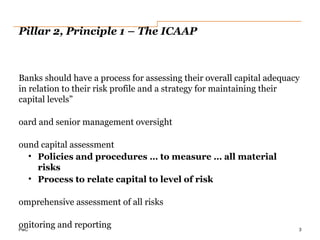
Pillar 2, Principle 1 – The ICAAP
Banks should have a process for assessing their overall capital adequacy
in relation to their risk profile and a strategy for maintaining their
capital levels”
oard and senior management oversight
ound capital assessment
• Policies and procedures … to measure … all material
risks
• Process to relate capital to level of risk
omprehensive assessment of all risks
onitoring and reporting 3
PwC
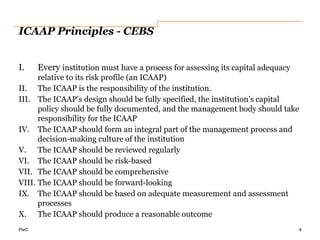
ICAAP Principles - CEBS
I. Every institution must have a process for assessing its capital adequacy
relative to its risk profile (an ICAAP)
II. The ICAAP is the responsibility of the institution.
III. The ICAAP’s design should be fully specified, the institution’s capital
policy should be fully documented, and the management body should take
responsibility for the ICAAP
IV. The ICAAP should form an integral part of the management process and
decision-making culture of the institution
V. The ICAAP should be reviewed regularly
VI. The ICAAP should be risk-based
VII. The ICAAP should be comprehensive
VIII. The ICAAP should be forward-looking
IX. The ICAAP should be based on adequate measurement and assessment
processes
X. The ICAAP should produce a reasonable outcome
4
PwC
ICAAP components
1. Description of risk governance
2. Statement of risk appetite
i. Link to risk limits
ii. Link to strategy
3. Comparison with risk-bearing capacity
4. Assessment of material risks
5. Comprehensive risk capital model (economic capital?)
6. Capital forecasts and stress tests, showing:
i. Regulatory capital
ii. Risk or economic capital
iii. Physical capital
iv. Available vs required capital
7. Capital allocation process and policies
8. Use test - embedded in business processes
5
PwC
Statement of risk appetite
1. Board-level document
2. Quantifies the desired level of risk that an institution is willing to
take.
3. Typically be expressed in terms of risk limits, but under an ICAAP
should also quantify those risk limits in terms of capital
4. Usually refreshed at least annually.
5. May be expressed in terms of earnings volatility (earnings
perspective), either in addition to or instead of the solvency
perspective.
6. Where an institution only uses an earnings perspective, meeting
Pillar 2 ICAAP requirements may be challenging
6
PwC
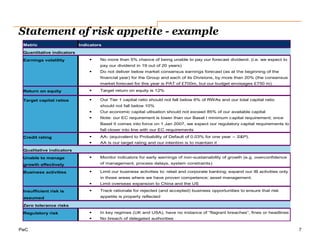
Statement of risk appetite - example
7
Metric Indicators
Quantitative indicators
Earnings volatility  No more than 5% chance of being unable to pay our forecast dividend. (i.e. we expect to
pay our dividend in 19 out of 20 years)
 Do not deliver below market consensus earnings forecast (as at the beginning of the
financial year) for the Group and each of its Divisions, by more than 20% (the consensus
market forecast for this year is PAT of £700m, but our budget envisages £750 m)
Return on equity  Target return on equity is 12%
Target capital ratios  Our Tier 1 capital ratio should not fall below 6% of RWAs and our total capital ratio
should not fall below 10%
 Our economic capital utlisation should not exceed 85% of our available capital
 Note: our EC requirement is lower than our Basel I minimum capital requirement; once
Basel II comes into force on 1 Jan 2007, we expect our regulatory capital requirements to
fall closer into line with our EC requirements
Credit rating  AA- (equivalent to Probability of Default of 0.03% for one year – S&P).
 AA is our target rating and our intention is to maintain it
Qualitative indicators
Unable to manage
growth effectively
 Monitor indicators for early warnings of non-sustainability of growth (e.g. overconfidence
of management, process delays, system constraints)
Business activities  Limit our business activities to: retail and corporate banking; expand our IB activities only
in those areas where we have proven competence; asset management.
 Limit overseas expansion to China and the US
Insufficient risk is
assumed
 Track rationale for rejected (and accepted) business opportunities to ensure that risk
appetite is properly reflected
Zero tolerance risks
Regulatory risk  In key regimes (UK and USA), have no instance of “flagrant breaches”, fines or headlines
 No breach of delegated authorities
PwC
Statement of risk-bearing capacity
1. Board-level document
2. Quantifies the ability of the institution to absorb risks
3. Typically expressed in terms of capital (solvency perspective) but
may also be expressed in an earnings perspective.
4. The statement of risk-bearing capacity and statement of risk
appetite are usually companion documents
8
PwC
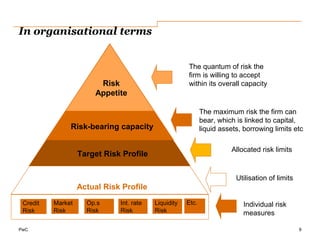
In organisational terms
9
Actual Risk Profile
Target Risk Profile
Risk-bearing capacity
Risk
Appetite
The quantum of risk the
firm is willing to accept
within its overall capacity
The maximum risk the firm can
bear, which is linked to capital,
liquid assets, borrowing limits etc
Allocated risk limits
Utilisation of limits
Credit
Risk
Market
Risk
Op.s
Risk
Int. rate
Risk
Liquidity
Risk
Etc. Individual risk
measures
PwC
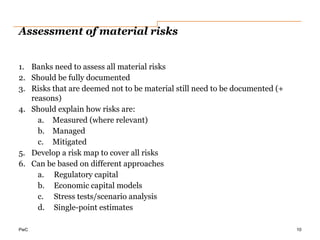
Assessment of material risks
1. Banks need to assess all material risks
2. Should be fully documented
3. Risks that are deemed not to be material still need to be documented (+
reasons)
4. Should explain how risks are:
a. Measured (where relevant)
b. Managed
c. Mitigated
5. Develop a risk map to cover all risks
6. Can be based on different approaches
a. Regulatory capital
b. Economic capital models
c. Stress tests/scenario analysis
d. Single-point estimates
10
PwC
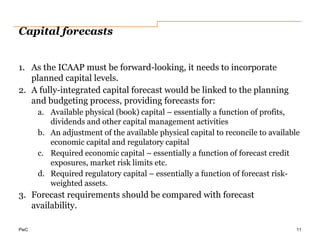
Capital forecasts
1. As the ICAAP must be forward-looking, it needs to incorporate
planned capital levels.
2. A fully-integrated capital forecast would be linked to the planning
and budgeting process, providing forecasts for:
a. Available physical (book) capital – essentially a function of profits,
dividends and other capital management activities
b. An adjustment of the available physical capital to reconcile to available
economic capital and regulatory capital
c. Required economic capital – essentially a function of forecast credit
exposures, market risk limits etc.
d. Required regulatory capital – essentially a function of forecast risk-
weighted assets.
3. Forecast requirements should be compared with forecast
availability.
11
PwC
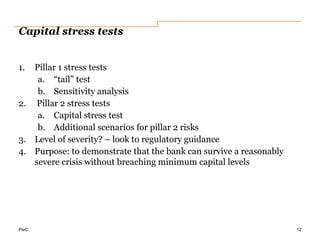
Capital stress tests
1. Pillar 1 stress tests
a. “tail” test
b. Sensitivity analysis
2. Pillar 2 stress tests
a. Capital stress test
b. Additional scenarios for pillar 2 risks
3. Level of severity? – look to regulatory guidance
4. Purpose: to demonstrate that the bank can survive a reasonably
severe crisis without breaching minimum capital levels
12
PwC
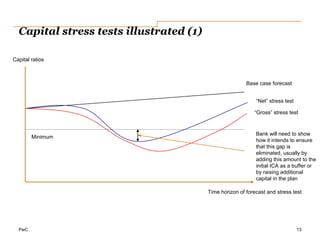
Capital stress tests illustrated (1)
13
Capital ratios
Time horizon of forecast and stress test
Minimum
Base case forecast
“Gross” stress test
“Net” stress test
Bank will need to show
how it intends to ensure
that this gap is
eliminated, usually by
adding this amount to the
initial ICA as a buffer or
by raising additional
capital in the plan
PwC
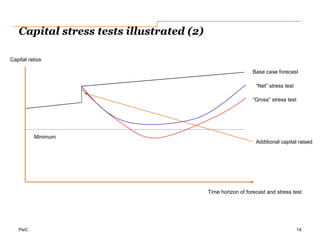
Capital stress tests illustrated (2)
14
Capital ratios
Time horizon of forecast and stress test
Minimum
Base case forecast
“Gross” stress test
“Net” stress test
Additional capital raised
PwC
Agenda
CAAP components
hallenges in implementing the ICAAP
oles of IA and risk management
ngoing maintenance
15
PwC
Challenges in implementation
1. Making it relevant for the business (and meeting the use test)
2. Defining risk appetite is not easy!
3. Assessment of material risks
a. Comprehensiveness
b. Appropriateness of approach
4. Capital forecasting
a. How robust is the planning/budgeting process?
b. Time horizon?
5. Capital stress testing
a. Is the stress scenario appropriate?
b. Are mitigating actions credible?
16
PwC
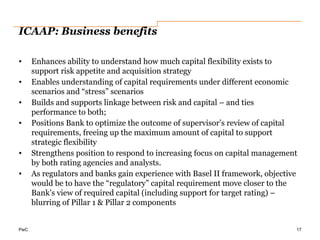
ICAAP: Business benefits
• Enhances ability to understand how much capital flexibility exists to
support risk appetite and acquisition strategy
• Enables understanding of capital requirements under different economic
scenarios and “stress” scenarios
• Builds and supports linkage between risk and capital – and ties
performance to both;
• Positions Bank to optimize the outcome of supervisor’s review of capital
requirements, freeing up the maximum amount of capital to support
strategic flexibility
• Strengthens position to respond to increasing focus on capital management
by both rating agencies and analysts.
• As regulators and banks gain experience with Basel II framework, objective
would be to have the “regulatory” capital requirement move closer to the
Bank’s view of required capital (including support for target rating) –
blurring of Pillar 1 & Pillar 2 components
17
PwC
Agenda
CAAP components
hallenges in implementing the ICAAP
oles of IA and risk management
ngoing maintenance
18
PwC
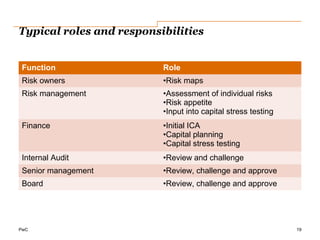
Typical roles and responsibilities
19
Function Role
Risk owners •Risk maps
Risk management •Assessment of individual risks
•Risk appetite
•Input into capital stress testing
Finance •Initial ICA
•Capital planning
•Capital stress testing
Internal Audit •Review and challenge
Senior management •Review, challenge and approve
Board •Review, challenge and approve
PwC
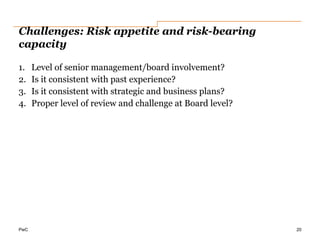
Challenges: Risk appetite and risk-bearing
capacity
1. Level of senior management/board involvement?
2. Is it consistent with past experience?
3. Is it consistent with strategic and business plans?
4. Proper level of review and challenge at Board level?
20
PwC
Challenges: Assessment of material risks
1. Was there full involvement of risk owners and risk management?
2. Risk maps fully documented?
3. Is it complete based on past experience?
4. Has all relevant date been incorporated into the assessment?
5. Is the modelling approach appropriate for the type of risk?
6. Has ‘material’ been clearly and properly defined?
7. Proper level of review and challenge at senior management and
Board level?
8. Arithmetic accuracy of Internal Capital Assessment?
21
PwC
Challenges: Capital planning
1. Robustness of underlying budgeting/planning process?
2. Appropriate time horizon (3-5 years)?
3. Sufficient granularity of detail?
a. Components of available capital?
b. Proper treatment of dividends etc?
c. Different assets classes?
d. Different RWA classes?
4. Consistent with past experience?
5. Arithmetic accuracy?
6. Proper challenge, review and sign-off?
22
PwC
Challenges: Capital stress testing
1. Is the severity of the stress scenario(s) appropriate?
2. Are the results consistent with the scenario(s) adopted?
3. Has there been proper involvement of all relevant departments?
a. Strategy
b. Economics
c. Business heads
d. Risk
e. Finance
4. Is it consistent with regulatory expectations?
5. Are management mitigating actions credible?
6. Arithmetic accuracy?
23
PwC
Challenges: Use test
1. How effectively is the ICAAP embedded into day-to-day
management processes?
a. Capital allocation
b. Capital budgeting and rationing
c. Performance measurement
d. Pricing
e. Compensation
f. Investor communications
g. Risk management (limits etc)
24
PwC
Challenges: Overall ICAAP governance
1. Was there a single ‘owner’ of the ICAAP to drive a consistent,
comprehensive approach?
2. Was there the right level of involvement of other stakeholders?
a. BUs, Risk, Finance, Strategy, Economics, etc?
3. Has senior management/the Board been actively involved in review
and challenge?
4. Was there a formal sign-off process?
5. Any involvement of external parties to develop/review the ICAAP?
a. Skills and qualifications?
b. Any issues raised by them not addressed?
25
PwC
Agenda
CAAP components
hallenges in implementing the ICAAP
oles of IA and risk management
ngoing maintenance
26
PwC
Ongoing maintenance
1. ICAAP should be refreshed at least annually
2. More frequently if:
a. Significant M&A or disposals
b. Significant changes in corporate structure
c. Material changes in regulatory requirements (e.g. Basel III)
d. Crisis occurs
3. If no major changes, it is a ‘refresh’, not a ‘re-do’
4. IA needs to review the process to ensure that:
a. All elements have been reviewed to ensure relevancy
b. Capital planning and stress testing updated
c. Proper review, challenge and approval
27
Thank you
his publication has been prepared for general guidance on matters of interest only, and does
not constitute professional advice. You should not act upon the information contained in this
publication without obtaining specific professional advice. No representation or warranty
(express or implied) is given as to the accuracy or completeness of the information contained
in this publication, and, to the extent permitted by law, [insert legal name of the PwC firm], its
members, employees and agents do not accept or assume any liability, responsibility or duty
of care for any consequences of you or anyone else acting, or refraining to act, in reliance on
the information contained in this publication or for any decision based on it.
© 2011 PricewaterhouseCoopers Limited. All rights reserved. In this document, “PwC” refers
to PricewaterhouseCoopers Limited which is a member firm of PricewaterhouseCoopers
International Limited, each member firm of which is a separate legal entity.

ICAAP - IBANK

  • 1.
    Developing an effective ICAAP ChrisMatten 31 May 2011 ww.pwc.com
  • 2.
    PwC Agenda CAAP components hallenges inimplementing the ICAAP oles of IA and risk management ngoing maintenance 2
  • 3.
    PwC Pillar 2, Principle1 – The ICAAP Banks should have a process for assessing their overall capital adequacy in relation to their risk profile and a strategy for maintaining their capital levels” oard and senior management oversight ound capital assessment • Policies and procedures … to measure … all material risks • Process to relate capital to level of risk omprehensive assessment of all risks onitoring and reporting 3
  • 4.
    PwC ICAAP Principles -CEBS I. Every institution must have a process for assessing its capital adequacy relative to its risk profile (an ICAAP) II. The ICAAP is the responsibility of the institution. III. The ICAAP’s design should be fully specified, the institution’s capital policy should be fully documented, and the management body should take responsibility for the ICAAP IV. The ICAAP should form an integral part of the management process and decision-making culture of the institution V. The ICAAP should be reviewed regularly VI. The ICAAP should be risk-based VII. The ICAAP should be comprehensive VIII. The ICAAP should be forward-looking IX. The ICAAP should be based on adequate measurement and assessment processes X. The ICAAP should produce a reasonable outcome 4
  • 5.
    PwC ICAAP components 1. Descriptionof risk governance 2. Statement of risk appetite i. Link to risk limits ii. Link to strategy 3. Comparison with risk-bearing capacity 4. Assessment of material risks 5. Comprehensive risk capital model (economic capital?) 6. Capital forecasts and stress tests, showing: i. Regulatory capital ii. Risk or economic capital iii. Physical capital iv. Available vs required capital 7. Capital allocation process and policies 8. Use test - embedded in business processes 5
  • 6.
    PwC Statement of riskappetite 1. Board-level document 2. Quantifies the desired level of risk that an institution is willing to take. 3. Typically be expressed in terms of risk limits, but under an ICAAP should also quantify those risk limits in terms of capital 4. Usually refreshed at least annually. 5. May be expressed in terms of earnings volatility (earnings perspective), either in addition to or instead of the solvency perspective. 6. Where an institution only uses an earnings perspective, meeting Pillar 2 ICAAP requirements may be challenging 6
  • 7.
    PwC Statement of riskappetite - example 7 Metric Indicators Quantitative indicators Earnings volatility  No more than 5% chance of being unable to pay our forecast dividend. (i.e. we expect to pay our dividend in 19 out of 20 years)  Do not deliver below market consensus earnings forecast (as at the beginning of the financial year) for the Group and each of its Divisions, by more than 20% (the consensus market forecast for this year is PAT of £700m, but our budget envisages £750 m) Return on equity  Target return on equity is 12% Target capital ratios  Our Tier 1 capital ratio should not fall below 6% of RWAs and our total capital ratio should not fall below 10%  Our economic capital utlisation should not exceed 85% of our available capital  Note: our EC requirement is lower than our Basel I minimum capital requirement; once Basel II comes into force on 1 Jan 2007, we expect our regulatory capital requirements to fall closer into line with our EC requirements Credit rating  AA- (equivalent to Probability of Default of 0.03% for one year – S&P).  AA is our target rating and our intention is to maintain it Qualitative indicators Unable to manage growth effectively  Monitor indicators for early warnings of non-sustainability of growth (e.g. overconfidence of management, process delays, system constraints) Business activities  Limit our business activities to: retail and corporate banking; expand our IB activities only in those areas where we have proven competence; asset management.  Limit overseas expansion to China and the US Insufficient risk is assumed  Track rationale for rejected (and accepted) business opportunities to ensure that risk appetite is properly reflected Zero tolerance risks Regulatory risk  In key regimes (UK and USA), have no instance of “flagrant breaches”, fines or headlines  No breach of delegated authorities
  • 8.
    PwC Statement of risk-bearingcapacity 1. Board-level document 2. Quantifies the ability of the institution to absorb risks 3. Typically expressed in terms of capital (solvency perspective) but may also be expressed in an earnings perspective. 4. The statement of risk-bearing capacity and statement of risk appetite are usually companion documents 8
  • 9.
    PwC In organisational terms 9 ActualRisk Profile Target Risk Profile Risk-bearing capacity Risk Appetite The quantum of risk the firm is willing to accept within its overall capacity The maximum risk the firm can bear, which is linked to capital, liquid assets, borrowing limits etc Allocated risk limits Utilisation of limits Credit Risk Market Risk Op.s Risk Int. rate Risk Liquidity Risk Etc. Individual risk measures
  • 10.
    PwC Assessment of materialrisks 1. Banks need to assess all material risks 2. Should be fully documented 3. Risks that are deemed not to be material still need to be documented (+ reasons) 4. Should explain how risks are: a. Measured (where relevant) b. Managed c. Mitigated 5. Develop a risk map to cover all risks 6. Can be based on different approaches a. Regulatory capital b. Economic capital models c. Stress tests/scenario analysis d. Single-point estimates 10
  • 11.
    PwC Capital forecasts 1. Asthe ICAAP must be forward-looking, it needs to incorporate planned capital levels. 2. A fully-integrated capital forecast would be linked to the planning and budgeting process, providing forecasts for: a. Available physical (book) capital – essentially a function of profits, dividends and other capital management activities b. An adjustment of the available physical capital to reconcile to available economic capital and regulatory capital c. Required economic capital – essentially a function of forecast credit exposures, market risk limits etc. d. Required regulatory capital – essentially a function of forecast risk- weighted assets. 3. Forecast requirements should be compared with forecast availability. 11
  • 12.
    PwC Capital stress tests 1.Pillar 1 stress tests a. “tail” test b. Sensitivity analysis 2. Pillar 2 stress tests a. Capital stress test b. Additional scenarios for pillar 2 risks 3. Level of severity? – look to regulatory guidance 4. Purpose: to demonstrate that the bank can survive a reasonably severe crisis without breaching minimum capital levels 12
  • 13.
    PwC Capital stress testsillustrated (1) 13 Capital ratios Time horizon of forecast and stress test Minimum Base case forecast “Gross” stress test “Net” stress test Bank will need to show how it intends to ensure that this gap is eliminated, usually by adding this amount to the initial ICA as a buffer or by raising additional capital in the plan
  • 14.
    PwC Capital stress testsillustrated (2) 14 Capital ratios Time horizon of forecast and stress test Minimum Base case forecast “Gross” stress test “Net” stress test Additional capital raised
  • 15.
    PwC Agenda CAAP components hallenges inimplementing the ICAAP oles of IA and risk management ngoing maintenance 15
  • 16.
    PwC Challenges in implementation 1.Making it relevant for the business (and meeting the use test) 2. Defining risk appetite is not easy! 3. Assessment of material risks a. Comprehensiveness b. Appropriateness of approach 4. Capital forecasting a. How robust is the planning/budgeting process? b. Time horizon? 5. Capital stress testing a. Is the stress scenario appropriate? b. Are mitigating actions credible? 16
  • 17.
    PwC ICAAP: Business benefits •Enhances ability to understand how much capital flexibility exists to support risk appetite and acquisition strategy • Enables understanding of capital requirements under different economic scenarios and “stress” scenarios • Builds and supports linkage between risk and capital – and ties performance to both; • Positions Bank to optimize the outcome of supervisor’s review of capital requirements, freeing up the maximum amount of capital to support strategic flexibility • Strengthens position to respond to increasing focus on capital management by both rating agencies and analysts. • As regulators and banks gain experience with Basel II framework, objective would be to have the “regulatory” capital requirement move closer to the Bank’s view of required capital (including support for target rating) – blurring of Pillar 1 & Pillar 2 components 17
  • 18.
    PwC Agenda CAAP components hallenges inimplementing the ICAAP oles of IA and risk management ngoing maintenance 18
  • 19.
    PwC Typical roles andresponsibilities 19 Function Role Risk owners •Risk maps Risk management •Assessment of individual risks •Risk appetite •Input into capital stress testing Finance •Initial ICA •Capital planning •Capital stress testing Internal Audit •Review and challenge Senior management •Review, challenge and approve Board •Review, challenge and approve
  • 20.
    PwC Challenges: Risk appetiteand risk-bearing capacity 1. Level of senior management/board involvement? 2. Is it consistent with past experience? 3. Is it consistent with strategic and business plans? 4. Proper level of review and challenge at Board level? 20
  • 21.
    PwC Challenges: Assessment ofmaterial risks 1. Was there full involvement of risk owners and risk management? 2. Risk maps fully documented? 3. Is it complete based on past experience? 4. Has all relevant date been incorporated into the assessment? 5. Is the modelling approach appropriate for the type of risk? 6. Has ‘material’ been clearly and properly defined? 7. Proper level of review and challenge at senior management and Board level? 8. Arithmetic accuracy of Internal Capital Assessment? 21
  • 22.
    PwC Challenges: Capital planning 1.Robustness of underlying budgeting/planning process? 2. Appropriate time horizon (3-5 years)? 3. Sufficient granularity of detail? a. Components of available capital? b. Proper treatment of dividends etc? c. Different assets classes? d. Different RWA classes? 4. Consistent with past experience? 5. Arithmetic accuracy? 6. Proper challenge, review and sign-off? 22
  • 23.
    PwC Challenges: Capital stresstesting 1. Is the severity of the stress scenario(s) appropriate? 2. Are the results consistent with the scenario(s) adopted? 3. Has there been proper involvement of all relevant departments? a. Strategy b. Economics c. Business heads d. Risk e. Finance 4. Is it consistent with regulatory expectations? 5. Are management mitigating actions credible? 6. Arithmetic accuracy? 23
  • 24.
    PwC Challenges: Use test 1.How effectively is the ICAAP embedded into day-to-day management processes? a. Capital allocation b. Capital budgeting and rationing c. Performance measurement d. Pricing e. Compensation f. Investor communications g. Risk management (limits etc) 24
  • 25.
    PwC Challenges: Overall ICAAPgovernance 1. Was there a single ‘owner’ of the ICAAP to drive a consistent, comprehensive approach? 2. Was there the right level of involvement of other stakeholders? a. BUs, Risk, Finance, Strategy, Economics, etc? 3. Has senior management/the Board been actively involved in review and challenge? 4. Was there a formal sign-off process? 5. Any involvement of external parties to develop/review the ICAAP? a. Skills and qualifications? b. Any issues raised by them not addressed? 25
  • 26.
    PwC Agenda CAAP components hallenges inimplementing the ICAAP oles of IA and risk management ngoing maintenance 26
  • 27.
    PwC Ongoing maintenance 1. ICAAPshould be refreshed at least annually 2. More frequently if: a. Significant M&A or disposals b. Significant changes in corporate structure c. Material changes in regulatory requirements (e.g. Basel III) d. Crisis occurs 3. If no major changes, it is a ‘refresh’, not a ‘re-do’ 4. IA needs to review the process to ensure that: a. All elements have been reviewed to ensure relevancy b. Capital planning and stress testing updated c. Proper review, challenge and approval 27
  • 28.
    Thank you his publicationhas been prepared for general guidance on matters of interest only, and does not constitute professional advice. You should not act upon the information contained in this publication without obtaining specific professional advice. No representation or warranty (express or implied) is given as to the accuracy or completeness of the information contained in this publication, and, to the extent permitted by law, [insert legal name of the PwC firm], its members, employees and agents do not accept or assume any liability, responsibility or duty of care for any consequences of you or anyone else acting, or refraining to act, in reliance on the information contained in this publication or for any decision based on it. © 2011 PricewaterhouseCoopers Limited. All rights reserved. In this document, “PwC” refers to PricewaterhouseCoopers Limited which is a member firm of PricewaterhouseCoopers International Limited, each member firm of which is a separate legal entity.