Payment Factories: different ways of achieving
payment efficiency
Jonathan Jordan
EMEA Payments Market Manager, Citi Transaction Services
The term Payment Factory is becoming increasingly talked about in the drive to achieve
payment processing efficiency. This article examines the route to setting up a Payments
Factory and highlights how – despite having one goal - Payment Factories take on many
forms.
Payment Factories
The term Payment Factory is used widely and is often interpreted in different ways.
Broadly speaking, a Payments Factory refers to an organisation establishing a central hub
to gain a degree of central control and management over the processing of previously
decentralised payment flows. The actual structure of a Payment Factory can manifest in
a number of ways with internal factors, such as configuration of processes, technology
and staff, and external factors, such as bank counterparties, connectivity and account
structures, leading to varying models.
One interpretation describes a Payment Factory as the construct resulting from a full
centralisation of both account payables processes and staff into a single location –as
within a Shared Services Centre (SSC) - while other organisations would consider a
Payments Factory to be a centralised hub, solely responsible for execution of payments to
banking partners and facilitated by decentralised accounts payable processes. Neither
interpretation is wrong therefore we need to understand the factors that influence a
Payments Factory set-up and what benefits can be realised.
Corporate Landscape
Today many corporates continue to manage their payments processing and bank accounts
at the business unit level or at the subsidiary level. While these methods may offer a
degree of flexibility, at the same time they can often result in poor visibility and high
maintenance costs. Multiple systems, banking relationships and processes tend to
introduce higher costs, lack of visibility into cash flows, complex approval processes,
operational risks, reporting challenges and a general lack of standardisation.
Cash management and payments processing structures will be influenced by various
factors including nature of business, trading model, location of buyers and suppliers, bank
relationships and degree of centralisation of processes. Payments setup will be influenced
by relationships with suppliers, operating currencies, bank connectivity and services,
technology/ERP status. Thus the starting point when evaluating payments structures will
likely be different for most corporates and also the benefits of centralisation.
While pressure to reduce costs has typically lead corporates to assess their processes,
SEPA developments are also leading organisations to focus on Payment Factories. The
European Parliament recently enacted a law which set 1st February 2014 as the end date,
within the Euro Member States, for the migration of Euro credit transfers and direct
debits to SEPA standards. This has focused many corporates to assess their existing Euro
payment flows in order to understand the impact of SEPA to their organisation and the
necessary preparation activities. As part of this SEPA effort, which promises
standardisation, efficiency and a reduction in Euro accounts, many are taking the
opportunity to evaluate their wider payments infrastructure.
What value can payments factories deliver?
A centralised approach to payment activities can help a corporate achieve benefits in a
number of areas dependent on their current activities and cash management strategy.
These include:
Increased Standardisation & Efficiency
 Gain consistency in payment process enabling automation, higher STP rates, less
manual activity and resultant cost reduction
 Ability to reduce number of banking relationships and rationalise account structures
 Standardisation of Euro payments processing through the utilisation of SEPA Credit
Transfers
 Harmonisation of bank connectivity and file formats utilising SWIFT and ISO
20022 XML
Increased Visibility & Control
 Visibility over internal payment and control over funding arrangement leading to
optimisation of liquidity
 Easier reporting for internal and regulatory purposes as payment information
becomes available centrally
 Fraud reduction through process management, visibility and implementation of
control policies
 Consolidated supplier visibility enabling better supply chain management and cost
negotiation
Lower Costs
 Lower transaction costs with better management of banking
 Improved Foreign Exchange spreads with consolidation of payment flows
 Better utilisation of available funds as funding processes and interest conditions are
optimized
Different starting points towards a Payments Factory
The structure of a corporate’s payments factory will vary depending on their existing
payment setup and the future cash management strategy of that organisation.
Organisations that are starting from a decentralised, multi-banked basis, will likely be
seeking, as their priority, control, visibility and standardisation over their payment flows.
This is typically achieved by either using a shared banking application or by adopting a
system that facilitates the receipt of instructions from business units and creates payment
files for onward delivery to banking partners. Essentially all external payments are sent
and all bank statements are received through a single delivery channel.
Those organisations that have already achieved a degree of payments centralisation will
be more focused on achieving further process efficiencies through improving straight-
through-processing (STP) rates, improving funding efficiency and automating processes.
In-House Banks, Netting and Payment-On-Behalf-Of (POBO) structures are also often
employed to facilitate intercompany activities, manage cash positions and aggregate
payment obligations.
Some important questions that need to be addressed at this stage include:
 How are payments processed today?
 How many banks are providing payment services?
 How does the communication take place with these providers?
 What are the core currencies for the organisation?
 Are incoming collections funding payments activities?
 Is there visibility and control across payment activities?
 How efficient is the funding process?
 Where is working capital trapped?
Varying corporate priorities
Having first understood the current structure, the next step is to define a future vision for
cash management and payment activities. This will inform the Payment Factory
priorities, help drive internal and external discussions and assist the process of
determining the payment factory solution. For some organisations the main focus and
priority will be increasing cash utilisation, for others it will be headcount reduction or
having a bank agnostic infrastructure. This vision is often driven by identifying the
immediate key challenges and cost areas in the corporates payments process. Discussions
with banking and technology partners can also help guide the decision making process
and help inform corporates of solutions that can support their Payment Factory model.
Corporates should consider the following:
 Scope (e.g. geographies and business units in scope, scope of change –processes,
staff numbers/location, intercompany activity)
 Banking Strategy (e.g. preferred number of payments processing partners, bank
capabilities, requirements for local account services)
 Liquidity Management (e.g. currencies, preferred account structures and locations,
funding arrangements, aggregation of liabilities, business unit control)
 Connectivity and File Formats (e.g. preferred method of bank communication,
relative importance of bank agnostic channels and formats SWIFT/ISO 20022
XML)
 Internal readiness to support changes in processes (e. g. changes in technology
required, ability to support changes in desired timelines, conflicting projects,
cultural hurdles such as local business unit autonomy)
 Legal and Tax (e.g. changes to account structures, tax implications, reporting
requirements
Desired Payment Factory models can vary based on multiple factors. While the drive
towards efficiency is common, so too is the use of technology as an enabler of payments
factories – today corporates are using, in varying ways, ERPs, TMS, online banking
applications, host to host connections and additional middleware to achieve their
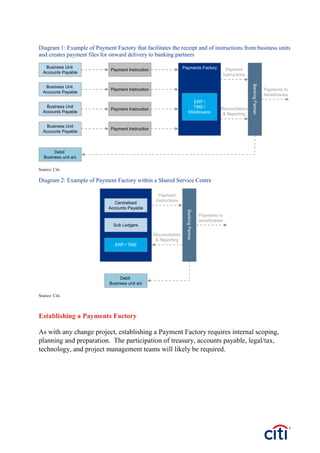
payments objectives. Below are some examples of how organisations can evolve their
Payments Factory set-up.
Diagram 1: Example of Payment Factory that facilitates the receipt and of instructions from business units
and creates payment files for onward delivery to banking partners
Business Unit
Accounts Payable
Business Unit
Accounts Payable
Business Unit
Accounts Payable
Business Unit
Accounts Payable
Payment Instruction
Payment Instruction
Payment Instruction
Payment Instruction
Debit
Business unit a/c
BankingPartner
Payment
Instructions
Reconciliation
& Reporting
Payments to
beneficiaries
Payments Factory
ERP /
TMS /
Middleware
Payments Factory
ERP /
TMS /
Middleware
Source: Citi.
Diagram 2: Example of Payment Factory within a Shared Service Centre
Debit
Business unit a/c
ERP / TMS
Centralised
Accounts Payable
Sub Ledgers
ERP / TMS
Centralised
Accounts Payable
Sub Ledgers
BankingPartner
Payment
Instructions
Reconciliation
& Reporting
Payments to
beneficiaries
Source: Citi.
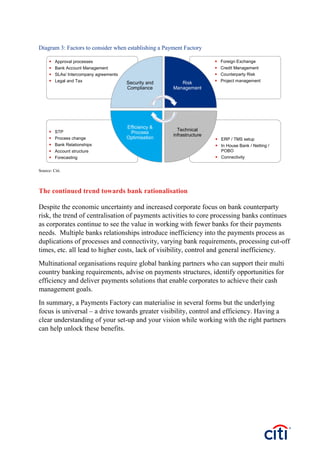
Establishing a Payments Factory
As with any change project, establishing a Payment Factory requires internal scoping,
planning and preparation. The participation of treasury, accounts payable, legal/tax,
technology, and project management teams will likely be required.
Diagram 3: Factors to consider when establishing a Payment Factory
 Foreign Exchange
 Credit Management
 Counterparty Risk
 Project management
 ERP / TMS setup
 In House Bank / Netting /
POBO
 Connectivity
 STP
 Process change
 Bank Relationships
 Account structure
 Forecasting
 Approval processes
 Bank Account Management
 SLAs/ Intercompany agreements
 Legal and Tax Security and
Compliance
Risk
Management
Efficiency &
Process
Optimisation
Technical
infrastructure
Source: Citi.
The continued trend towards bank rationalisation
Despite the economic uncertainty and increased corporate focus on bank counterparty
risk, the trend of centralisation of payments activities to core processing banks continues
as corporates continue to see the value in working with fewer banks for their payments
needs. Multiple banks relationships introduce inefficiency into the payments process as
duplications of processes and connectivity, varying bank requirements, processing cut-off
times, etc. all lead to higher costs, lack of visibility, control and general inefficiency.
Multinational organisations require global banking partners who can support their multi
country banking requirements, advise on payments structures, identify opportunities for
efficiency and deliver payments solutions that enable corporates to achieve their cash
management goals.
In summary, a Payments Factory can materialise in several forms but the underlying
focus is universal – a drive towards greater visibility, control and efficiency. Having a
clear understanding of your set-up and your vision while working with the right partners
can help unlock these benefits.
This article first appeared on gtnews.com in May 2012
About the Authors
Jonathan Jordan is currently the EMEA Payments Market Manager for Citi Transaction Services.
In this role Jonathan is responsible for positioning and packaging payments solutions for Citi
Transaction Services. He is based in London. Prior to this, Jonathan was a Business Development
Manager, responsible for executing partnerships and non-organic opportunities for Citi. He has as
also worked in cash management and trade services roles for Citi in other Western European and
Middle Eastern countries. Jonathan has been in the banking industry for nine years. He started his
career with Citi in New York after completing his degree in Business Information Systems from the
Dublin Institute of Technology, Ireland.
IRS Circular 230 Disclosure: Citigroup Inc. and its affiliates do not provide tax or legal advice. Any discussion of tax matters in
these materials (i) is not intended or written to be used, and cannot be used or relied upon, by you for the purpose of avoiding any
tax penalties and (ii) may have been written in connection with the "promotion or marketing" of any transaction contemplated
hereby ("Transaction"). Accordingly, you should seek advice based on your particular circumstances from an independent
tax advisor.
Any terms set forth herein are intended for discussion purposes only and are subject to the final terms as set forth in separate definitive
written agreements. This presentation is not a commitment to lend, syndicate a financing, underwrite or purchase securities, or commit
capital nor does it obligate us to enter into such a commitment, nor are we acting as a fiduciary to you. By accepting this presentation,
subject to applicable law or regulation, you agree to keep confidential the information contained herein and the existence of and proposed
terms for any Transaction.
Prior to entering into any Transaction, you should determine, without reliance upon us or our affiliates, the economic risks and merits (and
independently determine that you are able to assume these risks) as well as the legal, tax and accounting characterizations and
consequences of any such Transaction. In this regard, by accepting this presentation, you acknowledge that (a) we are not in the business
of providing (and you are not relying on us for) legal, tax or accounting advice, (b) there may be legal, tax or accounting risks associated with
any Transaction, (c) you should receive (and rely on) separate and qualified legal, tax and accounting advice and (d) you should apprise
senior management in your organization as to such legal, tax and accounting advice (and any risks associated with any Transaction) and
our disclaimer as to these matters. By acceptance of these materials, you and we hereby agree that from the commencement of
discussions with respect to any Transaction, and notwithstanding any other provision in this presentation, we hereby confirm that no
participant in any Transaction shall be limited from disclosing the U.S. tax treatment or U.S. tax structure of such Transaction.
We are required to obtain, verify and record certain information that identifies each entity that enters into a formal business relationship with
us. We will ask for your complete name, street address, and taxpayer ID number. We may also request corporate formation documents, or
other forms of identification, to verify information provided.
Any prices or levels contained herein are preliminary and indicative only and do not represent bids or offers. These indications are provided
solely for your information and consideration, are subject to change at any time without notice and are not intended as a solicitation with
respect to the purchase or sale of any instrument. The information contained in this presentation may include results of analyses from a
quantitative model which represent potential future events that may or may not be realized, and is not a complete analysis of every material
fact representing any product. Any estimates included herein constitute our judgment as of the date hereof and are subject to change
without any notice. We and/or our affiliates may make a market in these instruments for our customers and for our own account.
Accordingly, we may have a position in any such instrument at any time.
Although this material may contain publicly available information about Citi corporate bond research, fixed income strategy or economic and
market analysis, Citi policy (i) prohibits employees from offering, directly or indirectly, a favorable or negative research opinion or offering to
change an opinion as consideration or inducement for the receipt of business or for compensation; and (ii) prohibits analysts from being
compensated for specific recommendations or views contained in research reports. So as to reduce the potential for conflicts of interest, as
well as to reduce any appearance of conflicts of interest, Citi has enacted policies and procedures designed to limit communications
between its investment banking and research personnel to specifically prescribed circumstances.
[TRADEMARK SIGNOFF: add the appropriate signoff for the relevant legal vehicle]
© 2012 Citigroup Global Markets Inc. Member SIPC. All rights reserved. Citi and Citi and Arc Design are trademarks and service marks of
Citigroup Inc. or its affiliates and are used and registered throughout the world.
© 2012 Citigroup Global Markets Limited. Authorized and regulated by the Financial Services Authority. All rights reserved. Citi and Citi
and Arc Design are trademarks and service marks of Citigroup Inc. or its affiliates and are used and registered throughout the world.
© 2012 Citibank, N.A. All rights reserved. Citi and Citi and Arc Design are trademarks and service marks of Citigroup Inc. or its affiliates
and are used and registered throughout the world.
© 2012 Citigroup Inc. All rights reserved. Citi and Citi and Arc Design are trademarks and service marks of Citigroup Inc. or its affiliates and
are used and registered throughout the world.
© 2012 [Name of Legal Vehicle] [Name of regulatory body.] All rights reserved. Citi and Citi and Arc Design are trademarks and service
marks of Citigroup Inc. or its affiliates and are used and registered throughout the world.
Citi believes that sustainability is good business practice. We work closely with our clients, peer financial institutions, NGOs and other
partners to finance solutions to climate change, develop industry standards, reduce our own environmental footprint, and engage with
stakeholders to advance shared learning and solutions. Highlights of Citi’s unique role in promoting sustainability include: (a) releasing in
2007 a Climate Change Position Statement, the first US financial institution to do so; (b) targeting $50 billion over 10 years to address global
climate change: includes significant increases in investment and financing of renewable energy, clean technology, and other carbon-
emission reduction activities; (c) committing to an absolute reduction in GHG emissions of all Citi owned and leased properties around the
world by 10% by 2011; (d) purchasing more than 234,000 MWh of carbon neutral power for our operations over the last three years;
(e) establishing in 2008 the Carbon Principles; a framework for banks and their U.S. power clients to evaluate and address carbon risks in
the financing of electric power projects; (f) producing equity research related to climate issues that helps to inform investors on risks and
opportunities associated with the issue; and (g) engaging with a broad range of stakeholders on the issue of climate change to help advance
understanding and solutions.
Citi works with its clients in greenhouse gas intensive industries to evaluate emerging risks from climate change and, where appropriate, to
mitigate those risks.
efficiency, renewable energy & mitigation

Payment factory - IBANK

  • 1.
    Payment Factories: differentways of achieving payment efficiency Jonathan Jordan EMEA Payments Market Manager, Citi Transaction Services
  • 2.
    The term PaymentFactory is becoming increasingly talked about in the drive to achieve payment processing efficiency. This article examines the route to setting up a Payments Factory and highlights how – despite having one goal - Payment Factories take on many forms. Payment Factories The term Payment Factory is used widely and is often interpreted in different ways. Broadly speaking, a Payments Factory refers to an organisation establishing a central hub to gain a degree of central control and management over the processing of previously decentralised payment flows. The actual structure of a Payment Factory can manifest in a number of ways with internal factors, such as configuration of processes, technology and staff, and external factors, such as bank counterparties, connectivity and account structures, leading to varying models. One interpretation describes a Payment Factory as the construct resulting from a full centralisation of both account payables processes and staff into a single location –as within a Shared Services Centre (SSC) - while other organisations would consider a Payments Factory to be a centralised hub, solely responsible for execution of payments to banking partners and facilitated by decentralised accounts payable processes. Neither interpretation is wrong therefore we need to understand the factors that influence a Payments Factory set-up and what benefits can be realised. Corporate Landscape Today many corporates continue to manage their payments processing and bank accounts at the business unit level or at the subsidiary level. While these methods may offer a degree of flexibility, at the same time they can often result in poor visibility and high maintenance costs. Multiple systems, banking relationships and processes tend to introduce higher costs, lack of visibility into cash flows, complex approval processes, operational risks, reporting challenges and a general lack of standardisation. Cash management and payments processing structures will be influenced by various factors including nature of business, trading model, location of buyers and suppliers, bank relationships and degree of centralisation of processes. Payments setup will be influenced by relationships with suppliers, operating currencies, bank connectivity and services, technology/ERP status. Thus the starting point when evaluating payments structures will likely be different for most corporates and also the benefits of centralisation. While pressure to reduce costs has typically lead corporates to assess their processes, SEPA developments are also leading organisations to focus on Payment Factories. The
  • 3.
    European Parliament recentlyenacted a law which set 1st February 2014 as the end date, within the Euro Member States, for the migration of Euro credit transfers and direct debits to SEPA standards. This has focused many corporates to assess their existing Euro payment flows in order to understand the impact of SEPA to their organisation and the necessary preparation activities. As part of this SEPA effort, which promises standardisation, efficiency and a reduction in Euro accounts, many are taking the opportunity to evaluate their wider payments infrastructure. What value can payments factories deliver? A centralised approach to payment activities can help a corporate achieve benefits in a number of areas dependent on their current activities and cash management strategy. These include: Increased Standardisation & Efficiency  Gain consistency in payment process enabling automation, higher STP rates, less manual activity and resultant cost reduction  Ability to reduce number of banking relationships and rationalise account structures  Standardisation of Euro payments processing through the utilisation of SEPA Credit Transfers  Harmonisation of bank connectivity and file formats utilising SWIFT and ISO 20022 XML Increased Visibility & Control  Visibility over internal payment and control over funding arrangement leading to optimisation of liquidity  Easier reporting for internal and regulatory purposes as payment information becomes available centrally  Fraud reduction through process management, visibility and implementation of control policies  Consolidated supplier visibility enabling better supply chain management and cost negotiation
  • 4.
    Lower Costs  Lowertransaction costs with better management of banking  Improved Foreign Exchange spreads with consolidation of payment flows  Better utilisation of available funds as funding processes and interest conditions are optimized Different starting points towards a Payments Factory The structure of a corporate’s payments factory will vary depending on their existing payment setup and the future cash management strategy of that organisation. Organisations that are starting from a decentralised, multi-banked basis, will likely be seeking, as their priority, control, visibility and standardisation over their payment flows. This is typically achieved by either using a shared banking application or by adopting a system that facilitates the receipt of instructions from business units and creates payment files for onward delivery to banking partners. Essentially all external payments are sent and all bank statements are received through a single delivery channel. Those organisations that have already achieved a degree of payments centralisation will be more focused on achieving further process efficiencies through improving straight- through-processing (STP) rates, improving funding efficiency and automating processes. In-House Banks, Netting and Payment-On-Behalf-Of (POBO) structures are also often employed to facilitate intercompany activities, manage cash positions and aggregate payment obligations. Some important questions that need to be addressed at this stage include:  How are payments processed today?  How many banks are providing payment services?  How does the communication take place with these providers?  What are the core currencies for the organisation?  Are incoming collections funding payments activities?  Is there visibility and control across payment activities?  How efficient is the funding process?  Where is working capital trapped?
  • 5.
    Varying corporate priorities Havingfirst understood the current structure, the next step is to define a future vision for cash management and payment activities. This will inform the Payment Factory priorities, help drive internal and external discussions and assist the process of determining the payment factory solution. For some organisations the main focus and priority will be increasing cash utilisation, for others it will be headcount reduction or having a bank agnostic infrastructure. This vision is often driven by identifying the immediate key challenges and cost areas in the corporates payments process. Discussions with banking and technology partners can also help guide the decision making process and help inform corporates of solutions that can support their Payment Factory model. Corporates should consider the following:  Scope (e.g. geographies and business units in scope, scope of change –processes, staff numbers/location, intercompany activity)  Banking Strategy (e.g. preferred number of payments processing partners, bank capabilities, requirements for local account services)  Liquidity Management (e.g. currencies, preferred account structures and locations, funding arrangements, aggregation of liabilities, business unit control)  Connectivity and File Formats (e.g. preferred method of bank communication, relative importance of bank agnostic channels and formats SWIFT/ISO 20022 XML)  Internal readiness to support changes in processes (e. g. changes in technology required, ability to support changes in desired timelines, conflicting projects, cultural hurdles such as local business unit autonomy)  Legal and Tax (e.g. changes to account structures, tax implications, reporting requirements Desired Payment Factory models can vary based on multiple factors. While the drive towards efficiency is common, so too is the use of technology as an enabler of payments factories – today corporates are using, in varying ways, ERPs, TMS, online banking applications, host to host connections and additional middleware to achieve their payments objectives. Below are some examples of how organisations can evolve their Payments Factory set-up.
  • 6.
    Diagram 1: Exampleof Payment Factory that facilitates the receipt and of instructions from business units and creates payment files for onward delivery to banking partners Business Unit Accounts Payable Business Unit Accounts Payable Business Unit Accounts Payable Business Unit Accounts Payable Payment Instruction Payment Instruction Payment Instruction Payment Instruction Debit Business unit a/c BankingPartner Payment Instructions Reconciliation & Reporting Payments to beneficiaries Payments Factory ERP / TMS / Middleware Payments Factory ERP / TMS / Middleware Source: Citi. Diagram 2: Example of Payment Factory within a Shared Service Centre Debit Business unit a/c ERP / TMS Centralised Accounts Payable Sub Ledgers ERP / TMS Centralised Accounts Payable Sub Ledgers BankingPartner Payment Instructions Reconciliation & Reporting Payments to beneficiaries Source: Citi. Establishing a Payments Factory As with any change project, establishing a Payment Factory requires internal scoping, planning and preparation. The participation of treasury, accounts payable, legal/tax, technology, and project management teams will likely be required.
  • 7.
    Diagram 3: Factorsto consider when establishing a Payment Factory  Foreign Exchange  Credit Management  Counterparty Risk  Project management  ERP / TMS setup  In House Bank / Netting / POBO  Connectivity  STP  Process change  Bank Relationships  Account structure  Forecasting  Approval processes  Bank Account Management  SLAs/ Intercompany agreements  Legal and Tax Security and Compliance Risk Management Efficiency & Process Optimisation Technical infrastructure Source: Citi. The continued trend towards bank rationalisation Despite the economic uncertainty and increased corporate focus on bank counterparty risk, the trend of centralisation of payments activities to core processing banks continues as corporates continue to see the value in working with fewer banks for their payments needs. Multiple banks relationships introduce inefficiency into the payments process as duplications of processes and connectivity, varying bank requirements, processing cut-off times, etc. all lead to higher costs, lack of visibility, control and general inefficiency. Multinational organisations require global banking partners who can support their multi country banking requirements, advise on payments structures, identify opportunities for efficiency and deliver payments solutions that enable corporates to achieve their cash management goals. In summary, a Payments Factory can materialise in several forms but the underlying focus is universal – a drive towards greater visibility, control and efficiency. Having a clear understanding of your set-up and your vision while working with the right partners can help unlock these benefits.
  • 8.
    This article firstappeared on gtnews.com in May 2012 About the Authors Jonathan Jordan is currently the EMEA Payments Market Manager for Citi Transaction Services. In this role Jonathan is responsible for positioning and packaging payments solutions for Citi Transaction Services. He is based in London. Prior to this, Jonathan was a Business Development Manager, responsible for executing partnerships and non-organic opportunities for Citi. He has as also worked in cash management and trade services roles for Citi in other Western European and Middle Eastern countries. Jonathan has been in the banking industry for nine years. He started his career with Citi in New York after completing his degree in Business Information Systems from the Dublin Institute of Technology, Ireland.
  • 9.
    IRS Circular 230Disclosure: Citigroup Inc. and its affiliates do not provide tax or legal advice. Any discussion of tax matters in these materials (i) is not intended or written to be used, and cannot be used or relied upon, by you for the purpose of avoiding any tax penalties and (ii) may have been written in connection with the "promotion or marketing" of any transaction contemplated hereby ("Transaction"). Accordingly, you should seek advice based on your particular circumstances from an independent tax advisor. Any terms set forth herein are intended for discussion purposes only and are subject to the final terms as set forth in separate definitive written agreements. This presentation is not a commitment to lend, syndicate a financing, underwrite or purchase securities, or commit capital nor does it obligate us to enter into such a commitment, nor are we acting as a fiduciary to you. By accepting this presentation, subject to applicable law or regulation, you agree to keep confidential the information contained herein and the existence of and proposed terms for any Transaction. Prior to entering into any Transaction, you should determine, without reliance upon us or our affiliates, the economic risks and merits (and independently determine that you are able to assume these risks) as well as the legal, tax and accounting characterizations and consequences of any such Transaction. In this regard, by accepting this presentation, you acknowledge that (a) we are not in the business of providing (and you are not relying on us for) legal, tax or accounting advice, (b) there may be legal, tax or accounting risks associated with any Transaction, (c) you should receive (and rely on) separate and qualified legal, tax and accounting advice and (d) you should apprise senior management in your organization as to such legal, tax and accounting advice (and any risks associated with any Transaction) and our disclaimer as to these matters. By acceptance of these materials, you and we hereby agree that from the commencement of discussions with respect to any Transaction, and notwithstanding any other provision in this presentation, we hereby confirm that no participant in any Transaction shall be limited from disclosing the U.S. tax treatment or U.S. tax structure of such Transaction. We are required to obtain, verify and record certain information that identifies each entity that enters into a formal business relationship with us. We will ask for your complete name, street address, and taxpayer ID number. We may also request corporate formation documents, or other forms of identification, to verify information provided. Any prices or levels contained herein are preliminary and indicative only and do not represent bids or offers. These indications are provided solely for your information and consideration, are subject to change at any time without notice and are not intended as a solicitation with respect to the purchase or sale of any instrument. The information contained in this presentation may include results of analyses from a quantitative model which represent potential future events that may or may not be realized, and is not a complete analysis of every material fact representing any product. Any estimates included herein constitute our judgment as of the date hereof and are subject to change without any notice. We and/or our affiliates may make a market in these instruments for our customers and for our own account. Accordingly, we may have a position in any such instrument at any time. Although this material may contain publicly available information about Citi corporate bond research, fixed income strategy or economic and market analysis, Citi policy (i) prohibits employees from offering, directly or indirectly, a favorable or negative research opinion or offering to change an opinion as consideration or inducement for the receipt of business or for compensation; and (ii) prohibits analysts from being compensated for specific recommendations or views contained in research reports. So as to reduce the potential for conflicts of interest, as well as to reduce any appearance of conflicts of interest, Citi has enacted policies and procedures designed to limit communications between its investment banking and research personnel to specifically prescribed circumstances. [TRADEMARK SIGNOFF: add the appropriate signoff for the relevant legal vehicle] © 2012 Citigroup Global Markets Inc. Member SIPC. All rights reserved. Citi and Citi and Arc Design are trademarks and service marks of Citigroup Inc. or its affiliates and are used and registered throughout the world. © 2012 Citigroup Global Markets Limited. Authorized and regulated by the Financial Services Authority. All rights reserved. Citi and Citi and Arc Design are trademarks and service marks of Citigroup Inc. or its affiliates and are used and registered throughout the world. © 2012 Citibank, N.A. All rights reserved. Citi and Citi and Arc Design are trademarks and service marks of Citigroup Inc. or its affiliates and are used and registered throughout the world. © 2012 Citigroup Inc. All rights reserved. Citi and Citi and Arc Design are trademarks and service marks of Citigroup Inc. or its affiliates and are used and registered throughout the world. © 2012 [Name of Legal Vehicle] [Name of regulatory body.] All rights reserved. Citi and Citi and Arc Design are trademarks and service marks of Citigroup Inc. or its affiliates and are used and registered throughout the world. Citi believes that sustainability is good business practice. We work closely with our clients, peer financial institutions, NGOs and other partners to finance solutions to climate change, develop industry standards, reduce our own environmental footprint, and engage with stakeholders to advance shared learning and solutions. Highlights of Citi’s unique role in promoting sustainability include: (a) releasing in 2007 a Climate Change Position Statement, the first US financial institution to do so; (b) targeting $50 billion over 10 years to address global climate change: includes significant increases in investment and financing of renewable energy, clean technology, and other carbon- emission reduction activities; (c) committing to an absolute reduction in GHG emissions of all Citi owned and leased properties around the world by 10% by 2011; (d) purchasing more than 234,000 MWh of carbon neutral power for our operations over the last three years; (e) establishing in 2008 the Carbon Principles; a framework for banks and their U.S. power clients to evaluate and address carbon risks in the financing of electric power projects; (f) producing equity research related to climate issues that helps to inform investors on risks and opportunities associated with the issue; and (g) engaging with a broad range of stakeholders on the issue of climate change to help advance understanding and solutions. Citi works with its clients in greenhouse gas intensive industries to evaluate emerging risks from climate change and, where appropriate, to mitigate those risks. efficiency, renewable energy & mitigation