ANALYSIS AND FINDINGS ON
INNOVATION CREATION METHODOLOGIES
YURIKO SAWATANI, TAKANORI KASHINO
AND MARIE GOTO
AGENDA
▸ Introduction
▸ Design Thinking and related researches
▸ Business Model related researches
▸ Methods
▸ Results and Findings
INTRODUCTION
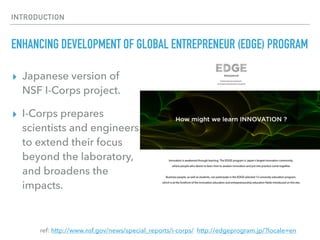
ENHANCING DEVELOPMENT OF GLOBAL ENTREPRENEUR (EDGE) PROGRAM
▸ Japanese version of
NSF I-Corps project.
▸ I-Corps prepares
scientists and engineers
to extend their focus
beyond the laboratory,
and broadens the
impacts.
ref: http://www.nsf.gov/news/special_reports/i-corps/ http://edgeprogram.jp/?locale=en
INTRODUCTION
EDGE PROGRAM OVERVIEW
▸ Educate students (undergraduates, masters and doctors)
and researchers to be innovators
▸ 13 universities are selected
▸ The University of Tokyo, Tokyo Institute of Technology,
Kyoto University, Wasoeda University, etc…
▸ 3 years program
▸ Survey the current activities at EDGE programs
INTRODUCTION
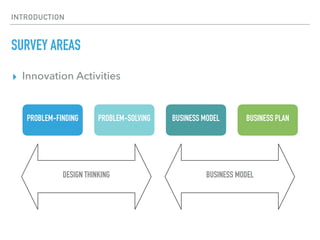
SURVEY AREAS
▸ Innovation Activities
PROBLEM-FINDING BUSINESS MODEL BUSINESS PLANPROBLEM-SOLVING
DESIGN THINKING BUSINESS MODEL
DESIGN THINKING AND RELATED RESEARCHES
DESIGN RESEARCH
▸ Designerly thinking (1960-)
▸ Design Thinking is simplified version
▸ Design definition:
▸ changing existing situations into preferred ones (Simon, 1996)
▸ the relation between creation and reflection (Schön, 1983)
▸ design process is a way of thinking to work on “wicked
problem” (Buchanan, 1992)
DESIGN THINKING AND RELATED RESEARCHES
TARGETS OF DESIGN PROCESS
1. symbolic and visual communication
2. material objects
3. activities and organized services
4. complex systems
5. environments for living, working, playing and learning
DESIGN THINKING AND RELATED RESEARCHES
DESIGN THINKING
▸ Design Thinking “a discipline that uses the designer’s
sensibility and methods to match people’s needs with
what is technologically feasible and what a viable business
strategy can convert into customer value and market
opportunity” (Brown, 2009)
▸ IDEO: Innovation = intersection of Human, Technology
and Business
DESIGN THINKING AND RELATED RESEARCHES
AIMS OF DESIGN THINKING
1. a methodology to make innovation with human-centered
design (Brown, 2008)
2. Management skill or theory to solve organizational
problems(Dunne and Martin, 2006; Boland and Collopy,
2004)
3. a learning process for effective knowledge creation
(Beckman and Barry, 2007)
DESIGN THINKING AND RELATED RESEARCHES
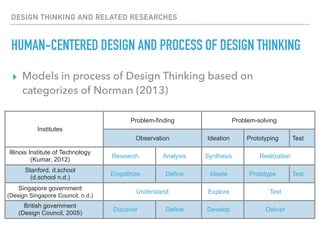
HUMAN-CENTERED DESIGN AND PROCESS OF DESIGN THINKING
▸ Models in process of Design Thinking based on
categorizes of Norman (2013)
Institutes
Problem-finding Problem-solving
Observation Ideation Prototyping Test
Illinois Institute of Technology
(Kumar, 2012)
Research Analysis Synthesis Realization
Stanford, d.school
(d.school n.d.)
Empathize Define Ideate Prototype Test
Singapore government
(Design Singapore Council, n.d.)
Understand Explore Test
British government
(Design Council, 2005)
Discover Define Develop Deliver
BUSINESS MODEL RELATED RESEARCHES
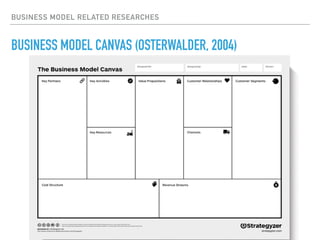
BUSINESS MODEL CANVAS (OSTERWALDER, 2004)
BUSINESS MODEL RELATED RESEARCHES
SERVICE SCIENCE RESEARCHES
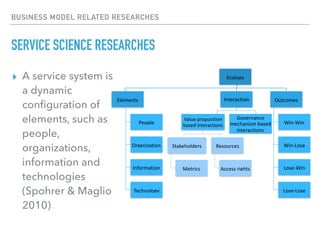
▸ A service system is
a dynamic
configuration of
elements, such as
people,
organizations,
information and
technologies
(Spohrer & Maglio
2010)
Ecology
Elements Interaction
Value	proposition	
based	interactions
Stakeholders
Metrics
Resources
Access	rights
Governance	
mechanism	based	
interactions
Outcomes
Win-Win
Win-Lose
Lose-Win
Lose-Lose
People
Organization
Information
Technology
BUSINESS MODEL RELATED RESEARCHES
MANAGEMENT RESEARCHES
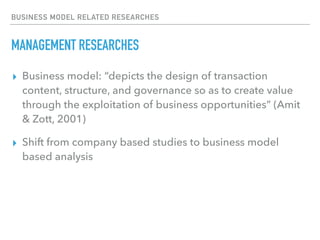
▸ Business model: “depicts the design of transaction
content, structure, and governance so as to create value
through the exploitation of business opportunities” (Amit
& Zott, 2001)
▸ Shift from company based studies to business model
based analysis
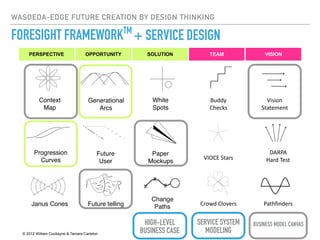
WASOEDA-EDGE FUTURE CREATION BY DESIGN THINKING
FORESIGHT FRAMEWORKTM
+ SERVICE DESIGN
PERSPECTIVE OPPORTUNITY SOLUTION TEAM VISION
X
X X
Context
Map
Generational
Arcs
Janus Cones
White
Spots
Buddy	
Checks
Vision	
Statement
VIOCE	Stars
DARPA	
Hard	Test
Crowd	Clovers
Future
User
Future telling
Change
Paths
Paper
Mockups
Progression
Curves
© 2012 William Cockayne & Tamara Carleton
SERVICE SYSTEM
MODELING
Pathfinders
BUSINESS MODEL CANVASHIGH-LEVEL
BUSINESS CASE
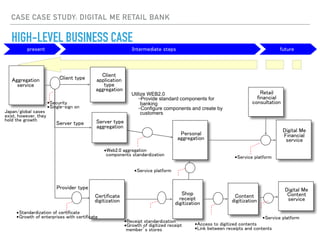
CASE CASE STUDY: DIGITAL ME RETAIL BANK
present Intermediate steps future
HIGH-LEVEL BUSINESS CASE
Aggregation
service
Personal
aggregation
Client
application
type
aggregation
Utilize WEB2.0
-Provide standard components for
banking
-Configure components and create by
customers
Certificate
digitization
▪Standardization of certificate
▪Growth of enterprises with certificate
▪Web2.0 aggregation
components standardization
Japan/global cases
exist, however, they
hold the growth
Shop
receipt
digitization
▪Receipt standardization
▪Growth of digitized receipt
member’s stores
Server type
Client type
Digital Me
Financial
service
Content
digitization
▪Access to digitized contents
▪Link between receipts and contents
▪Security
▪Single-sign on
Server type
aggregation
Digital Me
Content
service
▪Service platform
Retail
financial
consultation
▪Service platform
▪Service platform
Provider type
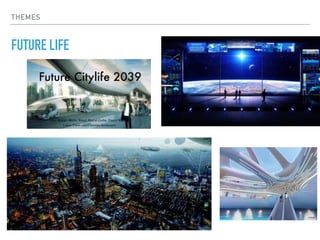
THEMES
FUTURE LIFE
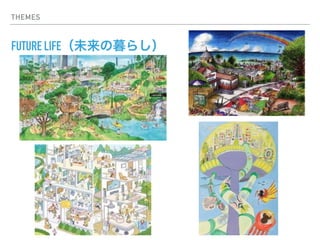
THEMES
FUTURE LIFE(未来の暮らし)
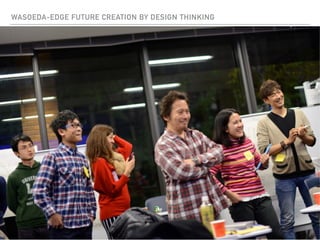
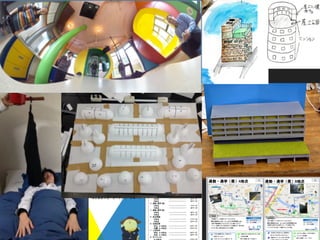
WASOEDA-EDGE FUTURE CREATION BY DESIGN THINKING
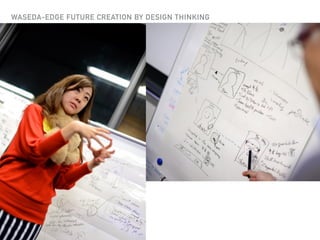
WASEDA-EDGE FUTURE CREATION BY DESIGN THINKING
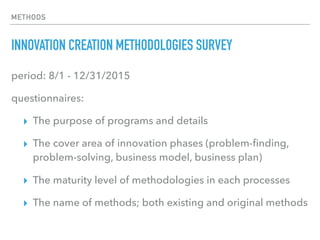
METHODS
INNOVATION CREATION METHODOLOGIES SURVEY
period: 8/1 - 12/31/2015
questionnaires:
▸ The purpose of programs and details
▸ The cover area of innovation phases (problem-finding,
problem-solving, business model, business plan)
▸ The maturity level of methodologies in each processes
▸ The name of methods; both existing and original methods
RESULTS & FINDINGS
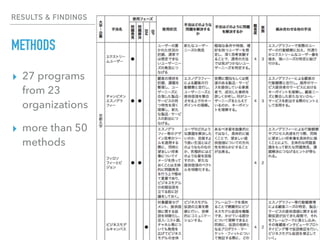
METHODS
▸ 27 programs
from 23
organizations
▸ more than 50
methods
RESULTS & FINDINGS
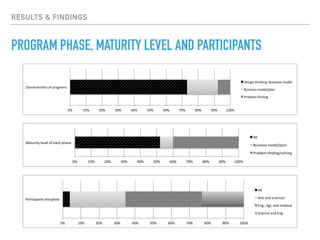
PROGRAM PHASE, MATURITY LEVEL AND PARTICIPANTS
0%	 10%	 20%	 30%	 40%	 50%	 60%	 70%	 80%	 90%	 100%	
Par0cipants	discipline	
All	
Arts	and	sciences	
Eng.,	Agl,	and	modical	
Science	and	Eng.	
0%	 10%	 20%	 30%	 40%	 50%	 60%	 70%	 80%	 90%	 100%	
Characteris6cs	of	programs	
Design	thinking Business	model	
Business	model/plan	
Problem-finding	
0%	 10%	 20%	 30%	 40%	 50%	 60%	 70%	 80%	 90%	 100%	
Maturity	level	of	each	phase	
All	
Business	model/plan	
Problem-finding/solving
RESULTS & FINDINGS
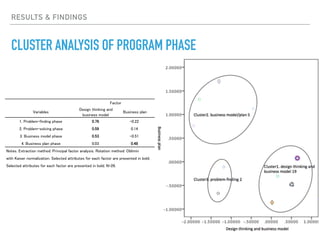
CLUSTER ANALYSIS OF PROGRAM PHASE
RESULTS & FINDINGS
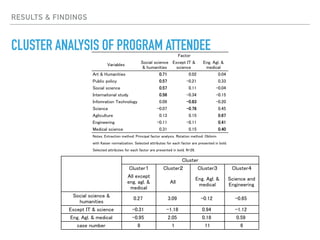
CLUSTER ANALYSIS OF PROGRAM ATTENDEE
RESULTS & FINDINGS
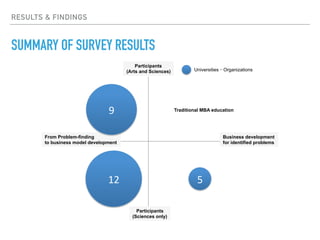
SUMMARY OF SURVEY RESULTS
Business development
for identified problems
From Problem-finding
to business model development
Participants
(Sciences only)
Participants
(Arts and Sciences)
9	
5	12	
Universities・Organizations
Traditional MBA education
Thank you!

Analysis and Findings on Innovation Creation Methodologies

  • 1.
    ANALYSIS AND FINDINGSON INNOVATION CREATION METHODOLOGIES YURIKO SAWATANI, TAKANORI KASHINO AND MARIE GOTO
  • 2.
    AGENDA ▸ Introduction ▸ DesignThinking and related researches ▸ Business Model related researches ▸ Methods ▸ Results and Findings
  • 3.
    INTRODUCTION ENHANCING DEVELOPMENT OFGLOBAL ENTREPRENEUR (EDGE) PROGRAM ▸ Japanese version of NSF I-Corps project. ▸ I-Corps prepares scientists and engineers to extend their focus beyond the laboratory, and broadens the impacts. ref: http://www.nsf.gov/news/special_reports/i-corps/ http://edgeprogram.jp/?locale=en
  • 4.
    INTRODUCTION EDGE PROGRAM OVERVIEW ▸Educate students (undergraduates, masters and doctors) and researchers to be innovators ▸ 13 universities are selected ▸ The University of Tokyo, Tokyo Institute of Technology, Kyoto University, Wasoeda University, etc… ▸ 3 years program ▸ Survey the current activities at EDGE programs
  • 5.
    INTRODUCTION SURVEY AREAS ▸ InnovationActivities PROBLEM-FINDING BUSINESS MODEL BUSINESS PLANPROBLEM-SOLVING DESIGN THINKING BUSINESS MODEL
  • 6.
    DESIGN THINKING ANDRELATED RESEARCHES DESIGN RESEARCH ▸ Designerly thinking (1960-) ▸ Design Thinking is simplified version ▸ Design definition: ▸ changing existing situations into preferred ones (Simon, 1996) ▸ the relation between creation and reflection (Schön, 1983) ▸ design process is a way of thinking to work on “wicked problem” (Buchanan, 1992)
  • 7.
    DESIGN THINKING ANDRELATED RESEARCHES TARGETS OF DESIGN PROCESS 1. symbolic and visual communication 2. material objects 3. activities and organized services 4. complex systems 5. environments for living, working, playing and learning
  • 8.
    DESIGN THINKING ANDRELATED RESEARCHES DESIGN THINKING ▸ Design Thinking “a discipline that uses the designer’s sensibility and methods to match people’s needs with what is technologically feasible and what a viable business strategy can convert into customer value and market opportunity” (Brown, 2009) ▸ IDEO: Innovation = intersection of Human, Technology and Business
  • 9.
    DESIGN THINKING ANDRELATED RESEARCHES AIMS OF DESIGN THINKING 1. a methodology to make innovation with human-centered design (Brown, 2008) 2. Management skill or theory to solve organizational problems(Dunne and Martin, 2006; Boland and Collopy, 2004) 3. a learning process for effective knowledge creation (Beckman and Barry, 2007)
  • 10.
    DESIGN THINKING ANDRELATED RESEARCHES HUMAN-CENTERED DESIGN AND PROCESS OF DESIGN THINKING ▸ Models in process of Design Thinking based on categorizes of Norman (2013) Institutes Problem-finding Problem-solving Observation Ideation Prototyping Test Illinois Institute of Technology (Kumar, 2012) Research Analysis Synthesis Realization Stanford, d.school (d.school n.d.) Empathize Define Ideate Prototype Test Singapore government (Design Singapore Council, n.d.) Understand Explore Test British government (Design Council, 2005) Discover Define Develop Deliver
  • 11.
    BUSINESS MODEL RELATEDRESEARCHES BUSINESS MODEL CANVAS (OSTERWALDER, 2004)
  • 12.
    BUSINESS MODEL RELATEDRESEARCHES SERVICE SCIENCE RESEARCHES ▸ A service system is a dynamic configuration of elements, such as people, organizations, information and technologies (Spohrer & Maglio 2010) Ecology Elements Interaction Value proposition based interactions Stakeholders Metrics Resources Access rights Governance mechanism based interactions Outcomes Win-Win Win-Lose Lose-Win Lose-Lose People Organization Information Technology
  • 13.
    BUSINESS MODEL RELATEDRESEARCHES MANAGEMENT RESEARCHES ▸ Business model: “depicts the design of transaction content, structure, and governance so as to create value through the exploitation of business opportunities” (Amit & Zott, 2001) ▸ Shift from company based studies to business model based analysis
  • 14.
    WASOEDA-EDGE FUTURE CREATIONBY DESIGN THINKING FORESIGHT FRAMEWORKTM + SERVICE DESIGN PERSPECTIVE OPPORTUNITY SOLUTION TEAM VISION X X X Context Map Generational Arcs Janus Cones White Spots Buddy Checks Vision Statement VIOCE Stars DARPA Hard Test Crowd Clovers Future User Future telling Change Paths Paper Mockups Progression Curves © 2012 William Cockayne & Tamara Carleton SERVICE SYSTEM MODELING Pathfinders BUSINESS MODEL CANVASHIGH-LEVEL BUSINESS CASE
  • 15.
    CASE CASE STUDY:DIGITAL ME RETAIL BANK present Intermediate steps future HIGH-LEVEL BUSINESS CASE Aggregation service Personal aggregation Client application type aggregation Utilize WEB2.0 -Provide standard components for banking -Configure components and create by customers Certificate digitization ▪Standardization of certificate ▪Growth of enterprises with certificate ▪Web2.0 aggregation components standardization Japan/global cases exist, however, they hold the growth Shop receipt digitization ▪Receipt standardization ▪Growth of digitized receipt member’s stores Server type Client type Digital Me Financial service Content digitization ▪Access to digitized contents ▪Link between receipts and contents ▪Security ▪Single-sign on Server type aggregation Digital Me Content service ▪Service platform Retail financial consultation ▪Service platform ▪Service platform Provider type
  • 16.
  • 17.
  • 18.
    WASOEDA-EDGE FUTURE CREATIONBY DESIGN THINKING
  • 19.
    WASEDA-EDGE FUTURE CREATIONBY DESIGN THINKING
  • 21.
    METHODS INNOVATION CREATION METHODOLOGIESSURVEY period: 8/1 - 12/31/2015 questionnaires: ▸ The purpose of programs and details ▸ The cover area of innovation phases (problem-finding, problem-solving, business model, business plan) ▸ The maturity level of methodologies in each processes ▸ The name of methods; both existing and original methods
  • 22.
    RESULTS & FINDINGS METHODS ▸27 programs from 23 organizations ▸ more than 50 methods
  • 23.
    RESULTS & FINDINGS PROGRAMPHASE, MATURITY LEVEL AND PARTICIPANTS 0% 10% 20% 30% 40% 50% 60% 70% 80% 90% 100% Par0cipants discipline All Arts and sciences Eng., Agl, and modical Science and Eng. 0% 10% 20% 30% 40% 50% 60% 70% 80% 90% 100% Characteris6cs of programs Design thinking Business model Business model/plan Problem-finding 0% 10% 20% 30% 40% 50% 60% 70% 80% 90% 100% Maturity level of each phase All Business model/plan Problem-finding/solving
  • 24.
    RESULTS & FINDINGS CLUSTERANALYSIS OF PROGRAM PHASE
  • 25.
    RESULTS & FINDINGS CLUSTERANALYSIS OF PROGRAM ATTENDEE
  • 26.
    RESULTS & FINDINGS SUMMARYOF SURVEY RESULTS Business development for identified problems From Problem-finding to business model development Participants (Sciences only) Participants (Arts and Sciences) 9 5 12 Universities・Organizations Traditional MBA education
  • 27.