FABRICATION AND CHARACTERIZATION OF B4CP PARTICLE
REINFORCED LM24 AL ALLOY COMPOSITES
Ch.V.M.Prasad1
& Dr.K.Mallikarjuna Rao2
1
Department of Mechanical Engineering, Sathya Institute of Technology and Management, Visakhapatnam, INDIA
2
Professor, Department of Mechanical Engineering, JNTU Kakinada, Kakinada, INDIA
ABSTRACT
In the present investigation, LM 24 Al alloy/B4Cp composites containing three different weight percentages (1, 2,
and 3%) with particle size of 10μmm of boron carbide have been fabricated using a compo casting method. Tensile
tests and hardness were conducted to examine the mechanical behavior of the aluminium alloy and its composites.
The uniform distribution of B4Cp particles was observed in the micro structural investigation of developed
composites. Results showed that composites reinforced with B4Cp particles exhibit superior mechanical behavior.
Composite Surface is analyzed using Scanning Electron Microscope to study the uniform distributions.
KEYWORDS: Boron carbide, compo casting method, micro structure, Scanning Electron Microscope
INTRODUCTION
In the modern technology the composite materials are plays a vital role . In the industrial world an Aluminium
matrix composite (AMC) are an important material. AMC are widely used in aerospace, automobile, marine
because its has good mechanical properties. In conventional diesel engine piston by replacement of aluminum
matrix composite instead of the nickel cast iron results lighter and cheaper product [K.K. Chawla (1998)]. In
applications such as automotive drive shafts, cylinder liners, connecting rods and because of conductivity and low
thermal expansion. In computers and electronics equipments Aluminium composites are used such as heat sinks,
high speed integrated circuit packages and base plates [K. K. Chawla (1998)]. Aluminium metal matrix
reinforcement are lighter in weight and strengthened by reinforcing less dense hard ceramic particles such as B4C,
Al2O3,SiC,TiB2, and AIN etc which improves the mechanical properties [Ramesh et al. (2009) and state methods,
liquid state method, deposition and insitu process [William et al. (1998) and Kalaiselvan et al. (2011)] out of these
stir casting has an attractive economic method to combined the particular with wide selection of materials and
processing condition which is a liquid state method [Shorowordi et al. (2003) and Kerti et al. (2008)]. In traditional
stir casting process, reinforcement material is being added to molten matrix and poured in to permanent molds after
stirring mechanism [Gopalkrishnan et al. (2010)]. By the Stir casting process results better bonding between matrix
and reinforcement. The Metal Matrix Composites are difficulty to fabricate in achieving homogeneous distribution
of particles, wettability, chemical reactions at the interface and porosity [Hashim et al. (1997), Hashim et al. (2002)
and Hashim et al. (2002)]. Maximum Al based MMC's fabrication has been being on SiC, Al2O3, TiB2 as
reinforcement material in present research works; but due to high cost and poor wetting with the Al matrix below
ISBN:978-1535061506
www.iaetsd.in
Proceedings of ICRMET-2016
©IAETSD 201650
1100°C of boron carbide particulates are very limited [Canacki et al. (2007)]. B4C is having ,specific density
(2.52g/cc),high stiffness(445GPa) , wear resistance, hardness of 3800Hv is the third hardest material next to
diamond and C-boron nitride and thermal conductivity (35W/mK) which makes it to find applications like ballistic
armor, as abrasive, nozzles etc [Katkar et al. (2011)]. Wettability of ceramic particles can be improved by several
ways which include pre-treatment, use of surface active agents [Kennedy et al. (2001)] which decreases surface
tension and interfacial forces [Sajjadi et al. (2011)]. Bonding between Al and B4C particles facilitating better
mechanical properties are improved in the composite material by Using K2TiF6 halide salt during casting
[Kalaiselvan etal. (2011)]. Further, the proper distribution of reinforcing particles in the matrix getting due to melt
stirring. Due to density differences of base material and ceramic particles are may e sink or float, the dispersion
becomes non homogeneous which may lead to clustering and segregation of particles at a particular place in the
melt. Such effect could lead to several microstructural defects like porosities, oxide inclusions and interfacial
reactions [Sajjadi et al.(2011)].
In the present works an attempt is being made to process LM24- B4C particulate composites at a temperature of
750°C by melt stirring. In the present work the two step addition used to helps from the problem of clustering of
reinforcing particles. In Al molten melt,pre-heated mix containing B4C particles and ADflux was added to improve
wettaility during the composite preparation. Further, the evaluation of mechanical properties of prepared composites
were subjected to note the extent of improvement achieved thereby.
EXPERIMENTAL DETAILS
The following section highlights the material, its properties and methods of composite preparation and testing.
MATERIALS USED
The matrix material for present study is LM24. Table.1 gives the chemical composition of LM24. The reinforcing
material selected is B4C of particle size 10μmm.
Table 1: Chemical Composition of LM24 by wt%
Element Al Si Fe Cu Mn Mg Cr Ni Zn Ti Trace
% Min - 7.5 - 3.00 - - - - - - -
% Max - 9.5 1.00 4.00 0.50 0.30 - 0.50 2.90 - 0.50
% Normal - 8.5 - 3.50 - - - - - - -
FABRICATION PROCESS
The Compo casting technique is used to prepare the cast composites as described below. A batch of 200g of LM24
was melted to 750°C-8000
C in a graphite crucible using furnace. With the help of stirrer the melt was disturbed to
form a fine vortex. 3g of degassing tablet was added to the vortex and slag was removed from the molten metal. At
ISBN:978-1535061506
www.iaetsd.in
Proceedings of ICRMET-2016
©IAETSD 201651
the temperature of 800°C the preheated B4C particles of 8vol.wt% was added into the vortex with mechanical
stirring at 300rpm for 5mins. 2g of ADflux was added to the molten metal to reduce the atmospheric contamination
Before pouring the molten metal to mould. The molten metal at a temperature of 850°C was then poured into mould
preheated to 300°C and allowed to solidify. The Aluminium metal matrix composites of LM24 with different weight
percentage (1, 2, and 3wt %) of B4C were fabricated by the same procedure.
MICROSTRUCTURE AND TESTING
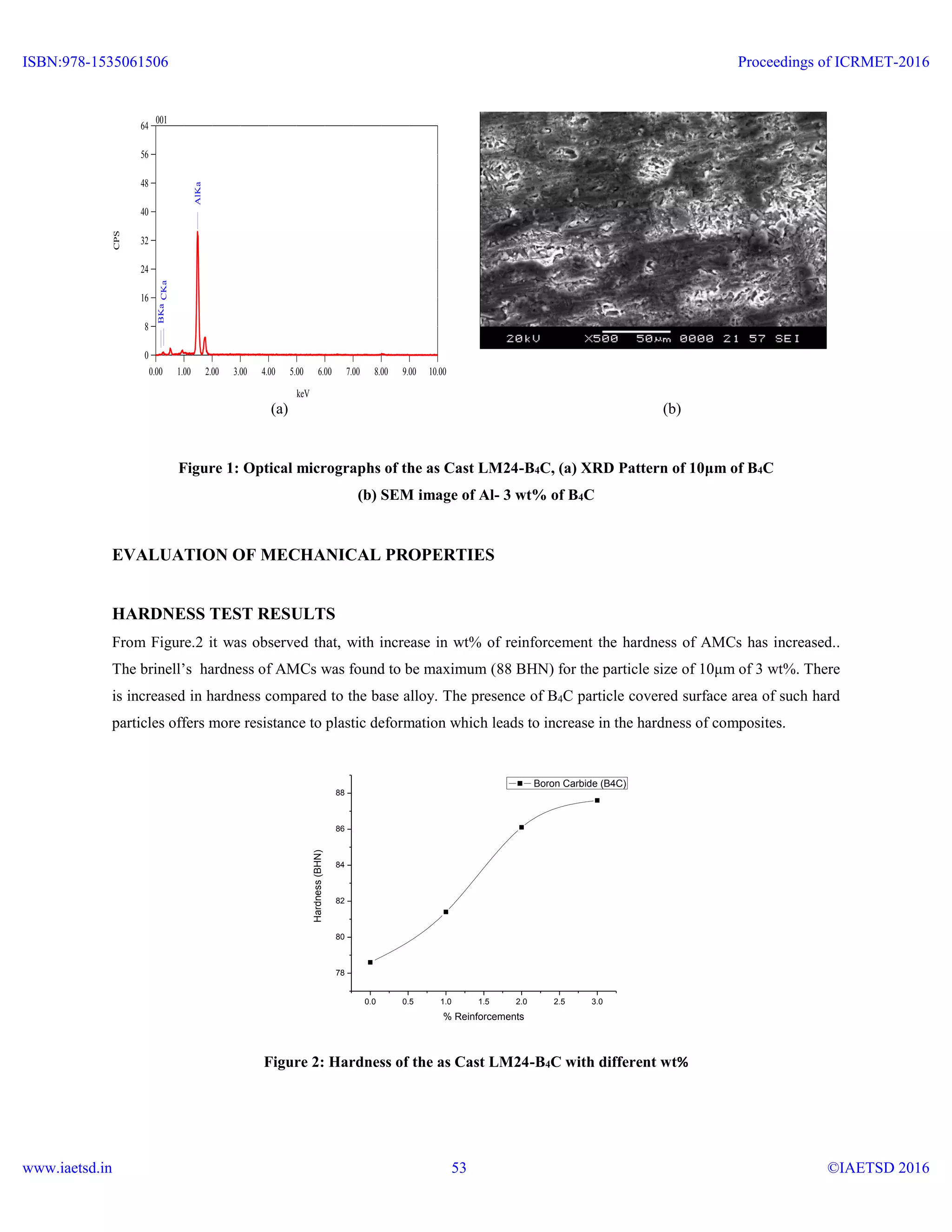
The microstructural characterization of prepared composites were Examined by using Scanning Electron. In the
SEM analysis we observed the distribution of reinforcement throughout the composite. In the entire composite B4C
and Aluminium matrix uniform distribution is clearly seen. It is observed that white area is aluminium matrix and
remaining grey area are the B4C reinforcement particles. The better interfacial bonding between the matrix and
reinforcement particles is observed because of less porosity. XRD analysis of the prepared composite was done
using XRD Machine. The experimental density of the prepared composite was determined using Archimedes’s
principle and compared with the theoretical densities of LM24 (2.7 g/cm3) and B4C particles (2.52g/cm3). Using
Brinells hardness tester machine the hardness measured on the prepared composite at different locations on the
specimens. The mechanical properties of tensile strength of the prepared composites were measured using a
Universal Testing Machine as per ASTM E08-8 standards under tension. Tensile tests were conducted on three
specimens for each composition and average value is reported.
RESULTS AND DISCUSSIONS
EVALUATION OF MICROSTRUCTURE
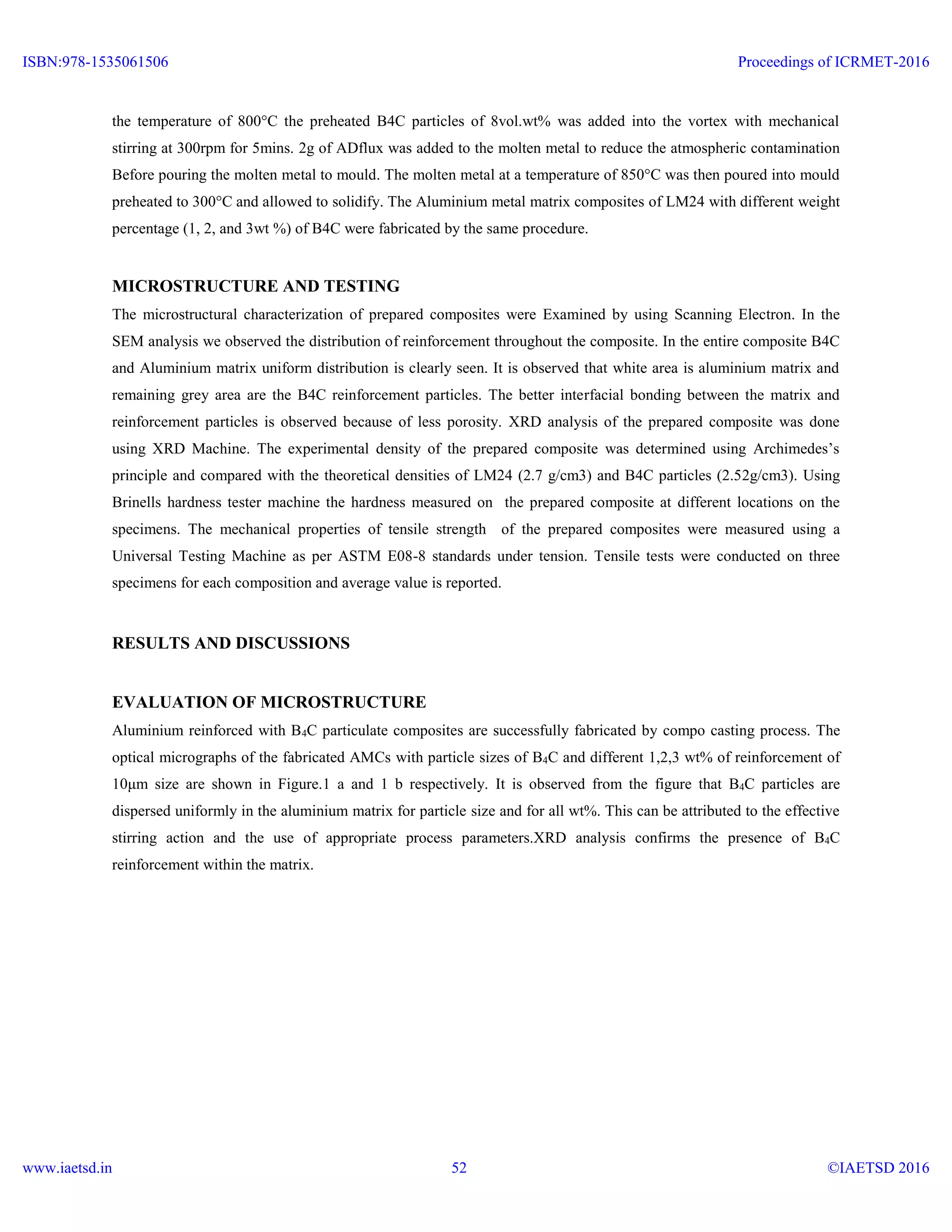
Aluminium reinforced with B4C particulate composites are successfully fabricated by compo casting process. The
optical micrographs of the fabricated AMCs with particle sizes of B4C and different 1,2,3 wt% of reinforcement of
10μm size are shown in Figure.1 a and 1 b respectively. It is observed from the figure that B4C particles are
dispersed uniformly in the aluminium matrix for particle size and for all wt%. This can be attributed to the effective
stirring action and the use of appropriate process parameters.XRD analysis confirms the presence of B4C
reinforcement within the matrix.
ISBN:978-1535061506
www.iaetsd.in
Proceedings of ICRMET-2016
©IAETSD 201652
(a) (b)
Figure 1: Optical micrographs of the as Cast LM24-B4C, (a) XRD Pattern of 10μm of B4C
(b) SEM image of Al- 3 wt% of B4C
EVALUATION OF MECHANICAL PROPERTIES
HARDNESS TEST RESULTS
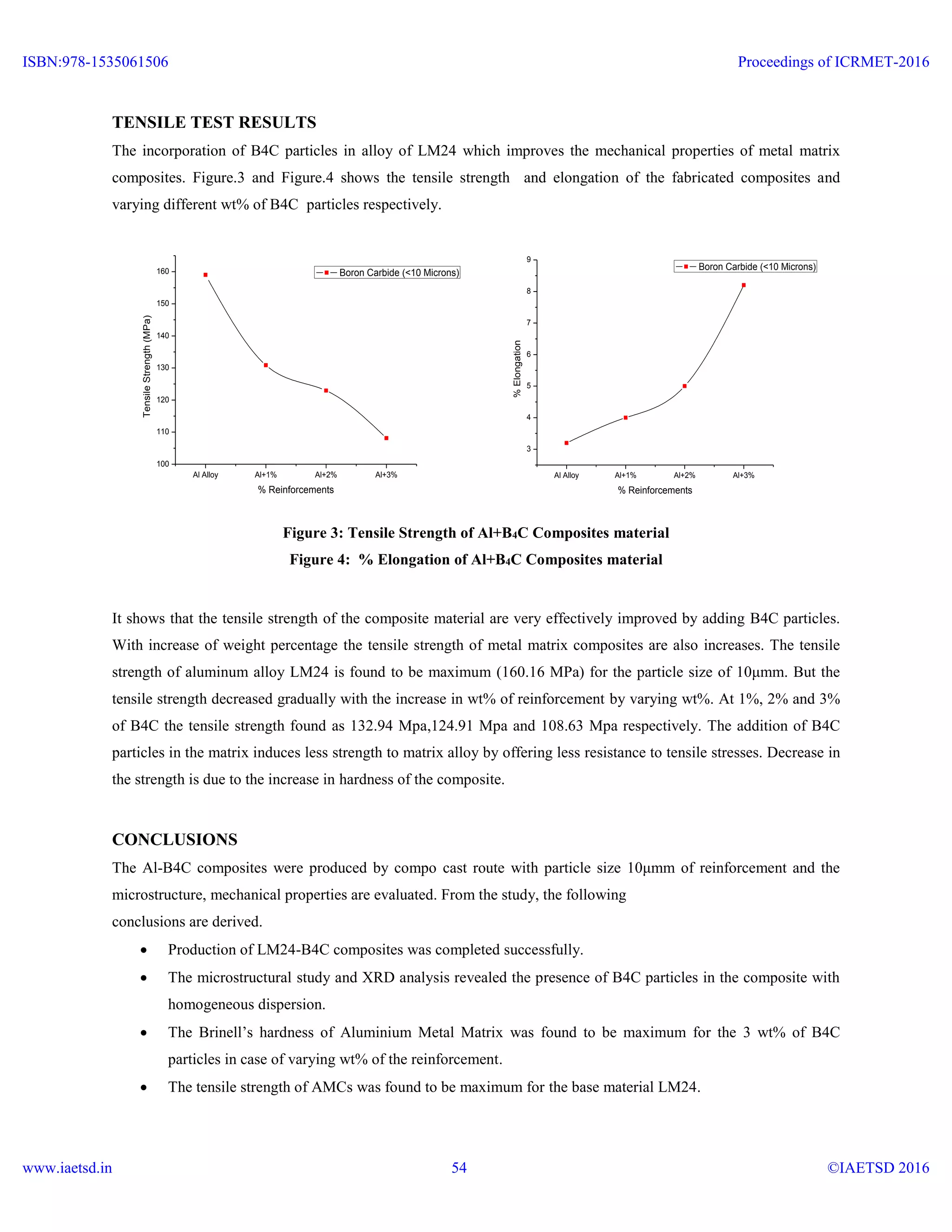
From Figure.2 it was observed that, with increase in wt% of reinforcement the hardness of AMCs has increased..
The brinell’s hardness of AMCs was found to be maximum (88 BHN) for the particle size of 10μm of 3 wt%. There
is increased in hardness compared to the base alloy. The presence of B4C particle covered surface area of such hard
particles offers more resistance to plastic deformation which leads to increase in the hardness of composites.
0.0 0.5 1.0 1.5 2.0 2.5 3.0
78
80
82
84
86
88
Hardness(BHN)
% Reinforcements
Boron Carbide (B4C)
Figure 2: Hardness of the as Cast LM24-B4C with different wt%
0.00 1.00 2.00 3.00 4.00 5.00 6.00 7.00 8.00 9.00 10.00
keV
001
0
8
16
24
32
40
48
56
64
CPS
BKaCKa
AlKa
ISBN:978-1535061506
www.iaetsd.in
Proceedings of ICRMET-2016
©IAETSD 201653
TENSILE TEST RESULTS
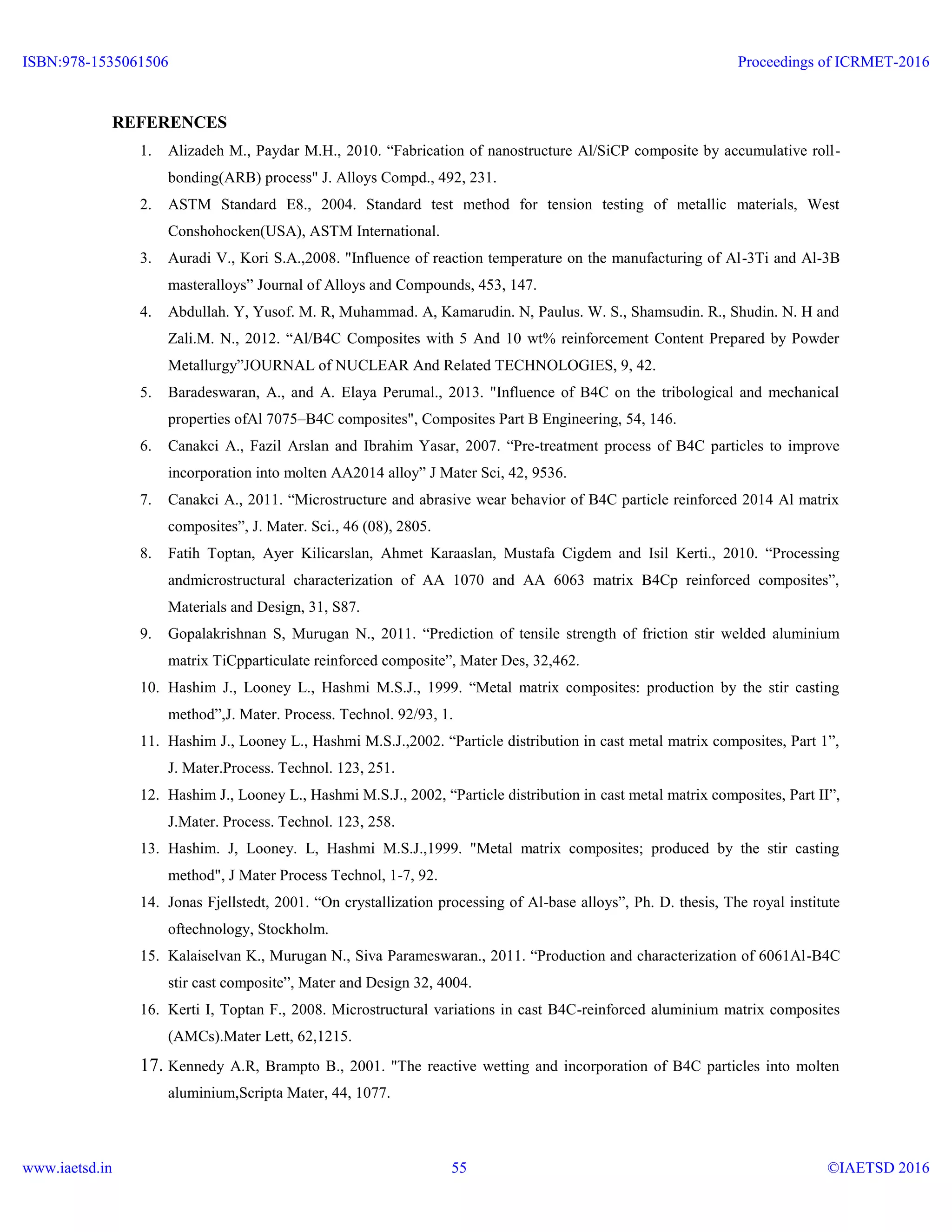
The incorporation of B4C particles in alloy of LM24 which improves the mechanical properties of metal matrix
composites. Figure.3 and Figure.4 shows the tensile strength and elongation of the fabricated composites and
varying different wt% of B4C particles respectively.
Al Alloy Al+1% Al+2% Al+3%
100
110
120
130
140
150
160
TensileStrength(MPa)
% Reinforcements
Boron Carbide (<10 Microns)
Al Alloy Al+1% Al+2% Al+3%
3
4
5
6
7
8
9
%Elongation
% Reinforcements
Boron Carbide (<10 Microns)
Figure 3: Tensile Strength of Al+B4C Composites material
Figure 4: % Elongation of Al+B4C Composites material
It shows that the tensile strength of the composite material are very effectively improved by adding B4C particles.
With increase of weight percentage the tensile strength of metal matrix composites are also increases. The tensile
strength of aluminum alloy LM24 is found to be maximum (160.16 MPa) for the particle size of 10μmm. But the
tensile strength decreased gradually with the increase in wt% of reinforcement by varying wt%. At 1%, 2% and 3%
of B4C the tensile strength found as 132.94 Mpa,124.91 Mpa and 108.63 Mpa respectively. The addition of B4C
particles in the matrix induces less strength to matrix alloy by offering less resistance to tensile stresses. Decrease in
the strength is due to the increase in hardness of the composite.
CONCLUSIONS
The Al-B4C composites were produced by compo cast route with particle size 10μmm of reinforcement and the
microstructure, mechanical properties are evaluated. From the study, the following
conclusions are derived.
 Production of LM24-B4C composites was completed successfully.
 The microstructural study and XRD analysis revealed the presence of B4C particles in the composite with
homogeneous dispersion.
 The Brinell’s hardness of Aluminium Metal Matrix was found to be maximum for the 3 wt% of B4C
particles in case of varying wt% of the reinforcement.
 The tensile strength of AMCs was found to be maximum for the base material LM24.
ISBN:978-1535061506
www.iaetsd.in
Proceedings of ICRMET-2016
©IAETSD 201654
REFERENCES
1. Alizadeh M., Paydar M.H., 2010. “Fabrication of nanostructure Al/SiCP composite by accumulative roll-
bonding(ARB) process" J. Alloys Compd., 492, 231.
2. ASTM Standard E8., 2004. Standard test method for tension testing of metallic materials, West
Conshohocken(USA), ASTM International.
3. Auradi V., Kori S.A.,2008. "Influence of reaction temperature on the manufacturing of Al-3Ti and Al-3B
masteralloys” Journal of Alloys and Compounds, 453, 147.
4. Abdullah. Y, Yusof. M. R, Muhammad. A, Kamarudin. N, Paulus. W. S., Shamsudin. R., Shudin. N. H and
Zali.M. N., 2012. “Al/B4C Composites with 5 And 10 wt% reinforcement Content Prepared by Powder
Metallurgy”JOURNAL of NUCLEAR And Related TECHNOLOGIES, 9, 42.
5. Baradeswaran, A., and A. Elaya Perumal., 2013. "Influence of B4C on the tribological and mechanical
properties ofAl 7075–B4C composites", Composites Part B Engineering, 54, 146.
6. Canakci A., Fazil Arslan and Ibrahim Yasar, 2007. “Pre-treatment process of B4C particles to improve
incorporation into molten AA2014 alloy” J Mater Sci, 42, 9536.
7. Canakci A., 2011. “Microstructure and abrasive wear behavior of B4C particle reinforced 2014 Al matrix
composites”, J. Mater. Sci., 46 (08), 2805.
8. Fatih Toptan, Ayer Kilicarslan, Ahmet Karaaslan, Mustafa Cigdem and Isil Kerti., 2010. “Processing
andmicrostructural characterization of AA 1070 and AA 6063 matrix B4Cp reinforced composites”,
Materials and Design, 31, S87.
9. Gopalakrishnan S, Murugan N., 2011. “Prediction of tensile strength of friction stir welded aluminium
matrix TiCpparticulate reinforced composite”, Mater Des, 32,462.
10. Hashim J., Looney L., Hashmi M.S.J., 1999. “Metal matrix composites: production by the stir casting
method”,J. Mater. Process. Technol. 92/93, 1.
11. Hashim J., Looney L., Hashmi M.S.J.,2002. “Particle distribution in cast metal matrix composites, Part 1”,
J. Mater.Process. Technol. 123, 251.
12. Hashim J., Looney L., Hashmi M.S.J., 2002, “Particle distribution in cast metal matrix composites, Part II”,
J.Mater. Process. Technol. 123, 258.
13. Hashim. J, Looney. L, Hashmi M.S.J.,1999. "Metal matrix composites; produced by the stir casting
method", J Mater Process Technol, 1-7, 92.
14. Jonas Fjellstedt, 2001. “On crystallization processing of Al-base alloys”, Ph. D. thesis, The royal institute
oftechnology, Stockholm.
15. Kalaiselvan K., Murugan N., Siva Parameswaran., 2011. “Production and characterization of 6061Al-B4C
stir cast composite”, Mater and Design 32, 4004.
16. Kerti I, Toptan F., 2008. Microstructural variations in cast B4C-reinforced aluminium matrix composites
(AMCs).Mater Lett, 62,1215.
17. Kennedy A.R, Brampto B., 2001. "The reactive wetting and incorporation of B4C particles into molten
aluminium,Scripta Mater, 44, 1077.
ISBN:978-1535061506
www.iaetsd.in
Proceedings of ICRMET-2016
©IAETSD 201655

Iaetsd fabrication and characterization of b4 cp particle reinforced lm24 al alloy composites

  • 1.
    FABRICATION AND CHARACTERIZATIONOF B4CP PARTICLE REINFORCED LM24 AL ALLOY COMPOSITES Ch.V.M.Prasad1 & Dr.K.Mallikarjuna Rao2 1 Department of Mechanical Engineering, Sathya Institute of Technology and Management, Visakhapatnam, INDIA 2 Professor, Department of Mechanical Engineering, JNTU Kakinada, Kakinada, INDIA ABSTRACT In the present investigation, LM 24 Al alloy/B4Cp composites containing three different weight percentages (1, 2, and 3%) with particle size of 10μmm of boron carbide have been fabricated using a compo casting method. Tensile tests and hardness were conducted to examine the mechanical behavior of the aluminium alloy and its composites. The uniform distribution of B4Cp particles was observed in the micro structural investigation of developed composites. Results showed that composites reinforced with B4Cp particles exhibit superior mechanical behavior. Composite Surface is analyzed using Scanning Electron Microscope to study the uniform distributions. KEYWORDS: Boron carbide, compo casting method, micro structure, Scanning Electron Microscope INTRODUCTION In the modern technology the composite materials are plays a vital role . In the industrial world an Aluminium matrix composite (AMC) are an important material. AMC are widely used in aerospace, automobile, marine because its has good mechanical properties. In conventional diesel engine piston by replacement of aluminum matrix composite instead of the nickel cast iron results lighter and cheaper product [K.K. Chawla (1998)]. In applications such as automotive drive shafts, cylinder liners, connecting rods and because of conductivity and low thermal expansion. In computers and electronics equipments Aluminium composites are used such as heat sinks, high speed integrated circuit packages and base plates [K. K. Chawla (1998)]. Aluminium metal matrix reinforcement are lighter in weight and strengthened by reinforcing less dense hard ceramic particles such as B4C, Al2O3,SiC,TiB2, and AIN etc which improves the mechanical properties [Ramesh et al. (2009) and state methods, liquid state method, deposition and insitu process [William et al. (1998) and Kalaiselvan et al. (2011)] out of these stir casting has an attractive economic method to combined the particular with wide selection of materials and processing condition which is a liquid state method [Shorowordi et al. (2003) and Kerti et al. (2008)]. In traditional stir casting process, reinforcement material is being added to molten matrix and poured in to permanent molds after stirring mechanism [Gopalkrishnan et al. (2010)]. By the Stir casting process results better bonding between matrix and reinforcement. The Metal Matrix Composites are difficulty to fabricate in achieving homogeneous distribution of particles, wettability, chemical reactions at the interface and porosity [Hashim et al. (1997), Hashim et al. (2002) and Hashim et al. (2002)]. Maximum Al based MMC's fabrication has been being on SiC, Al2O3, TiB2 as reinforcement material in present research works; but due to high cost and poor wetting with the Al matrix below ISBN:978-1535061506 www.iaetsd.in Proceedings of ICRMET-2016 ©IAETSD 201650
  • 2.
    1100°C of boroncarbide particulates are very limited [Canacki et al. (2007)]. B4C is having ,specific density (2.52g/cc),high stiffness(445GPa) , wear resistance, hardness of 3800Hv is the third hardest material next to diamond and C-boron nitride and thermal conductivity (35W/mK) which makes it to find applications like ballistic armor, as abrasive, nozzles etc [Katkar et al. (2011)]. Wettability of ceramic particles can be improved by several ways which include pre-treatment, use of surface active agents [Kennedy et al. (2001)] which decreases surface tension and interfacial forces [Sajjadi et al. (2011)]. Bonding between Al and B4C particles facilitating better mechanical properties are improved in the composite material by Using K2TiF6 halide salt during casting [Kalaiselvan etal. (2011)]. Further, the proper distribution of reinforcing particles in the matrix getting due to melt stirring. Due to density differences of base material and ceramic particles are may e sink or float, the dispersion becomes non homogeneous which may lead to clustering and segregation of particles at a particular place in the melt. Such effect could lead to several microstructural defects like porosities, oxide inclusions and interfacial reactions [Sajjadi et al.(2011)]. In the present works an attempt is being made to process LM24- B4C particulate composites at a temperature of 750°C by melt stirring. In the present work the two step addition used to helps from the problem of clustering of reinforcing particles. In Al molten melt,pre-heated mix containing B4C particles and ADflux was added to improve wettaility during the composite preparation. Further, the evaluation of mechanical properties of prepared composites were subjected to note the extent of improvement achieved thereby. EXPERIMENTAL DETAILS The following section highlights the material, its properties and methods of composite preparation and testing. MATERIALS USED The matrix material for present study is LM24. Table.1 gives the chemical composition of LM24. The reinforcing material selected is B4C of particle size 10μmm. Table 1: Chemical Composition of LM24 by wt% Element Al Si Fe Cu Mn Mg Cr Ni Zn Ti Trace % Min - 7.5 - 3.00 - - - - - - - % Max - 9.5 1.00 4.00 0.50 0.30 - 0.50 2.90 - 0.50 % Normal - 8.5 - 3.50 - - - - - - - FABRICATION PROCESS The Compo casting technique is used to prepare the cast composites as described below. A batch of 200g of LM24 was melted to 750°C-8000 C in a graphite crucible using furnace. With the help of stirrer the melt was disturbed to form a fine vortex. 3g of degassing tablet was added to the vortex and slag was removed from the molten metal. At ISBN:978-1535061506 www.iaetsd.in Proceedings of ICRMET-2016 ©IAETSD 201651
  • 3.
    the temperature of800°C the preheated B4C particles of 8vol.wt% was added into the vortex with mechanical stirring at 300rpm for 5mins. 2g of ADflux was added to the molten metal to reduce the atmospheric contamination Before pouring the molten metal to mould. The molten metal at a temperature of 850°C was then poured into mould preheated to 300°C and allowed to solidify. The Aluminium metal matrix composites of LM24 with different weight percentage (1, 2, and 3wt %) of B4C were fabricated by the same procedure. MICROSTRUCTURE AND TESTING The microstructural characterization of prepared composites were Examined by using Scanning Electron. In the SEM analysis we observed the distribution of reinforcement throughout the composite. In the entire composite B4C and Aluminium matrix uniform distribution is clearly seen. It is observed that white area is aluminium matrix and remaining grey area are the B4C reinforcement particles. The better interfacial bonding between the matrix and reinforcement particles is observed because of less porosity. XRD analysis of the prepared composite was done using XRD Machine. The experimental density of the prepared composite was determined using Archimedes’s principle and compared with the theoretical densities of LM24 (2.7 g/cm3) and B4C particles (2.52g/cm3). Using Brinells hardness tester machine the hardness measured on the prepared composite at different locations on the specimens. The mechanical properties of tensile strength of the prepared composites were measured using a Universal Testing Machine as per ASTM E08-8 standards under tension. Tensile tests were conducted on three specimens for each composition and average value is reported. RESULTS AND DISCUSSIONS EVALUATION OF MICROSTRUCTURE Aluminium reinforced with B4C particulate composites are successfully fabricated by compo casting process. The optical micrographs of the fabricated AMCs with particle sizes of B4C and different 1,2,3 wt% of reinforcement of 10μm size are shown in Figure.1 a and 1 b respectively. It is observed from the figure that B4C particles are dispersed uniformly in the aluminium matrix for particle size and for all wt%. This can be attributed to the effective stirring action and the use of appropriate process parameters.XRD analysis confirms the presence of B4C reinforcement within the matrix. ISBN:978-1535061506 www.iaetsd.in Proceedings of ICRMET-2016 ©IAETSD 201652
  • 4.
    (a) (b) Figure 1:Optical micrographs of the as Cast LM24-B4C, (a) XRD Pattern of 10μm of B4C (b) SEM image of Al- 3 wt% of B4C EVALUATION OF MECHANICAL PROPERTIES HARDNESS TEST RESULTS From Figure.2 it was observed that, with increase in wt% of reinforcement the hardness of AMCs has increased.. The brinell’s hardness of AMCs was found to be maximum (88 BHN) for the particle size of 10μm of 3 wt%. There is increased in hardness compared to the base alloy. The presence of B4C particle covered surface area of such hard particles offers more resistance to plastic deformation which leads to increase in the hardness of composites. 0.0 0.5 1.0 1.5 2.0 2.5 3.0 78 80 82 84 86 88 Hardness(BHN) % Reinforcements Boron Carbide (B4C) Figure 2: Hardness of the as Cast LM24-B4C with different wt% 0.00 1.00 2.00 3.00 4.00 5.00 6.00 7.00 8.00 9.00 10.00 keV 001 0 8 16 24 32 40 48 56 64 CPS BKaCKa AlKa ISBN:978-1535061506 www.iaetsd.in Proceedings of ICRMET-2016 ©IAETSD 201653
  • 5.
    TENSILE TEST RESULTS Theincorporation of B4C particles in alloy of LM24 which improves the mechanical properties of metal matrix composites. Figure.3 and Figure.4 shows the tensile strength and elongation of the fabricated composites and varying different wt% of B4C particles respectively. Al Alloy Al+1% Al+2% Al+3% 100 110 120 130 140 150 160 TensileStrength(MPa) % Reinforcements Boron Carbide (<10 Microns) Al Alloy Al+1% Al+2% Al+3% 3 4 5 6 7 8 9 %Elongation % Reinforcements Boron Carbide (<10 Microns) Figure 3: Tensile Strength of Al+B4C Composites material Figure 4: % Elongation of Al+B4C Composites material It shows that the tensile strength of the composite material are very effectively improved by adding B4C particles. With increase of weight percentage the tensile strength of metal matrix composites are also increases. The tensile strength of aluminum alloy LM24 is found to be maximum (160.16 MPa) for the particle size of 10μmm. But the tensile strength decreased gradually with the increase in wt% of reinforcement by varying wt%. At 1%, 2% and 3% of B4C the tensile strength found as 132.94 Mpa,124.91 Mpa and 108.63 Mpa respectively. The addition of B4C particles in the matrix induces less strength to matrix alloy by offering less resistance to tensile stresses. Decrease in the strength is due to the increase in hardness of the composite. CONCLUSIONS The Al-B4C composites were produced by compo cast route with particle size 10μmm of reinforcement and the microstructure, mechanical properties are evaluated. From the study, the following conclusions are derived.  Production of LM24-B4C composites was completed successfully.  The microstructural study and XRD analysis revealed the presence of B4C particles in the composite with homogeneous dispersion.  The Brinell’s hardness of Aluminium Metal Matrix was found to be maximum for the 3 wt% of B4C particles in case of varying wt% of the reinforcement.  The tensile strength of AMCs was found to be maximum for the base material LM24. ISBN:978-1535061506 www.iaetsd.in Proceedings of ICRMET-2016 ©IAETSD 201654
  • 6.
    REFERENCES 1. Alizadeh M.,Paydar M.H., 2010. “Fabrication of nanostructure Al/SiCP composite by accumulative roll- bonding(ARB) process" J. Alloys Compd., 492, 231. 2. ASTM Standard E8., 2004. Standard test method for tension testing of metallic materials, West Conshohocken(USA), ASTM International. 3. Auradi V., Kori S.A.,2008. "Influence of reaction temperature on the manufacturing of Al-3Ti and Al-3B masteralloys” Journal of Alloys and Compounds, 453, 147. 4. Abdullah. Y, Yusof. M. R, Muhammad. A, Kamarudin. N, Paulus. W. S., Shamsudin. R., Shudin. N. H and Zali.M. N., 2012. “Al/B4C Composites with 5 And 10 wt% reinforcement Content Prepared by Powder Metallurgy”JOURNAL of NUCLEAR And Related TECHNOLOGIES, 9, 42. 5. Baradeswaran, A., and A. Elaya Perumal., 2013. "Influence of B4C on the tribological and mechanical properties ofAl 7075–B4C composites", Composites Part B Engineering, 54, 146. 6. Canakci A., Fazil Arslan and Ibrahim Yasar, 2007. “Pre-treatment process of B4C particles to improve incorporation into molten AA2014 alloy” J Mater Sci, 42, 9536. 7. Canakci A., 2011. “Microstructure and abrasive wear behavior of B4C particle reinforced 2014 Al matrix composites”, J. Mater. Sci., 46 (08), 2805. 8. Fatih Toptan, Ayer Kilicarslan, Ahmet Karaaslan, Mustafa Cigdem and Isil Kerti., 2010. “Processing andmicrostructural characterization of AA 1070 and AA 6063 matrix B4Cp reinforced composites”, Materials and Design, 31, S87. 9. Gopalakrishnan S, Murugan N., 2011. “Prediction of tensile strength of friction stir welded aluminium matrix TiCpparticulate reinforced composite”, Mater Des, 32,462. 10. Hashim J., Looney L., Hashmi M.S.J., 1999. “Metal matrix composites: production by the stir casting method”,J. Mater. Process. Technol. 92/93, 1. 11. Hashim J., Looney L., Hashmi M.S.J.,2002. “Particle distribution in cast metal matrix composites, Part 1”, J. Mater.Process. Technol. 123, 251. 12. Hashim J., Looney L., Hashmi M.S.J., 2002, “Particle distribution in cast metal matrix composites, Part II”, J.Mater. Process. Technol. 123, 258. 13. Hashim. J, Looney. L, Hashmi M.S.J.,1999. "Metal matrix composites; produced by the stir casting method", J Mater Process Technol, 1-7, 92. 14. Jonas Fjellstedt, 2001. “On crystallization processing of Al-base alloys”, Ph. D. thesis, The royal institute oftechnology, Stockholm. 15. Kalaiselvan K., Murugan N., Siva Parameswaran., 2011. “Production and characterization of 6061Al-B4C stir cast composite”, Mater and Design 32, 4004. 16. Kerti I, Toptan F., 2008. Microstructural variations in cast B4C-reinforced aluminium matrix composites (AMCs).Mater Lett, 62,1215. 17. Kennedy A.R, Brampto B., 2001. "The reactive wetting and incorporation of B4C particles into molten aluminium,Scripta Mater, 44, 1077. ISBN:978-1535061506 www.iaetsd.in Proceedings of ICRMET-2016 ©IAETSD 201655