IOSR Journal of Mechanical and Civil Engineering (IOSR-JMCE)
e-ISSN: 2278-1684,p-ISSN: 2320-334X, Volume 7, Issue 4 (Jul. - Aug. 2013), PP 37-41
www.iosrjournals.org
www.iosrjournals.org 37 | Page
Performance of Self Compacting High Strength Fiber Reinforced
Concrete (SCHSFRC)
Vinayak B. Jatale1
, M. N. Mangulkar2
1
(PG Student, Department of Civil Engineering, MGM’s Jawaharlal Nehru Engineering College,
Aurangabad/ Dr. B.A. Marathwada University, Aurangabad, India)
2
(Assistant Professor, Department of Civil Engineering, MGM’s Jawaharlal Nehru Engineering College,
Aurangabad/ Dr. B.A. Marathwada University, Aurangabad, India)
Abstract: In this experimental study the changes on some mechanical properties of self compacting concrete
specimen produced by silica fume, metakaolin, fly ash and steel fibers were investigated. The main objective of
this is to obtain ductile Self Compacting High Strength Concrete (SCHSC) which flows under its own weight
and homogeneity while completely filling any formwork and passing around congested reinforcement. The Self
Compacting High Strength Concrete produced by using silica fume, metakaolin, fly ash, steel fibers and
Polycarboxylatether base superplasticizer. Three types of steel fibers were used in the experiments and volume
fractions of steel fiber were 0.5% to 4.0 %. Addition of silica fume, metakaolin and fly ash into the concrete
were 2.5 %, 2.5 % and 10 % by weight of cement content respectively. Water/cement ratio was 0.29.
Compressive strength and split tensile strength tests were made on hardened concrete specimens.
Keywords–Compressive Strength, Fly Ash, High Strength Concrete (HSC), High Strength Fiber Reinforced
Concrete (HSFRC), Metakaolin, Silica fume, Split Tensile Strength, Steel Fibres.
I. Introduction
Construction of durable concrete structures requires skilled labor for placing and compacting concrete.
Self Compacting Concrete achieves this by its unique fresh state properties. In the plastic state, it flows under its
own weight and homogeneity while completely filling any formwork and passing around congested
reinforcement. In the hardened state, it equals or excels standard concrete with respect to strength and durability.
This work is aimed to study the performance of steel fiber reinforced self compacting concrete as plain
self compacting concrete is studied in depth but the fiber reinforced self compacting concrete is not studied to
that extent. The main objective of this study is to optimize the Steel Fiber Reinforced Self Compacting High
Strength Concrete (SFRSCHSC) in the hardened state. But the literature indicates that some studies are
available on plain SCC but sufficient literature is not available on Steel Fiber Reinforced Self Compacting High
Strength Concrete (SFRSCHSC) with different mineral admixtures. Hence an attempt is made in this work to
study the mechanical properties of both plain Self Compacting High Strength Concrete (SCHSC) and SFRSCC.
II. Material Used
2.1 Cement
Ordinary Portland Cement of 53 Grade conforming to IS: 12269-1987 was used in the investigation.
The specific gravity of cement was 3.10.
2.2 Coarse Aggregate
Crushed stone metal with a maximum size of 12.5 mm from a local source having the specific gravity
of 2.7 conforming to IS: 383-1970 was used.
2.3 Fine Aggregate
Locally available river sand passing through 4.75 mm IS sieve conforming to grading zone-II of IS:
383-1970 was used. The specific gravity of fine aggregate was 2.54.
2.4 Silica fume
The American Concrete Institute (ACI) defines silica fume as “very fine noncrystalline silica
produced in electric arc furnace as a byproduct of production of elemental silicon or alloys containing silicon”.
Silica fume is also known as micro silica, condensed silica fume, volatized silica or silica dust. The physical
properties and chemical composition of Silica fume are shown in table 2.1and table 2.2 respectively.
2.5 Metakaolin
Metakaolin is not a byproduct. It is obtained by the calcinations of pure or refined Kaolinite clay at a
Performance of Self Compacting High Strength Fiber Reinforced Concrete (SCHSFRC)
www.iosrjournals.org 38 | Page
temperature between 6500
C and 8500
C, followed by grinding to achieve a fineness of 700-900 m2
/kg.
Metakaolin is a high quality pozzolonic material, which is blended with cement in order to improve the
durability of concrete. The physical properties and chemical composition of metakaolin are shown in table
2.1and table 2.2 respectively.
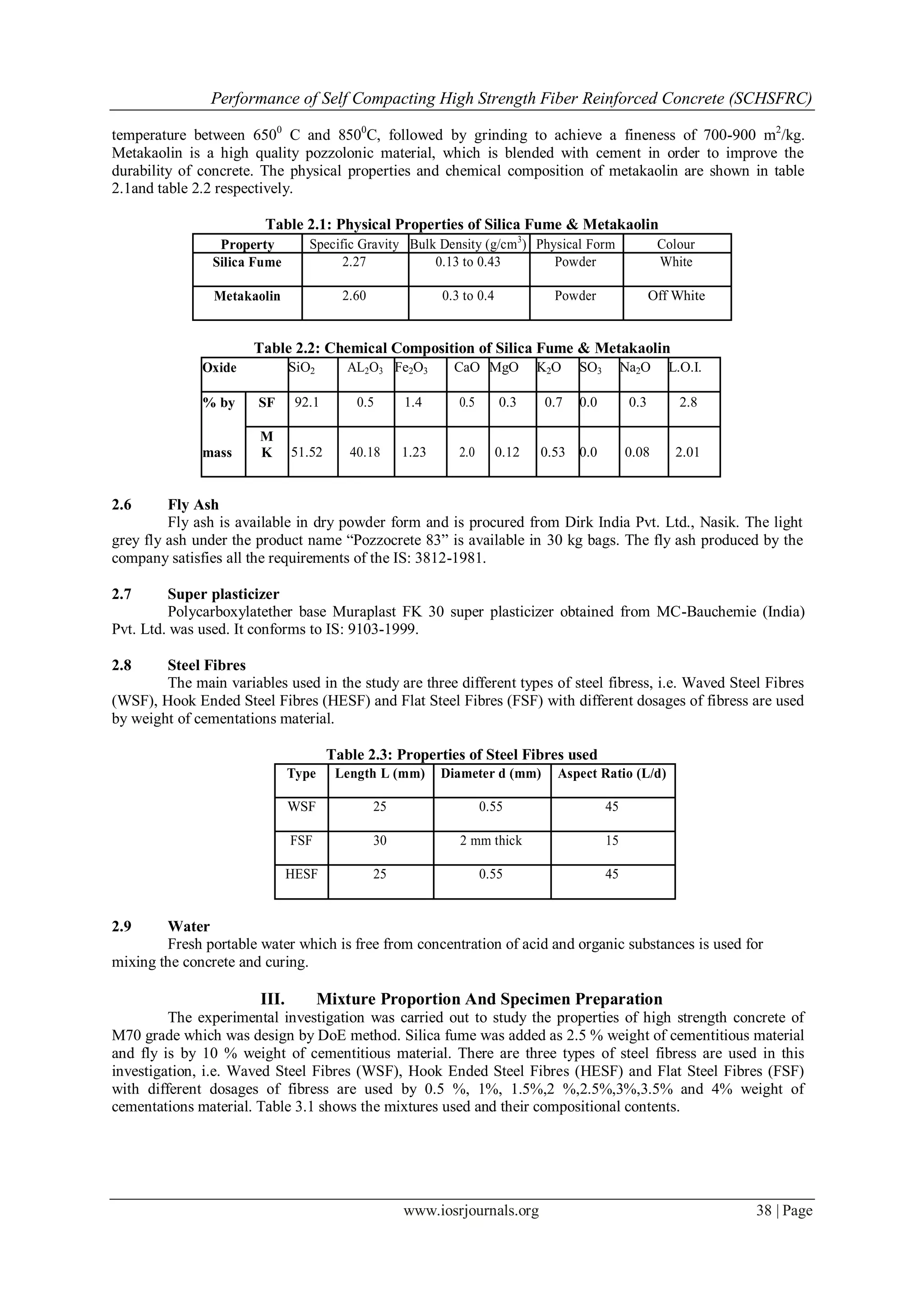
Table 2.1: Physical Properties of Silica Fume & Metakaolin
Property Specific Gravity Bulk Density (g/cm3
) Physical Form Colour
Silica Fume 2.27 0.13 to 0.43 Powder White
Metakaolin 2.60 0.3 to 0.4 Powder Off White
Table 2.2: Chemical Composition of Silica Fume & Metakaolin
Oxide SiO2 AL2O3 Fe2O3 CaO MgO K2O SO3 Na2O L.O.I.
% by SF 92.1 0.5 1.4 0.5 0.3 0.7 0.0 0.3 2.8
mass
M
K 51.52 40.18 1.23 2.0 0.12 0.53 0.0 0.08 2.01
2.6 Fly Ash
Fly ash is available in dry powder form and is procured from Dirk India Pvt. Ltd., Nasik. The light
grey fly ash under the product name “Pozzocrete 83” is available in 30 kg bags. The fly ash produced by the
company satisfies all the requirements of the IS: 3812-1981.
2.7 Super plasticizer
Polycarboxylatether base Muraplast FK 30 super plasticizer obtained from MC-Bauchemie (India)
Pvt. Ltd. was used. It conforms to IS: 9103-1999.
2.8 Steel Fibres
The main variables used in the study are three different types of steel fibress, i.e. Waved Steel Fibres
(WSF), Hook Ended Steel Fibres (HESF) and Flat Steel Fibres (FSF) with different dosages of fibress are used
by weight of cementations material.
Table 2.3: Properties of Steel Fibres used
Type Length L (mm) Diameter d (mm) Aspect Ratio (L/d)
WSF 25 0.55 45
FSF 30 2 mm thick 15
HESF 25 0.55 45
2.9 Water
Fresh portable water which is free from concentration of acid and organic substances is used for
mixing the concrete and curing.
III. Mixture Proportion And Specimen Preparation
The experimental investigation was carried out to study the properties of high strength concrete of
M70 grade which was design by DoE method. Silica fume was added as 2.5 % weight of cementitious material
and fly is by 10 % weight of cementitious material. There are three types of steel fibress are used in this
investigation, i.e. Waved Steel Fibres (WSF), Hook Ended Steel Fibres (HESF) and Flat Steel Fibres (FSF)
with different dosages of fibress are used by 0.5 %, 1%, 1.5%,2 %,2.5%,3%,3.5% and 4% weight of
cementations material. Table 3.1 shows the mixtures used and their compositional contents.
Performance of Self Compacting High Strength Fiber Reinforced Concrete (SCHSFRC)
www.iosrjournals.org 39 | Page
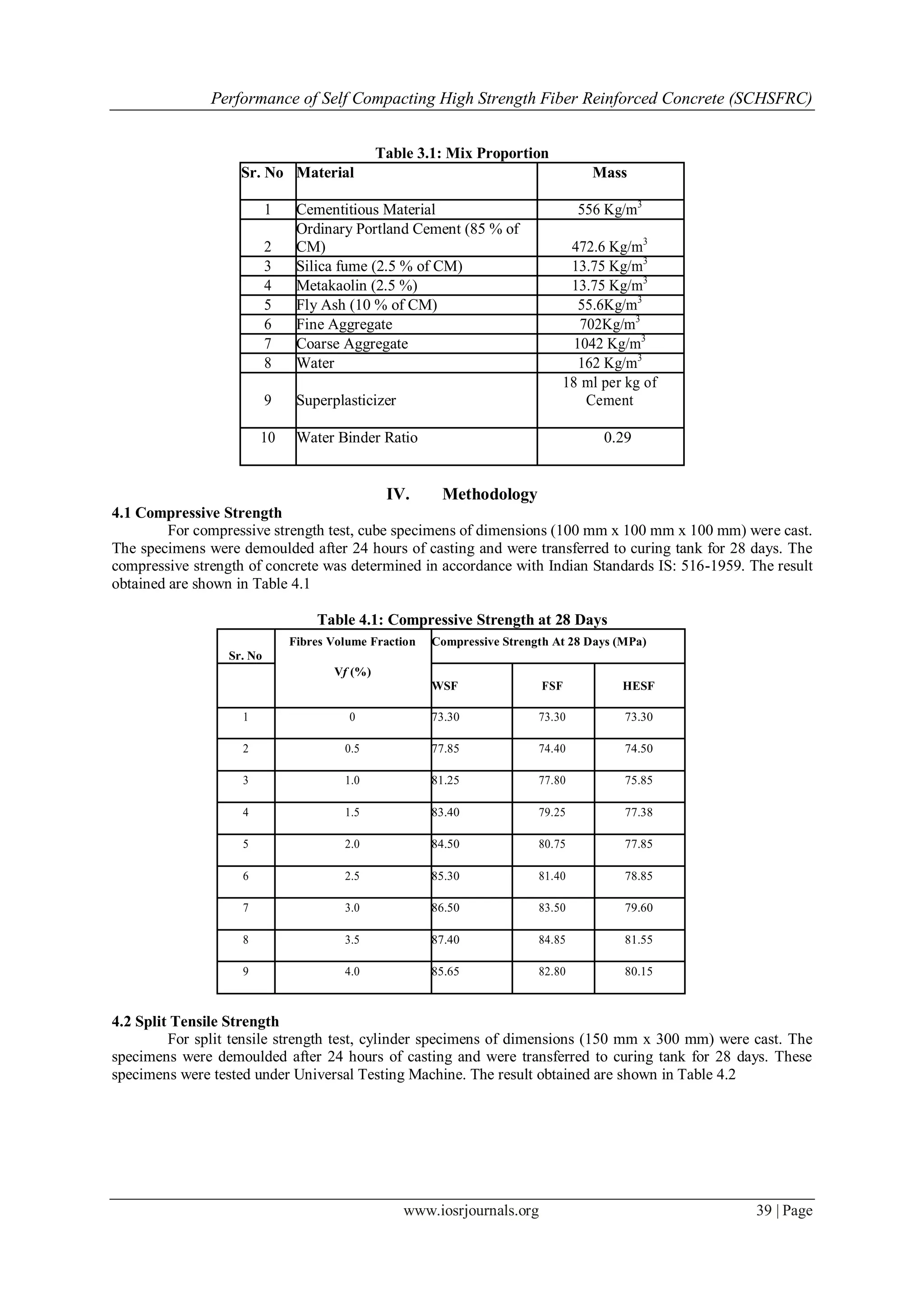
Table 3.1: Mix Proportion
Sr. No Material Mass
1 Cementitious Material 556 Kg/m3
2
Ordinary Portland Cement (85 % of
CM) 472.6 Kg/m3
3 Silica fume (2.5 % of CM) 13.75 Kg/m3
4 Metakaolin (2.5 %) 13.75 Kg/m3
5 Fly Ash (10 % of CM) 55.6Kg/m3
6 Fine Aggregate 702Kg/m3
7 Coarse Aggregate 1042 Kg/m3
8 Water 162 Kg/m3
9 Superplasticizer
18 ml per kg of
Cement
10 Water Binder Ratio 0.29
IV. Methodology
4.1 Compressive Strength
For compressive strength test, cube specimens of dimensions (100 mm x 100 mm x 100 mm) were cast.
The specimens were demoulded after 24 hours of casting and were transferred to curing tank for 28 days. The
compressive strength of concrete was determined in accordance with Indian Standards IS: 516-1959. The result
obtained are shown in Table 4.1
Table 4.1: Compressive Strength at 28 Days
Sr. No
Fibres Volume Fraction Compressive Strength At 28 Days (MPa)
Vf (%)
WSF FSF HESF
1 0 73.30 73.30 73.30
2 0.5 77.85 74.40 74.50
3 1.0 81.25 77.80 75.85
4 1.5 83.40 79.25 77.38
5 2.0 84.50 80.75 77.85
6 2.5 85.30 81.40 78.85
7 3.0 86.50 83.50 79.60
8 3.5 87.40 84.85 81.55
9 4.0 85.65 82.80 80.15
4.2 Split Tensile Strength
For split tensile strength test, cylinder specimens of dimensions (150 mm x 300 mm) were cast. The
specimens were demoulded after 24 hours of casting and were transferred to curing tank for 28 days. These
specimens were tested under Universal Testing Machine. The result obtained are shown in Table 4.2
Performance of Self Compacting High Strength Fiber Reinforced Concrete (SCHSFRC)
www.iosrjournals.org 40 | Page
Table 4.2: Split Tensile Strength at 28 Days
Sr. No
Fibres Volume Fraction Compressive Strength At 28 Days (MPa)
Vf (%)
WSF FSF HESF
1 0 3.67 3.67 3.67
2 0.5 3.89 3.72 3.73
3 1.0 4.06 3.89 3.79
4 1.5 4.17 3.96 3.87
5 2.0 4.23 4.04 3.89
6 2.5 4.27 4.07 3.94
7 3.0 4.33 4.18 3.98
8 3.5 4.37 4.24 4.08
9 4.0 4.28 4.14 4.01
3 | Page
V. Result And Discussion
5.1 Effect of fibres content (%) on Compressive Strength of High Strength Concrete
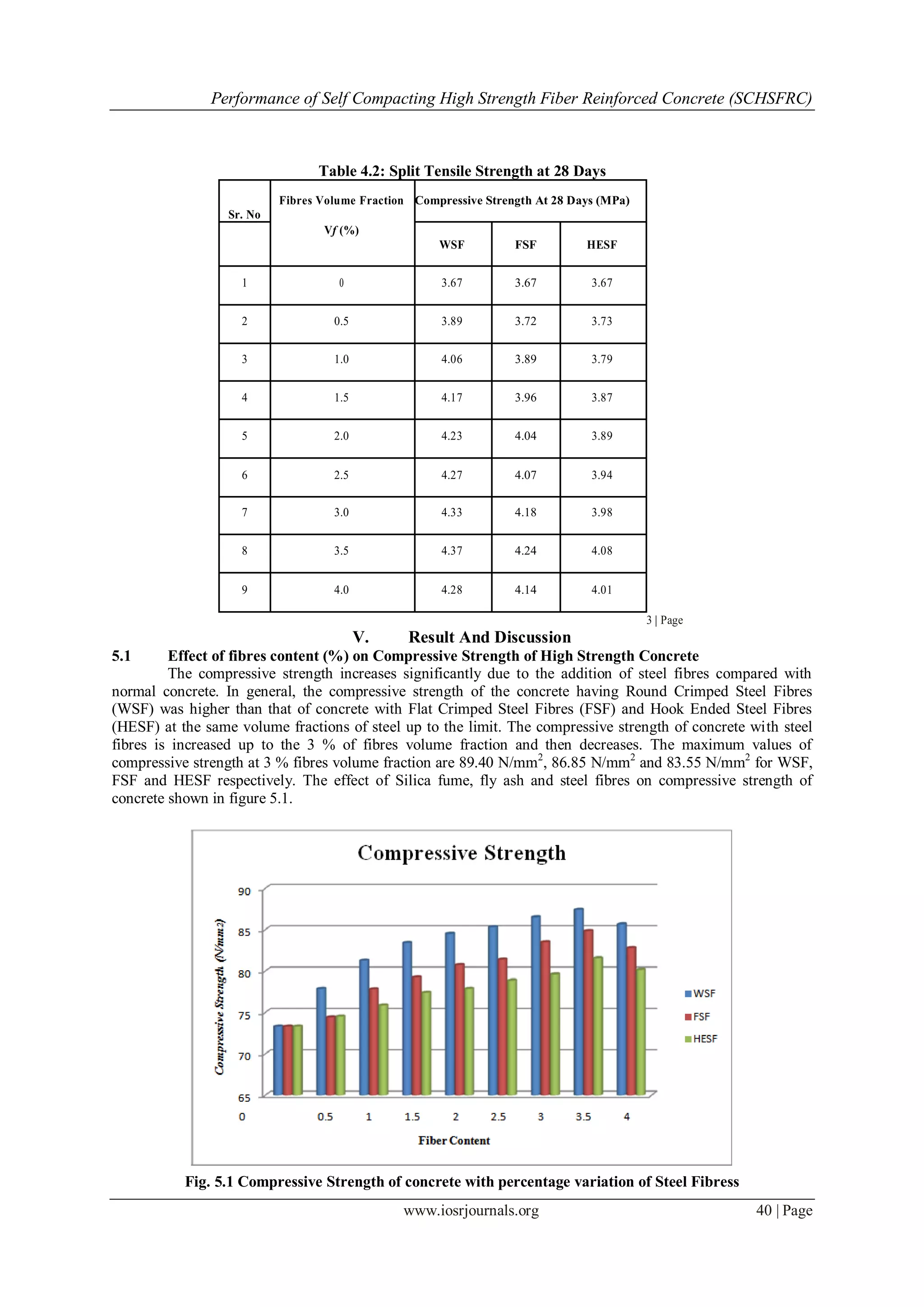
The compressive strength increases significantly due to the addition of steel fibres compared with
normal concrete. In general, the compressive strength of the concrete having Round Crimped Steel Fibres
(WSF) was higher than that of concrete with Flat Crimped Steel Fibres (FSF) and Hook Ended Steel Fibres
(HESF) at the same volume fractions of steel up to the limit. The compressive strength of concrete with steel
fibres is increased up to the 3 % of fibres volume fraction and then decreases. The maximum values of
compressive strength at 3 % fibres volume fraction are 89.40 N/mm2
, 86.85 N/mm2
and 83.55 N/mm2
for WSF,
FSF and HESF respectively. The effect of Silica fume, fly ash and steel fibres on compressive strength of
concrete shown in figure 5.1.
Fig. 5.1 Compressive Strength of concrete with percentage variation of Steel Fibress
Performance of Self Compacting High Strength Fiber Reinforced Concrete (SCHSFRC)
www.iosrjournals.org 41 | Page
5.2 Effect of fibres content (%) on Split Tensile Strength of High Strength Concrete
The result from Table 4.2 shows that the cylinder split tensile strength of concrete increases
considerably with an increase in fibres content. A continuous increase in strength is observed up to a limit. The
3.5 % of fibres content has given maximum increase in split tensile strength as compared to that of normal
concrete. The Flat Crimped Steel Fibres (FSF) gives maximum split tensile strength than that of Round Crimped
Steel Fibres (WSF) and Hook Ended Steel Fibres (HESF). The effect of Silica fume, Metakaolin, fly ash and
steel fibres on split tensile strength of concrete shown in figure 5.2.
Fig. 5.2 Split Tensile Strength of concrete with percentage variation of Steel Fibress
VI. Conclusion
Following conclusions are drawn based on the result discussed above:
1. In general, the significant improvement in various strengths is observed with the inclusion of steel fibres
in the plain concrete.
2. In general the compressive strength and the flexural strength increase with increase in the percentage of
fiber content up to certain limit.
3. The optimum fiber content for increase in compressive and split tensile strength is 3.5%.
4. The compressive strength and split tensile strength of concrete increasing with fibres content. The
maximum value of compressive strength gives the WSF and split tensile strength gives FSF at 3.5 %
fibres content.
References
[1] Hajime Okamura and Masahiro Ouchi, “Self Compacting Concrete”, Journal of Advanced Concrete Technology Vol. 1, No. 1,
April 2003, pp. 5-15.
[2] Khayat K. H., “Workability, Testing and Performance of Self Consolidating Concrete”, ACI Materials Journal, Vol. 96 , No. 3,
May-June 1999, pp.346-354.
[3] EFNARC, “The European Guidelines for Self Compacting Concrete Specification, Production and Use”, May 2005.
[4] Jacek K.,“ Steel Fiber and Steel Fiber Reinforced Concrete in Civil Engineering”, The Pacific Journal of Scie nce And
Technology, Vol. 7, No. 1, May2006, pp.53-58.
[5] Chuan Mein Wong, “Use of Short Fibres in Structural Concrete to Enhance Mechanical Properties”, University of Southern
Queensland, November 2004.
[6] Rame G. M., Narasimhan M.C., Karisddappa and Rajeeva S. V., “Study of the Properties of SCC with Quarry Dust”, The
Indian Concrete Journal published by ACC limited, Vol.83, No.8, August 2009, pp.54-60.
[7] Joaquim A.O.B., Lucio A.P., Varma R.K. and Delfina M.F., “Cost Competitive Steel Fiber Reinforced SCC for Structural
Applications”, The Indian Concrete Journal published by ACC limited, Vol.83, No.8, August 2009, pp.15 -26.
[8] IS: 456-2000, “Indian Standard for code of practice for plain and reinforced concrete”.
[9] IS: 383-1970. “Specification for course and Fine Aggregates from natural sources for concrete.” Bureau of Indian standards,
New Delhi.
[10] IS: 516-1959, Edition 1.2 (1991-07), “Indian Standard for Methods of test for strength of concrete.
[11] Sadr Momtazi A, Ranjbar M. M., Balalaei F, Nemati R, “The effect of Iran’s Silica fume in enhancing the concrete
compressive strength”, Cement and Concrete Research,pp.-1-7.

Performance of Self Compacting High Strength Fiber Reinforced Concrete (SCHSFRC)

  • 1.
    IOSR Journal ofMechanical and Civil Engineering (IOSR-JMCE) e-ISSN: 2278-1684,p-ISSN: 2320-334X, Volume 7, Issue 4 (Jul. - Aug. 2013), PP 37-41 www.iosrjournals.org www.iosrjournals.org 37 | Page Performance of Self Compacting High Strength Fiber Reinforced Concrete (SCHSFRC) Vinayak B. Jatale1 , M. N. Mangulkar2 1 (PG Student, Department of Civil Engineering, MGM’s Jawaharlal Nehru Engineering College, Aurangabad/ Dr. B.A. Marathwada University, Aurangabad, India) 2 (Assistant Professor, Department of Civil Engineering, MGM’s Jawaharlal Nehru Engineering College, Aurangabad/ Dr. B.A. Marathwada University, Aurangabad, India) Abstract: In this experimental study the changes on some mechanical properties of self compacting concrete specimen produced by silica fume, metakaolin, fly ash and steel fibers were investigated. The main objective of this is to obtain ductile Self Compacting High Strength Concrete (SCHSC) which flows under its own weight and homogeneity while completely filling any formwork and passing around congested reinforcement. The Self Compacting High Strength Concrete produced by using silica fume, metakaolin, fly ash, steel fibers and Polycarboxylatether base superplasticizer. Three types of steel fibers were used in the experiments and volume fractions of steel fiber were 0.5% to 4.0 %. Addition of silica fume, metakaolin and fly ash into the concrete were 2.5 %, 2.5 % and 10 % by weight of cement content respectively. Water/cement ratio was 0.29. Compressive strength and split tensile strength tests were made on hardened concrete specimens. Keywords–Compressive Strength, Fly Ash, High Strength Concrete (HSC), High Strength Fiber Reinforced Concrete (HSFRC), Metakaolin, Silica fume, Split Tensile Strength, Steel Fibres. I. Introduction Construction of durable concrete structures requires skilled labor for placing and compacting concrete. Self Compacting Concrete achieves this by its unique fresh state properties. In the plastic state, it flows under its own weight and homogeneity while completely filling any formwork and passing around congested reinforcement. In the hardened state, it equals or excels standard concrete with respect to strength and durability. This work is aimed to study the performance of steel fiber reinforced self compacting concrete as plain self compacting concrete is studied in depth but the fiber reinforced self compacting concrete is not studied to that extent. The main objective of this study is to optimize the Steel Fiber Reinforced Self Compacting High Strength Concrete (SFRSCHSC) in the hardened state. But the literature indicates that some studies are available on plain SCC but sufficient literature is not available on Steel Fiber Reinforced Self Compacting High Strength Concrete (SFRSCHSC) with different mineral admixtures. Hence an attempt is made in this work to study the mechanical properties of both plain Self Compacting High Strength Concrete (SCHSC) and SFRSCC. II. Material Used 2.1 Cement Ordinary Portland Cement of 53 Grade conforming to IS: 12269-1987 was used in the investigation. The specific gravity of cement was 3.10. 2.2 Coarse Aggregate Crushed stone metal with a maximum size of 12.5 mm from a local source having the specific gravity of 2.7 conforming to IS: 383-1970 was used. 2.3 Fine Aggregate Locally available river sand passing through 4.75 mm IS sieve conforming to grading zone-II of IS: 383-1970 was used. The specific gravity of fine aggregate was 2.54. 2.4 Silica fume The American Concrete Institute (ACI) defines silica fume as “very fine noncrystalline silica produced in electric arc furnace as a byproduct of production of elemental silicon or alloys containing silicon”. Silica fume is also known as micro silica, condensed silica fume, volatized silica or silica dust. The physical properties and chemical composition of Silica fume are shown in table 2.1and table 2.2 respectively. 2.5 Metakaolin Metakaolin is not a byproduct. It is obtained by the calcinations of pure or refined Kaolinite clay at a
  • 2.
    Performance of SelfCompacting High Strength Fiber Reinforced Concrete (SCHSFRC) www.iosrjournals.org 38 | Page temperature between 6500 C and 8500 C, followed by grinding to achieve a fineness of 700-900 m2 /kg. Metakaolin is a high quality pozzolonic material, which is blended with cement in order to improve the durability of concrete. The physical properties and chemical composition of metakaolin are shown in table 2.1and table 2.2 respectively. Table 2.1: Physical Properties of Silica Fume & Metakaolin Property Specific Gravity Bulk Density (g/cm3 ) Physical Form Colour Silica Fume 2.27 0.13 to 0.43 Powder White Metakaolin 2.60 0.3 to 0.4 Powder Off White Table 2.2: Chemical Composition of Silica Fume & Metakaolin Oxide SiO2 AL2O3 Fe2O3 CaO MgO K2O SO3 Na2O L.O.I. % by SF 92.1 0.5 1.4 0.5 0.3 0.7 0.0 0.3 2.8 mass M K 51.52 40.18 1.23 2.0 0.12 0.53 0.0 0.08 2.01 2.6 Fly Ash Fly ash is available in dry powder form and is procured from Dirk India Pvt. Ltd., Nasik. The light grey fly ash under the product name “Pozzocrete 83” is available in 30 kg bags. The fly ash produced by the company satisfies all the requirements of the IS: 3812-1981. 2.7 Super plasticizer Polycarboxylatether base Muraplast FK 30 super plasticizer obtained from MC-Bauchemie (India) Pvt. Ltd. was used. It conforms to IS: 9103-1999. 2.8 Steel Fibres The main variables used in the study are three different types of steel fibress, i.e. Waved Steel Fibres (WSF), Hook Ended Steel Fibres (HESF) and Flat Steel Fibres (FSF) with different dosages of fibress are used by weight of cementations material. Table 2.3: Properties of Steel Fibres used Type Length L (mm) Diameter d (mm) Aspect Ratio (L/d) WSF 25 0.55 45 FSF 30 2 mm thick 15 HESF 25 0.55 45 2.9 Water Fresh portable water which is free from concentration of acid and organic substances is used for mixing the concrete and curing. III. Mixture Proportion And Specimen Preparation The experimental investigation was carried out to study the properties of high strength concrete of M70 grade which was design by DoE method. Silica fume was added as 2.5 % weight of cementitious material and fly is by 10 % weight of cementitious material. There are three types of steel fibress are used in this investigation, i.e. Waved Steel Fibres (WSF), Hook Ended Steel Fibres (HESF) and Flat Steel Fibres (FSF) with different dosages of fibress are used by 0.5 %, 1%, 1.5%,2 %,2.5%,3%,3.5% and 4% weight of cementations material. Table 3.1 shows the mixtures used and their compositional contents.
  • 3.
    Performance of SelfCompacting High Strength Fiber Reinforced Concrete (SCHSFRC) www.iosrjournals.org 39 | Page Table 3.1: Mix Proportion Sr. No Material Mass 1 Cementitious Material 556 Kg/m3 2 Ordinary Portland Cement (85 % of CM) 472.6 Kg/m3 3 Silica fume (2.5 % of CM) 13.75 Kg/m3 4 Metakaolin (2.5 %) 13.75 Kg/m3 5 Fly Ash (10 % of CM) 55.6Kg/m3 6 Fine Aggregate 702Kg/m3 7 Coarse Aggregate 1042 Kg/m3 8 Water 162 Kg/m3 9 Superplasticizer 18 ml per kg of Cement 10 Water Binder Ratio 0.29 IV. Methodology 4.1 Compressive Strength For compressive strength test, cube specimens of dimensions (100 mm x 100 mm x 100 mm) were cast. The specimens were demoulded after 24 hours of casting and were transferred to curing tank for 28 days. The compressive strength of concrete was determined in accordance with Indian Standards IS: 516-1959. The result obtained are shown in Table 4.1 Table 4.1: Compressive Strength at 28 Days Sr. No Fibres Volume Fraction Compressive Strength At 28 Days (MPa) Vf (%) WSF FSF HESF 1 0 73.30 73.30 73.30 2 0.5 77.85 74.40 74.50 3 1.0 81.25 77.80 75.85 4 1.5 83.40 79.25 77.38 5 2.0 84.50 80.75 77.85 6 2.5 85.30 81.40 78.85 7 3.0 86.50 83.50 79.60 8 3.5 87.40 84.85 81.55 9 4.0 85.65 82.80 80.15 4.2 Split Tensile Strength For split tensile strength test, cylinder specimens of dimensions (150 mm x 300 mm) were cast. The specimens were demoulded after 24 hours of casting and were transferred to curing tank for 28 days. These specimens were tested under Universal Testing Machine. The result obtained are shown in Table 4.2
  • 4.
    Performance of SelfCompacting High Strength Fiber Reinforced Concrete (SCHSFRC) www.iosrjournals.org 40 | Page Table 4.2: Split Tensile Strength at 28 Days Sr. No Fibres Volume Fraction Compressive Strength At 28 Days (MPa) Vf (%) WSF FSF HESF 1 0 3.67 3.67 3.67 2 0.5 3.89 3.72 3.73 3 1.0 4.06 3.89 3.79 4 1.5 4.17 3.96 3.87 5 2.0 4.23 4.04 3.89 6 2.5 4.27 4.07 3.94 7 3.0 4.33 4.18 3.98 8 3.5 4.37 4.24 4.08 9 4.0 4.28 4.14 4.01 3 | Page V. Result And Discussion 5.1 Effect of fibres content (%) on Compressive Strength of High Strength Concrete The compressive strength increases significantly due to the addition of steel fibres compared with normal concrete. In general, the compressive strength of the concrete having Round Crimped Steel Fibres (WSF) was higher than that of concrete with Flat Crimped Steel Fibres (FSF) and Hook Ended Steel Fibres (HESF) at the same volume fractions of steel up to the limit. The compressive strength of concrete with steel fibres is increased up to the 3 % of fibres volume fraction and then decreases. The maximum values of compressive strength at 3 % fibres volume fraction are 89.40 N/mm2 , 86.85 N/mm2 and 83.55 N/mm2 for WSF, FSF and HESF respectively. The effect of Silica fume, fly ash and steel fibres on compressive strength of concrete shown in figure 5.1. Fig. 5.1 Compressive Strength of concrete with percentage variation of Steel Fibress
  • 5.
    Performance of SelfCompacting High Strength Fiber Reinforced Concrete (SCHSFRC) www.iosrjournals.org 41 | Page 5.2 Effect of fibres content (%) on Split Tensile Strength of High Strength Concrete The result from Table 4.2 shows that the cylinder split tensile strength of concrete increases considerably with an increase in fibres content. A continuous increase in strength is observed up to a limit. The 3.5 % of fibres content has given maximum increase in split tensile strength as compared to that of normal concrete. The Flat Crimped Steel Fibres (FSF) gives maximum split tensile strength than that of Round Crimped Steel Fibres (WSF) and Hook Ended Steel Fibres (HESF). The effect of Silica fume, Metakaolin, fly ash and steel fibres on split tensile strength of concrete shown in figure 5.2. Fig. 5.2 Split Tensile Strength of concrete with percentage variation of Steel Fibress VI. Conclusion Following conclusions are drawn based on the result discussed above: 1. In general, the significant improvement in various strengths is observed with the inclusion of steel fibres in the plain concrete. 2. In general the compressive strength and the flexural strength increase with increase in the percentage of fiber content up to certain limit. 3. The optimum fiber content for increase in compressive and split tensile strength is 3.5%. 4. The compressive strength and split tensile strength of concrete increasing with fibres content. The maximum value of compressive strength gives the WSF and split tensile strength gives FSF at 3.5 % fibres content. References [1] Hajime Okamura and Masahiro Ouchi, “Self Compacting Concrete”, Journal of Advanced Concrete Technology Vol. 1, No. 1, April 2003, pp. 5-15. [2] Khayat K. H., “Workability, Testing and Performance of Self Consolidating Concrete”, ACI Materials Journal, Vol. 96 , No. 3, May-June 1999, pp.346-354. [3] EFNARC, “The European Guidelines for Self Compacting Concrete Specification, Production and Use”, May 2005. [4] Jacek K.,“ Steel Fiber and Steel Fiber Reinforced Concrete in Civil Engineering”, The Pacific Journal of Scie nce And Technology, Vol. 7, No. 1, May2006, pp.53-58. [5] Chuan Mein Wong, “Use of Short Fibres in Structural Concrete to Enhance Mechanical Properties”, University of Southern Queensland, November 2004. [6] Rame G. M., Narasimhan M.C., Karisddappa and Rajeeva S. V., “Study of the Properties of SCC with Quarry Dust”, The Indian Concrete Journal published by ACC limited, Vol.83, No.8, August 2009, pp.54-60. [7] Joaquim A.O.B., Lucio A.P., Varma R.K. and Delfina M.F., “Cost Competitive Steel Fiber Reinforced SCC for Structural Applications”, The Indian Concrete Journal published by ACC limited, Vol.83, No.8, August 2009, pp.15 -26. [8] IS: 456-2000, “Indian Standard for code of practice for plain and reinforced concrete”. [9] IS: 383-1970. “Specification for course and Fine Aggregates from natural sources for concrete.” Bureau of Indian standards, New Delhi. [10] IS: 516-1959, Edition 1.2 (1991-07), “Indian Standard for Methods of test for strength of concrete. [11] Sadr Momtazi A, Ranjbar M. M., Balalaei F, Nemati R, “The effect of Iran’s Silica fume in enhancing the concrete compressive strength”, Cement and Concrete Research,pp.-1-7.