Kumar Vikas, Singh Shailesh, International Journal of Advance Research, Ideas and Innovations in Technology.
© 2017, www.IJARIIT.com All Rights Reserved Page | 54
ISSN: 2454-132X
Impact Factor: 4.295
(Volume3, Issue6)
Available online at: https://www.ijariit.com
Fabrication and Evaluation of Mechanical Properties of AL6061-
4%B4C-4%CU Based Composite Experimentally
Vikas Kumar
M.Tech Scholar
Mechanical Engineering Department
IEC College of Engineering & Technology, Greater Noida
012vikaskumar@gmail.com
Shailesh Singh
Assistant Professor
Mechanical Engineering Department
IEC College of Engineering & Technology, Greater Noida
mechshaileshsingh@gmail.com
Abstract – Metal matrix composite are widely used in automotive industries because they exhibits different mechanical properties
such as high strength and good wear resistance, high specific stiffness, low weight and high hardness etc. Due to these properties
metal matrix composite with particulate reinforcement and fabricating method has become one of the most important areas of
research. The work is mainly focus on fabrication of Al 6061 reinforced with 4% B4C (particle size 100 mesh) & 4% Cu and
method used for fabrication is stir casting method. Tensile strength, hardness, impact strength, microstructure of fabricated
composite are used to characterize it. By addition of B4C & Cu tensile strength and hardness of the fabricated composite has
increased and slightly decreased in impact strength. Scanning Electron microscopy is used to confirm the microstructure and
uniform distribution of B4C & Cu particles in metal matrix composite. The value of tensile strength increase up to 20% and
hardness increase upto15% due to addition of B4C & Cu paritcles.The physical and mechanical properties of composite are
improved so it can be used for automotive industrial applications.
Key Words- Stir Casting, Tensile Strength, Impact Strength, Metal Matrix Composite, and Hardness, Microstructure
1 INTRODUCTION
When metal matrix composite (MMC’s) compared with unreinforced metal they show high strength ,hardness ,impact strength as
well as wear and fatigue strength at low and high temperatures so they are highly utilized designing of ground transportations
vehicles, aircraft etc. Use of pure aluminum in designing industries is limited because it has poor mechanical properties and poor
tribological properties also. The role played by the aluminum is vital in development of metal matrix composite reinforced with a
B4C,SiC,TiC,Al2O3,TiC etc. they are commonly known as aluminum metal matrix composite (AMC’s). Composition, mechanical
behavior, response to heat treatment etc. are some common aspect to be considered corresponding to the metal matrix composite.
Properties such as low weight, good corrosion resistance, and good mechanical properties such as tensile strength, hardness,
toughness and impact resistance, fatigue etc. made aluminum use as matrix material. Some application require high melting point
so aluminum also exhibits this property also .Boron carbide use in reinforcement due to it has good corrosion resistance , good
thermal resistance, high strength, easily available, and good culpability with aluminum matrix. Boron carbide powder has very high
cost and poor wetting characteristics so research work has been not enough due to these drawbacks. Boron carbide generally used
for manufacturing of armor tanks, bullets proof vests etc. Hence, when boron carbide used with low cost routing technique is highly
utilized for research purposes. Instead of using Sic carbide, the use of Cu the ductility of AMC’s not reduce and it is low brittle as
compare to the use of Sic
Rajneesh Kumar Verma, Lucky Agarwal and D.S. Awana found that when Al 6061 reinforced with cu and Sic fabricated by stir
casting method ultimate tensile strength increase with increase in weight % of cu and hardness also increased and due to addition
on SiC, the tensile strength and corrosion resistance improved significantly when they compared with pure aluminum.
Shobhit jain found that when aluminum reinforced with boron carbide and cu manufactured by powder metallurgical the tensile
strength increase up to 10% and there is a significant in increase in hardness and compressive strength also. When the amount of
Kumar Vikas, Singh Shailesh, International Journal of Advance Research, Ideas and Innovations in Technology.
© 2017, www.IJARIIT.com All Rights Reserved Page | 55
boron carbide or Cu or both increase the tensile strength, hardness and compressive strength are increase up to a higher level but
ductility decreased and brittleness increases.
Saikeerthi.S.P. studies that boron carbide highly effective in improving the tensile strength of composite and when particle size of
boron carbide increases the tensile strength also increased and found that when particle size is about 105µ the tensile strength is
maximum. AMC’s offer more resistance to tensile strength by addition of boron carbide.
In current research aluminum 6061(having a purity of >99% Aluminum) 4% Cu & 4% B4C particulate (size 100 mesh) have been
used for metal matrix composite. MMC fabricated by stir casting method which is widely used for fabrication and it is very fast and
cheap process also. . Stir casting is one of the simplest ways of producing aluminum matrix composites (AMCs). This work focuses
on the fabrication of AMCs reinforced with weight percentages of Cu particulates and Boron Carbide particulates by modified stir
casting route. The reinforced material silicon carbide and boron carbide in increased volume fraction increases the elastic modulus,
work hardening rate, yield & tensile strengths, but coupled with lower ductility. The effects of applied load and temperature on Al
6061-SiC composites concluded that the wear rate decreases with increased applied load. MMCs containing B4C particles exhibit
improved wear resistance Stir casting method generally used because it help in generation of homogenous microstructure and
Uniform distribution of boron carbide and Cu in metal matrix. When mixing is uniform then properties obtained are also at good
level of satisfactory.
2. MATERIALS AND EXPERIMENTAL SET UP
In the present research aluminum which available commercially, boron carbide (size of particle 100mesh), and Cu with 4% of both.
Stir casting used for casting of cylindrical specimens. Different test are performed on specimens after machining of object in correct
dimensions and mechanical properties are obtained.
2.1 ALUMINIUM 6061
Aluminum alloy 6061 is one of the most extensively used of the 6000 series aluminum alloys. It is a versatile heat treatable extruded
alloy with medium to high strength capabilities. 6061 is a precipitation hardening aluminum alloy, containing magnesium and silicon
as its major alloying elements. Originally called "Alloy 61S," it was developed in 1935.
Composition:
Table 1: Typical composition of aluminum alloy 6061
Component Amount % weight
Aluminum Balance
Magnesium 0.8-1.2
Silicon 0.4-0.8
Iron Max 0.7
Cu 0.15-0.40
Zinc Max0.25
Titanium Max 0.15
Manganese Max 0.15
Chromium 0.04-0.35
2.2 BORON CARBIDE
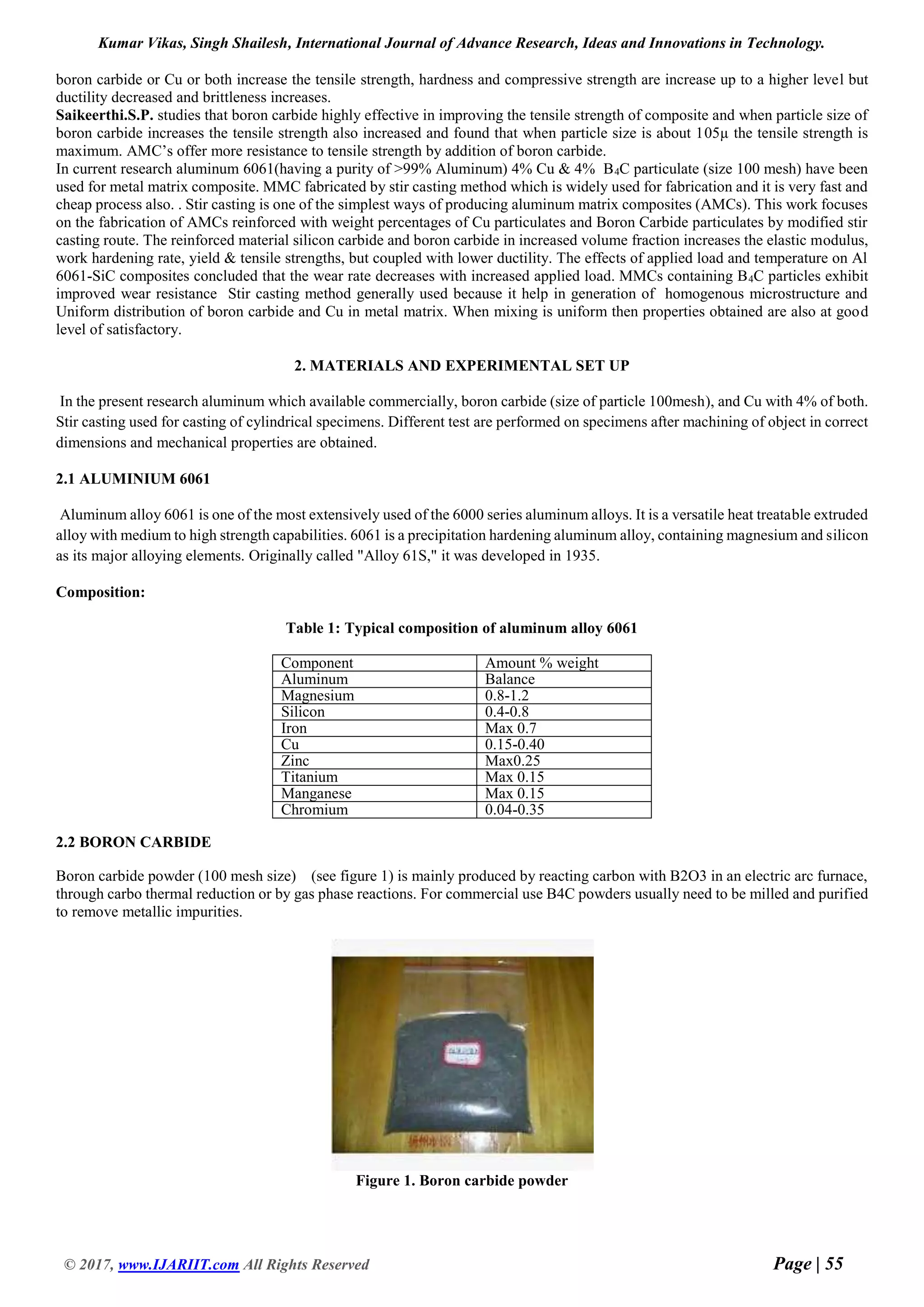
Boron carbide powder (100 mesh size) (see figure 1) is mainly produced by reacting carbon with B2O3 in an electric arc furnace,
through carbo thermal reduction or by gas phase reactions. For commercial use B4C powders usually need to be milled and purified
to remove metallic impurities.
Figure 1. Boron carbide powder
Kumar Vikas, Singh Shailesh, International Journal of Advance Research, Ideas and Innovations in Technology.
© 2017, www.IJARIIT.com All Rights Reserved Page | 56
Table 2: Typical properties of boron carbide
Density (g.cm-3) 2.52
Melting point 2445
Hardness( Knoop 100g) (kg.mm-2
) 2980-3580
Fracture Toughness(MPa.m-1/2
) 2.9-3.7
Young Modulus 450-470
Electrical conductivity 140
Thermal conductivity 30-42
Thermal expansion °C 5
Thermal Neutron capture cross section( bam) 600
2.3 COPPER POWDER
CU possesses very good mechanical properties so it can be used for various applications and AMC’s also .pure Cu is very soft and
very difficult to machine so widely used for alloying and MMC’s.
Table 3:
Properties of Cu:
Density (g.cm-3) 8.89
Modulus of Elasticity GPa 100-150
Tensile strength MPa 220-345
Coefficient of thermal Expansion 17
Thermal conductivity 300
2.4 STIR CASTING METHOD & SET UP
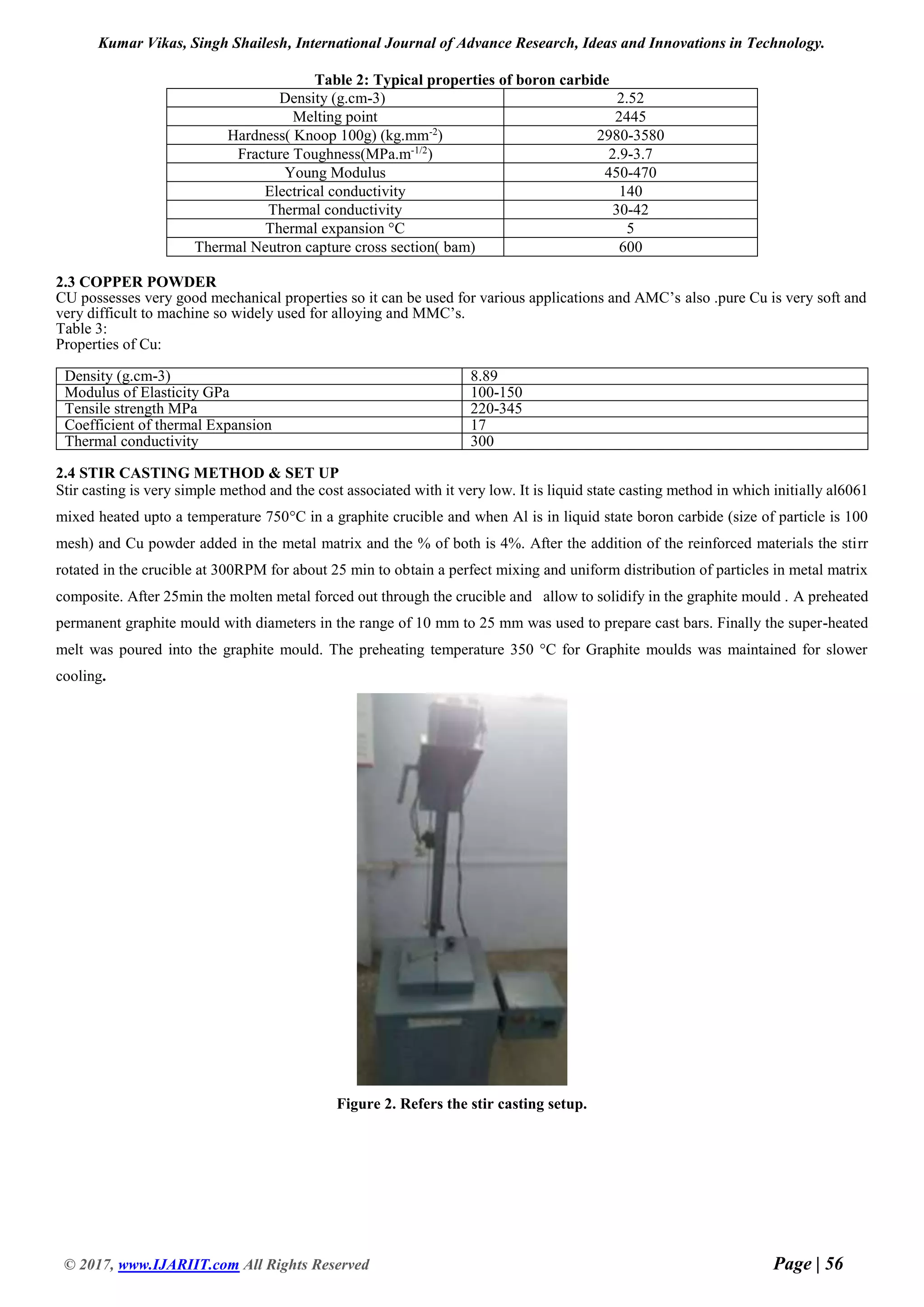
Stir casting is very simple method and the cost associated with it very low. It is liquid state casting method in which initially al6061
mixed heated upto a temperature 750°C in a graphite crucible and when Al is in liquid state boron carbide (size of particle is 100
mesh) and Cu powder added in the metal matrix and the % of both is 4%. After the addition of the reinforced materials the stirr
rotated in the crucible at 300RPM for about 25 min to obtain a perfect mixing and uniform distribution of particles in metal matrix
composite. After 25min the molten metal forced out through the crucible and allow to solidify in the graphite mould . A preheated
permanent graphite mould with diameters in the range of 10 mm to 25 mm was used to prepare cast bars. Finally the super-heated
melt was poured into the graphite mould. The preheating temperature 350 °C for Graphite moulds was maintained for slower
cooling.
Figure 2. Refers the stir casting setup.
Kumar Vikas, Singh Shailesh, International Journal of Advance Research, Ideas and Innovations in Technology.
© 2017, www.IJARIIT.com All Rights Reserved Page | 57
3. TESTING OF SPECIMENS AND RESULT
3.1 Tensile Testing
The tensile strength of prepared metal matrix composite find out by using universal tensile testing machine. Specimen used for
tensile testing was prepared according to ASTM E8 standard. Tensile strength of specimen was increased by addition of boron
carbide particle and Cu particles. Due to uniform distribution and better bonding characteristics of B4C and Cu in metal matrix
phase the tensile strength of AMCs enhanced up to a higher level without sacrifices in ductility. Due to presence of very hard
particles of B4C in metal matrix phase increase the tensile strength and possess very high resistance against applied tensile stress.
Microstructructral ability of alloy to resist displacement motion affects the strength properties of materials.
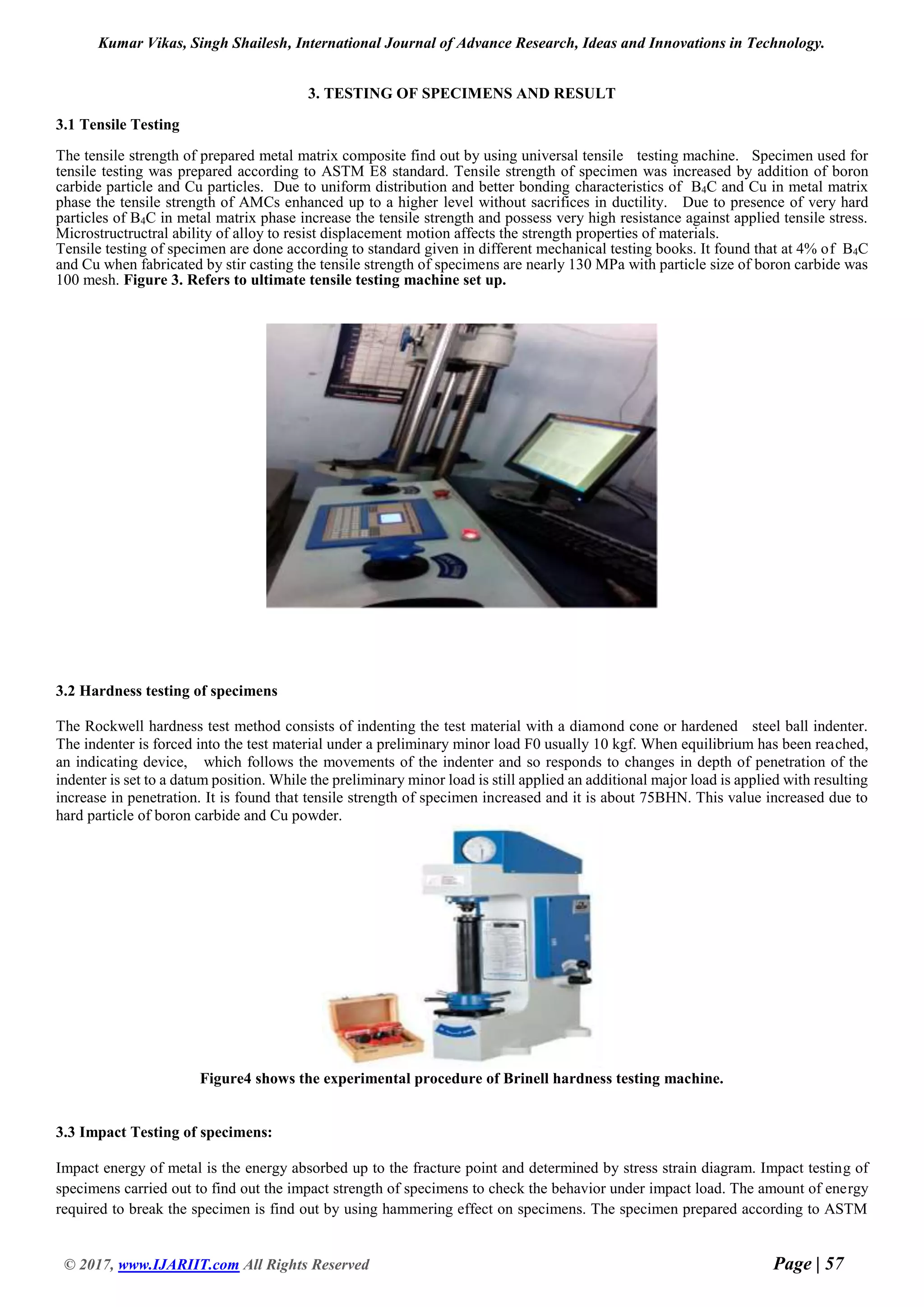
Tensile testing of specimen are done according to standard given in different mechanical testing books. It found that at 4% of B4C
and Cu when fabricated by stir casting the tensile strength of specimens are nearly 130 MPa with particle size of boron carbide was
100 mesh. Figure 3. Refers to ultimate tensile testing machine set up.
3.2 Hardness testing of specimens
The Rockwell hardness test method consists of indenting the test material with a diamond cone or hardened steel ball indenter.
The indenter is forced into the test material under a preliminary minor load F0 usually 10 kgf. When equilibrium has been reached,
an indicating device, which follows the movements of the indenter and so responds to changes in depth of penetration of the
indenter is set to a datum position. While the preliminary minor load is still applied an additional major load is applied with resulting
increase in penetration. It is found that tensile strength of specimen increased and it is about 75BHN. This value increased due to
hard particle of boron carbide and Cu powder.
Figure4 shows the experimental procedure of Brinell hardness testing machine.
3.3 Impact Testing of specimens:
Impact energy of metal is the energy absorbed up to the fracture point and determined by stress strain diagram. Impact testing of
specimens carried out to find out the impact strength of specimens to check the behavior under impact load. The amount of energy
required to break the specimen is find out by using hammering effect on specimens. The specimen prepared according to ASTM
Kumar Vikas, Singh Shailesh, International Journal of Advance Research, Ideas and Innovations in Technology.
© 2017, www.IJARIIT.com All Rights Reserved Page | 58
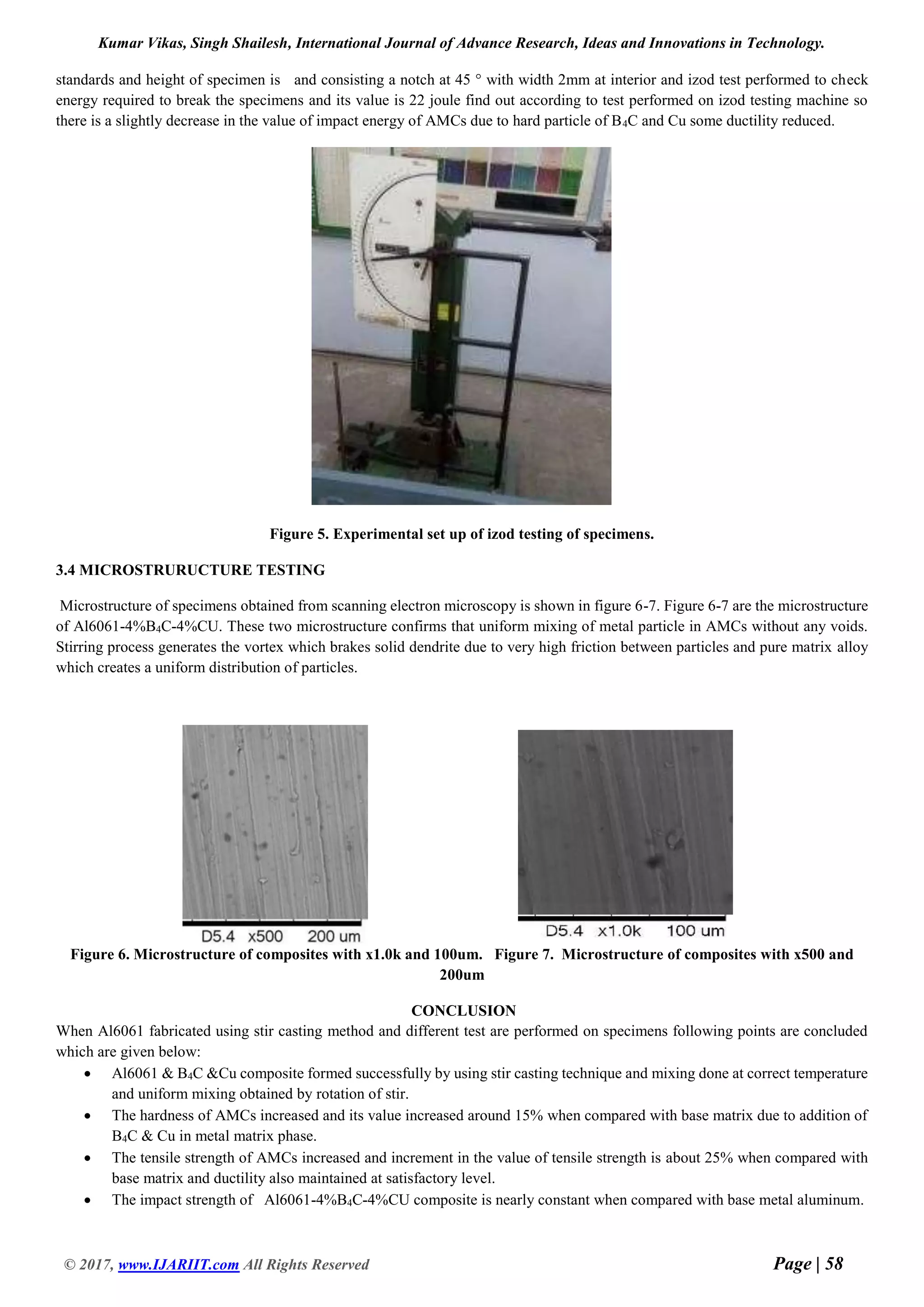
standards and height of specimen is and consisting a notch at 45 ° with width 2mm at interior and izod test performed to check
energy required to break the specimens and its value is 22 joule find out according to test performed on izod testing machine so
there is a slightly decrease in the value of impact energy of AMCs due to hard particle of B4C and Cu some ductility reduced.
Figure 5. Experimental set up of izod testing of specimens.
3.4 MICROSTRURUCTURE TESTING
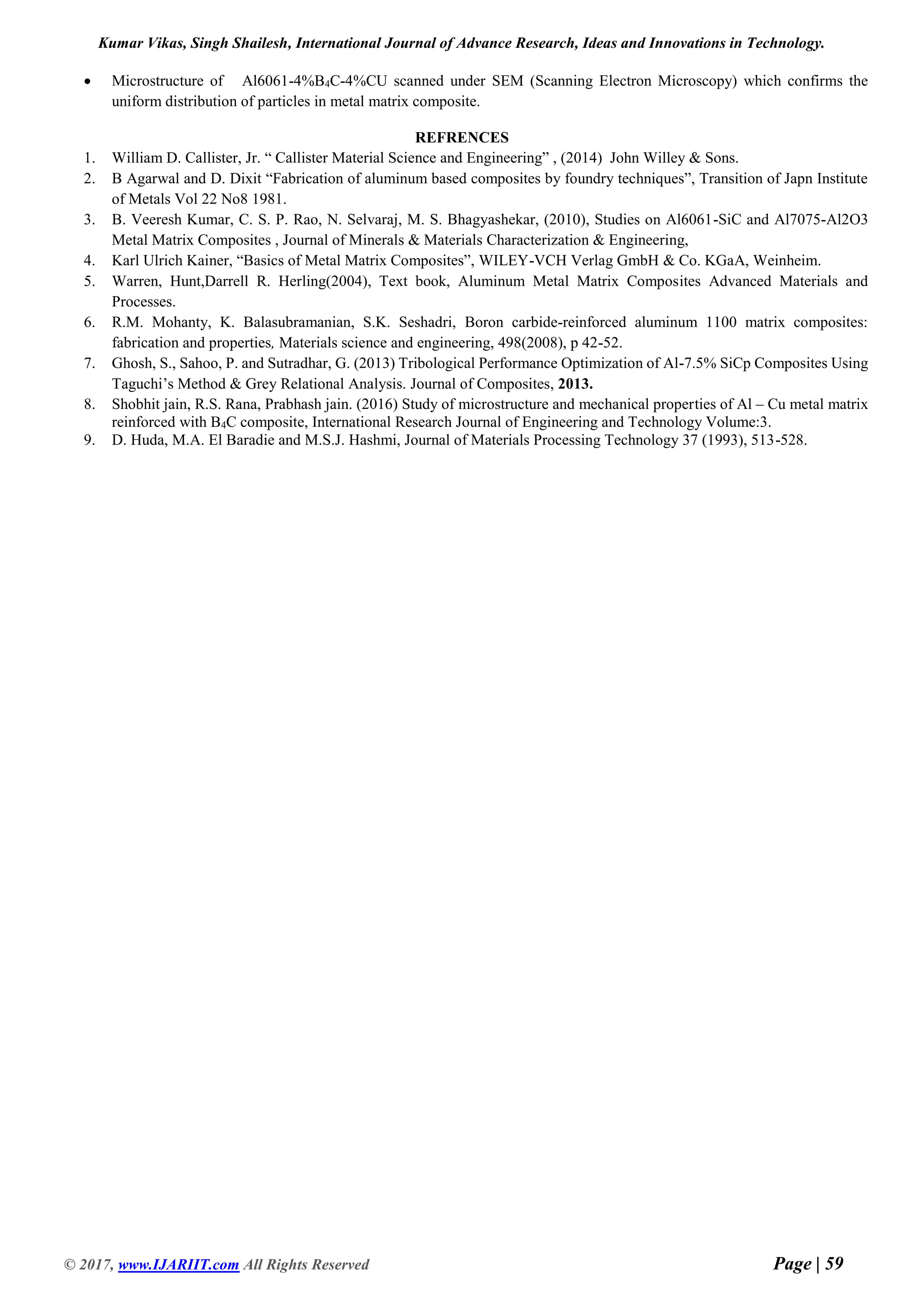
Microstructure of specimens obtained from scanning electron microscopy is shown in figure 6-7. Figure 6-7 are the microstructure
of Al6061-4%B4C-4%CU. These two microstructure confirms that uniform mixing of metal particle in AMCs without any voids.
Stirring process generates the vortex which brakes solid dendrite due to very high friction between particles and pure matrix alloy
which creates a uniform distribution of particles.
Figure 6. Microstructure of composites with x1.0k and 100um. Figure 7. Microstructure of composites with x500 and
200um
CONCLUSION
When Al6061 fabricated using stir casting method and different test are performed on specimens following points are concluded
which are given below:
 Al6061 & B4C &Cu composite formed successfully by using stir casting technique and mixing done at correct temperature
and uniform mixing obtained by rotation of stir.
 The hardness of AMCs increased and its value increased around 15% when compared with base matrix due to addition of
B4C & Cu in metal matrix phase.
 The tensile strength of AMCs increased and increment in the value of tensile strength is about 25% when compared with
base matrix and ductility also maintained at satisfactory level.
 The impact strength of Al6061-4%B4C-4%CU composite is nearly constant when compared with base metal aluminum.
Kumar Vikas, Singh Shailesh, International Journal of Advance Research, Ideas and Innovations in Technology.
© 2017, www.IJARIIT.com All Rights Reserved Page | 59
 Microstructure of Al6061-4%B4C-4%CU scanned under SEM (Scanning Electron Microscopy) which confirms the
uniform distribution of particles in metal matrix composite.
REFRENCES
1. William D. Callister, Jr. “ Callister Material Science and Engineering” , (2014) John Willey & Sons.
2. B Agarwal and D. Dixit “Fabrication of aluminum based composites by foundry techniques”, Transition of Japn Institute
of Metals Vol 22 No8 1981.
3. B. Veeresh Kumar, C. S. P. Rao, N. Selvaraj, M. S. Bhagyashekar, (2010), Studies on Al6061-SiC and Al7075-Al2O3
Metal Matrix Composites , Journal of Minerals & Materials Characterization & Engineering,
4. Karl Ulrich Kainer, “Basics of Metal Matrix Composites”, WILEY-VCH Verlag GmbH & Co. KGaA, Weinheim.
5. Warren, Hunt,Darrell R. Herling(2004), Text book, Aluminum Metal Matrix Composites Advanced Materials and
Processes.
6. R.M. Mohanty, K. Balasubramanian, S.K. Seshadri, Boron carbide-reinforced aluminum 1100 matrix composites:
fabrication and properties, Materials science and engineering, 498(2008), p 42-52.
7. Ghosh, S., Sahoo, P. and Sutradhar, G. (2013) Tribological Performance Optimization of Al-7.5% SiCp Composites Using
Taguchi’s Method & Grey Relational Analysis. Journal of Composites, 2013.
8. Shobhit jain, R.S. Rana, Prabhash jain. (2016) Study of microstructure and mechanical properties of Al – Cu metal matrix
reinforced with B4C composite, International Research Journal of Engineering and Technology Volume:3.
9. D. Huda, M.A. El Baradie and M.S.J. Hashmi, Journal of Materials Processing Technology 37 (1993), 513-528.

Fabrication and evaluation of mechanical properties of al6061

  • 1.
    Kumar Vikas, SinghShailesh, International Journal of Advance Research, Ideas and Innovations in Technology. © 2017, www.IJARIIT.com All Rights Reserved Page | 54 ISSN: 2454-132X Impact Factor: 4.295 (Volume3, Issue6) Available online at: https://www.ijariit.com Fabrication and Evaluation of Mechanical Properties of AL6061- 4%B4C-4%CU Based Composite Experimentally Vikas Kumar M.Tech Scholar Mechanical Engineering Department IEC College of Engineering & Technology, Greater Noida 012vikaskumar@gmail.com Shailesh Singh Assistant Professor Mechanical Engineering Department IEC College of Engineering & Technology, Greater Noida mechshaileshsingh@gmail.com Abstract – Metal matrix composite are widely used in automotive industries because they exhibits different mechanical properties such as high strength and good wear resistance, high specific stiffness, low weight and high hardness etc. Due to these properties metal matrix composite with particulate reinforcement and fabricating method has become one of the most important areas of research. The work is mainly focus on fabrication of Al 6061 reinforced with 4% B4C (particle size 100 mesh) & 4% Cu and method used for fabrication is stir casting method. Tensile strength, hardness, impact strength, microstructure of fabricated composite are used to characterize it. By addition of B4C & Cu tensile strength and hardness of the fabricated composite has increased and slightly decreased in impact strength. Scanning Electron microscopy is used to confirm the microstructure and uniform distribution of B4C & Cu particles in metal matrix composite. The value of tensile strength increase up to 20% and hardness increase upto15% due to addition of B4C & Cu paritcles.The physical and mechanical properties of composite are improved so it can be used for automotive industrial applications. Key Words- Stir Casting, Tensile Strength, Impact Strength, Metal Matrix Composite, and Hardness, Microstructure 1 INTRODUCTION When metal matrix composite (MMC’s) compared with unreinforced metal they show high strength ,hardness ,impact strength as well as wear and fatigue strength at low and high temperatures so they are highly utilized designing of ground transportations vehicles, aircraft etc. Use of pure aluminum in designing industries is limited because it has poor mechanical properties and poor tribological properties also. The role played by the aluminum is vital in development of metal matrix composite reinforced with a B4C,SiC,TiC,Al2O3,TiC etc. they are commonly known as aluminum metal matrix composite (AMC’s). Composition, mechanical behavior, response to heat treatment etc. are some common aspect to be considered corresponding to the metal matrix composite. Properties such as low weight, good corrosion resistance, and good mechanical properties such as tensile strength, hardness, toughness and impact resistance, fatigue etc. made aluminum use as matrix material. Some application require high melting point so aluminum also exhibits this property also .Boron carbide use in reinforcement due to it has good corrosion resistance , good thermal resistance, high strength, easily available, and good culpability with aluminum matrix. Boron carbide powder has very high cost and poor wetting characteristics so research work has been not enough due to these drawbacks. Boron carbide generally used for manufacturing of armor tanks, bullets proof vests etc. Hence, when boron carbide used with low cost routing technique is highly utilized for research purposes. Instead of using Sic carbide, the use of Cu the ductility of AMC’s not reduce and it is low brittle as compare to the use of Sic Rajneesh Kumar Verma, Lucky Agarwal and D.S. Awana found that when Al 6061 reinforced with cu and Sic fabricated by stir casting method ultimate tensile strength increase with increase in weight % of cu and hardness also increased and due to addition on SiC, the tensile strength and corrosion resistance improved significantly when they compared with pure aluminum. Shobhit jain found that when aluminum reinforced with boron carbide and cu manufactured by powder metallurgical the tensile strength increase up to 10% and there is a significant in increase in hardness and compressive strength also. When the amount of
  • 2.
    Kumar Vikas, SinghShailesh, International Journal of Advance Research, Ideas and Innovations in Technology. © 2017, www.IJARIIT.com All Rights Reserved Page | 55 boron carbide or Cu or both increase the tensile strength, hardness and compressive strength are increase up to a higher level but ductility decreased and brittleness increases. Saikeerthi.S.P. studies that boron carbide highly effective in improving the tensile strength of composite and when particle size of boron carbide increases the tensile strength also increased and found that when particle size is about 105µ the tensile strength is maximum. AMC’s offer more resistance to tensile strength by addition of boron carbide. In current research aluminum 6061(having a purity of >99% Aluminum) 4% Cu & 4% B4C particulate (size 100 mesh) have been used for metal matrix composite. MMC fabricated by stir casting method which is widely used for fabrication and it is very fast and cheap process also. . Stir casting is one of the simplest ways of producing aluminum matrix composites (AMCs). This work focuses on the fabrication of AMCs reinforced with weight percentages of Cu particulates and Boron Carbide particulates by modified stir casting route. The reinforced material silicon carbide and boron carbide in increased volume fraction increases the elastic modulus, work hardening rate, yield & tensile strengths, but coupled with lower ductility. The effects of applied load and temperature on Al 6061-SiC composites concluded that the wear rate decreases with increased applied load. MMCs containing B4C particles exhibit improved wear resistance Stir casting method generally used because it help in generation of homogenous microstructure and Uniform distribution of boron carbide and Cu in metal matrix. When mixing is uniform then properties obtained are also at good level of satisfactory. 2. MATERIALS AND EXPERIMENTAL SET UP In the present research aluminum which available commercially, boron carbide (size of particle 100mesh), and Cu with 4% of both. Stir casting used for casting of cylindrical specimens. Different test are performed on specimens after machining of object in correct dimensions and mechanical properties are obtained. 2.1 ALUMINIUM 6061 Aluminum alloy 6061 is one of the most extensively used of the 6000 series aluminum alloys. It is a versatile heat treatable extruded alloy with medium to high strength capabilities. 6061 is a precipitation hardening aluminum alloy, containing magnesium and silicon as its major alloying elements. Originally called "Alloy 61S," it was developed in 1935. Composition: Table 1: Typical composition of aluminum alloy 6061 Component Amount % weight Aluminum Balance Magnesium 0.8-1.2 Silicon 0.4-0.8 Iron Max 0.7 Cu 0.15-0.40 Zinc Max0.25 Titanium Max 0.15 Manganese Max 0.15 Chromium 0.04-0.35 2.2 BORON CARBIDE Boron carbide powder (100 mesh size) (see figure 1) is mainly produced by reacting carbon with B2O3 in an electric arc furnace, through carbo thermal reduction or by gas phase reactions. For commercial use B4C powders usually need to be milled and purified to remove metallic impurities. Figure 1. Boron carbide powder
  • 3.
    Kumar Vikas, SinghShailesh, International Journal of Advance Research, Ideas and Innovations in Technology. © 2017, www.IJARIIT.com All Rights Reserved Page | 56 Table 2: Typical properties of boron carbide Density (g.cm-3) 2.52 Melting point 2445 Hardness( Knoop 100g) (kg.mm-2 ) 2980-3580 Fracture Toughness(MPa.m-1/2 ) 2.9-3.7 Young Modulus 450-470 Electrical conductivity 140 Thermal conductivity 30-42 Thermal expansion °C 5 Thermal Neutron capture cross section( bam) 600 2.3 COPPER POWDER CU possesses very good mechanical properties so it can be used for various applications and AMC’s also .pure Cu is very soft and very difficult to machine so widely used for alloying and MMC’s. Table 3: Properties of Cu: Density (g.cm-3) 8.89 Modulus of Elasticity GPa 100-150 Tensile strength MPa 220-345 Coefficient of thermal Expansion 17 Thermal conductivity 300 2.4 STIR CASTING METHOD & SET UP Stir casting is very simple method and the cost associated with it very low. It is liquid state casting method in which initially al6061 mixed heated upto a temperature 750°C in a graphite crucible and when Al is in liquid state boron carbide (size of particle is 100 mesh) and Cu powder added in the metal matrix and the % of both is 4%. After the addition of the reinforced materials the stirr rotated in the crucible at 300RPM for about 25 min to obtain a perfect mixing and uniform distribution of particles in metal matrix composite. After 25min the molten metal forced out through the crucible and allow to solidify in the graphite mould . A preheated permanent graphite mould with diameters in the range of 10 mm to 25 mm was used to prepare cast bars. Finally the super-heated melt was poured into the graphite mould. The preheating temperature 350 °C for Graphite moulds was maintained for slower cooling. Figure 2. Refers the stir casting setup.
  • 4.
    Kumar Vikas, SinghShailesh, International Journal of Advance Research, Ideas and Innovations in Technology. © 2017, www.IJARIIT.com All Rights Reserved Page | 57 3. TESTING OF SPECIMENS AND RESULT 3.1 Tensile Testing The tensile strength of prepared metal matrix composite find out by using universal tensile testing machine. Specimen used for tensile testing was prepared according to ASTM E8 standard. Tensile strength of specimen was increased by addition of boron carbide particle and Cu particles. Due to uniform distribution and better bonding characteristics of B4C and Cu in metal matrix phase the tensile strength of AMCs enhanced up to a higher level without sacrifices in ductility. Due to presence of very hard particles of B4C in metal matrix phase increase the tensile strength and possess very high resistance against applied tensile stress. Microstructructral ability of alloy to resist displacement motion affects the strength properties of materials. Tensile testing of specimen are done according to standard given in different mechanical testing books. It found that at 4% of B4C and Cu when fabricated by stir casting the tensile strength of specimens are nearly 130 MPa with particle size of boron carbide was 100 mesh. Figure 3. Refers to ultimate tensile testing machine set up. 3.2 Hardness testing of specimens The Rockwell hardness test method consists of indenting the test material with a diamond cone or hardened steel ball indenter. The indenter is forced into the test material under a preliminary minor load F0 usually 10 kgf. When equilibrium has been reached, an indicating device, which follows the movements of the indenter and so responds to changes in depth of penetration of the indenter is set to a datum position. While the preliminary minor load is still applied an additional major load is applied with resulting increase in penetration. It is found that tensile strength of specimen increased and it is about 75BHN. This value increased due to hard particle of boron carbide and Cu powder. Figure4 shows the experimental procedure of Brinell hardness testing machine. 3.3 Impact Testing of specimens: Impact energy of metal is the energy absorbed up to the fracture point and determined by stress strain diagram. Impact testing of specimens carried out to find out the impact strength of specimens to check the behavior under impact load. The amount of energy required to break the specimen is find out by using hammering effect on specimens. The specimen prepared according to ASTM
  • 5.
    Kumar Vikas, SinghShailesh, International Journal of Advance Research, Ideas and Innovations in Technology. © 2017, www.IJARIIT.com All Rights Reserved Page | 58 standards and height of specimen is and consisting a notch at 45 ° with width 2mm at interior and izod test performed to check energy required to break the specimens and its value is 22 joule find out according to test performed on izod testing machine so there is a slightly decrease in the value of impact energy of AMCs due to hard particle of B4C and Cu some ductility reduced. Figure 5. Experimental set up of izod testing of specimens. 3.4 MICROSTRURUCTURE TESTING Microstructure of specimens obtained from scanning electron microscopy is shown in figure 6-7. Figure 6-7 are the microstructure of Al6061-4%B4C-4%CU. These two microstructure confirms that uniform mixing of metal particle in AMCs without any voids. Stirring process generates the vortex which brakes solid dendrite due to very high friction between particles and pure matrix alloy which creates a uniform distribution of particles. Figure 6. Microstructure of composites with x1.0k and 100um. Figure 7. Microstructure of composites with x500 and 200um CONCLUSION When Al6061 fabricated using stir casting method and different test are performed on specimens following points are concluded which are given below:  Al6061 & B4C &Cu composite formed successfully by using stir casting technique and mixing done at correct temperature and uniform mixing obtained by rotation of stir.  The hardness of AMCs increased and its value increased around 15% when compared with base matrix due to addition of B4C & Cu in metal matrix phase.  The tensile strength of AMCs increased and increment in the value of tensile strength is about 25% when compared with base matrix and ductility also maintained at satisfactory level.  The impact strength of Al6061-4%B4C-4%CU composite is nearly constant when compared with base metal aluminum.
  • 6.
    Kumar Vikas, SinghShailesh, International Journal of Advance Research, Ideas and Innovations in Technology. © 2017, www.IJARIIT.com All Rights Reserved Page | 59  Microstructure of Al6061-4%B4C-4%CU scanned under SEM (Scanning Electron Microscopy) which confirms the uniform distribution of particles in metal matrix composite. REFRENCES 1. William D. Callister, Jr. “ Callister Material Science and Engineering” , (2014) John Willey & Sons. 2. B Agarwal and D. Dixit “Fabrication of aluminum based composites by foundry techniques”, Transition of Japn Institute of Metals Vol 22 No8 1981. 3. B. Veeresh Kumar, C. S. P. Rao, N. Selvaraj, M. S. Bhagyashekar, (2010), Studies on Al6061-SiC and Al7075-Al2O3 Metal Matrix Composites , Journal of Minerals & Materials Characterization & Engineering, 4. Karl Ulrich Kainer, “Basics of Metal Matrix Composites”, WILEY-VCH Verlag GmbH & Co. KGaA, Weinheim. 5. Warren, Hunt,Darrell R. Herling(2004), Text book, Aluminum Metal Matrix Composites Advanced Materials and Processes. 6. R.M. Mohanty, K. Balasubramanian, S.K. Seshadri, Boron carbide-reinforced aluminum 1100 matrix composites: fabrication and properties, Materials science and engineering, 498(2008), p 42-52. 7. Ghosh, S., Sahoo, P. and Sutradhar, G. (2013) Tribological Performance Optimization of Al-7.5% SiCp Composites Using Taguchi’s Method & Grey Relational Analysis. Journal of Composites, 2013. 8. Shobhit jain, R.S. Rana, Prabhash jain. (2016) Study of microstructure and mechanical properties of Al – Cu metal matrix reinforced with B4C composite, International Research Journal of Engineering and Technology Volume:3. 9. D. Huda, M.A. El Baradie and M.S.J. Hashmi, Journal of Materials Processing Technology 37 (1993), 513-528.