HYPOTHYROIDISM
Aaqib nawaz wassan
Abdul moiz soomro
 Hypothyroidism is defined as a deficiency in thyroid harmone
secretion.
 This disorder occurs in 2 to 15% of the population, more
commonly in women than in men.
 The risk of developing hypothyroidism increases with age.
 When there is low thyroid harmone a variety of clinical signs and
symptoms of hypometabolism develops.
Defination:
 Cardiovascular system
 Respiratory system
 Renal system
 Central nervous system
 Neuromuscular system
 Gastrointestinal system
 Hematology
Effect of hypothyroidism on different organ
system:
 Hypothyroidism is characterized by a decrease in oxygen and
substrate utilization by all the major organ systems of the body.
 As a result, the demands for cardiac output decrease.
 So, major cardiovascular changes that occur in hypothyroidism
includes:
 decrease in cardiac output
 decrease in cardiac contractility
 reduction in heart rate
 increase in peripheral vascular resistance
Cardiovascular system
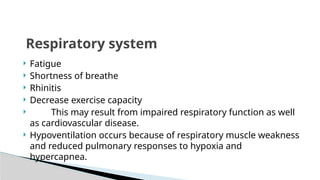
 Fatigue
 Shortness of breathe
 Rhinitis
 Decrease exercise capacity
 This may result from impaired respiratory function as well
as cardiovascular disease.
 Hypoventilation occurs because of respiratory muscle weakness
and reduced pulmonary responses to hypoxia and
hypercapnea.
Respiratory system
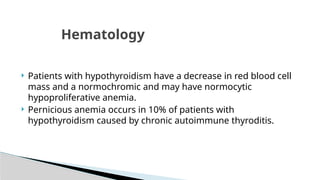
 Patients with hypothyroidism have a decrease in red blood cell
mass and a normochromic and may have normocytic
hypoproliferative anemia.
 Pernicious anemia occurs in 10% of patients with
hypothyroidism caused by chronic autoimmune thyroditis.
Hematology
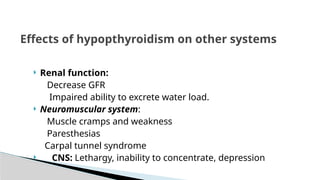
 Renal function:
Decrease GFR
Impaired ability to excrete water load.
 Neuromuscular system:
Muscle cramps and weakness
Paresthesias
Carpal tunnel syndrome
 CNS: Lethargy, inability to concentrate, depression
Effects of hypopthyroidism on other systems
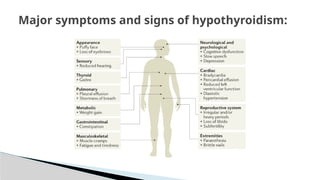
Major symptoms and signs of hypothyroidism:
 Primary Hypothyroidism
 Central Hypothyroidism
 Congenital Hypothyroidism
Types of hypothyroidism:
 Primary hypothyroidism is the gland itself is abnormal
It is the most common type about 90%.
Decreased T3,T4 and increased TSH.
Central hypothyroidism:
It is defined as hypothyroidism due to insufficient stimulation
of thyroid gland by TSH
: Secretion of TSH can be impaired at the hypothalamic or pituatory levels.
::: TSH is the most useful investigation of thyroid function for both hypo
and hyperthyroidism
Primary hypothyroidism:
 Iodine deficiency
 Autoimmune thyroiditis
 Previous thyroidectomy
 Previous radio iodine treatment
 Previous external beam radiotherapy to the neck
 Drugs { Amiodarone, Lithium}
 Secondary hypothyroidism:
 Lesions compressing the pituatory like pituatory
adenoma,craniophyrangioma and menningioma
Primary hypothyroidism causes:
 when iodine deficiency is more severe, thyroid harmone
production falls and the patient may experience a hypothyroid
condition.
 In such cases adults have the usual signs and symptoms of
hypothyroidism and may lead to myxedema.
 However congenital hypothyroidism also known as cretinism
fetus and young children prevents central nervous system
development and maturation resulting in permenant
mental retardation, neurologic defects and growth
abnormalities.
Iodine deficiency hypothyroidism
 Severe iodine deficiency result in impaired thyroid harmone
synthesis and thyroid enlargement {GOITER}
 Population effects of severe iodine dificiency termed as iodine
dificiency disorders { IDDs } include:
 Endemic goiter
 Hypothyroidism
 Cretinism
 A significant danger of iodine dificiency is maternal
hypothyroidism leading to an insufficient supply of thyroid
harmone to the fetus is entirely dependent on maternal thyroid
harmone.
 Thus maternal hypothyroidism can produce a reduction in the
IQ of the affected child.
 Maternal iodine dificiency will produce fetal iodine dificiency.
 Drugs such as thionamides PTU inhibit the oxidation of iodine
and subsequent binding of iodine to tyrosine residues in
thyroglobulin.
 Lithium which is used in Tx of bipolar disorder, can induce
hypothyroidism.
 The action of lithium appears similar to that high dose iodine
inhibiting thyroid harmone release and organification of
iodine.
 prolonged use of nitropruside may lead to hypothyroidism.
Drug induced Hypothyroidism
 Hashimoto thyroiditis is characterized by the
destruction of thyroid cells by various cell and
antibody-mediated immune processes.
 Patients with Hashimoto thyroiditis have antibodies
to various thyroid antigens,
 ..anti-thyroid peroxidase { anti- TPO }
 ..antithyroglobulin { anti- Tg }
 ..TSH receptor-blocking antibodies { TBII }
Autoimmune thyroid disease :
 There is marked lymphocytic infiltration of the thyroid with
germinal center formation, atrophy of the thyroid follicles,
absence of colloid, and mild to moderate fibrosis.
 In atrophic thyroiditis, the fibrosis is much more extensive,
lymphocyte infiltration is less pronounced, and thyroid follicles
are almost completely absent.
 Atrophic thyroiditis likely represents the end stage of
Hashimotos rather than distinct disorder.
Pathogenesis:
 In Hashimoto disaese destructive thyroiditis results from both
cell mediated and humoral attack on the thyroid disease.
 The gland is typically enlarged but small and firm in early cases,
with a palpable pyramidal lobe.
 Hyperthyroidism may transiently occur.
 But further gland damage rapidly leads to permenant
hypothyroidism.
 Regression of goiter and the gland remnant will composed of
fibrous tissue.
 The process gradually reduces thyroid function.
 There is a phase of compensation when normal thyroid
harmone levels are maintained by rised in TSH.
 Later, T4 levels fall and TSH level rises further.
 Symtoms become more readily apparent at this stage.
 which is referred to a clinical hypothyroidism or overt
hypothyroidism.
 Central hypothyroidism is defined as hypothyroidism due to
insufficient stimulation of thyroid gland by TSH.
 Secretion of TSH can be impaired at the hypothylamic or
pituatory levels.
Central hypothyroidism
 TUMOR
 HEMORRHAGE
 TRAUMA
 MALFORMATION
 POST-INFECTIOUS DAMAGE
 POST SURGICAL DAMAGE
Causes of central hypothyroidism:
 The term myxedema refers to the thickened, nonpitting
edemetous changes to the soft tissues of patients in a
markedly hypothyroid state.
 Myxedema coma is life threatening condition
 It occurs late in the progression of hypothyroidism
 The condition is seen typically in elderly women and is often
precipitated by infection, medication, environmental exposure,
or other metabolic-related stresses.
Myxedema Coma
 Symptoms can menifest in all organ system and range in severity
based on the degree of harmone dificiency.
 The disease typically progresses over month to years.
 Onset of disease is quick following cessation of thyroid
replacement medication or surgical removal of the thyroid gland.
 Decrease mental ability
 cardiovascular collapse
 severe electrolyte imbalance
 cetrebral hypoxia { elevated CO2 levels }
 severe hypothermia.
 Coma
If condition of hypothyroid progress lead to:
 TFT
 Ultrasonography of neck
 Thyroid stimulating antibodies
Biochemical changes:
High triglycerides and high cholesterol
Reduction in LDL receptors
High creatinine level.
Low plasma sodium
Decrease Hb
Investigations:
 In most cases, hypothyroidism is treated by replacing the
amount of hormone that your thyroid is no longer making.
 This is typically done with a medication.
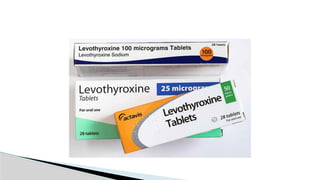
 One medication that is commonly used is called
levothyroxine. Taken orally, this medication increases the
amount of thyroid hormone your body produces, evening out
your levels.
How hypothyroidism is treated?
 Levothyroxine should be taken on an empty stomach with no other drugs or
vitamins; multivitamins, including calcium and iron, can decrease its absorption.
 • If a patient has coronary heart disease that needs intervention, do the
intervention (CABG or stent placement) before thyroid hormone replacement is
initiated.
 Hypothyroidism is a manageable disease. However, you will need to
continuously take medication to normalize the amount of hormones in your
body for the rest of your life. With careful management, and follow-up
appointments with your healthcare provider to make sure your treatment is
working properly, you can lead a normal and healthy life.
THANKYOU

hypothyroidism a autoimune endocrine disorder

  • 1.
  • 2.
     Hypothyroidism isdefined as a deficiency in thyroid harmone secretion.  This disorder occurs in 2 to 15% of the population, more commonly in women than in men.  The risk of developing hypothyroidism increases with age.  When there is low thyroid harmone a variety of clinical signs and symptoms of hypometabolism develops. Defination:
  • 3.
     Cardiovascular system Respiratory system  Renal system  Central nervous system  Neuromuscular system  Gastrointestinal system  Hematology Effect of hypothyroidism on different organ system:
  • 4.
     Hypothyroidism ischaracterized by a decrease in oxygen and substrate utilization by all the major organ systems of the body.  As a result, the demands for cardiac output decrease.  So, major cardiovascular changes that occur in hypothyroidism includes:  decrease in cardiac output  decrease in cardiac contractility  reduction in heart rate  increase in peripheral vascular resistance Cardiovascular system
  • 5.
     Fatigue  Shortnessof breathe  Rhinitis  Decrease exercise capacity  This may result from impaired respiratory function as well as cardiovascular disease.  Hypoventilation occurs because of respiratory muscle weakness and reduced pulmonary responses to hypoxia and hypercapnea. Respiratory system
  • 6.
     Patients withhypothyroidism have a decrease in red blood cell mass and a normochromic and may have normocytic hypoproliferative anemia.  Pernicious anemia occurs in 10% of patients with hypothyroidism caused by chronic autoimmune thyroditis. Hematology
  • 7.
     Renal function: DecreaseGFR Impaired ability to excrete water load.  Neuromuscular system: Muscle cramps and weakness Paresthesias Carpal tunnel syndrome  CNS: Lethargy, inability to concentrate, depression Effects of hypopthyroidism on other systems
  • 8.
    Major symptoms andsigns of hypothyroidism:
  • 9.
     Primary Hypothyroidism Central Hypothyroidism  Congenital Hypothyroidism Types of hypothyroidism:
  • 10.
     Primary hypothyroidismis the gland itself is abnormal It is the most common type about 90%. Decreased T3,T4 and increased TSH. Central hypothyroidism: It is defined as hypothyroidism due to insufficient stimulation of thyroid gland by TSH : Secretion of TSH can be impaired at the hypothalamic or pituatory levels. ::: TSH is the most useful investigation of thyroid function for both hypo and hyperthyroidism Primary hypothyroidism:
  • 11.
     Iodine deficiency Autoimmune thyroiditis  Previous thyroidectomy  Previous radio iodine treatment  Previous external beam radiotherapy to the neck  Drugs { Amiodarone, Lithium}  Secondary hypothyroidism:  Lesions compressing the pituatory like pituatory adenoma,craniophyrangioma and menningioma Primary hypothyroidism causes:
  • 12.
     when iodinedeficiency is more severe, thyroid harmone production falls and the patient may experience a hypothyroid condition.  In such cases adults have the usual signs and symptoms of hypothyroidism and may lead to myxedema.  However congenital hypothyroidism also known as cretinism fetus and young children prevents central nervous system development and maturation resulting in permenant mental retardation, neurologic defects and growth abnormalities. Iodine deficiency hypothyroidism
  • 13.
     Severe iodinedeficiency result in impaired thyroid harmone synthesis and thyroid enlargement {GOITER}  Population effects of severe iodine dificiency termed as iodine dificiency disorders { IDDs } include:  Endemic goiter  Hypothyroidism  Cretinism
  • 14.
     A significantdanger of iodine dificiency is maternal hypothyroidism leading to an insufficient supply of thyroid harmone to the fetus is entirely dependent on maternal thyroid harmone.  Thus maternal hypothyroidism can produce a reduction in the IQ of the affected child.  Maternal iodine dificiency will produce fetal iodine dificiency.
  • 15.
     Drugs suchas thionamides PTU inhibit the oxidation of iodine and subsequent binding of iodine to tyrosine residues in thyroglobulin.  Lithium which is used in Tx of bipolar disorder, can induce hypothyroidism.  The action of lithium appears similar to that high dose iodine inhibiting thyroid harmone release and organification of iodine.  prolonged use of nitropruside may lead to hypothyroidism. Drug induced Hypothyroidism
  • 16.
     Hashimoto thyroiditisis characterized by the destruction of thyroid cells by various cell and antibody-mediated immune processes.  Patients with Hashimoto thyroiditis have antibodies to various thyroid antigens,  ..anti-thyroid peroxidase { anti- TPO }  ..antithyroglobulin { anti- Tg }  ..TSH receptor-blocking antibodies { TBII } Autoimmune thyroid disease :
  • 17.
     There ismarked lymphocytic infiltration of the thyroid with germinal center formation, atrophy of the thyroid follicles, absence of colloid, and mild to moderate fibrosis.  In atrophic thyroiditis, the fibrosis is much more extensive, lymphocyte infiltration is less pronounced, and thyroid follicles are almost completely absent.  Atrophic thyroiditis likely represents the end stage of Hashimotos rather than distinct disorder. Pathogenesis:
  • 18.
     In Hashimotodisaese destructive thyroiditis results from both cell mediated and humoral attack on the thyroid disease.  The gland is typically enlarged but small and firm in early cases, with a palpable pyramidal lobe.  Hyperthyroidism may transiently occur.  But further gland damage rapidly leads to permenant hypothyroidism.  Regression of goiter and the gland remnant will composed of fibrous tissue.
  • 19.
     The processgradually reduces thyroid function.  There is a phase of compensation when normal thyroid harmone levels are maintained by rised in TSH.  Later, T4 levels fall and TSH level rises further.  Symtoms become more readily apparent at this stage.  which is referred to a clinical hypothyroidism or overt hypothyroidism.
  • 20.
     Central hypothyroidismis defined as hypothyroidism due to insufficient stimulation of thyroid gland by TSH.  Secretion of TSH can be impaired at the hypothylamic or pituatory levels. Central hypothyroidism
  • 21.
     TUMOR  HEMORRHAGE TRAUMA  MALFORMATION  POST-INFECTIOUS DAMAGE  POST SURGICAL DAMAGE Causes of central hypothyroidism:
  • 22.
     The termmyxedema refers to the thickened, nonpitting edemetous changes to the soft tissues of patients in a markedly hypothyroid state.  Myxedema coma is life threatening condition  It occurs late in the progression of hypothyroidism  The condition is seen typically in elderly women and is often precipitated by infection, medication, environmental exposure, or other metabolic-related stresses. Myxedema Coma
  • 23.
     Symptoms canmenifest in all organ system and range in severity based on the degree of harmone dificiency.  The disease typically progresses over month to years.  Onset of disease is quick following cessation of thyroid replacement medication or surgical removal of the thyroid gland.
  • 24.
     Decrease mentalability  cardiovascular collapse  severe electrolyte imbalance  cetrebral hypoxia { elevated CO2 levels }  severe hypothermia.  Coma If condition of hypothyroid progress lead to:
  • 25.
     TFT  Ultrasonographyof neck  Thyroid stimulating antibodies Biochemical changes: High triglycerides and high cholesterol Reduction in LDL receptors High creatinine level. Low plasma sodium Decrease Hb Investigations:
  • 26.
     In mostcases, hypothyroidism is treated by replacing the amount of hormone that your thyroid is no longer making.  This is typically done with a medication.  One medication that is commonly used is called levothyroxine. Taken orally, this medication increases the amount of thyroid hormone your body produces, evening out your levels. How hypothyroidism is treated?
  • 27.
     Levothyroxine shouldbe taken on an empty stomach with no other drugs or vitamins; multivitamins, including calcium and iron, can decrease its absorption.  • If a patient has coronary heart disease that needs intervention, do the intervention (CABG or stent placement) before thyroid hormone replacement is initiated.  Hypothyroidism is a manageable disease. However, you will need to continuously take medication to normalize the amount of hormones in your body for the rest of your life. With careful management, and follow-up appointments with your healthcare provider to make sure your treatment is working properly, you can lead a normal and healthy life.
  • 29.