Group no – 5
Ashish Sharma
DEFINITION
Hypothesis testing is a method for testing a claim or
hypothesis about a parameter in a population,
using data measured in a sample.
Five stEPS:
Step 1 : State the hypotheses.
Step 2 : level of significance.
 Step 3 : select the test statistic.
 Step 4 : formulate the decision rule.
 Step 5 : make a decision.
 We begin by stating the value of a population
mean in a null hypothesis.
 The null hypothesis, stated as the null, is a
statement about a population parameter, such as
the population mean, that is assumed to be true.
Step 1 : State the hypotheses.
 To set the criteria for a decision, we state the level
of significance for a test.
 Level of significance, or significance level, refers to
a criterion of judgment upon which a decision is
made regarding the value stated in a null
hypothesis.
Step 2 : level of significance
 The test statistic is a mathematical formula that
allows researchers to determine the likelihood of
obtaining sample outcomes if the null hypothesis
were true.
Step 3 : select the test
statistic
Step 4 : formulate the decision rule
 A decision rule is a statement of the specific condition.
 critical value : the dividing point between the region
where the null hypothesis is rejected or not.
Step 5: Make a decision
The final step in hypothesis testing is
computing the test statistics, comparing it to the
critical value and making a decision to reject or
not to reject.
Example: Pizza House
A Pizza restaurant provides one of the fastest home
delivery services in the world with 20 mobile units. The
manager of home delivery services wants to formulate a
hypothesis test that could use a sample of response times
to determine whether or not the service goal of 12 minutes
or less is being achieved.
A sample of 40 home deliveries yields an average time of
13.25 minutes and standard deviation =3.2 minutes. Test
the hypothesis at 0.05 level of significance.
Example: Pizza House
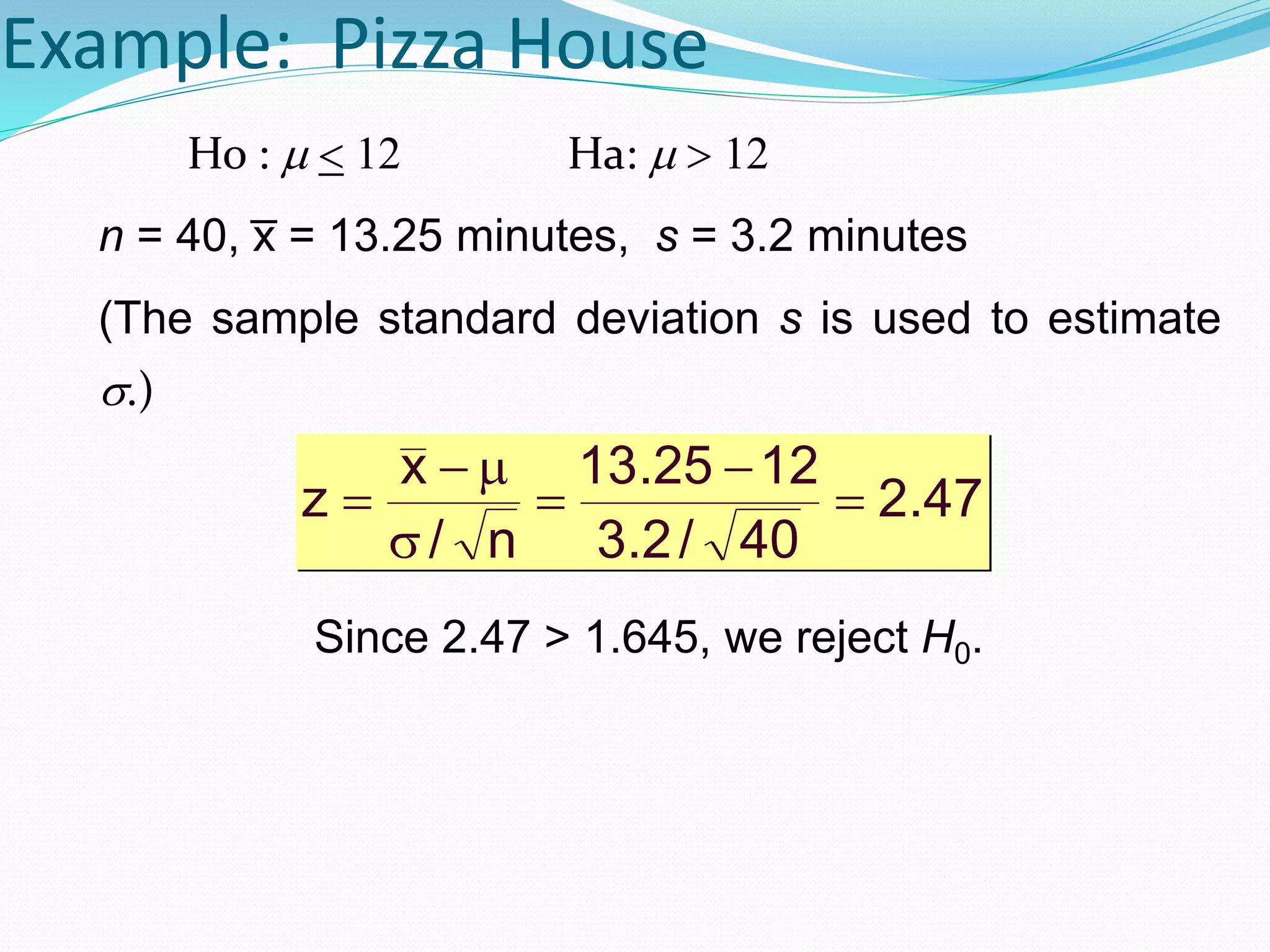
Ho :   Ha: 
n = 40, x̅ = 13.25 minutes, s = 3.2 minutes
(The sample standard deviation s is used to estimate
.)
Since 2.47 > 1.645, we reject H0.
47.2
40/2.3
1225.13
n/
x
z 





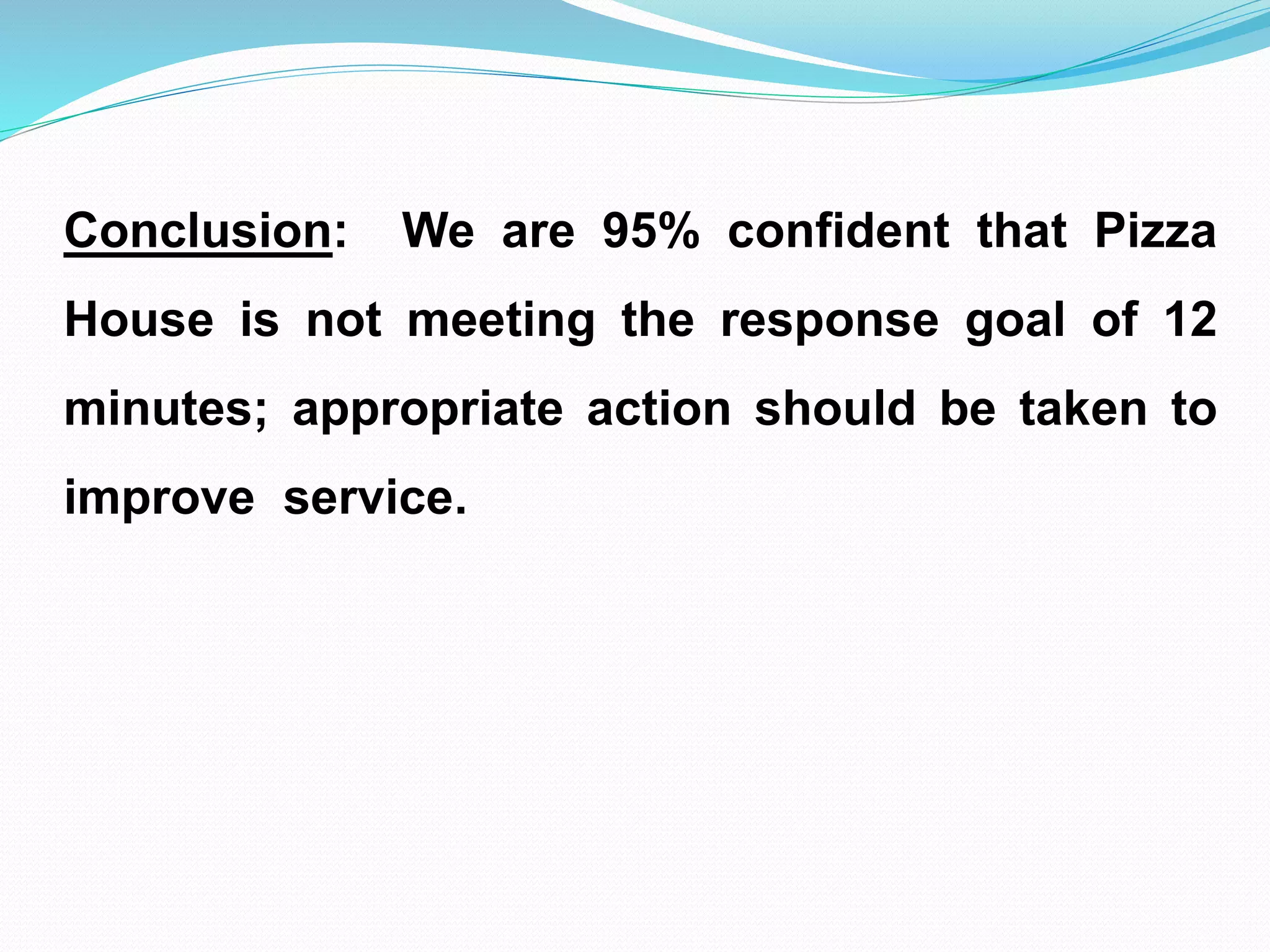
Conclusion: We are 95% confident that Pizza
House is not meeting the response goal of 12
minutes; appropriate action should be taken to
improve service.

Hypothesis testing

  • 1.
    Group no –5 Ashish Sharma
  • 2.
    DEFINITION Hypothesis testing isa method for testing a claim or hypothesis about a parameter in a population, using data measured in a sample.
  • 3.
    Five stEPS: Step 1: State the hypotheses. Step 2 : level of significance.  Step 3 : select the test statistic.  Step 4 : formulate the decision rule.  Step 5 : make a decision.
  • 4.
     We beginby stating the value of a population mean in a null hypothesis.  The null hypothesis, stated as the null, is a statement about a population parameter, such as the population mean, that is assumed to be true. Step 1 : State the hypotheses.
  • 5.
     To setthe criteria for a decision, we state the level of significance for a test.  Level of significance, or significance level, refers to a criterion of judgment upon which a decision is made regarding the value stated in a null hypothesis. Step 2 : level of significance
  • 6.
     The teststatistic is a mathematical formula that allows researchers to determine the likelihood of obtaining sample outcomes if the null hypothesis were true. Step 3 : select the test statistic
  • 7.
    Step 4 :formulate the decision rule  A decision rule is a statement of the specific condition.  critical value : the dividing point between the region where the null hypothesis is rejected or not.
  • 8.
    Step 5: Makea decision The final step in hypothesis testing is computing the test statistics, comparing it to the critical value and making a decision to reject or not to reject.
  • 9.
    Example: Pizza House APizza restaurant provides one of the fastest home delivery services in the world with 20 mobile units. The manager of home delivery services wants to formulate a hypothesis test that could use a sample of response times to determine whether or not the service goal of 12 minutes or less is being achieved. A sample of 40 home deliveries yields an average time of 13.25 minutes and standard deviation =3.2 minutes. Test the hypothesis at 0.05 level of significance.
  • 10.
    Example: Pizza House Ho:   Ha:  n = 40, x̅ = 13.25 minutes, s = 3.2 minutes (The sample standard deviation s is used to estimate .) Since 2.47 > 1.645, we reject H0. 47.2 40/2.3 1225.13 n/ x z      
  • 11.
    Conclusion: We are95% confident that Pizza House is not meeting the response goal of 12 minutes; appropriate action should be taken to improve service.