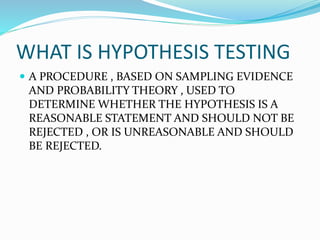
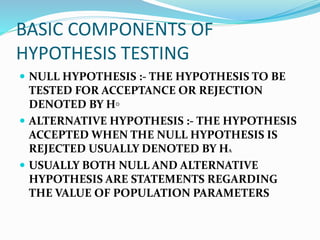
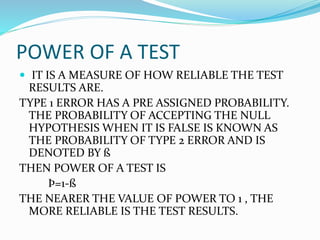
Hypothesis testing is a statistical procedure used to determine if a hypothesis should be accepted or rejected based on sample data. It involves stating the null and alternative hypotheses, selecting a significance level, choosing a test statistic and distribution, determining decision rules based on critical values, collecting a sample, computing the test statistic, and comparing it to the critical value to either reject or fail to reject the null hypothesis. The power of a test measures how reliable its results are based on the probabilities of type 1 and type 2 errors. Limitations include uncertainty due to probability, misconceptions about the purpose of tests, samples not perfectly representing populations, and tests only indicating differences without explanation.


![RSS 2013 - A re-analysis of the Cochrane Library data]](https://cdn.slidesharecdn.com/ss_thumbnails/rssnewcastle3sep13-140606083345-phpapp02-thumbnail.jpg?width=640&height=640&fit=bounds)


