TYPE 1.5 Diabetes LADA & MODY Dr KURIAN JOSEPH SMALL TOPIC PRESENTATIONS
MODY
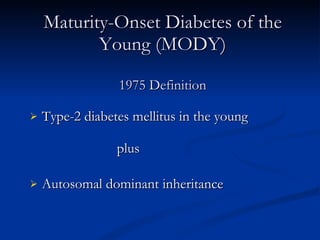
Maturity-Onset Diabetes of the Young (MODY) 1975 Definition Type-2 diabetes mellitus in the young   plus Autosomal dominant inheritance
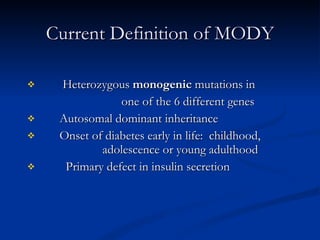
Current Definition of MODY Heterozygous  monogenic  mutations in   one of the 6 different genes Autosomal dominant inheritance  Onset of diabetes early in life:  childhood,      adolescence or young adulthood Primary defect in insulin secretion
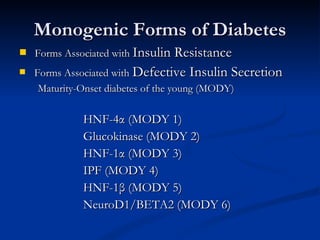
Monogenic Forms of Diabetes Forms Associated with  Insulin Resistance  Forms Associated with   Defective Insulin Secretion Maturity-Onset diabetes of the young (MODY)  HNF-4 α  (MODY 1) Glucokinase (MODY 2) HNF-1 α  (MODY 3)  IPF (MODY 4) HNF-1 β  (MODY 5) NeuroD1/BETA2 (MODY 6)
 
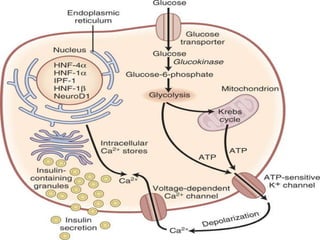
MODY-Related Proteins  [1/4]   Glucokinase Expressed in   -cells and liver GSK catalyzes the formation of glucose-6-phosphate from glucose. Beta cells - “Glucose sensor” Control rate of Glucose phosphorylation Liver – Helps in storage of glucose as glycogen Mild stable hyperglycemia  Does not respond to Sulfonylureas.
Liver-enriched transcription factors    HNF-1  , HNF-1  , and HNF-4  Expressed in liver, pancreatic islets, kidneys and genitalia. In Beta cells they regulate  The expression of the insulin gene  Proteins involved in glucose transport and metabolism.  Mutations results in defect of insulin secretion response to glucose, leading to progressive decline in glycemic control.  MODY 1 &3 responds to sulfonylurea initially.
MODY-Related Proteins  Transcription factor IPF-1 Expressed in pancreatic islets Central role in development of pancreas.  Mediates glucose-induced stimulation of insulin-gene transcription Exocrine pancreatic insufficiency may occur.
MODY-Related Proteins  Transcription factor Neuro-D1 (BETA2) Rare Expressed in pancreatic islets Activates  the transcription of the insulin gene Required for normal development of the pancreatic islets
Phenotypic Expression and Natural History of MODY Recognition at young age 1.Mild, asymptomatic increase in blood glucose in a child,  adolescent or young adult(<25 years) 2. Prominent family history of diabetes in 2-3 generations   3. Usually not associated with obesity Not progressive, or slowly progressive hyperglycemia Hyperglycemia responsive to diet and/or oral  anti-hyperglycemic agents for years to decades
When to suspect MODY a “type 1″ diabetes patient who has negative blood testing for autoantibodies. a “type 1″ diabetes patient who generates a significant amount of insulin for years beyond diagnosis (detectable blood levels of c-peptide, proinsulin, and/ or insulin) a “type 2″ diabetes patient who is normal weight and shows no signs of insulin resistance. a diabetes with family history of early onset diabetes for 2-3 generations. Diabetes paired with pancreatic insufficiency  Individual or family history of diabetes paired with developmental kidney disease or kidney cysts
Genetic Testing Only definitive way to confirm MODY   blood or saliva  Not all mutations cause diabetes Each child will have a 50% chance of inheriting the gene   1 st  degree relatives have a 50% chance of carrying the same gene mutation Then they have  a >95% chance of developing MODY at some time in their life.
Rx for MODY Rx depends on the involved gene and other factors MODY 3 and 1 can be treated initially with  sulfonylureas, prompts the body to produce insulin. Usually GCK-MODY requires no treatment at all.  Other type of MODY Rx is unclear may require  multiple daily Insulin injections.
  LADA TYPE 1.5 DIABETES
LATENT AUTOIMMUNE DIABETES OF ADULTHOOD Late-onset autoimmune diabetes of adulthood Slow Onset Type 1 diabetes Type 1.5 diabetes - Type 1 diabetes develops in adults Mistakenly diagnosed as T2DM
Characteristics of LADA Adult age (usually over 30 years) at time of diagnosis May initially appear to be non-obese Type 2 diabetes May initially be controlled with nutrition and exercise Patient gradually becomes dependent on insulin Positive for auto-antibodies Low C-peptide levels in the body Often does not have a family history of Type 2 diabetes
Criteria for LADA Aged at least 30 years or older Positive for at least one of the auto-antibodies found in type 1 diabetes  Free from insulin treatment for the first six months after diagnosis. 20% of persons diagnosed as having non-obesity-related type 2 diabetes may actually have LADA
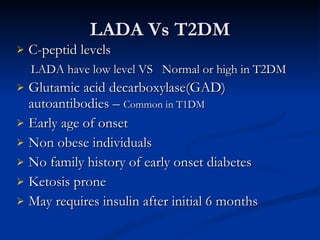
LADA Vs T2DM C-peptid levels LADA have low level VS  Normal or high in T2DM Glutamic acid decarboxylase(GAD) autoantibodies –  Common in T1DM Early age of onset Non obese individuals  No family history of early onset diabetes Ketosis prone  May requires insulin after initial 6 months
Diagnosis Performing a GAD antibody test is the most common method of diagnosing LADA.  Islet cell antibodies (ICA) are also common.
Management LADA often does not require insulin at the time of diagnosis and may be managed with diet and exercise.   Due to destruction of the β-cells, they become insulin dependent more rapidly than “classic” type 2 diabetes May require multiple daily Insulin injections(after 6 months)
Thank you
 
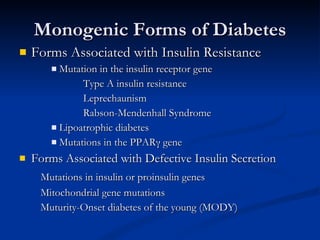
Monogenic Forms of Diabetes Forms Associated with Insulin Resistance  Mutation in the insulin receptor gene Type A insulin resistance Leprechaunism Rabson-Mendenhall Syndrome Lipoatrophic diabetes Mutations in the PPAR γ  gene Forms Associated with Defective Insulin Secretion Mutations in insulin or proinsulin genes Mitochondrial gene mutations Muturity-Onset diabetes of the young (MODY)
MODY  Associated with Defective Insulin Secretion HNF-4 α  (MODY 1) Glucokinase (MODY 2) HNF-1 α  (MODY 3)  IPF (MODY 4) HNF-1 β  (MODY 5) NeuroD1/BETA2 (MODY 6)
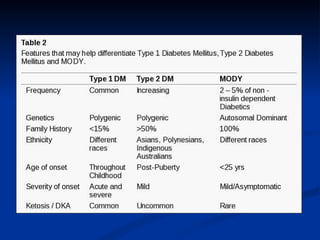
MODY Vs T2DM Mode of inheritance MODY: Monogenic, autosomal dominant DM2:  Polygenic Age of onset MODY: Childhood, adolescence,  usually <25 years DM2:  Usually 40-60 years;  occasionally in obese adolescents Pedigree MODY: Multi-generational DM2:  Rarely multi-generational
Distinguishing Clinical Characteristics of MODY and Type 2 Diabetes   [2/2] Penetrance MODY: 80-95 % DM2:  Variable (10-40 %) Body habitus MODY: Not obese DM2:  Usually obese Dysmetabolic syndrome MODY: Absent DM2:  Usually present
 
Investigations MODY should be considered in patients with 1.non-ketotic diabetes at presentation 2. Strong family history of diabetes mellitus without pancreatic auto-antibodies.  MODY Vs T2DM   hyperinsulinaemia and high-normal c-peptide in T2DM
MODY vs T2DM Prominent family history of diabetes in 2-3 generations  Childhood, adolescence, usually <25 years Usually not associated with obesity

LADA & MODY DIABETES

  • 1.
    TYPE 1.5 DiabetesLADA & MODY Dr KURIAN JOSEPH SMALL TOPIC PRESENTATIONS
  • 2.
  • 3.
    Maturity-Onset Diabetes ofthe Young (MODY) 1975 Definition Type-2 diabetes mellitus in the young plus Autosomal dominant inheritance
  • 4.
    Current Definition ofMODY Heterozygous monogenic mutations in one of the 6 different genes Autosomal dominant inheritance Onset of diabetes early in life: childhood, adolescence or young adulthood Primary defect in insulin secretion
  • 5.
    Monogenic Forms ofDiabetes Forms Associated with Insulin Resistance Forms Associated with Defective Insulin Secretion Maturity-Onset diabetes of the young (MODY) HNF-4 α (MODY 1) Glucokinase (MODY 2) HNF-1 α (MODY 3) IPF (MODY 4) HNF-1 β (MODY 5) NeuroD1/BETA2 (MODY 6)
  • 6.
  • 7.
    MODY-Related Proteins [1/4] Glucokinase Expressed in  -cells and liver GSK catalyzes the formation of glucose-6-phosphate from glucose. Beta cells - “Glucose sensor” Control rate of Glucose phosphorylation Liver – Helps in storage of glucose as glycogen Mild stable hyperglycemia Does not respond to Sulfonylureas.
  • 8.
    Liver-enriched transcription factors HNF-1  , HNF-1  , and HNF-4  Expressed in liver, pancreatic islets, kidneys and genitalia. In Beta cells they regulate The expression of the insulin gene Proteins involved in glucose transport and metabolism. Mutations results in defect of insulin secretion response to glucose, leading to progressive decline in glycemic control. MODY 1 &3 responds to sulfonylurea initially.
  • 9.
    MODY-Related Proteins Transcription factor IPF-1 Expressed in pancreatic islets Central role in development of pancreas. Mediates glucose-induced stimulation of insulin-gene transcription Exocrine pancreatic insufficiency may occur.
  • 10.
    MODY-Related Proteins Transcription factor Neuro-D1 (BETA2) Rare Expressed in pancreatic islets Activates the transcription of the insulin gene Required for normal development of the pancreatic islets
  • 11.
    Phenotypic Expression andNatural History of MODY Recognition at young age 1.Mild, asymptomatic increase in blood glucose in a child, adolescent or young adult(<25 years) 2. Prominent family history of diabetes in 2-3 generations 3. Usually not associated with obesity Not progressive, or slowly progressive hyperglycemia Hyperglycemia responsive to diet and/or oral anti-hyperglycemic agents for years to decades
  • 12.
    When to suspectMODY a “type 1″ diabetes patient who has negative blood testing for autoantibodies. a “type 1″ diabetes patient who generates a significant amount of insulin for years beyond diagnosis (detectable blood levels of c-peptide, proinsulin, and/ or insulin) a “type 2″ diabetes patient who is normal weight and shows no signs of insulin resistance. a diabetes with family history of early onset diabetes for 2-3 generations. Diabetes paired with pancreatic insufficiency  Individual or family history of diabetes paired with developmental kidney disease or kidney cysts
  • 13.
    Genetic Testing Onlydefinitive way to confirm MODY   blood or saliva  Not all mutations cause diabetes Each child will have a 50% chance of inheriting the gene  1 st degree relatives have a 50% chance of carrying the same gene mutation Then they have  a >95% chance of developing MODY at some time in their life.
  • 14.
    Rx for MODYRx depends on the involved gene and other factors MODY 3 and 1 can be treated initially with sulfonylureas, prompts the body to produce insulin. Usually GCK-MODY requires no treatment at all. Other type of MODY Rx is unclear may require multiple daily Insulin injections.
  • 15.
    LADATYPE 1.5 DIABETES
  • 16.
    LATENT AUTOIMMUNE DIABETESOF ADULTHOOD Late-onset autoimmune diabetes of adulthood Slow Onset Type 1 diabetes Type 1.5 diabetes - Type 1 diabetes develops in adults Mistakenly diagnosed as T2DM
  • 17.
    Characteristics of LADAAdult age (usually over 30 years) at time of diagnosis May initially appear to be non-obese Type 2 diabetes May initially be controlled with nutrition and exercise Patient gradually becomes dependent on insulin Positive for auto-antibodies Low C-peptide levels in the body Often does not have a family history of Type 2 diabetes
  • 18.
    Criteria for LADAAged at least 30 years or older Positive for at least one of the auto-antibodies found in type 1 diabetes Free from insulin treatment for the first six months after diagnosis. 20% of persons diagnosed as having non-obesity-related type 2 diabetes may actually have LADA
  • 19.
    LADA Vs T2DMC-peptid levels LADA have low level VS Normal or high in T2DM Glutamic acid decarboxylase(GAD) autoantibodies – Common in T1DM Early age of onset Non obese individuals No family history of early onset diabetes Ketosis prone May requires insulin after initial 6 months
  • 20.
    Diagnosis Performing aGAD antibody test is the most common method of diagnosing LADA. Islet cell antibodies (ICA) are also common.
  • 21.
    Management LADA oftendoes not require insulin at the time of diagnosis and may be managed with diet and exercise.   Due to destruction of the β-cells, they become insulin dependent more rapidly than “classic” type 2 diabetes May require multiple daily Insulin injections(after 6 months)
  • 22.
  • 23.
  • 24.
    Monogenic Forms ofDiabetes Forms Associated with Insulin Resistance Mutation in the insulin receptor gene Type A insulin resistance Leprechaunism Rabson-Mendenhall Syndrome Lipoatrophic diabetes Mutations in the PPAR γ gene Forms Associated with Defective Insulin Secretion Mutations in insulin or proinsulin genes Mitochondrial gene mutations Muturity-Onset diabetes of the young (MODY)
  • 25.
    MODY Associatedwith Defective Insulin Secretion HNF-4 α (MODY 1) Glucokinase (MODY 2) HNF-1 α (MODY 3) IPF (MODY 4) HNF-1 β (MODY 5) NeuroD1/BETA2 (MODY 6)
  • 26.
    MODY Vs T2DMMode of inheritance MODY: Monogenic, autosomal dominant DM2: Polygenic Age of onset MODY: Childhood, adolescence, usually <25 years DM2: Usually 40-60 years; occasionally in obese adolescents Pedigree MODY: Multi-generational DM2: Rarely multi-generational
  • 27.
    Distinguishing Clinical Characteristicsof MODY and Type 2 Diabetes [2/2] Penetrance MODY: 80-95 % DM2: Variable (10-40 %) Body habitus MODY: Not obese DM2: Usually obese Dysmetabolic syndrome MODY: Absent DM2: Usually present
  • 28.
  • 29.
    Investigations MODY shouldbe considered in patients with 1.non-ketotic diabetes at presentation 2. Strong family history of diabetes mellitus without pancreatic auto-antibodies. MODY Vs T2DM   hyperinsulinaemia and high-normal c-peptide in T2DM
  • 30.
    MODY vs T2DMProminent family history of diabetes in 2-3 generations Childhood, adolescence, usually <25 years Usually not associated with obesity