“
1
Hypoglycemia
Hello!
I am Dr. Banaful Roy
I am here to discuss with
you about Hypoglycaemia.
You can find me at
FB.com/banaful
2
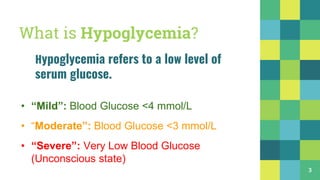
What is Hypoglycemia?
Hypoglycemia refers to a low level of
serum glucose.
• “Mild”: Blood Glucose <4 mmol/L
• “Moderate”: Blood Glucose <3 mmol/L
• “Severe”: Very Low Blood Glucose
(Unconscious state)
3
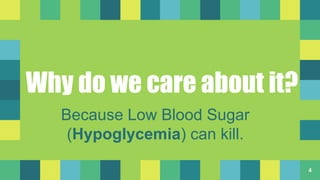
Why do we care about it?
Because Low Blood Sugar
(Hypoglycemia) can kill.
4
❖ It most commonly
happens when a
person with
diabetes has taken
too much insulin.
❖ Lack of glucagon
hormone.
❖ Skipping meals.
What are the causes of
Hypoglycemia?
❖ Exercise without
proper food intake.
❖ Excessive alcohol
consumption.
❖ Tumor of pancreas
known as an
Insulinoma.
5
What are the
symptoms?
7
How can we
manage
Hypoglycemic
patient?
8
If Blood Glucose <4 mmol/L
stabilize it by eating.
For conscious patient:
Oral glucose, sucrose or any sugar containing fluid.
For unconscious patient:
1. IV 50% dextrose 25 – 50 ml or as much as
possible until patient mental state recover.
2. If hypoglycemia is caused by long acting insulin
continue 10% dextrose drip for 24 hr. – 48 hr.
3. Glucagon 1 mg IM, SC can be given to treat
severe hypoglycemia if IV accesses difficult. 9
REACTIVE
HYPOGLYCAEMIA
Reactive hypoglycemia or
postprandial hypoglycemia is a term
describing recurrent episodes of
symptomatic hypoglycemia
occurring within four hours after a
high carbohydrate meal in people
with and without diabetes.
10
Let’s discuss several kinds of
Reactive Hypoglycemia
Alimentary
Hypoglycemia
It occurs in about 15% of
people who have had
stomach surgery.
Hormonal
Hypoglycemia
It occurs due to hormonal
imbalance.
H. Pylori Induced
Gastritis
Some reports suggest this bacteria
may contribute to the occurrence of
reactive hypoglycemia.
11
Congenital Enzyme
Deficiencies
Hereditary fructose intolerance,
Galactosemia, and leucine sensitivity of
childhood.
Late Hypoglycemia
Delay in early insulin release from
pancreatic beta-cells, resulting in initial
exaggeration of hyperglycemia during a
glucose tolerance test.
Treatment
Of
Reactive
Hypoglycemia
1) Avoiding or limiting
sugar intake
1) Exercising regularly
1) Eating a variety of foods
1) Choosing high-fiber
foods
Low-carbohydrate diet or frequent small meals is the first
treatment of this condition.
To relieve Reactive Hypoglycemia:
6) Avoiding eating meals
or snacks composed
entirely of
carbohydrates
6) Consistently choosing
longer lasting, complex
carbohydrates to
prevent rapid blood-
sugar dips
13
❖ Checking blood
glucose levels.
❖ Eat regularly.
❖ Make sure you
have eaten some
carbohydrate-rich
food before you do
any exercise.
How to prevent Hypoglycemia?
❖ Patient with
diabetes type 1
should always carry
a container of
sugary fruit juice or
a candy bar so that
they are ready if
symptoms are felt.
❖ Let people know if
you are susceptible
to attacks of 14
Thank
You
All

Presentation on Hypoglycemia

  • 1.
  • 2.
    Hello! I am Dr.Banaful Roy I am here to discuss with you about Hypoglycaemia. You can find me at FB.com/banaful 2
  • 3.
    What is Hypoglycemia? Hypoglycemiarefers to a low level of serum glucose. • “Mild”: Blood Glucose <4 mmol/L • “Moderate”: Blood Glucose <3 mmol/L • “Severe”: Very Low Blood Glucose (Unconscious state) 3
  • 4.
    Why do wecare about it? Because Low Blood Sugar (Hypoglycemia) can kill. 4
  • 5.
    ❖ It mostcommonly happens when a person with diabetes has taken too much insulin. ❖ Lack of glucagon hormone. ❖ Skipping meals. What are the causes of Hypoglycemia? ❖ Exercise without proper food intake. ❖ Excessive alcohol consumption. ❖ Tumor of pancreas known as an Insulinoma. 5
  • 6.
  • 7.
  • 8.
  • 9.
    If Blood Glucose<4 mmol/L stabilize it by eating. For conscious patient: Oral glucose, sucrose or any sugar containing fluid. For unconscious patient: 1. IV 50% dextrose 25 – 50 ml or as much as possible until patient mental state recover. 2. If hypoglycemia is caused by long acting insulin continue 10% dextrose drip for 24 hr. – 48 hr. 3. Glucagon 1 mg IM, SC can be given to treat severe hypoglycemia if IV accesses difficult. 9
  • 10.
    REACTIVE HYPOGLYCAEMIA Reactive hypoglycemia or postprandialhypoglycemia is a term describing recurrent episodes of symptomatic hypoglycemia occurring within four hours after a high carbohydrate meal in people with and without diabetes. 10
  • 11.
    Let’s discuss severalkinds of Reactive Hypoglycemia Alimentary Hypoglycemia It occurs in about 15% of people who have had stomach surgery. Hormonal Hypoglycemia It occurs due to hormonal imbalance. H. Pylori Induced Gastritis Some reports suggest this bacteria may contribute to the occurrence of reactive hypoglycemia. 11 Congenital Enzyme Deficiencies Hereditary fructose intolerance, Galactosemia, and leucine sensitivity of childhood. Late Hypoglycemia Delay in early insulin release from pancreatic beta-cells, resulting in initial exaggeration of hyperglycemia during a glucose tolerance test.
  • 12.
  • 13.
    1) Avoiding orlimiting sugar intake 1) Exercising regularly 1) Eating a variety of foods 1) Choosing high-fiber foods Low-carbohydrate diet or frequent small meals is the first treatment of this condition. To relieve Reactive Hypoglycemia: 6) Avoiding eating meals or snacks composed entirely of carbohydrates 6) Consistently choosing longer lasting, complex carbohydrates to prevent rapid blood- sugar dips 13
  • 14.
    ❖ Checking blood glucoselevels. ❖ Eat regularly. ❖ Make sure you have eaten some carbohydrate-rich food before you do any exercise. How to prevent Hypoglycemia? ❖ Patient with diabetes type 1 should always carry a container of sugary fruit juice or a candy bar so that they are ready if symptoms are felt. ❖ Let people know if you are susceptible to attacks of 14
  • 15.