Hypnosis
Beah Romeo
Debbie Ung
Period 4
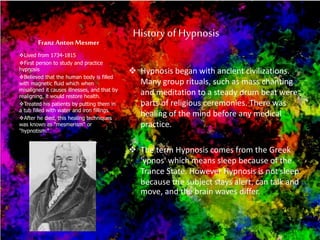
Franz AntonMesmer
History of Hypnosis
 Hypnosis began with ancient civilizations.
Many group rituals, such as mass chanting
and meditation to a steady drum beat were
parts of religious ceremonies. There was
healing of the mind before any medical
practice.
 The term Hypnosis comes from the Greek
'ypnos' which means sleep because of the
Trance State. However Hypnosis is not sleep
because the subject stays alert, can talk and
move, and the brain waves differ.
Lived from 1734-1815
First person to study and practice
hypnosis
Believed that the human body is filled
with magnetic fluid which when
misaligned it causes illnesses, and that by
realigning, it would restore health.
Treated his patients by putting them in
a tub filled with water and iron fillings
After he died, this healing techniques
was known as "mesmerism" or
"hypnotism."
AnimalHypnosis
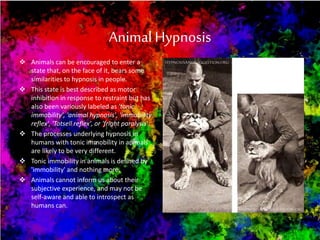
 Animals can be encouraged to enter a
state that, on the face of it, bears some
similarities to hypnosis in people.
 This state is best described as motor
inhibition in response to restraint but has
also been variously labeled as 'tonic
immobility', 'animal hypnosis', 'immobility
reflex', 'Totsell reflex', or 'fright paralysis'.
 The processes underlying hypnosis in
humans with tonic immobility in animals
are likely to be very different.
 Tonic immobility in animals is defined by
'immobility' and nothing more.
 Animals cannot inform us about their
subjective experience, and may not be
self-aware and able to introspect as
humans can.
How does hypnosis work?
• Hypnotists induce a trance by
slowly persuading the participant
to relax and to lose interest in
external distractions. By this
point, the hypnotist can directly
access the person's subconscious
mind. People may think the
participant is asleep during
hypnosis, but in reality, a person
is even more aware of what is
going on than the person would
ordinarily be. It takes cooperation
in order for this practice to work.
Also under hypnosis, people will
not do things against their
morals. They will only accept the
things they think will benefit
them.
Effectsof Hypnosis
 Effects can vary dramatically from one person to another.
 Some hypnotized individuals report feeling a sense of detachment or
extreme relaxation during the hypnotic state.
 Others feel that their actions seem to occur outside of their conscious
volition.
 Other individuals may remain fully aware and able to carry out
conversations while under hypnosis.
 Effects can be permanent as long as one believes in it and if it fulfills the
needs of the person.
 Hypnosis will not work if the person does not think it will fulfill their own
personal needs, or if they simply do not believe in it.
What can hypnosis be used for?
 The treatment of chronic pain conditions
such as rheumatoid arthritis.
 The treatment and reduction of pain
during childbirth.
 The reduction of the symptoms of
dementia.
 Hypnotherapy may be helpful for certain
symptoms of ADHD.
 The reduction of nausea and vomiting in
cancer patients undergoing
chemotherapy.
 Control of pain during dental procedures.
 Elimination or reduction of skin conditions
including warts and psoriasis.
 Alleviation of symptoms association with
Irritable Bowel Syndrome.
Can you be Hypnotized?
Fifteen percent of
people are very responsive
to hypnosis.
 Children tend to be
more susceptible to
hypnosis.
Approximately ten
percent of adults are
considered difficult or
impossible to hypnotize.
 People who can become
easily absorbed in
fantasies are much more
responsive to hypnosis.
Theoriesof Hypnosis
Hilgard’s neodissociation
theory of hypnosis
 People in a hypnotic state experience a split
consciousness in which there are two
different streams of mental activity. While
one stream of consciousness responds to
the hypnotist’s suggestions, another
dissociated stream processes information
outside of the hypnotized individuals
conscious awareness.
Dissociated control theory
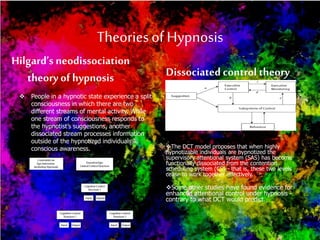
The DCT model proposes that when highly
hypnotizable individuals are hypnotized the
supervisory attentional system (SAS) has become
functionally dissociated from the contention
scheduling system (CS) - that is, these two levels
cease to work together effectively.
Some other studies have found evidence for
enhanced attentional control under hypnosis -
contrary to what DCT would predict.
Myths of Hypnosis
 The hypnotist has complete
control of your actions while
you’re under hypnosis.
While people often feel that their actions
under hypnosis seem to occur without the
influence of their will, a hypnotist cannot
make you perform actions that are against
your values or morals.
 Hypnosis can make you super-strong, fast
or athletically talented.
While hypnosis can be used to enhance
performance, it cannot make people
stronger or more athletic than their
existing physical capabilities.
 You can be hypnotized against your will.
Despite stories about people being
hypnotized without their consent,
hypnosis requires voluntary participation
on the part of the patient.
 Hypnosis can help people remember
the exact details of a crime they
witnessed.
While hypnosis can be used to enhance
memory, the effects have been
dramatically exaggerated in popular
media. Research has found that hypnosis
does not lead to significant memory
enhancement or accuracy, and hypnosis
can actually lead to false or distorted
memories.
 When you wake up from hypnosis, you
won’t remember anything that happened
when you were hypnotized.
While amnesia may occur in very rare cases,
people generally remember everything that
occurred while they were hypnotized.
However, hypnosis can have a significant
effect on memory. Posthypnotic amnesia can
lead an individual to forget certain things
that occurred before or during hypnosis.
However, this effect is generally limited and
temporary.
Dangers of Stage Hypnosis
 Misinterpretation ofSuggestions
 One of the most important things that
a stage hypnotist must do is to remove
all suggestions at the end of the show.
 True stage hypnosis is mass hypnosis.
 Sometimes when you give a
suggestion to just one particular
individual another person also will
react to the suggestion given.
 Physical Casualties
 On many occasions people will sustain
minor injuries.
 These can occur from falling off their
chair to the more dangerous accidents
like falling off the stage.
Grief Charge
 When we experience painful and
traumatic events in life the emotions
are sometimes locked away and
forgotten about in the subconscious
mind.
 When a person experiences deep
hypnosis the brain waves slow down
into a cycle known as theta.
 As soon as the subconscious mind is
opened up the emotional pain is
released.
 If the psyche or ego is damaged
through this uncontrolled re-
stimulation of emotions it could well
lead to depression or personality
changes for life.
Work Cited
 http://ezinearticles.com/?How-Does-Hypnosis-Work?&id=4057240
 http://www.sleepnow.com/HypnosisBackground.html
 http://www.danielolson.com/hypnosis/hypnosis_history.html
 http://psychology.about.com/od/statesofconsciousness/a/hypnosis.htm
 http://www.hypnosisandsuggestion.org/animal-hypnosis.html
 http://www.dangers-of-
hypnosis.co.uk/hypnotist_dangers_of_stage_hypnosis.html
 http://www.essortment.com/articles/effects-hypnosis-last_4865.htm

Hypnosis

  • 1.
  • 2.
    Franz AntonMesmer History ofHypnosis  Hypnosis began with ancient civilizations. Many group rituals, such as mass chanting and meditation to a steady drum beat were parts of religious ceremonies. There was healing of the mind before any medical practice.  The term Hypnosis comes from the Greek 'ypnos' which means sleep because of the Trance State. However Hypnosis is not sleep because the subject stays alert, can talk and move, and the brain waves differ. Lived from 1734-1815 First person to study and practice hypnosis Believed that the human body is filled with magnetic fluid which when misaligned it causes illnesses, and that by realigning, it would restore health. Treated his patients by putting them in a tub filled with water and iron fillings After he died, this healing techniques was known as "mesmerism" or "hypnotism."
  • 3.
    AnimalHypnosis  Animals canbe encouraged to enter a state that, on the face of it, bears some similarities to hypnosis in people.  This state is best described as motor inhibition in response to restraint but has also been variously labeled as 'tonic immobility', 'animal hypnosis', 'immobility reflex', 'Totsell reflex', or 'fright paralysis'.  The processes underlying hypnosis in humans with tonic immobility in animals are likely to be very different.  Tonic immobility in animals is defined by 'immobility' and nothing more.  Animals cannot inform us about their subjective experience, and may not be self-aware and able to introspect as humans can.
  • 4.
    How does hypnosiswork? • Hypnotists induce a trance by slowly persuading the participant to relax and to lose interest in external distractions. By this point, the hypnotist can directly access the person's subconscious mind. People may think the participant is asleep during hypnosis, but in reality, a person is even more aware of what is going on than the person would ordinarily be. It takes cooperation in order for this practice to work. Also under hypnosis, people will not do things against their morals. They will only accept the things they think will benefit them.
  • 5.
    Effectsof Hypnosis  Effectscan vary dramatically from one person to another.  Some hypnotized individuals report feeling a sense of detachment or extreme relaxation during the hypnotic state.  Others feel that their actions seem to occur outside of their conscious volition.  Other individuals may remain fully aware and able to carry out conversations while under hypnosis.  Effects can be permanent as long as one believes in it and if it fulfills the needs of the person.  Hypnosis will not work if the person does not think it will fulfill their own personal needs, or if they simply do not believe in it.
  • 6.
    What can hypnosisbe used for?  The treatment of chronic pain conditions such as rheumatoid arthritis.  The treatment and reduction of pain during childbirth.  The reduction of the symptoms of dementia.  Hypnotherapy may be helpful for certain symptoms of ADHD.  The reduction of nausea and vomiting in cancer patients undergoing chemotherapy.  Control of pain during dental procedures.  Elimination or reduction of skin conditions including warts and psoriasis.  Alleviation of symptoms association with Irritable Bowel Syndrome.
  • 7.
    Can you beHypnotized? Fifteen percent of people are very responsive to hypnosis.  Children tend to be more susceptible to hypnosis. Approximately ten percent of adults are considered difficult or impossible to hypnotize.  People who can become easily absorbed in fantasies are much more responsive to hypnosis.
  • 8.
    Theoriesof Hypnosis Hilgard’s neodissociation theoryof hypnosis  People in a hypnotic state experience a split consciousness in which there are two different streams of mental activity. While one stream of consciousness responds to the hypnotist’s suggestions, another dissociated stream processes information outside of the hypnotized individuals conscious awareness. Dissociated control theory The DCT model proposes that when highly hypnotizable individuals are hypnotized the supervisory attentional system (SAS) has become functionally dissociated from the contention scheduling system (CS) - that is, these two levels cease to work together effectively. Some other studies have found evidence for enhanced attentional control under hypnosis - contrary to what DCT would predict.
  • 9.
    Myths of Hypnosis The hypnotist has complete control of your actions while you’re under hypnosis. While people often feel that their actions under hypnosis seem to occur without the influence of their will, a hypnotist cannot make you perform actions that are against your values or morals.  Hypnosis can make you super-strong, fast or athletically talented. While hypnosis can be used to enhance performance, it cannot make people stronger or more athletic than their existing physical capabilities.  You can be hypnotized against your will. Despite stories about people being hypnotized without their consent, hypnosis requires voluntary participation on the part of the patient.  Hypnosis can help people remember the exact details of a crime they witnessed. While hypnosis can be used to enhance memory, the effects have been dramatically exaggerated in popular media. Research has found that hypnosis does not lead to significant memory enhancement or accuracy, and hypnosis can actually lead to false or distorted memories.  When you wake up from hypnosis, you won’t remember anything that happened when you were hypnotized. While amnesia may occur in very rare cases, people generally remember everything that occurred while they were hypnotized. However, hypnosis can have a significant effect on memory. Posthypnotic amnesia can lead an individual to forget certain things that occurred before or during hypnosis. However, this effect is generally limited and temporary.
  • 10.
    Dangers of StageHypnosis  Misinterpretation ofSuggestions  One of the most important things that a stage hypnotist must do is to remove all suggestions at the end of the show.  True stage hypnosis is mass hypnosis.  Sometimes when you give a suggestion to just one particular individual another person also will react to the suggestion given.  Physical Casualties  On many occasions people will sustain minor injuries.  These can occur from falling off their chair to the more dangerous accidents like falling off the stage. Grief Charge  When we experience painful and traumatic events in life the emotions are sometimes locked away and forgotten about in the subconscious mind.  When a person experiences deep hypnosis the brain waves slow down into a cycle known as theta.  As soon as the subconscious mind is opened up the emotional pain is released.  If the psyche or ego is damaged through this uncontrolled re- stimulation of emotions it could well lead to depression or personality changes for life.
  • 11.
    Work Cited  http://ezinearticles.com/?How-Does-Hypnosis-Work?&id=4057240 http://www.sleepnow.com/HypnosisBackground.html  http://www.danielolson.com/hypnosis/hypnosis_history.html  http://psychology.about.com/od/statesofconsciousness/a/hypnosis.htm  http://www.hypnosisandsuggestion.org/animal-hypnosis.html  http://www.dangers-of- hypnosis.co.uk/hypnotist_dangers_of_stage_hypnosis.html  http://www.essortment.com/articles/effects-hypnosis-last_4865.htm