Hypnosis
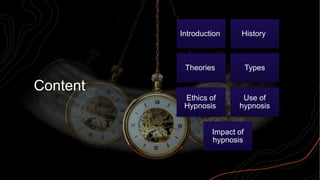
Content
Introduction History
Theories Types
Ethics of
Hypnosis
Use of
hypnosis
Impact of
hypnosis
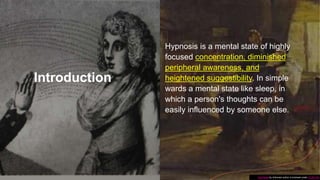
Introduction
Hypnosis is a mental state of highly
focused concentration, diminished
peripheral awareness, and
heightened suggestibility. In simple
wards a mental state like sleep, in
which a person's thoughts can be
easily influenced by someone else.
This Photo by Unknown author is licensed under CC BY-SA.
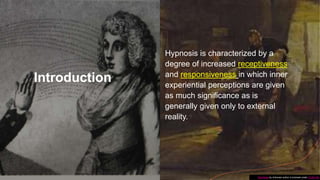
Introduction
Hypnosis is characterized by a
degree of increased receptiveness
and responsiveness in which inner
experiential perceptions are given
as much significance as is
generally given only to external
reality.
This Photo by Unknown author is licensed under CC BY-SA.
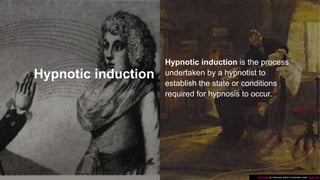
Hypnotic induction
Hypnotic induction is the process
undertaken by a hypnotist to
establish the state or conditions
required for hypnosis to occur.
This Photo by Unknown author is licensed under CC BY-SA.
Hypnotic state
Therapists bring about hypnosis
(also referred to as hypnotherapy
or hypnotic suggestion) with the
help of mental imagery and
soothing verbal repetition that ease
the patient into a trance-like state.
Once relaxed, patients’ minds are
more open to transformative
messages.
This Photo by Unknown author is licensed under CC BY-SA.
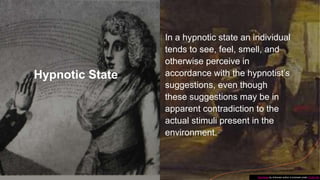
Hypnotic State
In a hypnotic state an individual
tends to see, feel, smell, and
otherwise perceive in
accordance with the hypnotist’s
suggestions, even though
these suggestions may be in
apparent contradiction to the
actual stimuli present in the
environment.
This Photo by Unknown author is licensed under CC BY-SA.
History
The history of hypnosis is as ancient as that of sorcery, magic,
and medicine; indeed, hypnosis has been used as a method in
all three. Its scientific history began in the latter part of the 18th
century with Franz Mesmer, a German physician who used
technique known as mesmerism or animal magnetism was
related to an invisible substance a fluid that runs within the
subject or between the subject and the therapist, was the
forerunner of the modern practice of hypnosis.
This Photo by Unknown author is licensed under CC BY-NC-ND.
History
A number of clinicians made use of
it without fully understanding its
nature until the middle of the 19th
century, when the English
physician James Braid studied the
phenomenon and coined the
terms hypnotism and hypnosis,
after the Greek god of
sleep, Hypnos. He also known as
father of hypnosis.
This Photo by Unknown author is licensed under CC BY-SA.
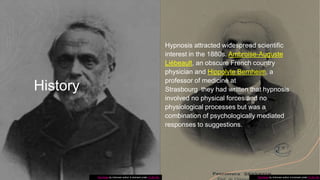
History
Hypnosis attracted widespread scientific
interest in the 1880s. Ambroise-Auguste
Liébeault, an obscure French country
physician and Hippolyte Bernheim, a
professor of medicine at
Strasbourg they had written that hypnosis
involved no physical forces and no
physiological processes but was a
combination of psychologically mediated
responses to suggestions.
This Photo by Unknown author is licensed under CC BY-SA. This Photo by Unknown author is licensed under CC BY-SA.
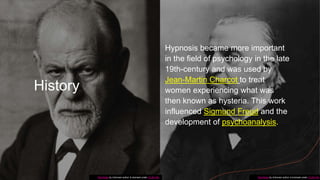
History
Hypnosis became more important
in the field of psychology in the late
19th-century and was used by
Jean-Martin Charcot to treat
women experiencing what was
then known as hysteria. This work
influenced Sigmund Freud and the
development of psychoanalysis.
This Photo by Unknown author is licensed under CC BY-SA.This Photo by Unknown author is licensed under CC BY-SA.
Theories
1. The role theory states that a hypnotized
person is not actually in an alternate
state of consciousness but is playing the role of
being hypnotized, which includes complying
with the instructions of the hypnotist.
2. The state theory describes hypnosis as an
altered state of consciousness. According
to this theory, real, significant changes in
basic mental processes take
place during hypnosis.
Theories
3. In E. R. Hilgard's (1986) neodissociation
theory, responses are hypothesized to be due
to a division of consciousness into 2 or more
simultaneous streams, separated by an amnesic
barrier that prevents access to suggestion-
related executive functions, monitoring
functions, or both.
4. In K. S. Bowers's (1992) dissociated control
theory, hypnotic inductions are hypothesized to
weaken frontal control of behavioural schemas,
thereby allowing direct activation of behaviour by
the hypnotist's suggestions
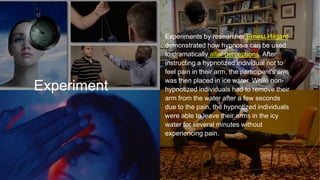
Experiment
Experiments by researcher Ernest Hilgard
demonstrated how hypnosis can be used
to dramatically alter perceptions. After
instructing a hypnotized individual not to
feel pain in their arm, the participant's arm
was then placed in ice water. While non-
hypnotized individuals had to remove their
arm from the water after a few seconds
due to the pain, the hypnotized individuals
were able to leave their arms in the icy
water for several minutes without
experiencing pain.
Types
Guided
hypnosis
Hypnotherapy
Self-hypnosis
Guided hypnosis
This form of hypnosis involves the
use of tools such as recorded
instructions and music to induce a
hypnotic state. Online sites and
mobile apps often utilize this form
of hypnosis. Some apps
are Hypnobox, Relax and Sleep
Well Hypnosis and Harmony
Hypnosis Meditation.
Hypnotherapy
Hypnotherapy is a form of
adjunctive technique of hypnosis
that used in psychotherapy and is
practiced by licensed physicians .
Hypnotherapy works by inducing a
hypnotic state that is marked by a
state of waking awareness in which
people experience detached
external attention and a focus on
inner experiences
Self-hypnosis
Self-hypnosis is a process that
occurs when a person self-induces
a hypnotic state. It is often used as
a self-help tool for controlling pain
or managing stress.
The Ethics of
Hypnosis
The international society of
hypnosis (ISH) is dedicated to
promoting and maintaining the
highest professional standards in
the practice of hypnosis for clinical,
teaching or experimental purposes:
1. Professional Conduct with
Patients or Subjects
2. Applications of Hypnosis to
Professional Work
The Ethics of
Hypnosis
3. The Undertaking of Private
Therapy
4. Teaching of hypnosis and its
application in non-professional
work
5. Use of the Society’s Name
6. Hypnosis and Entertainment
7. Ending remarks
Use of Hypnosis
Hypnosis deal with chronic pain or to
alleviate pain and anxiety caused by
medical procedures such as surgery or
childbirth.
The following are just a few of the
applications for hypnosis that have been
demonstrated through research:
1. Alleviation of symptoms associated with
irritable bowel syndrome (IBS)
2. Control of pain during dental
procedures
3. Elimination or reduction of
skin conditions including warts and
psoriasis
Use of Hypnosis
4. Management of certain symptoms of
ADHD
5. Treatment of chronic pain conditions
such as rheumatoid arthritis
6. Treatment and reduction of pain during
childbirth
7. Reduction of dementia symptoms
8. Reduction of nausea and vomiting in
cancer patients undergoing chemotherapy
Hypnosis has also been used to help
people with behavior changes such as
quitting smoking, losing weight, or
preventing bed-wetting.
Impact of
Hypnosis
The experience of hypnosis can vary
dramatically from one person to another.
Some hypnotized individuals report feeling
a sense of detachment or extreme
relaxation during the hypnotic state while
others even feel that their actions seem to
occur outside of their conscious volition.
Other individuals may remain fully aware
and able to carry out conversations while
under hypnosis.
Reference
 Cherry, K. (n.d.). 5 Myths About Hypnosis Debunked.
 Hypnosis. (n.d.). Retrieved November 07, 2020, from
https://www.britannica.com/science/hypnosis
 Fritscher, L. (2020, September 25). Conquering Phobias Through Hypnotherapy.
 Code of Ethics. (n.d.). Retrieved November 07, 2020, from
https://www.ishhypnosis.org/administration/code-of-ethics
 SJ;, K. (n.d.). Dissociation theories of hypnosis. Retrieved November 10, 2020, from
https://pubmed.ncbi.nlm.nih.gov/9461855/
This Photo by Unknown author is licensed under CC BY-SA.

Hypnosis

  • 1.
  • 2.
    Content Introduction History Theories Types Ethicsof Hypnosis Use of hypnosis Impact of hypnosis
  • 3.
    Introduction Hypnosis is amental state of highly focused concentration, diminished peripheral awareness, and heightened suggestibility. In simple wards a mental state like sleep, in which a person's thoughts can be easily influenced by someone else. This Photo by Unknown author is licensed under CC BY-SA.
  • 4.
    Introduction Hypnosis is characterizedby a degree of increased receptiveness and responsiveness in which inner experiential perceptions are given as much significance as is generally given only to external reality. This Photo by Unknown author is licensed under CC BY-SA.
  • 5.
    Hypnotic induction Hypnotic inductionis the process undertaken by a hypnotist to establish the state or conditions required for hypnosis to occur. This Photo by Unknown author is licensed under CC BY-SA.
  • 6.
    Hypnotic state Therapists bringabout hypnosis (also referred to as hypnotherapy or hypnotic suggestion) with the help of mental imagery and soothing verbal repetition that ease the patient into a trance-like state. Once relaxed, patients’ minds are more open to transformative messages. This Photo by Unknown author is licensed under CC BY-SA.
  • 7.
    Hypnotic State In ahypnotic state an individual tends to see, feel, smell, and otherwise perceive in accordance with the hypnotist’s suggestions, even though these suggestions may be in apparent contradiction to the actual stimuli present in the environment. This Photo by Unknown author is licensed under CC BY-SA.
  • 8.
    History The history ofhypnosis is as ancient as that of sorcery, magic, and medicine; indeed, hypnosis has been used as a method in all three. Its scientific history began in the latter part of the 18th century with Franz Mesmer, a German physician who used technique known as mesmerism or animal magnetism was related to an invisible substance a fluid that runs within the subject or between the subject and the therapist, was the forerunner of the modern practice of hypnosis. This Photo by Unknown author is licensed under CC BY-NC-ND.
  • 9.
    History A number ofclinicians made use of it without fully understanding its nature until the middle of the 19th century, when the English physician James Braid studied the phenomenon and coined the terms hypnotism and hypnosis, after the Greek god of sleep, Hypnos. He also known as father of hypnosis. This Photo by Unknown author is licensed under CC BY-SA.
  • 10.
    History Hypnosis attracted widespreadscientific interest in the 1880s. Ambroise-Auguste Liébeault, an obscure French country physician and Hippolyte Bernheim, a professor of medicine at Strasbourg they had written that hypnosis involved no physical forces and no physiological processes but was a combination of psychologically mediated responses to suggestions. This Photo by Unknown author is licensed under CC BY-SA. This Photo by Unknown author is licensed under CC BY-SA.
  • 11.
    History Hypnosis became moreimportant in the field of psychology in the late 19th-century and was used by Jean-Martin Charcot to treat women experiencing what was then known as hysteria. This work influenced Sigmund Freud and the development of psychoanalysis. This Photo by Unknown author is licensed under CC BY-SA.This Photo by Unknown author is licensed under CC BY-SA.
  • 12.
    Theories 1. The roletheory states that a hypnotized person is not actually in an alternate state of consciousness but is playing the role of being hypnotized, which includes complying with the instructions of the hypnotist. 2. The state theory describes hypnosis as an altered state of consciousness. According to this theory, real, significant changes in basic mental processes take place during hypnosis.
  • 13.
    Theories 3. In E.R. Hilgard's (1986) neodissociation theory, responses are hypothesized to be due to a division of consciousness into 2 or more simultaneous streams, separated by an amnesic barrier that prevents access to suggestion- related executive functions, monitoring functions, or both. 4. In K. S. Bowers's (1992) dissociated control theory, hypnotic inductions are hypothesized to weaken frontal control of behavioural schemas, thereby allowing direct activation of behaviour by the hypnotist's suggestions
  • 14.
    Experiment Experiments by researcherErnest Hilgard demonstrated how hypnosis can be used to dramatically alter perceptions. After instructing a hypnotized individual not to feel pain in their arm, the participant's arm was then placed in ice water. While non- hypnotized individuals had to remove their arm from the water after a few seconds due to the pain, the hypnotized individuals were able to leave their arms in the icy water for several minutes without experiencing pain.
  • 15.
  • 16.
    Guided hypnosis This formof hypnosis involves the use of tools such as recorded instructions and music to induce a hypnotic state. Online sites and mobile apps often utilize this form of hypnosis. Some apps are Hypnobox, Relax and Sleep Well Hypnosis and Harmony Hypnosis Meditation.
  • 17.
    Hypnotherapy Hypnotherapy is aform of adjunctive technique of hypnosis that used in psychotherapy and is practiced by licensed physicians . Hypnotherapy works by inducing a hypnotic state that is marked by a state of waking awareness in which people experience detached external attention and a focus on inner experiences
  • 18.
    Self-hypnosis Self-hypnosis is aprocess that occurs when a person self-induces a hypnotic state. It is often used as a self-help tool for controlling pain or managing stress.
  • 19.
    The Ethics of Hypnosis Theinternational society of hypnosis (ISH) is dedicated to promoting and maintaining the highest professional standards in the practice of hypnosis for clinical, teaching or experimental purposes: 1. Professional Conduct with Patients or Subjects 2. Applications of Hypnosis to Professional Work
  • 20.
    The Ethics of Hypnosis 3.The Undertaking of Private Therapy 4. Teaching of hypnosis and its application in non-professional work 5. Use of the Society’s Name 6. Hypnosis and Entertainment 7. Ending remarks
  • 21.
    Use of Hypnosis Hypnosisdeal with chronic pain or to alleviate pain and anxiety caused by medical procedures such as surgery or childbirth. The following are just a few of the applications for hypnosis that have been demonstrated through research: 1. Alleviation of symptoms associated with irritable bowel syndrome (IBS) 2. Control of pain during dental procedures 3. Elimination or reduction of skin conditions including warts and psoriasis
  • 22.
    Use of Hypnosis 4.Management of certain symptoms of ADHD 5. Treatment of chronic pain conditions such as rheumatoid arthritis 6. Treatment and reduction of pain during childbirth 7. Reduction of dementia symptoms 8. Reduction of nausea and vomiting in cancer patients undergoing chemotherapy Hypnosis has also been used to help people with behavior changes such as quitting smoking, losing weight, or preventing bed-wetting.
  • 23.
    Impact of Hypnosis The experienceof hypnosis can vary dramatically from one person to another. Some hypnotized individuals report feeling a sense of detachment or extreme relaxation during the hypnotic state while others even feel that their actions seem to occur outside of their conscious volition. Other individuals may remain fully aware and able to carry out conversations while under hypnosis.
  • 24.
    Reference  Cherry, K.(n.d.). 5 Myths About Hypnosis Debunked.  Hypnosis. (n.d.). Retrieved November 07, 2020, from https://www.britannica.com/science/hypnosis  Fritscher, L. (2020, September 25). Conquering Phobias Through Hypnotherapy.  Code of Ethics. (n.d.). Retrieved November 07, 2020, from https://www.ishhypnosis.org/administration/code-of-ethics  SJ;, K. (n.d.). Dissociation theories of hypnosis. Retrieved November 10, 2020, from https://pubmed.ncbi.nlm.nih.gov/9461855/ This Photo by Unknown author is licensed under CC BY-SA.