EXERCISE AND DIABETES
Ismail Abdullateef
28th February, 2018
By
-Introduction
-Pathophysiology
-Risk factors
-Clinical presentation
-Diagnosis
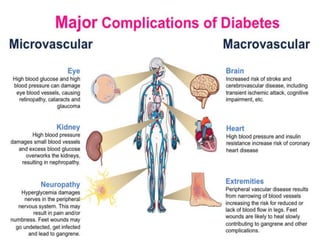
-Complications
-Management
-Exercise and Diabetes
-Benefits of exercises in diabetes
-Guidelines for a sound exercise program
-Conclusions
SYNOPSIS
- Diabetes is a metabolic disorder in which the body is unable to
appropriately regulate the level of sugar, specifically glucose, in the
blood, either by poor sensitivity to the protein insulin, or due to
inadequate production of insulin by the pancreas.
- Type 2 diabetes accounts for 90-95% of all diabetes cases.
- Diabetes itself is not a high-mortality condition (1.3 million deaths
globally), but it is a major risk factor for other causes of death and has
a high attributable burden of disability. Diabetes is also a major risk
factor for cardiovascular disease, kidney disease and blindness.
INTRODUCTION
-Diabetes Mellitus primarily affects the Islets of Langerhans of the
pancreas, where glucagon (from the alpha cells) and insulin (from the beta
cells) are produced.
-Glucagon raises the blood glucose level, while insulin lowers it. In Type 1
DM (Insulin Dependent), the loss of function of the beta cells leads to an
absolute insulin deficiency.
-In Type 2 DM (Non-insulin Dependent), the impaired production and
secretion of insulin by the beta cells is concommitant with the impaired
ability of the tissues to utilize insulin (termed insulin resistance). The
resulting accumulation of glucose in the blood is further elevated by the
greater synthesis of glucose in the liver, which releases it to the general
circulation.
PATHOPHYSIOLOGY
-over Weight and Obesity.
- Inactivity.
-Family history
-Race
-Age
-Gestational diabetes.
-High blood pressure
-Abnormal cholesterol and triglyceride levels
RISK FACTORS
Classic triad of Diabetes Mellitus are
-Polydipsia
-Polyphagia
-Polyuria
-Weight loss
-Fatigue with weakness
-Irritability
-Blurred vision
-Numbness or tingling sensations in the hands and feet are also present
-Glucose and Ketone bodies in urine
CLINICAL PRESENTATION
-Fasting plasma glucose level ≥ 7.0 mmol/l (126 mg/dl)
-Plasma glucose ≥ 11.1 mmol/l (200 mg/dl) two hours after a 75 g oral
glucose load as in a glucose tolerance test
-Symptoms of high blood sugar and casual plasma glucose ≥ 11.1 mmol/l
(200 mg/dl)
-Glycated hemoglobin (HbA1C) ≥ 48 mmol/mol (≥ 6.5%).
DIAGNOSIS
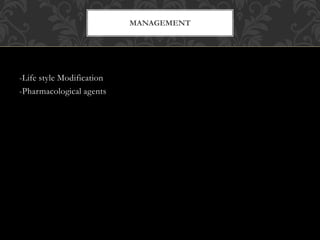
-Life style Modification
-Pharmacological agents
MANAGEMENT
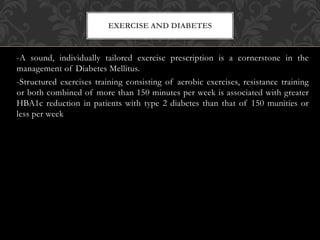
-A sound, individually tailored exercise prescription is a cornerstone in the
management of Diabetes Mellitus.
-Structured exercises training consisting of aerobic exercises, resistance training
or both combined of more than 150 minutes per week is associated with greater
HBA1c reduction in patients with type 2 diabetes than that of 150 munities or
less per week
EXERCISE AND DIABETES
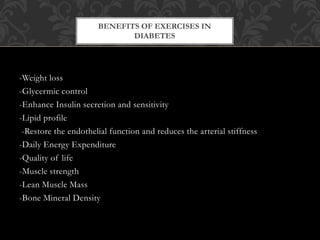
-Weight loss
-Glycermic control
-Enhance Insulin secretion and sensitivity
-Lipid profile
-Restore the endothelial function and reduces the arterial stiffness
-Daily Energy Expenditure
-Quality of life
-Muscle strength
-Lean Muscle Mass
-Bone Mineral Density
BENEFITS OF EXERCISES IN
DIABETES
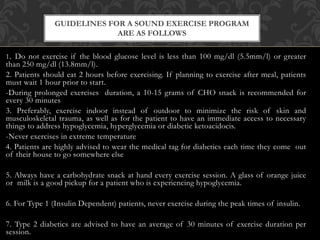
1. Do not exercise if the blood glucose level is less than 100 mg/dl (5.5mm/l) or greater
than 250 mg/dl (13.8mm/l).
2. Patients should eat 2 hours before exercising. If planning to exercise after meal, patients
must wait 1 hour prior to start.
-During prolonged exercises duration, a 10-15 grams of CHO snack is recommended for
every 30 minutes
3. Preferably, exercise indoor instead of outdoor to minimize the risk of skin and
musculoskeletal trauma, as well as for the patient to have an immediate access to necessary
things to address hypoglycemia, hyperglycemia or diabetic ketoacidocis.
-Never exercises in extreme temperature
4. Patients are highly advised to wear the medical tag for diabetics each time they come out
of their house to go somewhere else
5. Always have a carbohydrate snack at hand every exercise session. A glass of orange juice
or milk is a good pickup for a patient who is experiencing hypoglycemia.
6. For Type 1 (Insulin Dependent) patients, never exercise during the peak times of insulin.
7. Type 2 diabetics are advised to have an average of 30 minutes of exercise duration per
session.
GUIDELINES FOR A SOUND EXERCISE PROGRAM
ARE AS FOLLOWS
8. Always wear proper footwear and exercise in a safe environment.
9. Type 1 diabetics may need to reduce insulin or increase food intake prior to the start of an
exercise program.
10. Patients who are on Sulfonylureas are red flags because it can cause exercise-induced
hypoglycemia.
11. Menstruating women need to increase insulin during menses, especially if they're not active.
12. There should be no short-acting insulin injections close to the muscles to be exercised
within one hour of exercise.
13. Patients must always carry their own portable blood glucose monitor. They must check
their glucose levels before and after exercise.
14. Patients are advised to drink 17 oz. of fluid before exercise.
15. Exercise five times a week as a maintenance (or at least every other day) and at the same
schedule / time, preferably.
-<100 mg/dL ( give 10-15 g CHO snack and retest glucose levels 15 minutes
later )
-100-250 mg/dL (safe exercise levels; proceed with treatment )
-250-300 mg/dL at start of exercise "caution zone"; postpone exercise until
stable levels are achieved; ketones in urine are checked for at these levels
->300 mg/dL= stop exercise immediately!!!! (NOT SAFE)
BLOOD GLUCOSE LEVELS IN RELATION TO
EXERCISE THAT WE SHOULD BE AWARE OF:
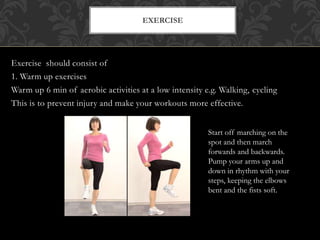
Exercise should consist of
1. Warm up exercises
Warm up 6 min of aerobic activities at a low intensity e.g. Walking, cycling
This is to prevent injury and make your workouts more effective.
EXERCISE
Start off marching on the
spot and then march
forwards and backwards.
Pump your arms up and
down in rhythm with your
steps, keeping the elbows
bent and the fists soft.
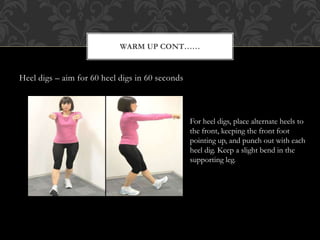
Heel digs – aim for 60 heel digs in 60 seconds
WARM UP CONT……
For heel digs, place alternate heels to
the front, keeping the front foot
pointing up, and punch out with each
heel dig. Keep a slight bend in the
supporting leg.
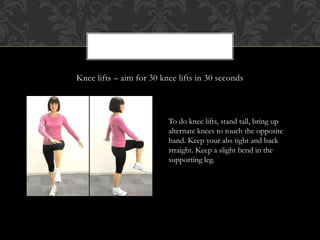
Knee lifts – aim for 30 knee lifts in 30 seconds
To do knee lifts, stand tall, bring up
alternate knees to touch the opposite
hand. Keep your abs tight and back
straight. Keep a slight bend in the
supporting leg.
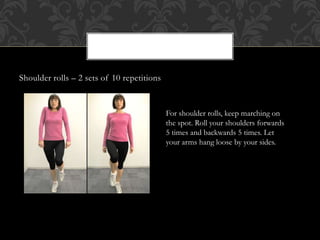
Shoulder rolls – 2 sets of 10 repetitions
For shoulder rolls, keep marching on
the spot. Roll your shoulders forwards
5 times and backwards 5 times. Let
your arms hang loose by your sides.
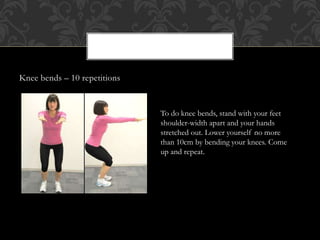
Knee bends – 10 repetitions
To do knee bends, stand with your feet
shoulder-width apart and your hands
stretched out. Lower yourself no more
than 10cm by bending your knees. Come
up and repeat.
Stretching exercises should be done for 6 minutes in order to prevent muscle
tear during exercise
STRETCHING EXERCISES
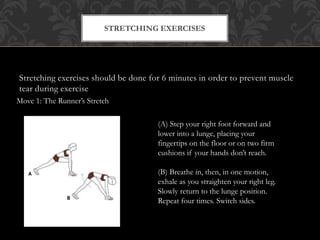
Move 1: The Runner’s Stretch
(A) Step your right foot forward and
lower into a lunge, placing your
fingertips on the floor or on two firm
cushions if your hands don’t reach.
(B) Breathe in, then, in one motion,
exhale as you straighten your right leg.
Slowly return to the lunge position.
Repeat four times. Switch sides.
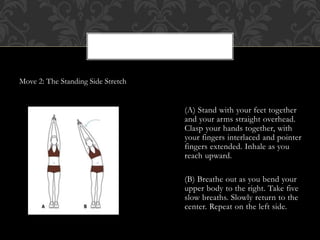
Move 2: The Standing Side Stretch
(A) Stand with your feet together
and your arms straight overhead.
Clasp your hands together, with
your fingers interlaced and pointer
fingers extended. Inhale as you
reach upward.
(B) Breathe out as you bend your
upper body to the right. Take five
slow breaths. Slowly return to the
center. Repeat on the left side.
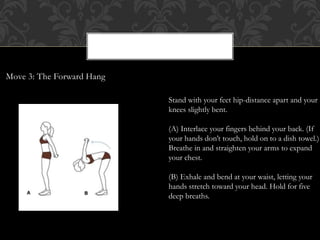
Move 3: The Forward Hang
Stand with your feet hip-distance apart and your
knees slightly bent.
(A) Interlace your fingers behind your back. (If
your hands don’t touch, hold on to a dish towel.)
Breathe in and straighten your arms to expand
your chest.
(B) Exhale and bend at your waist, letting your
hands stretch toward your head. Hold for five
deep breaths.
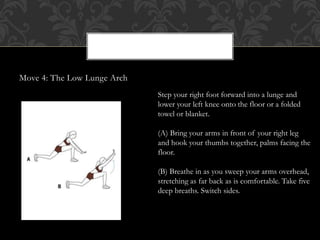
Move 4: The Low Lunge Arch
Step your right foot forward into a lunge and
lower your left knee onto the floor or a folded
towel or blanket.
(A) Bring your arms in front of your right leg
and hook your thumbs together, palms facing the
floor.
(B) Breathe in as you sweep your arms overhead,
stretching as far back as is comfortable. Take five
deep breaths. Switch sides.
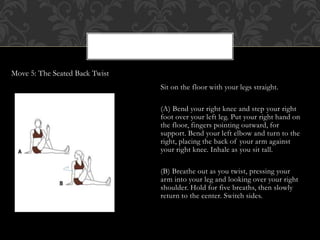
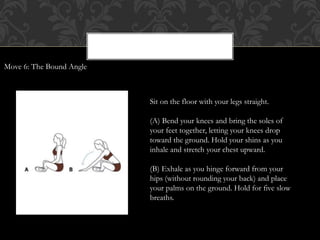
Sit on the floor with your legs straight.
(A) Bend your right knee and step your right
foot over your left leg. Put your right hand on
the floor, fingers pointing outward, for
support. Bend your left elbow and turn to the
right, placing the back of your arm against
your right knee. Inhale as you sit tall.
(B) Breathe out as you twist, pressing your
arm into your leg and looking over your right
shoulder. Hold for five breaths, then slowly
return to the center. Switch sides.
Move 5: The Seated Back Twist
Sit on the floor with your legs straight.
(A) Bend your knees and bring the soles of
your feet together, letting your knees drop
toward the ground. Hold your shins as you
inhale and stretch your chest upward.
(B) Exhale as you hinge forward from your
hips (without rounding your back) and place
your palms on the ground. Hold for five slow
breaths.
Move 6: The Bound Angle
This should be done for about 20 minutes. This include aerobic exercises and
resistance exercises ( moderate intensity exercises)
Example are. Brisk walking, jogging, swimming, running, treadmill exercises,
use of dumbbells, Multi-gym, cycling etc.
3. ACTIVE EXERCISES
Cool down should be done for 6 minutes, and it should be structured similarly
to warm up,.
Cool down gradually bring down the heart rate down to its pre-exercises level.
For patients with diabetes it is advised to see your physician and
physiotherapist before commencing on any exercises.
4. COOL DOWN
The role of exercise in the prevention and management of DM cannot
be overemphasized when combine with healthy dietary pattern and
medication.
CONCLUSION
THANK YOU FOR LISTENING

Exercise and diabetes

  • 1.
    EXERCISE AND DIABETES IsmailAbdullateef 28th February, 2018 By
  • 2.
    -Introduction -Pathophysiology -Risk factors -Clinical presentation -Diagnosis -Complications -Management -Exerciseand Diabetes -Benefits of exercises in diabetes -Guidelines for a sound exercise program -Conclusions SYNOPSIS
  • 3.
    - Diabetes isa metabolic disorder in which the body is unable to appropriately regulate the level of sugar, specifically glucose, in the blood, either by poor sensitivity to the protein insulin, or due to inadequate production of insulin by the pancreas. - Type 2 diabetes accounts for 90-95% of all diabetes cases. - Diabetes itself is not a high-mortality condition (1.3 million deaths globally), but it is a major risk factor for other causes of death and has a high attributable burden of disability. Diabetes is also a major risk factor for cardiovascular disease, kidney disease and blindness. INTRODUCTION
  • 4.
    -Diabetes Mellitus primarilyaffects the Islets of Langerhans of the pancreas, where glucagon (from the alpha cells) and insulin (from the beta cells) are produced. -Glucagon raises the blood glucose level, while insulin lowers it. In Type 1 DM (Insulin Dependent), the loss of function of the beta cells leads to an absolute insulin deficiency. -In Type 2 DM (Non-insulin Dependent), the impaired production and secretion of insulin by the beta cells is concommitant with the impaired ability of the tissues to utilize insulin (termed insulin resistance). The resulting accumulation of glucose in the blood is further elevated by the greater synthesis of glucose in the liver, which releases it to the general circulation. PATHOPHYSIOLOGY
  • 5.
    -over Weight andObesity. - Inactivity. -Family history -Race -Age -Gestational diabetes. -High blood pressure -Abnormal cholesterol and triglyceride levels RISK FACTORS
  • 6.
    Classic triad ofDiabetes Mellitus are -Polydipsia -Polyphagia -Polyuria -Weight loss -Fatigue with weakness -Irritability -Blurred vision -Numbness or tingling sensations in the hands and feet are also present -Glucose and Ketone bodies in urine CLINICAL PRESENTATION
  • 7.
    -Fasting plasma glucoselevel ≥ 7.0 mmol/l (126 mg/dl) -Plasma glucose ≥ 11.1 mmol/l (200 mg/dl) two hours after a 75 g oral glucose load as in a glucose tolerance test -Symptoms of high blood sugar and casual plasma glucose ≥ 11.1 mmol/l (200 mg/dl) -Glycated hemoglobin (HbA1C) ≥ 48 mmol/mol (≥ 6.5%). DIAGNOSIS
  • 9.
  • 10.
    -A sound, individuallytailored exercise prescription is a cornerstone in the management of Diabetes Mellitus. -Structured exercises training consisting of aerobic exercises, resistance training or both combined of more than 150 minutes per week is associated with greater HBA1c reduction in patients with type 2 diabetes than that of 150 munities or less per week EXERCISE AND DIABETES
  • 11.
    -Weight loss -Glycermic control -EnhanceInsulin secretion and sensitivity -Lipid profile -Restore the endothelial function and reduces the arterial stiffness -Daily Energy Expenditure -Quality of life -Muscle strength -Lean Muscle Mass -Bone Mineral Density BENEFITS OF EXERCISES IN DIABETES
  • 12.
    1. Do notexercise if the blood glucose level is less than 100 mg/dl (5.5mm/l) or greater than 250 mg/dl (13.8mm/l). 2. Patients should eat 2 hours before exercising. If planning to exercise after meal, patients must wait 1 hour prior to start. -During prolonged exercises duration, a 10-15 grams of CHO snack is recommended for every 30 minutes 3. Preferably, exercise indoor instead of outdoor to minimize the risk of skin and musculoskeletal trauma, as well as for the patient to have an immediate access to necessary things to address hypoglycemia, hyperglycemia or diabetic ketoacidocis. -Never exercises in extreme temperature 4. Patients are highly advised to wear the medical tag for diabetics each time they come out of their house to go somewhere else 5. Always have a carbohydrate snack at hand every exercise session. A glass of orange juice or milk is a good pickup for a patient who is experiencing hypoglycemia. 6. For Type 1 (Insulin Dependent) patients, never exercise during the peak times of insulin. 7. Type 2 diabetics are advised to have an average of 30 minutes of exercise duration per session. GUIDELINES FOR A SOUND EXERCISE PROGRAM ARE AS FOLLOWS

  • 13.
    8. Always wearproper footwear and exercise in a safe environment. 9. Type 1 diabetics may need to reduce insulin or increase food intake prior to the start of an exercise program. 10. Patients who are on Sulfonylureas are red flags because it can cause exercise-induced hypoglycemia. 11. Menstruating women need to increase insulin during menses, especially if they're not active. 12. There should be no short-acting insulin injections close to the muscles to be exercised within one hour of exercise. 13. Patients must always carry their own portable blood glucose monitor. They must check their glucose levels before and after exercise. 14. Patients are advised to drink 17 oz. of fluid before exercise. 15. Exercise five times a week as a maintenance (or at least every other day) and at the same schedule / time, preferably.

  • 14.
    -<100 mg/dL (give 10-15 g CHO snack and retest glucose levels 15 minutes later ) -100-250 mg/dL (safe exercise levels; proceed with treatment ) -250-300 mg/dL at start of exercise "caution zone"; postpone exercise until stable levels are achieved; ketones in urine are checked for at these levels ->300 mg/dL= stop exercise immediately!!!! (NOT SAFE) BLOOD GLUCOSE LEVELS IN RELATION TO EXERCISE THAT WE SHOULD BE AWARE OF:
  • 15.
    Exercise should consistof 1. Warm up exercises Warm up 6 min of aerobic activities at a low intensity e.g. Walking, cycling This is to prevent injury and make your workouts more effective. EXERCISE Start off marching on the spot and then march forwards and backwards. Pump your arms up and down in rhythm with your steps, keeping the elbows bent and the fists soft.
  • 16.
    Heel digs –aim for 60 heel digs in 60 seconds WARM UP CONT…… For heel digs, place alternate heels to the front, keeping the front foot pointing up, and punch out with each heel dig. Keep a slight bend in the supporting leg.
  • 17.
    Knee lifts –aim for 30 knee lifts in 30 seconds To do knee lifts, stand tall, bring up alternate knees to touch the opposite hand. Keep your abs tight and back straight. Keep a slight bend in the supporting leg.
  • 18.
    Shoulder rolls –2 sets of 10 repetitions For shoulder rolls, keep marching on the spot. Roll your shoulders forwards 5 times and backwards 5 times. Let your arms hang loose by your sides.
  • 19.
    Knee bends –10 repetitions To do knee bends, stand with your feet shoulder-width apart and your hands stretched out. Lower yourself no more than 10cm by bending your knees. Come up and repeat.
  • 20.
    Stretching exercises shouldbe done for 6 minutes in order to prevent muscle tear during exercise STRETCHING EXERCISES Move 1: The Runner’s Stretch (A) Step your right foot forward and lower into a lunge, placing your fingertips on the floor or on two firm cushions if your hands don’t reach. (B) Breathe in, then, in one motion, exhale as you straighten your right leg. Slowly return to the lunge position. Repeat four times. Switch sides.
  • 21.
    Move 2: TheStanding Side Stretch (A) Stand with your feet together and your arms straight overhead. Clasp your hands together, with your fingers interlaced and pointer fingers extended. Inhale as you reach upward. (B) Breathe out as you bend your upper body to the right. Take five slow breaths. Slowly return to the center. Repeat on the left side.
  • 22.
    Move 3: TheForward Hang Stand with your feet hip-distance apart and your knees slightly bent. (A) Interlace your fingers behind your back. (If your hands don’t touch, hold on to a dish towel.) Breathe in and straighten your arms to expand your chest. (B) Exhale and bend at your waist, letting your hands stretch toward your head. Hold for five deep breaths.
  • 23.
    Move 4: TheLow Lunge Arch Step your right foot forward into a lunge and lower your left knee onto the floor or a folded towel or blanket. (A) Bring your arms in front of your right leg and hook your thumbs together, palms facing the floor. (B) Breathe in as you sweep your arms overhead, stretching as far back as is comfortable. Take five deep breaths. Switch sides.
  • 24.
    Sit on thefloor with your legs straight. (A) Bend your right knee and step your right foot over your left leg. Put your right hand on the floor, fingers pointing outward, for support. Bend your left elbow and turn to the right, placing the back of your arm against your right knee. Inhale as you sit tall. (B) Breathe out as you twist, pressing your arm into your leg and looking over your right shoulder. Hold for five breaths, then slowly return to the center. Switch sides. Move 5: The Seated Back Twist
  • 25.
    Sit on thefloor with your legs straight. (A) Bend your knees and bring the soles of your feet together, letting your knees drop toward the ground. Hold your shins as you inhale and stretch your chest upward. (B) Exhale as you hinge forward from your hips (without rounding your back) and place your palms on the ground. Hold for five slow breaths. Move 6: The Bound Angle
  • 26.
    This should bedone for about 20 minutes. This include aerobic exercises and resistance exercises ( moderate intensity exercises) Example are. Brisk walking, jogging, swimming, running, treadmill exercises, use of dumbbells, Multi-gym, cycling etc. 3. ACTIVE EXERCISES
  • 27.
    Cool down shouldbe done for 6 minutes, and it should be structured similarly to warm up,. Cool down gradually bring down the heart rate down to its pre-exercises level. For patients with diabetes it is advised to see your physician and physiotherapist before commencing on any exercises. 4. COOL DOWN
  • 28.
    The role ofexercise in the prevention and management of DM cannot be overemphasized when combine with healthy dietary pattern and medication. CONCLUSION
  • 29.
    THANK YOU FORLISTENING