
Physiotherapist
Department of PMR,
CMC, Vellore
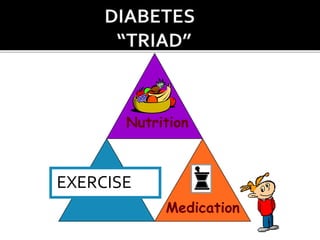
EXERCISE
Medication
Nutrition
“Exercise is the best insulin sensitizer on
the market; better than any medication
we currently have available"
Bartol
During the first few minutes of exercise:
Glycogen in the muscles is broken down
anaerobically
After 5-10 minutes of activity:
Muscle glycogen breakdown decreases.
Glucose broken down in the liver is released
into the blood stream and is taken up by the
muscles as fuel.This glucose becomes the
major source of fuel (hepatic glycogenolysis).
At 20 minutes or more:
The muscles’ glycogen stores are now
depleted. Blood glucose is now maintained
by hepatic glycogenolysis and triglycerides
that are broken down from adipose tissue. As
exercise continues fat breaks down to free
fatty acids (FFA) and is used as a source of
fuel for the muscles, through the process of
hepatic gluconeogenesis rather than hepatic
glycogenolysis.
Longer duration of exercise:
 Should low-to-moderately
intensive exercise continue
for a long period of time,
the muscles will continue
to use the glucose derived
from hepatic
gluconeogenesis.
 FFA cannot completely
replace the use of glucose
and if carbohydrates are
limited, then ketone
bodies may form.
 Increase the risk of DKA in a
person who is insulin deficient;
such asType I with elevated
blood glucose.
 If carbohydrate is consumed
during exercise, the decrease in
blood glucose can be delayed
and the exercise can be sustained
for a longer period.This is often
done by people with diabetes
who are marathon runners or
engage in moderate to intensive
exercise for long periods of time.
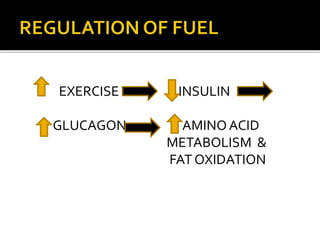
SHIFT IN FUEL USAGE
N E F A ‘S
Muscle Glycogen
EXERCISE INSULIN
GLUCAGON AMINOACID
METABOLISM &
FAT OXIDATION
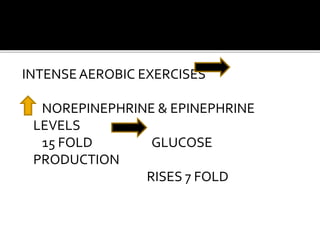
INTENSEAEROBIC EXERCISES
NOREPINEPHRINE & EPINEPHRINE
LEVELS
15 FOLD GLUCOSE
PRODUCTION
RISES 7 FOLD
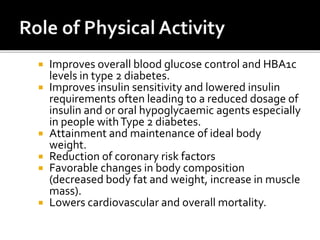
 Improves overall blood glucose control and HBA1c
levels in type 2 diabetes.
 Improves insulin sensitivity and lowered insulin
requirements often leading to a reduced dosage of
insulin and or oral hypoglycaemic agents especially
in people withType 2 diabetes.
 Attainment and maintenance of ideal body
weight.
 Reduction of coronary risk factors
 Favorable changes in body composition
(decreased body fat and weight, increase in muscle
mass).
 Lowers cardiovascular and overall mortality.
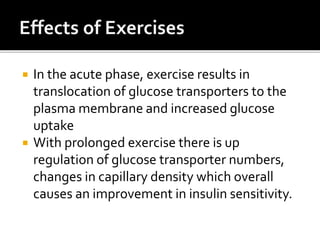
 In the acute phase, exercise results in
translocation of glucose transporters to the
plasma membrane and increased glucose
uptake
 With prolonged exercise there is up
regulation of glucose transporter numbers,
changes in capillary density which overall
causes an improvement in insulin sensitivity.
 Even short-term (2-week), regular aerobic
exercise in type 2 diabetic patients results in
significant improvement in both aerobic
capacity and whole-body insulin sensitivity.
 Long-term endurance training in diabetic
patients markedly improves whole-body insulin
sensitivity and the expression of key muscle
enzymes regulated by insulin. However, the
maintenance of this effect seems to require
dedication to a regular and uninterrupted
exercise regimen.
 Intramyocellular lipid accumulation, which is
associated with insulin resistance in muscle, can
be acutely decreased by even a single bout of
sustained endurance exercise.
 Exercise is beneficial for both glucose uptake
mechanisms and the anti-lipolytic effects of
insulin.
 Cardiovascular
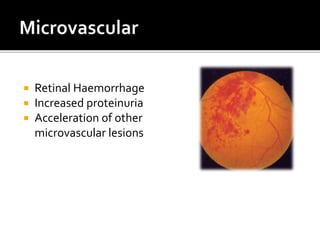
 Microvascular
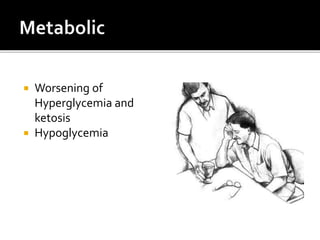
 Metabolic
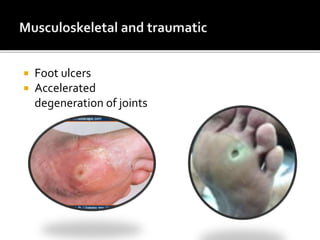
 Musculoskeletal and traumatic
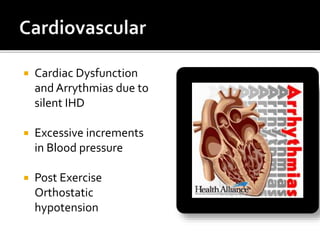
 Cardiac Dysfunction
and Arrythmias due to
silent IHD
 Excessive increments
in Blood pressure
 Post Exercise
Orthostatic
hypotension
 Retinal Haemorrhage
 Increased proteinuria
 Acceleration of other
microvascular lesions
 Worsening of
Hyperglycemia and
ketosis
 Hypoglycemia
 Foot ulcers
 Accelerated
degeneration of joints
EVALUATION OF A
PATIENT BEFORE
EXERCISES
Exercise ECG
Borg’s Rate of Perceived
Exertion
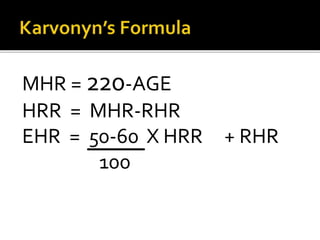
Karvonyn’s Formula
MHR = 220-AGE
HRR = MHR-RHR
EHR = 50-60 X HRR + RHR
100
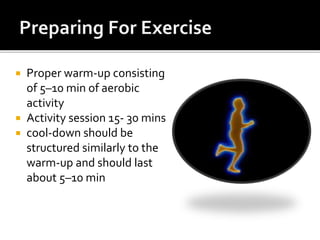
 Proper warm-up consisting
of 5–10 min of aerobic
activity
 Activity session 15- 30 mins
 cool-down should be
structured similarly to the
warm-up and should last
about 5–10 min
The Mnemonic: “SAFE” exercises are
recommended:
 Strengthening exercises
 Aerobic exercises
 Flexibility exercises
 Endurance exercises
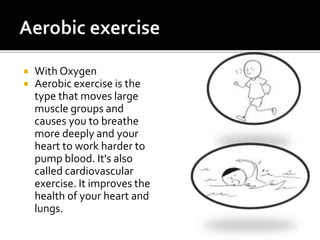
 With Oxygen
 Aerobic exercise is the
type that moves large
muscle groups and
causes you to breathe
more deeply and your
heart to work harder to
pump blood. It's also
called cardiovascular
exercise. It improves the
health of your heart and
lungs.
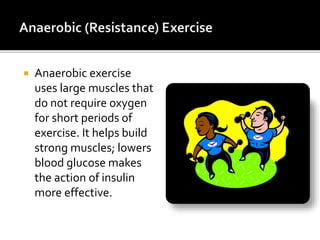
 Anaerobic exercise
uses large muscles that
do not require oxygen
for short periods of
exercise. It helps build
strong muscles; lowers
blood glucose makes
the action of insulin
more effective.
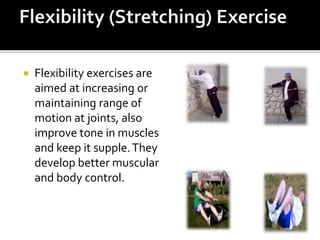
 Flexibility exercises are
aimed at increasing or
maintaining range of
motion at joints, also
improve tone in muscles
and keep it supple.They
develop better muscular
and body control.
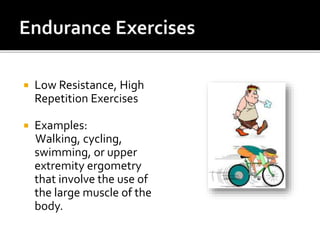
 Low Resistance, High
Repetition Exercises
 Examples:
Walking, cycling,
swimming, or upper
extremity ergometry
that involve the use of
the large muscle of the
body.
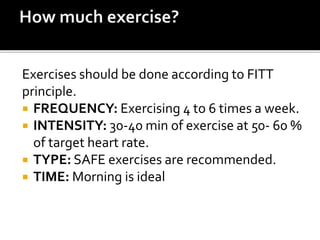
Exercises should be done according to FITT
principle.
 FREQUENCY: Exercising 4 to 6 times a week.
 INTENSITY: 30-40 min of exercise at 50- 60 %
of target heart rate.
 TYPE: SAFE exercises are recommended.
 TIME: Morning is ideal
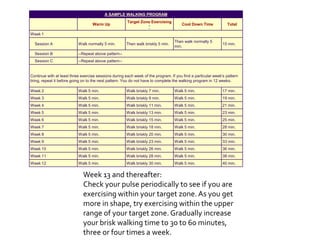
A SAMPLE WALKING PROGRAM
Warm Up
Target Zone Exercising
*
Cool Down Time Total
Week 1
Session A Walk normally 5 min. Then walk briskly 5 min.
Then walk normally 5
min.
15 min.
Session B --Repeat above pattern--
Session C --Repeat above pattern--
Continue with at least three exercise sessions during each week of the program. If you find a particular week's pattern
tiring, repeat it before going on to the next pattern. You do not have to complete the walking program in 12 weeks.
Week 2 Walk 5 min. Walk briskly 7 min. Walk 5 min. 17 min.
Week 3 Walk 5 min. Walk briskly 9 min. Walk 5 min. 19 min.
Week 4 Walk 5 min. Walk briskly 11 min. Walk 5 min. 21 min.
Week 5 Walk 5 min. Walk briskly 13 min. Walk 5 min. 23 min.
Week 6 Walk 5 min. Walk briskly 15 min. Walk 5 min. 25 min.
Week 7 Walk 5 min. Walk briskly 18 min. Walk 5 min. 28 min.
Week 8 Walk 5 min. Walk briskly 20 min. Walk 5 min. 30 min.
Week 9 Walk 5 min. Walk briskly 23 min. Walk 5 min. 33 min.
Week 10 Walk 5 min. Walk briskly 26 min. Walk 5 min. 36 min.
Week 11 Walk 5 min. Walk briskly 28 min. Walk 5 min. 38 min.
Week 12 Walk 5 min. Walk briskly 30 min. Walk 5 min. 40 min.
Week 13 and thereafter:
Check your pulse periodically to see if you are
exercising within your target zone. As you get
more in shape, try exercising within the upper
range of your target zone. Gradually increase
your brisk walking time to 30 to 60 minutes,
three or four times a week.
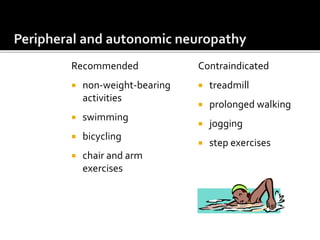
Recommended
 non-weight-bearing
activities
 swimming
 bicycling
 chair and arm
exercises
Contraindicated
 treadmill
 prolonged walking
 jogging
 step exercises
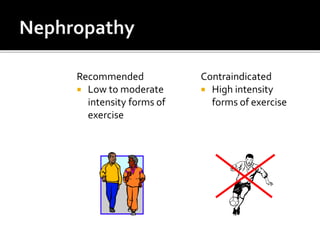
Recommended
 Low to moderate
intensity forms of
exercise
Contraindicated
 High intensity
forms of exercise
Recommended
 Low-impact
cardiovascular
conditioning, such as
swimming, walking,
low-impact aerobics,
stationary cycling,
endurance exercises
Contraindicated
 Strenuous activities,
pounding or jarring,
such as weight lifting,
jogging, high-impact
aerobics, racquet
sports.
 The person should be instructed to stop
exercising. People at risk for hypoglycaemia
should always carry a source of glucose with
them such as glucose tablets, candy or juice
in order to treat hypoglycaemia.
Remember it is a medical
emergency
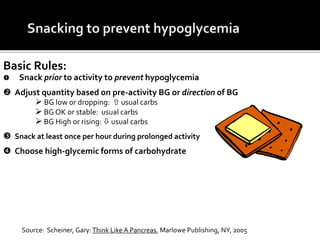
Basic Rules:
 Snack prior to activity to prevent hypoglycemia
 Adjust quantity based on pre-activity BG or direction of BG
 BG low or dropping:  usual carbs
 BG OK or stable: usual carbs
 BG High or rising:  usual carbs
 Snack at least once per hour during prolonged activity
 Choose high-glycemic forms of carbohydrate
Source: Scheiner, Gary:Think Like A Pancreas, Marlowe Publishing, NY, 2005
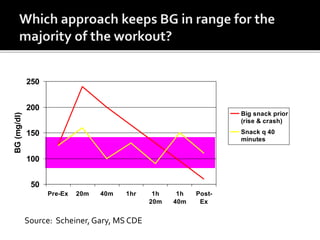
50
100
150
200
250
Pre-Ex 20m 40m 1hr 1h
20m
1h
40m
Post-
Ex
BG
(mg/dl)
Big snack prior
(rise & crash)
Snack q 40
minutes
Source: Scheiner, Gary, MS CDE
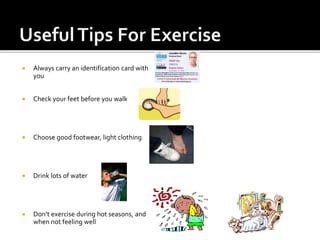
 Always carry an identification card with
you
 Check your feet before you walk
 Choose good footwear, light clothing
 Drink lots of water
 Don’t exercise during hot seasons, and
when not feeling well
 Physical activity should be encouraged in
all people with diabetes
 People need to be educated about
prevention and treatment of
hypoglycaemia
 People should be taught to plan for
periods of physical activity
Thank you

Diabetes and Exercise

  • 1.
  • 2.
  • 3.
    “Exercise is thebest insulin sensitizer on the market; better than any medication we currently have available" Bartol
  • 4.
    During the firstfew minutes of exercise: Glycogen in the muscles is broken down anaerobically
  • 5.
    After 5-10 minutesof activity: Muscle glycogen breakdown decreases. Glucose broken down in the liver is released into the blood stream and is taken up by the muscles as fuel.This glucose becomes the major source of fuel (hepatic glycogenolysis).
  • 6.
    At 20 minutesor more: The muscles’ glycogen stores are now depleted. Blood glucose is now maintained by hepatic glycogenolysis and triglycerides that are broken down from adipose tissue. As exercise continues fat breaks down to free fatty acids (FFA) and is used as a source of fuel for the muscles, through the process of hepatic gluconeogenesis rather than hepatic glycogenolysis.
  • 7.
    Longer duration ofexercise:  Should low-to-moderately intensive exercise continue for a long period of time, the muscles will continue to use the glucose derived from hepatic gluconeogenesis.  FFA cannot completely replace the use of glucose and if carbohydrates are limited, then ketone bodies may form.  Increase the risk of DKA in a person who is insulin deficient; such asType I with elevated blood glucose.  If carbohydrate is consumed during exercise, the decrease in blood glucose can be delayed and the exercise can be sustained for a longer period.This is often done by people with diabetes who are marathon runners or engage in moderate to intensive exercise for long periods of time.
  • 8.
    SHIFT IN FUELUSAGE N E F A ‘S Muscle Glycogen
  • 9.
  • 10.
    INTENSEAEROBIC EXERCISES NOREPINEPHRINE &EPINEPHRINE LEVELS 15 FOLD GLUCOSE PRODUCTION RISES 7 FOLD
  • 11.
     Improves overallblood glucose control and HBA1c levels in type 2 diabetes.  Improves insulin sensitivity and lowered insulin requirements often leading to a reduced dosage of insulin and or oral hypoglycaemic agents especially in people withType 2 diabetes.  Attainment and maintenance of ideal body weight.  Reduction of coronary risk factors  Favorable changes in body composition (decreased body fat and weight, increase in muscle mass).  Lowers cardiovascular and overall mortality.
  • 12.
     In theacute phase, exercise results in translocation of glucose transporters to the plasma membrane and increased glucose uptake  With prolonged exercise there is up regulation of glucose transporter numbers, changes in capillary density which overall causes an improvement in insulin sensitivity.
  • 13.
     Even short-term(2-week), regular aerobic exercise in type 2 diabetic patients results in significant improvement in both aerobic capacity and whole-body insulin sensitivity.  Long-term endurance training in diabetic patients markedly improves whole-body insulin sensitivity and the expression of key muscle enzymes regulated by insulin. However, the maintenance of this effect seems to require dedication to a regular and uninterrupted exercise regimen.
  • 14.
     Intramyocellular lipidaccumulation, which is associated with insulin resistance in muscle, can be acutely decreased by even a single bout of sustained endurance exercise.  Exercise is beneficial for both glucose uptake mechanisms and the anti-lipolytic effects of insulin.
  • 15.
     Cardiovascular  Microvascular Metabolic  Musculoskeletal and traumatic
  • 16.
     Cardiac Dysfunction andArrythmias due to silent IHD  Excessive increments in Blood pressure  Post Exercise Orthostatic hypotension
  • 17.
     Retinal Haemorrhage Increased proteinuria  Acceleration of other microvascular lesions
  • 18.
     Worsening of Hyperglycemiaand ketosis  Hypoglycemia
  • 19.
     Foot ulcers Accelerated degeneration of joints
  • 20.
    EVALUATION OF A PATIENTBEFORE EXERCISES
  • 21.
    Exercise ECG Borg’s Rateof Perceived Exertion Karvonyn’s Formula
  • 22.
    MHR = 220-AGE HRR= MHR-RHR EHR = 50-60 X HRR + RHR 100
  • 23.
     Proper warm-upconsisting of 5–10 min of aerobic activity  Activity session 15- 30 mins  cool-down should be structured similarly to the warm-up and should last about 5–10 min
  • 24.
    The Mnemonic: “SAFE”exercises are recommended:  Strengthening exercises  Aerobic exercises  Flexibility exercises  Endurance exercises
  • 25.
     With Oxygen Aerobic exercise is the type that moves large muscle groups and causes you to breathe more deeply and your heart to work harder to pump blood. It's also called cardiovascular exercise. It improves the health of your heart and lungs.
  • 26.
     Anaerobic exercise useslarge muscles that do not require oxygen for short periods of exercise. It helps build strong muscles; lowers blood glucose makes the action of insulin more effective.
  • 27.
     Flexibility exercisesare aimed at increasing or maintaining range of motion at joints, also improve tone in muscles and keep it supple.They develop better muscular and body control.
  • 28.
     Low Resistance,High Repetition Exercises  Examples: Walking, cycling, swimming, or upper extremity ergometry that involve the use of the large muscle of the body.
  • 29.
    Exercises should bedone according to FITT principle.  FREQUENCY: Exercising 4 to 6 times a week.  INTENSITY: 30-40 min of exercise at 50- 60 % of target heart rate.  TYPE: SAFE exercises are recommended.  TIME: Morning is ideal
  • 30.
    A SAMPLE WALKINGPROGRAM Warm Up Target Zone Exercising * Cool Down Time Total Week 1 Session A Walk normally 5 min. Then walk briskly 5 min. Then walk normally 5 min. 15 min. Session B --Repeat above pattern-- Session C --Repeat above pattern-- Continue with at least three exercise sessions during each week of the program. If you find a particular week's pattern tiring, repeat it before going on to the next pattern. You do not have to complete the walking program in 12 weeks. Week 2 Walk 5 min. Walk briskly 7 min. Walk 5 min. 17 min. Week 3 Walk 5 min. Walk briskly 9 min. Walk 5 min. 19 min. Week 4 Walk 5 min. Walk briskly 11 min. Walk 5 min. 21 min. Week 5 Walk 5 min. Walk briskly 13 min. Walk 5 min. 23 min. Week 6 Walk 5 min. Walk briskly 15 min. Walk 5 min. 25 min. Week 7 Walk 5 min. Walk briskly 18 min. Walk 5 min. 28 min. Week 8 Walk 5 min. Walk briskly 20 min. Walk 5 min. 30 min. Week 9 Walk 5 min. Walk briskly 23 min. Walk 5 min. 33 min. Week 10 Walk 5 min. Walk briskly 26 min. Walk 5 min. 36 min. Week 11 Walk 5 min. Walk briskly 28 min. Walk 5 min. 38 min. Week 12 Walk 5 min. Walk briskly 30 min. Walk 5 min. 40 min. Week 13 and thereafter: Check your pulse periodically to see if you are exercising within your target zone. As you get more in shape, try exercising within the upper range of your target zone. Gradually increase your brisk walking time to 30 to 60 minutes, three or four times a week.
  • 37.
    Recommended  non-weight-bearing activities  swimming bicycling  chair and arm exercises Contraindicated  treadmill  prolonged walking  jogging  step exercises
  • 38.
    Recommended  Low tomoderate intensity forms of exercise Contraindicated  High intensity forms of exercise
  • 39.
    Recommended  Low-impact cardiovascular conditioning, suchas swimming, walking, low-impact aerobics, stationary cycling, endurance exercises Contraindicated  Strenuous activities, pounding or jarring, such as weight lifting, jogging, high-impact aerobics, racquet sports.
  • 40.
     The personshould be instructed to stop exercising. People at risk for hypoglycaemia should always carry a source of glucose with them such as glucose tablets, candy or juice in order to treat hypoglycaemia. Remember it is a medical emergency
  • 41.
    Basic Rules:  Snackprior to activity to prevent hypoglycemia  Adjust quantity based on pre-activity BG or direction of BG  BG low or dropping:  usual carbs  BG OK or stable: usual carbs  BG High or rising:  usual carbs  Snack at least once per hour during prolonged activity  Choose high-glycemic forms of carbohydrate Source: Scheiner, Gary:Think Like A Pancreas, Marlowe Publishing, NY, 2005
  • 42.
    50 100 150 200 250 Pre-Ex 20m 40m1hr 1h 20m 1h 40m Post- Ex BG (mg/dl) Big snack prior (rise & crash) Snack q 40 minutes Source: Scheiner, Gary, MS CDE
  • 43.
     Always carryan identification card with you  Check your feet before you walk  Choose good footwear, light clothing  Drink lots of water  Don’t exercise during hot seasons, and when not feeling well
  • 44.
     Physical activityshould be encouraged in all people with diabetes  People need to be educated about prevention and treatment of hypoglycaemia  People should be taught to plan for periods of physical activity
  • 45.