HYPERNATREMIA
&
HYPONATREMIA
Haroon Chaudhry MD PGY1
Khewra Salt Mines , Punjab, Pakistan
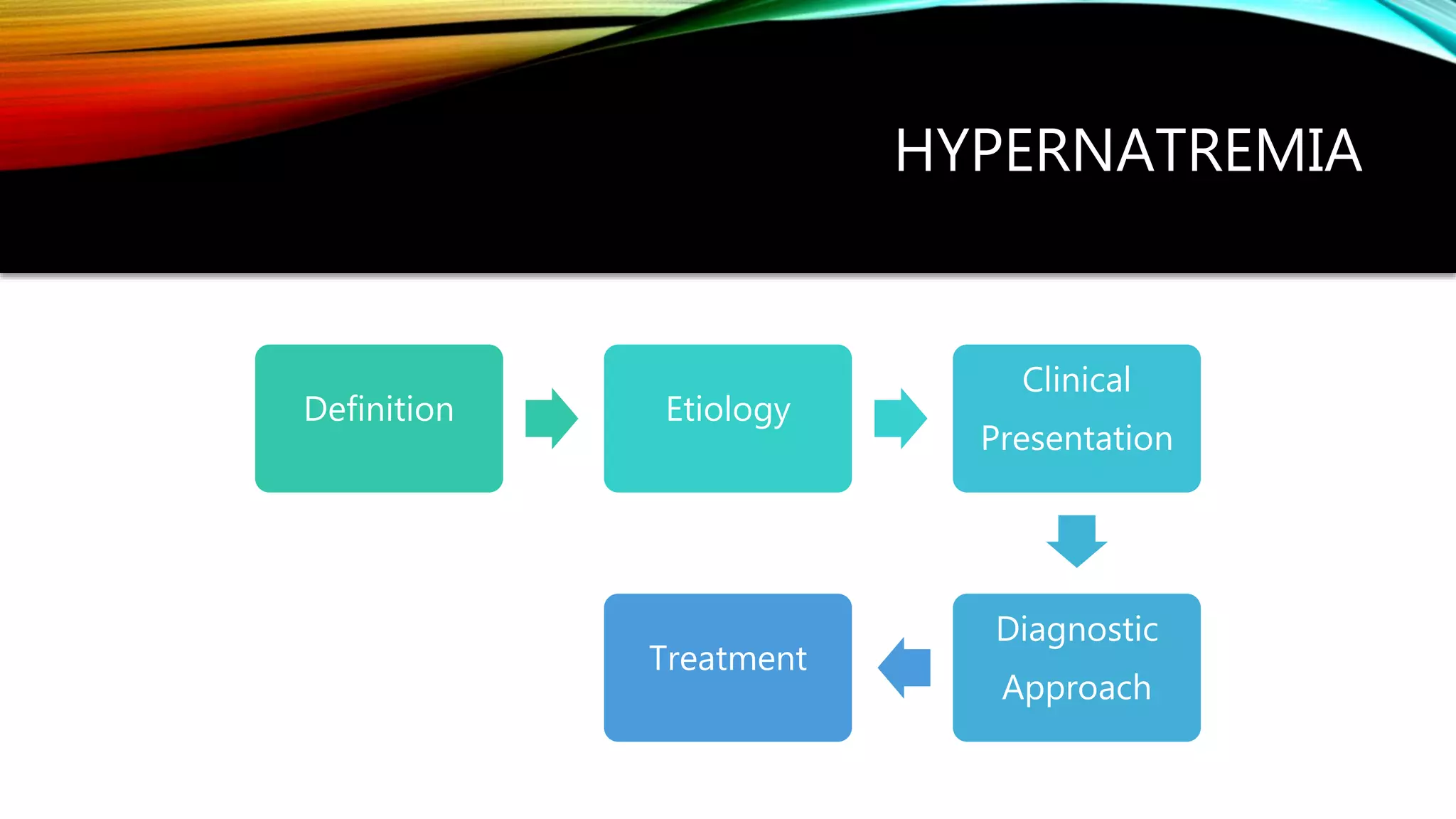
HYPERNATREMIA
Definition Etiology
Clinical
Presentation
Diagnostic
Approach
Treatment
DEFINITION PLASMA SODIUM > 145 MEq/L
•1% of hospitalized patients
•More common in ICU (7%)
•Mortality rate as high as 40% with Hyper Na
Palevsky PM et al. Hypernatremia in hospitalized patients. Ann Intern Med 1996 Jan 15 124 197203
Lindner G, Funk GC, Schwarz C, Kneidinger N, Kaider A, Schneeweiss B, Kramer L, Druml W. Hypernatremia in the critically ill is an
independent risk factor for mortality. Am J Kidney Dis. 2007 Dec;50(6):952-7.
ETIOLOGY
Primary Na gain OR Water deficit
Compensation: Thirst or Max concentrated Urine
BOTH Compensatory mech impaired in Hyper Na
• Thirst: Elderly, Institutionalized, Handicap, Post-Op, Intubated, Mentally impaired
• Na gain (Iatrogenic: Hypertonic Saline, Unchecked 0.9 % NS during admission)
• Water loss: Non-Renal OR Renal
• Non-Renal Water loss:
• Skin (Fever, Exercise, Heat exposure, Burns)
• Respiratory (Mechanical Ventilation)
• GI (Osmotic Diarrhea- lactulose, Malabsorption, Infectious Diarrhea)
• Renal Water loss
• Osmotic Diuresis-Glycosuria, High Osmolar feeds, Inc
Urea generation (Accelerated Catabolism, High
Protein feeds, Stress dose steroids)
• Diabetes Insipidus-Hyper Na is Less common if
adequate fluid intake is maintained
Central DI-Destruction of Neurohypophysis 2/2 idiopathic
causes, Neurosurgery, trauma, Ca, infiltrative disease,
CVA, infection= Impaired secretion of Vasopressin
Nephrogenic DI-Lithium, Demeclocycline, Amphotericin
B, Hypercalcemia, Hypokalemia, Loop diuretics, intrinsic
renal disease=Resistance to Vasopressin (Partial=
CDI+NDI, more common)
Gestational DI: Placental protease degradation of
Arginine vasopressin (AVP) hormone- Rx DDAVP
Diagnostic Approach
History: Thirst, polyuria, water loss
Physical: Thirst or Max concentrated Urine
Documentation of I’s and O’s
Urine Osmolality = Solute,
UOsm High,
UNa High
UOsm High,
UNa Low
UOsm Low,
UNa Variable UOsm High,
UNa Variable
UOsm High,
UNa High
Kidney 😵
Kidney 😵
ADH = >2 pg/ml (N)
ADH Indetectable
ADH = <1.5 pg/ml
ADH = > 5 pg/ml
ADH = 5 pg/ml
Treatment Goal <145 meq/L
Rate of Correction
Acute symptomatic: Correction Rate* 0.5 mEq/L/hr, Max 10-12 units
drop
Chronic asymptomatic: Correction Rate* 0.3 mEq/L/hr, Max 5-8 units
drop
Appropriate interventions: PO/NG Water, D5W or ¼ NS
Address Underlying disorders
*doi: 10.2215/cjn.02950319, doi: 10.2215/cjn.10640918, doi:10.1053/j.ajkd.2019.07.014
Hypovolemic Hypernatremia: D5W, 0.45% NS, 0.2%NS in
D5W
CDI: DDAVP (Vasopressin analogue)
NDI: Low Na Diet with Thiazide diuretic, mild volume
depletion causing proximal reabsorption of salt and water
Lithium associated NDI: Amiloride, NSAIDS and COX-2
Inhibitor
HYPONATREMIA
Definition
Etiology
Clinical Presentation
Diagnostic Approach
Treatment
HYPONATREMIA
• Definition Na <135 meq/L
ETIOLOGY
Disorder of H2O Homeostasis
Increased Arginine Vasopressin
Increased sensitivity to Arginine Vasopressin such
as Beer Potomania (Excessive intake of alcohol,
particularly beer, together with poor dietary solute
intake that leads to fatigue, dizziness, and
muscular weakness)
CLINICAL
PRESENTATION
Acute vs Chronic
Na <135 : Nausea, Vomiting Confusion,
Lethargy and Disorientation
Na <120:Seizure, Central Herniation,
Coma, Death
DIAGNOSTIC APPROACH
“Osis”
Cardiosis
Nephrosis
Cirrhosis
ACUTE
SYMPTOMATIC
HYPONATREMIA
Pathophysiology: Sudden Drop of Na  brain can’t
regulate cell volume cerebral edema, seizures, death
Causes: Iatrogenic: Post-Op Hypotonic fluids, HCTZ,
Colonoscopy Prep, Intraoperative use of Glycine
irritants, Polydipsia, Marathon (inc. H2O intake with
sweating), Ecstasy (methylene-dioxy-methamphetamine
[MDMA] ↑AVP and thirst
ACUTE
SYMPTOMATIC
HYPONATREMIA
Management: Symptoms present?, <48 hours
Hypertonic Saline 1-2 meq/L/hr to 4-6 meq/L change to
relieve Cerebral Edema symptoms
BMP for Na Q2-4 hr
Na Deficit: 0.6 × body weight × (target [Na+] – starting
[Na+]
Supplemental O2/Ventilator in case of Pulmonary
Edema or Hypercapnic Resp Failure
CHRONIC HYPONATREMIA
• ↑Risk of Osmotic Demyelination Syndrome  Goal Na↓10-12
meq/L in first 24 hrs, 18meq/L in 48 hrs
HYPOVOLEMIC
HYPONATREMIA
Pathophysiology: SIADH (PNA, TB, Pleural Effusion Ca, CNS Trauma/SAD,
Meningitis, Drugs: SSRIs, TCA, Antipsychotic, Narcotic,), Hypothyroidism,
Adrenal Insufficiency 2/2 Pituitary Disease (Steroid's repletion  AVP level
drop  Overcorrection of Na
Loop Diuretics + Oral Salt tablets, H2O restriction 1L/d.
Oral Urea (Efficacy equal to Tolvaptan which can affect LFTs)
Vasopressin antagonists (e.g., tolvaptan and conivaptan) in SIADH  if
overcorrected Na  Rx DDAVP
HYPERVOLEMIC
HYPONATREMIA
“OSIS”
• Pathophysiology: Arterial filling and circulatory
integrity decreased 2/2 Cardiac dysfunction,
peripheral vasodilation in cirrhosis, and
hypoalbuminemia in nephrotic syndrome
• Rx of underlying disorder (e.g., Afterload
reduction in CHF (ACE, Hydralazine, NO3, Ca
Channel blockers), IV Albumin in cirrhosis,
immunomodulatory therapy in some forms of
nephrotic syndrome),
• Na+ restriction, diuretic therapy, and, in some
pts, H2O restriction.
• Vasopressin antagonists (e.g., tolvaptan and
conivaptan)
Questions ????

Hypernatremia and Hyponatremia

  • 1.
  • 2.
    Khewra Salt Mines, Punjab, Pakistan
  • 5.
  • 6.
  • 7.
    •1% of hospitalizedpatients •More common in ICU (7%) •Mortality rate as high as 40% with Hyper Na Palevsky PM et al. Hypernatremia in hospitalized patients. Ann Intern Med 1996 Jan 15 124 197203 Lindner G, Funk GC, Schwarz C, Kneidinger N, Kaider A, Schneeweiss B, Kramer L, Druml W. Hypernatremia in the critically ill is an independent risk factor for mortality. Am J Kidney Dis. 2007 Dec;50(6):952-7.
  • 8.
    ETIOLOGY Primary Na gainOR Water deficit Compensation: Thirst or Max concentrated Urine BOTH Compensatory mech impaired in Hyper Na • Thirst: Elderly, Institutionalized, Handicap, Post-Op, Intubated, Mentally impaired
  • 9.
    • Na gain(Iatrogenic: Hypertonic Saline, Unchecked 0.9 % NS during admission) • Water loss: Non-Renal OR Renal • Non-Renal Water loss: • Skin (Fever, Exercise, Heat exposure, Burns) • Respiratory (Mechanical Ventilation) • GI (Osmotic Diarrhea- lactulose, Malabsorption, Infectious Diarrhea)
  • 10.
    • Renal Waterloss • Osmotic Diuresis-Glycosuria, High Osmolar feeds, Inc Urea generation (Accelerated Catabolism, High Protein feeds, Stress dose steroids) • Diabetes Insipidus-Hyper Na is Less common if adequate fluid intake is maintained
  • 11.
    Central DI-Destruction ofNeurohypophysis 2/2 idiopathic causes, Neurosurgery, trauma, Ca, infiltrative disease, CVA, infection= Impaired secretion of Vasopressin Nephrogenic DI-Lithium, Demeclocycline, Amphotericin B, Hypercalcemia, Hypokalemia, Loop diuretics, intrinsic renal disease=Resistance to Vasopressin (Partial= CDI+NDI, more common) Gestational DI: Placental protease degradation of Arginine vasopressin (AVP) hormone- Rx DDAVP
  • 13.
    Diagnostic Approach History: Thirst,polyuria, water loss Physical: Thirst or Max concentrated Urine Documentation of I’s and O’s Urine Osmolality = Solute,
  • 14.
    UOsm High, UNa High UOsmHigh, UNa Low UOsm Low, UNa Variable UOsm High, UNa Variable UOsm High, UNa High Kidney 😵 Kidney 😵
  • 16.
    ADH = >2pg/ml (N) ADH Indetectable ADH = <1.5 pg/ml ADH = > 5 pg/ml ADH = 5 pg/ml
  • 20.
    Treatment Goal <145meq/L Rate of Correction Acute symptomatic: Correction Rate* 0.5 mEq/L/hr, Max 10-12 units drop Chronic asymptomatic: Correction Rate* 0.3 mEq/L/hr, Max 5-8 units drop Appropriate interventions: PO/NG Water, D5W or ¼ NS Address Underlying disorders *doi: 10.2215/cjn.02950319, doi: 10.2215/cjn.10640918, doi:10.1053/j.ajkd.2019.07.014
  • 21.
    Hypovolemic Hypernatremia: D5W,0.45% NS, 0.2%NS in D5W CDI: DDAVP (Vasopressin analogue) NDI: Low Na Diet with Thiazide diuretic, mild volume depletion causing proximal reabsorption of salt and water Lithium associated NDI: Amiloride, NSAIDS and COX-2 Inhibitor
  • 23.
  • 24.
  • 25.
    ETIOLOGY Disorder of H2OHomeostasis Increased Arginine Vasopressin Increased sensitivity to Arginine Vasopressin such as Beer Potomania (Excessive intake of alcohol, particularly beer, together with poor dietary solute intake that leads to fatigue, dizziness, and muscular weakness)
  • 26.
    CLINICAL PRESENTATION Acute vs Chronic Na<135 : Nausea, Vomiting Confusion, Lethargy and Disorientation Na <120:Seizure, Central Herniation, Coma, Death
  • 27.
  • 28.
    ACUTE SYMPTOMATIC HYPONATREMIA Pathophysiology: Sudden Dropof Na  brain can’t regulate cell volume cerebral edema, seizures, death Causes: Iatrogenic: Post-Op Hypotonic fluids, HCTZ, Colonoscopy Prep, Intraoperative use of Glycine irritants, Polydipsia, Marathon (inc. H2O intake with sweating), Ecstasy (methylene-dioxy-methamphetamine [MDMA] ↑AVP and thirst
  • 29.
    ACUTE SYMPTOMATIC HYPONATREMIA Management: Symptoms present?,<48 hours Hypertonic Saline 1-2 meq/L/hr to 4-6 meq/L change to relieve Cerebral Edema symptoms BMP for Na Q2-4 hr Na Deficit: 0.6 × body weight × (target [Na+] – starting [Na+] Supplemental O2/Ventilator in case of Pulmonary Edema or Hypercapnic Resp Failure
  • 30.
    CHRONIC HYPONATREMIA • ↑Riskof Osmotic Demyelination Syndrome  Goal Na↓10-12 meq/L in first 24 hrs, 18meq/L in 48 hrs
  • 31.
    HYPOVOLEMIC HYPONATREMIA Pathophysiology: SIADH (PNA,TB, Pleural Effusion Ca, CNS Trauma/SAD, Meningitis, Drugs: SSRIs, TCA, Antipsychotic, Narcotic,), Hypothyroidism, Adrenal Insufficiency 2/2 Pituitary Disease (Steroid's repletion  AVP level drop  Overcorrection of Na Loop Diuretics + Oral Salt tablets, H2O restriction 1L/d. Oral Urea (Efficacy equal to Tolvaptan which can affect LFTs) Vasopressin antagonists (e.g., tolvaptan and conivaptan) in SIADH  if overcorrected Na  Rx DDAVP
  • 32.
    HYPERVOLEMIC HYPONATREMIA “OSIS” • Pathophysiology: Arterialfilling and circulatory integrity decreased 2/2 Cardiac dysfunction, peripheral vasodilation in cirrhosis, and hypoalbuminemia in nephrotic syndrome • Rx of underlying disorder (e.g., Afterload reduction in CHF (ACE, Hydralazine, NO3, Ca Channel blockers), IV Albumin in cirrhosis, immunomodulatory therapy in some forms of nephrotic syndrome), • Na+ restriction, diuretic therapy, and, in some pts, H2O restriction. • Vasopressin antagonists (e.g., tolvaptan and conivaptan)
  • 34.