HYPERNATREMIA
Dr. Nyatundo N. Yvonne
15th March, 2022
Definition
 A rise in serum sodium concentration to a value exceeding 145 mmol/L
Risk Factors
 Age older than 65 years.
 mental or physical disability may result in impaired thirst sensation, an
impaired ability to express thirst, and/or decreased access to water
 Breastfeeding-associated neonatal hypernatremia
Etiology
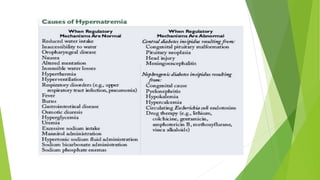
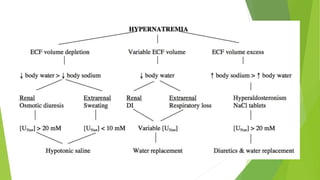
 Hypernatremia can be classified on the basis of the concurrent water loss or
electrolyte gain and on corresponding changes in ECF, as follows:
 Hypotonic fluid deficits (loss of water and electrolytes)
 Pure-water deficits
 Hypertonic sodium gain (gain of electrolytes in excess of water).
Loss of hypotonic fluid (loss of water in
excess of electrolytes)
 These patients have a deficit in free water and electrolytes (low total body
Na+ and K+) and have decreased ECF.
 In these patients, hypovolemia may be more life-threatening than
hypertonicity.
 When physical evidence of hypovolemia is present, fluid resuscitation with
normal saline is the first step in therapy.
Loss of hypotonic fluid (loss of water in
excess of electrolytes)
 Renal hypotonic fluid loss results from anything that will interfere with the
ability of the kidney to concentrate the urine or osmotic diuresis:
 Diuretic drugs (loop and thiazide diuretics)
 Osmotic diuresis (hyperglycemia, mannitol, urea [high-protein tube feeding])
 Postobstructive diuresis
 Diuretic phase of acute tubular necrosis
 Nonrenal hypotonic fluid loss can result from any of the following:
 GI – Vomiting, diarrhea, lactulose, cathartics, nasogastric suction,
gastrointestinal fluid drains, and fistulas
 Cutaneous – Sweating (extreme sports, marathon runs), burn injuries
Pure-water deficits
 These patients have a normal ECF with normal total body Na+ and K+. This
condition most commonly develops when impaired intake is combined with
increased insensible (eg, respiratory) or renal water losses.
 Free-water loss will also result from an inability of the kidney to concentrate
the urine.
 The cause of that can be either from failure of the hypothalamic-pituitary
axis to synthesize or release adequate amounts of AVP (central DI) or a lack of
responsiveness of the kidney to AVP (nephrogenic DI).
Pure-water deficits
 Water intake less than insensible losses may result from any of the following:
 Lack of access to water (through incarceration, restraints, intubation,
immobilization)
 Altered mental status (through medications, disease)
 Neurologic disease (dementia, impaired motor function)
 Abnormal thirst (eg, geriatric hypodipsia
 Loss of water through the respiratory tract
Vasopressin (AVP) deficiency (diabetes
insipidus)
 Central DI can be caused by any pathologic process that destroys the anatomic
structures of the hypothalamic-pituitary axis involved in AVP production and
secretion. Such processes include the following:
 Pituitary injury – Posttraumatic, neurosurgical, hemorrhage, ischemia (Sheehan’s),
idiopathic-autoimmune, IgG4-related disease
 Tumors – Craniopharyngioma, pinealoma, meningioma, germinoma, lymphoma,
metastatic disease, cysts
 Aneurysms – Particularly anterior communicating
 Inflammatory states and granulomatous disease – Acute meningitis/encephalitis,
Langerhans cell histiocytosis, neurosarcoidosis, tuberculosis
 Drugs – Ethanol (transient), phenytoin
 Genetic – AVP carrier protein gene defect
Nephrogenic diabetes insipidus (decreased
responsiveness of the kidney to vasopressin)
 Causes include the following:
 Genetic – V2-receptor defects, aquaporin defects (AQP2 and AQP1)
 Structural – Urinary tract obstruction, papillary necrosis, sickle-cell
nephropathy
 Tubulointerstitial disease – Medullary cystic disease, polycystic kidney disease,
nephrocalcinosis, Sjögren’s syndrome, lupus, analgesic-abuse nephropathy,
sarcoidosis, M-protein disease, cystinosis,
 Others – Distal RTA, Bartter syndrome,
 Electrolyte disorders –Hypercalcemia, hypokalemia
 Medications
Nephrogenic diabetes insipidus (decreased
responsiveness of the kidney to vasopressin)
 Medications that can induce Nephrogenic DI
 Lithium (40% of patients)
 Amphotericin B
 Demeclocycline
 Dopamine
 Ofloxacin
 Orlistat
 Ifosfamide
Gestational diabetes insipidus
 In this form of diabetes insipidus, AVP is rapidly degraded by a high circulating
level of oxytocinase/vasopressinase. It is a rare condition, because increased
AVP secretion will compensate for the increased rate of degradation.
 Gestational diabetes insipidus occurs only in combination with impaired AVP
production.
Hypertonic sodium gain
 Patients with hypertonic sodium gain have a high total-body sodium and an
extracellular volume overload (rare, mostly iatrogenic). When thirst and renal
function are intact, this condition is transient. Causes include the following:
 Administration of hypertonic electrolyte solutions – Eg, sodium bicarbonate
solutions, hypertonic alimentation solutions, normal saline with or without
potassium supplements
 Sodium ingestion – NaCl tablets, seawater ingestion
 Sodium modeling in hemodialysis
Water shift (transient)
 Water shifts into muscle cells during extreme exercise or seizures because of
increased intracellular osmoles).
History
 Assess Baseline mental status, elderly
 Risk factors
 Advanced age
 Mental or physical impairment
 Uncontrolled diabetes (solute diuresis)
 Underlying polyuria disorders
 Diuretic therapy
 Residency in nursing home, inadequate nursing care
 Hospitalization
R/Fs
 Hospitalized patients may develop hypernatremia because of any of the
following:
 Decreased baseline levels of consciousness
 Tube feeding
 Hypertonic infusion
 Osmotic diuresis
 Lactulose
 Mechanical ventilation
 Medication (eg, diuretics, sedatives)
Physical examination
 The examination should include an accurate assessment of volume status and
cognitive function
Diagnosis
 The diagnosis of hypernatremia is based on an elevated serum sodium
concentration (Na+ >145 mEq/L).
 Serum electrolytes (Na+, K+, Ca2+)
 Glucose level
 Urea
 Creatinine
 Urine electrolytes (Na+, K+)
 Urine and plasma osmolality
 24-hour urine volume
 Plasma arginine vasopressin (AVP) level
 Imaging – CT /MRI brain - central DI -? Head trauma or infiltrative lesions
Renal vs extra renal losses
 In the hypovolemic patient, a hypertonic urine (urine osmolality usually
greater than 600 mOsm/kg) with a low Una+ (usually less than 10–20 mEq/L)
will point toward extrarenal fluid losses (eg, gastrointestinal, dermal),
whereas an isotonic or hypotonic urine (urine osmolality 300 mOsm/kg or less)
with a Una+ higher than 20–30 mEq/L indicates renal fluid loss (eg, from
diuretics, osmotic diuresis, intrinsic renal disease).
 To distinguish between central and nephrogenic diabetes insipidus, first
obtain a plasma AVP level and then determine the response of the urine
osmolality to a dose of AVP (or preferably, the V2-receptor agonist DDAVP).
Generally, an increase in urine osmolality of greater than 50% reliably
indicates central diabetes insipidus, while an increase of less than 10%
indicates nephrogenic diabetes insipidus
Management
 Goals of management in hypernatremia are as follows
 Recognition of the symptoms, when present
 Identification of the underlying cause(s)
 Correction of volume disturbances
 Correction of hypertonicity
 Acute symptomatic hypernatremia, defined as hypernatremia occurring in a
documented period of less than 24 hours, should be corrected rapidly. With
chronic hypernatremia (> 48 h), established practice is to correct more slowly
due to the risks of brain edema during treatment.
Treatment recommendations for
symptomatic hypernatremia
 Establish documented onset (acute, < 48 h; chronic, >48h)
 In acute hypernatremia, correct the serum sodium at an initial rate of 2-3
mEq/L/h (for 2-3 h) (maximum total, 12 mEq/L/d).
 Measure serum and urine electrolytes every 1-2 hours
 Perform serial neurologic examinations and decrease the rate of correction
with improvement in symptoms
 Chronic hypernatremia with no or mild symptoms should be corrected at a
rate not to exceed 0.5 mEq/L/h and a total of 8-10 mEq/d (eg, 160 mEq/L to
152 mEq/L in 24 h).
 If a volume deficit and hypernatremia are present, intravascular volume
should be restored with isotonic sodium chloride prior to free-water
administration.
Estimation of the replacement fluid
 TBW = weight (kg) x correction factor
 Children: 0.6
 Nonelderly men: 0.6
 Nonelderly women: 0.5
 Elderly men: 0.5
 Elderly women: 0.45
 Change in serum Na+ = (infusate Na+ - serum Na+) ÷ (TBW + 1)
 If the deficit is small and the patient is alert and oriented, oral correction
may be preferred.
 Once hypernatremia is corrected, efforts are directed at treating the
underlying cause of the condition. Such efforts may include free access to
water and better control of diabetes mellitus. In addition, correction of
hypokalemia and hypercalcemia as etiologies for nephrogenic diabetes
insipidus may be required.
 Vasopressin should be used for the treatment of central diabetes insipidus.
Prognosis
 Factors independently associated with mortality
 Low systolic blood pressure
 Low pH
 Serum sodium >166 mmol/L
 Increased plasma osmolarity
 Mean sodium reduction rate of 0.134 mmol/L/h or less
 Dehydration
 Pneumonia
 Mortality rates of 30-48% have been shown in patients in ICUs who have serum
sodium levels exceeding 150 mmol/L.
 THANK YOU

Hypernatremia

  • 1.
    HYPERNATREMIA Dr. Nyatundo N.Yvonne 15th March, 2022
  • 3.
    Definition  A risein serum sodium concentration to a value exceeding 145 mmol/L
  • 4.
    Risk Factors  Ageolder than 65 years.  mental or physical disability may result in impaired thirst sensation, an impaired ability to express thirst, and/or decreased access to water  Breastfeeding-associated neonatal hypernatremia
  • 5.
    Etiology  Hypernatremia canbe classified on the basis of the concurrent water loss or electrolyte gain and on corresponding changes in ECF, as follows:  Hypotonic fluid deficits (loss of water and electrolytes)  Pure-water deficits  Hypertonic sodium gain (gain of electrolytes in excess of water).
  • 7.
    Loss of hypotonicfluid (loss of water in excess of electrolytes)  These patients have a deficit in free water and electrolytes (low total body Na+ and K+) and have decreased ECF.  In these patients, hypovolemia may be more life-threatening than hypertonicity.  When physical evidence of hypovolemia is present, fluid resuscitation with normal saline is the first step in therapy.
  • 8.
    Loss of hypotonicfluid (loss of water in excess of electrolytes)  Renal hypotonic fluid loss results from anything that will interfere with the ability of the kidney to concentrate the urine or osmotic diuresis:  Diuretic drugs (loop and thiazide diuretics)  Osmotic diuresis (hyperglycemia, mannitol, urea [high-protein tube feeding])  Postobstructive diuresis  Diuretic phase of acute tubular necrosis  Nonrenal hypotonic fluid loss can result from any of the following:  GI – Vomiting, diarrhea, lactulose, cathartics, nasogastric suction, gastrointestinal fluid drains, and fistulas  Cutaneous – Sweating (extreme sports, marathon runs), burn injuries
  • 9.
    Pure-water deficits  Thesepatients have a normal ECF with normal total body Na+ and K+. This condition most commonly develops when impaired intake is combined with increased insensible (eg, respiratory) or renal water losses.  Free-water loss will also result from an inability of the kidney to concentrate the urine.  The cause of that can be either from failure of the hypothalamic-pituitary axis to synthesize or release adequate amounts of AVP (central DI) or a lack of responsiveness of the kidney to AVP (nephrogenic DI).
  • 11.
    Pure-water deficits  Waterintake less than insensible losses may result from any of the following:  Lack of access to water (through incarceration, restraints, intubation, immobilization)  Altered mental status (through medications, disease)  Neurologic disease (dementia, impaired motor function)  Abnormal thirst (eg, geriatric hypodipsia  Loss of water through the respiratory tract
  • 12.
    Vasopressin (AVP) deficiency(diabetes insipidus)  Central DI can be caused by any pathologic process that destroys the anatomic structures of the hypothalamic-pituitary axis involved in AVP production and secretion. Such processes include the following:  Pituitary injury – Posttraumatic, neurosurgical, hemorrhage, ischemia (Sheehan’s), idiopathic-autoimmune, IgG4-related disease  Tumors – Craniopharyngioma, pinealoma, meningioma, germinoma, lymphoma, metastatic disease, cysts  Aneurysms – Particularly anterior communicating  Inflammatory states and granulomatous disease – Acute meningitis/encephalitis, Langerhans cell histiocytosis, neurosarcoidosis, tuberculosis  Drugs – Ethanol (transient), phenytoin  Genetic – AVP carrier protein gene defect
  • 13.
    Nephrogenic diabetes insipidus(decreased responsiveness of the kidney to vasopressin)  Causes include the following:  Genetic – V2-receptor defects, aquaporin defects (AQP2 and AQP1)  Structural – Urinary tract obstruction, papillary necrosis, sickle-cell nephropathy  Tubulointerstitial disease – Medullary cystic disease, polycystic kidney disease, nephrocalcinosis, Sjögren’s syndrome, lupus, analgesic-abuse nephropathy, sarcoidosis, M-protein disease, cystinosis,  Others – Distal RTA, Bartter syndrome,  Electrolyte disorders –Hypercalcemia, hypokalemia  Medications
  • 14.
    Nephrogenic diabetes insipidus(decreased responsiveness of the kidney to vasopressin)  Medications that can induce Nephrogenic DI  Lithium (40% of patients)  Amphotericin B  Demeclocycline  Dopamine  Ofloxacin  Orlistat  Ifosfamide
  • 15.
    Gestational diabetes insipidus In this form of diabetes insipidus, AVP is rapidly degraded by a high circulating level of oxytocinase/vasopressinase. It is a rare condition, because increased AVP secretion will compensate for the increased rate of degradation.  Gestational diabetes insipidus occurs only in combination with impaired AVP production.
  • 16.
    Hypertonic sodium gain Patients with hypertonic sodium gain have a high total-body sodium and an extracellular volume overload (rare, mostly iatrogenic). When thirst and renal function are intact, this condition is transient. Causes include the following:  Administration of hypertonic electrolyte solutions – Eg, sodium bicarbonate solutions, hypertonic alimentation solutions, normal saline with or without potassium supplements  Sodium ingestion – NaCl tablets, seawater ingestion  Sodium modeling in hemodialysis
  • 17.
    Water shift (transient) Water shifts into muscle cells during extreme exercise or seizures because of increased intracellular osmoles).
  • 18.
    History  Assess Baselinemental status, elderly  Risk factors  Advanced age  Mental or physical impairment  Uncontrolled diabetes (solute diuresis)  Underlying polyuria disorders  Diuretic therapy  Residency in nursing home, inadequate nursing care  Hospitalization
  • 19.
    R/Fs  Hospitalized patientsmay develop hypernatremia because of any of the following:  Decreased baseline levels of consciousness  Tube feeding  Hypertonic infusion  Osmotic diuresis  Lactulose  Mechanical ventilation  Medication (eg, diuretics, sedatives)
  • 22.
    Physical examination  Theexamination should include an accurate assessment of volume status and cognitive function
  • 23.
    Diagnosis  The diagnosisof hypernatremia is based on an elevated serum sodium concentration (Na+ >145 mEq/L).  Serum electrolytes (Na+, K+, Ca2+)  Glucose level  Urea  Creatinine  Urine electrolytes (Na+, K+)  Urine and plasma osmolality  24-hour urine volume  Plasma arginine vasopressin (AVP) level  Imaging – CT /MRI brain - central DI -? Head trauma or infiltrative lesions
  • 24.
    Renal vs extrarenal losses  In the hypovolemic patient, a hypertonic urine (urine osmolality usually greater than 600 mOsm/kg) with a low Una+ (usually less than 10–20 mEq/L) will point toward extrarenal fluid losses (eg, gastrointestinal, dermal), whereas an isotonic or hypotonic urine (urine osmolality 300 mOsm/kg or less) with a Una+ higher than 20–30 mEq/L indicates renal fluid loss (eg, from diuretics, osmotic diuresis, intrinsic renal disease).  To distinguish between central and nephrogenic diabetes insipidus, first obtain a plasma AVP level and then determine the response of the urine osmolality to a dose of AVP (or preferably, the V2-receptor agonist DDAVP). Generally, an increase in urine osmolality of greater than 50% reliably indicates central diabetes insipidus, while an increase of less than 10% indicates nephrogenic diabetes insipidus
  • 28.
    Management  Goals ofmanagement in hypernatremia are as follows  Recognition of the symptoms, when present  Identification of the underlying cause(s)  Correction of volume disturbances  Correction of hypertonicity
  • 29.
     Acute symptomatichypernatremia, defined as hypernatremia occurring in a documented period of less than 24 hours, should be corrected rapidly. With chronic hypernatremia (> 48 h), established practice is to correct more slowly due to the risks of brain edema during treatment.
  • 33.
    Treatment recommendations for symptomatichypernatremia  Establish documented onset (acute, < 48 h; chronic, >48h)  In acute hypernatremia, correct the serum sodium at an initial rate of 2-3 mEq/L/h (for 2-3 h) (maximum total, 12 mEq/L/d).  Measure serum and urine electrolytes every 1-2 hours  Perform serial neurologic examinations and decrease the rate of correction with improvement in symptoms  Chronic hypernatremia with no or mild symptoms should be corrected at a rate not to exceed 0.5 mEq/L/h and a total of 8-10 mEq/d (eg, 160 mEq/L to 152 mEq/L in 24 h).  If a volume deficit and hypernatremia are present, intravascular volume should be restored with isotonic sodium chloride prior to free-water administration.
  • 34.
    Estimation of thereplacement fluid  TBW = weight (kg) x correction factor  Children: 0.6  Nonelderly men: 0.6  Nonelderly women: 0.5  Elderly men: 0.5  Elderly women: 0.45  Change in serum Na+ = (infusate Na+ - serum Na+) ÷ (TBW + 1)
  • 35.
     If thedeficit is small and the patient is alert and oriented, oral correction may be preferred.  Once hypernatremia is corrected, efforts are directed at treating the underlying cause of the condition. Such efforts may include free access to water and better control of diabetes mellitus. In addition, correction of hypokalemia and hypercalcemia as etiologies for nephrogenic diabetes insipidus may be required.  Vasopressin should be used for the treatment of central diabetes insipidus.
  • 36.
    Prognosis  Factors independentlyassociated with mortality  Low systolic blood pressure  Low pH  Serum sodium >166 mmol/L  Increased plasma osmolarity  Mean sodium reduction rate of 0.134 mmol/L/h or less  Dehydration  Pneumonia  Mortality rates of 30-48% have been shown in patients in ICUs who have serum sodium levels exceeding 150 mmol/L.
  • 37.

Editor's Notes

  • #10 Patients with diabetes insipidus and intact thirst mechanisms most often present with normal plasma osmolality and serum NA+, but with symptoms of polyuria and polydipsia
  • #12 ; osmoreceptor dysfunction (reset of the osmotic threshold); injury to the thirst centers by any lesions to the hypothalamus, including from metastasis, granulomatous diseases, vascular abnormalities, and trauma; autoantibodies to the sodium-level sensor (Na) in the brain