HYPONATREMIA
HYPERNATREMIA
DISORDERS OF SERUM NA+ CONCENTRATION ARE CAUSED BY ABNORMALITIES IN WATER HOMEOSTASIS
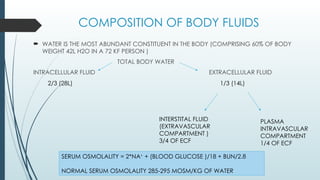
COMPOSITION OF BODY FLUIDS
 WATER IS THE MOST ABUNDANT CONSTITUENT IN THE BODY (COMPRISING 60% OF BODY
WEIGHT 42L H2O IN A 72 KF PERSON )
TOTAL BODY WATER
INTRACELLULAR FLUID EXTRACELLULAR FLUID
2/3 (28L) 1/3 (14L)
INTERSTITAL FLUID
(EXTRAVASCULAR
COMPARTMENT )
3/4 OF ECF
PLASMA
INTRAVASCULAR
COMPARTMENT
1/4 OF ECF
SERUM OSMOLALITY = 2*NA+
+ (BLOOD GLUCOSE )/18 + BUN/2.8
NORMAL SERUM OSMOLALITY 285-295 MOSM/KG OF WATER
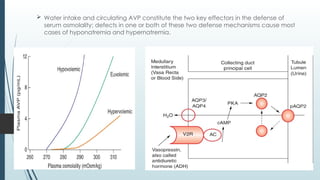
 Water intake and circulating AVP constitute the two key effectors in the defense of
serum osmolality; defects in one or both of these two defense mechanisms cause most
cases of hyponatremia and hypernatremia.
HYPONATREMIA
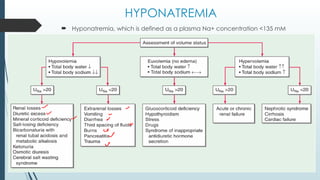
 Hyponatremia, which is defined as a plasma Na+ concentration <135 mM
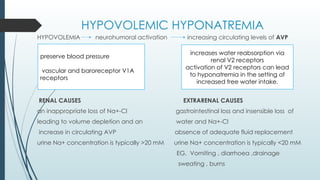
HYPOVOLEMIC HYPONATREMIA
HYPOVOLEMIA neurohumoral activation increasing circulating levels of AVP
RENAL CAUSES EXTRARENAL CAUSES
an inappropriate loss of Na+-Cl gastrointestinal loss and insensible loss of
leading to volume depletion and an water and Na+-Cl
increase in circulating AVP absence of adequate fluid replacement
urine Na+ concentration is typically >20 mM urine Na+ concentration is typically <20 mM
EG. Vomiting , diarrhoea ,drainage
sweating , burns
preserve blood pressure
vascular and baroreceptor V1A
receptors
increases water reabsorption via
renal V2 receptors
activation of V2 receptors can lead
to hyponatremia in the setting of
increased free water intake.
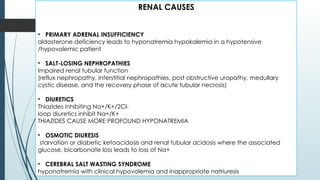
RENAL CAUSES
• PRIMARY ADRENAL INSUFFICIENCY
aldosterone deficiency leads to hyponatremia hypokalemia in a hypotensive
/hypovolemic patient
• SALT-LOSING NEPHROPATHIES
Impaired renal tubular function
(reflux nephropathy, interstitial nephropathies, post obstructive uropathy, medullary
cystic disease, and the recovery phase of acute tubular necrosis)
• DIURETICS
Thiazides inhibiting Na+/K+/2Cl-
loop diuretics inhibit Na+/K+
THIAZIDES CAUSE MORE PROFOUND HYPONATREMIA
• OSMOTIC DIURESIS
starvation or diabetic ketoacidosis and renal tubular acidosis where the associated
glucose, bicarbonate loss leads to loss of Na+
• CEREBRAL SALT WASTING SYNDROME
hyponatremia with clinical hypovolemia and inappropriate natriuresis
HYPERVOLEMIC HYPONATREMIA
Increase in total-body Na+-Cl– that is accompanied by a proportionately greater
increase in total-body water leading to a reduced plasma Na+ concentration.
URINARY SODIUM >20MM
Acute or chronic renal failure
URINARY SODIUM <10 MM
• congestive heart failure [CHF]
( cardiac dysfunction in CHF)
• cirrhosis
peripheral vasodilation in cirrhosis
• nephrotic syndrome
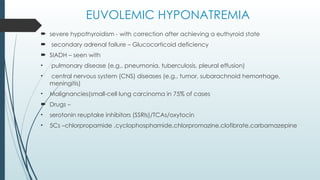
EUVOLEMIC HYPONATREMIA
 severe hypothyroidism - with correction after achieving a euthyroid state
 secondary adrenal failure – Glucocorticoid deficiency
 SIADH – seen with
• pulmonary disease (e.g., pneumonia, tuberculosis, pleural effusion)
• central nervous system (CNS) diseases (e.g., tumor, subarachnoid hemorrhage,
meningitis)
• Malignancies(small-cell lung carcinoma in 75% of cases
 Drugs –
• serotonin reuptake inhibitors (SSRIs)/TCAs/oxytocin
• 5Cs –chlorpropamide ,cyclophosphamide,chlorpromazine,clofibrate,carbamazepine
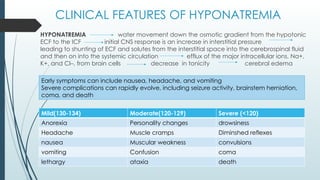
CLINICAL FEATURES OF HYPONATREMIA
HYPONATREMIA water movement down the osmotic gradient from the hypotonic
ECF to the ICF initial CNS response is an increase in interstitial pressure
leading to shunting of ECF and solutes from the interstitial space into the cerebrospinal fluid
and then on into the systemic circulation efflux of the major intracellular ions, Na+,
K+, and Cl–, from brain cells decrease in tonicity cerebral edema
Early symptoms can include nausea, headache, and vomiting
Severe complications can rapidly evolve, including seizure activity, brainstem herniation,
coma, and death
Mild(130-134) Moderate(120-129) Severe (<120)
Anorexia Personality changes drowsiness
Headache Muscle cramps Diminshed reflexes
nausea Muscular weakness convulsions
vomiting Confusion coma
lethargy ataxia death
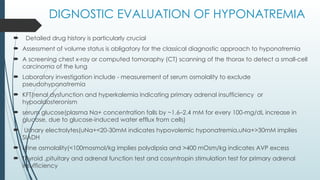
DIGNOSTIC EVALUATION OF HYPONATREMIA
 Detailed drug history is particularly crucial
 Assessment of volume status is obligatory for the classical diagnostic approach to hyponatremia
 A screening chest x-ray or computed tomoraphy (CT) scanning of the thorax to detect a small-cell
carcinoma of the lung
 Laboratory investigation include - measurement of serum osmolality to exclude
pseudohyponatremia
 KFT(renal dysfunction and hyperkalemia indicating primary adrenal insufficiency or
hypoaldosteronism
 serum glucose(plasma Na+ concentration falls by ~1.6–2.4 mM for every 100-mg/dL increase in
glucose, due to glucose-induced water efflux from cells)
 Urinary electrolytes(uNa+<20-30mM indicates hypovolemic hyponatremia,uNa+>30mM implies
SIADH
 Urine osmolality(<100mosmol/kg implies polydipsia and >400 mOsm/kg indicates AVP excess
 Thyroid ,pituitary and adrenal function test and cosyntropin stimulation test for primary adrenal
insufficiency
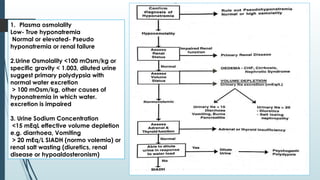
1. Plasma osmolality
Low- True hyponatremia
Normal or elevated- Pseudo
hyponatremia or renal failure
2.Urine Osmolality <100 mOsm/kg or
specific gravity < 1.003, diluted urine
suggest primary polydypsia with
normal water excretion
> 100 mOsm/kg, other causes of
hyponatremia in which water.
excretion is impaired
3. Urine Sodium Concentration
<15 mEqL effective volume depletion
e.g. diarrhoea, Vomiting
> 20 mEq/L SIADH (normo volemia) or
renal salt wasting (diuretics, renal
disease or hypoaldosteronism)
TREATMENT OF HYPONATREMIA
 First, the presence and/or severity of symptoms determine the urgency and goals of
therapy.
 Patients with euvolemic hyponatremia due to SIAD, hypothyroidism, or secondary
adrenal failure will respond to successful treatment of the underlying cause, with an
increase in plasma Na+ concentration
Hypervolemic hyponatremia
improve by therapy of the
underlying cardiomyopathy
By using (ACE) inhibition
Hypovolemic hyponatremia
I.V hydration with isotonic NS
rapid reduction in AVP
brisk water diuresis text here
euvolemic hyponatremia
Respond to fluid restriction
The urine-to plasma electrolyte
ratio (urinary [Na+] +
[K+]/plasma [Na+])
• ratio oof >1 should be more
aggressively
restricted (<500 mL/d)
ratio of ~1 should be restricted
to 500–700 mL/d
• ratio <1 should be
restricted to <1 L/d
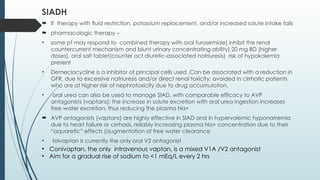
SIADH
 If therapy with fluid restriction, potassium replacement, and/or increased solute intake fails
 pharmacologic therapy –
• some pt may respond to combined therapy with oral furosemide( inhibit the renal
countercurrent mechanism and blunt urinary concentrating ability) 20 mg BD (higher
doses), oral salt tablet(counter act diuretic-associated natriuresis) risk of hypokalemia
present
• Demeclocycline is a inhibitor of principal cells used ,Can be associated with a reduction in
GFR, due to excessive natriuresis and/or direct renal toxicity; avoided in cirrhotic patients
who are at higher risk of nephrotoxicity due to drug accumulation.
• oral urea can also be used to manage SIAD, with comparable efficacy to AVP
antagonists (vaptans); the increase in solute excretion with oral urea ingestion increases
free water excretion, thus reducing the plasma Na+
 AVP antagonists (vaptans) are highly effective in SIAD and in hypervolemic hyponatremia
due to heart failure or cirrhosis, reliably increasing plasma Na+ concentration due to their
“aquaretic” effects (augmentation of free water clearance
• tolvaptan is currently the only oral V2 antagonist
• Conivaptan, the only intravenous vaptan, is a mixed V1A /V2 antagonist
• Aim for a gradual rise of sodium to <1 mEq/L every 2 hrs
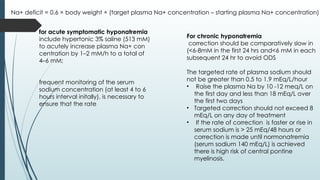
for acute symptomatic hyponatremia
include hypertonic 3% saline (513 mM)
to acutely increase plasma Na+ con
centration by 1–2 mM/h to a total of
4–6 mM;
frequent monitoring of the serum
sodium concentration (at least 4 to 6
hours interval initally), is necessary to
ensure that the rate
Na+ deficit = 0.6 × body weight × (target plasma Na+ concentration – starting plasma Na+ concentration)
For chronic hyponatremia
correction should be comparatively slow in
(<6-8mM in the first 24 hrs and<6 mM in each
subsequent 24 hr to avoid ODS
The targeted rate of plasma sodium should
not be greater than 0.5 to 1.9 mEq/L/hour
• Raise the plasma Na by 10 -12 meq/L on
the first day and less than 18 mEq/L over
the first two days
• Targeted correction should not exceed 8
mEq/L on any day of treatment
• If the rate of correction is faster or rise in
serum sodium is > 25 mEq/48 hours or
correction is made until normonatremia
(serum sodium 140 mEq/L) is achieved
there is high risk of central pontine
myelinosis.
HYPERNATREMIA
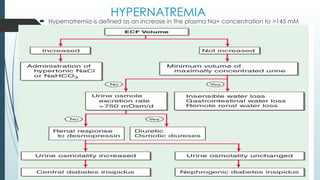
 Hypernatremia is defined as an increase in the plasma Na+ concentration to >145 mM
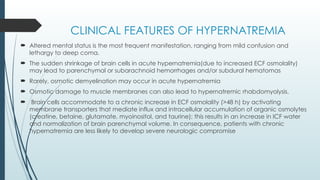
CLINICAL FEATURES OF HYPERNATREMIA
 Altered mental status is the most frequent manifestation, ranging from mild confusion and
lethargy to deep coma.
 The sudden shrinkage of brain cells in acute hypernatremia(due to increased ECF osmolality)
may lead to parenchymal or subarachnoid hemorrhages and/or subdural hematomas
 Rarely, osmotic demyelination may occur in acute hypernatremia
 Osmotic damage to muscle membranes can also lead to hypernatremic rhabdomyolysis.
 Brain cells accommodate to a chronic increase in ECF osmolality (>48 h) by activating
membrane transporters that mediate influx and intracellular accumulation of organic osmolytes
(creatine, betaine, glutamate, myoinositol, and taurine); this results in an increase in ICF water
and normalization of brain parenchymal volume. In consequence, patients with chronic
hypernatremia are less likely to develop severe neurologic compromise
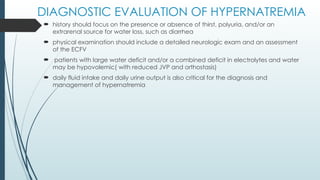
DIAGNOSTIC EVALUATION OF HYPERNATREMIA
 history should focus on the presence or absence of thirst, polyuria, and/or an
extrarenal source for water loss, such as diarrhea
 physical examination should include a detailed neurologic exam and an assessment
of the ECFV
 patients with large water deficit and/or a combined deficit in electrolytes and water
may be hypovolemic( with reduced JVP and orthostasis)
 daily fluid intake and daily urine output is also critical for the diagnosis and
management of hypernatremia
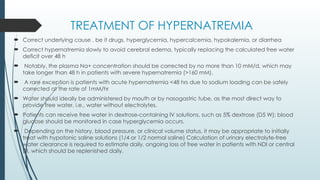
TREATMENT OF HYPERNATREMIA
 Correct underlying cause , be it drugs, hyperglycemia, hypercalcemia, hypokalemia, or diarrhea
 Correct hypernatremia slowly to avoid cerebral edema, typically replacing the calculated free water
deficit over 48 h
 Notably, the plasma Na+ concentration should be corrected by no more than 10 mM/d, which may
take longer than 48 h in patients with severe hypernatremia (>160 mM).
 A rare exception is patients with acute hypernatremia <48 hrs due to sodium loading can be safely
corrected at the rate of 1mM/hr
 Water should ideally be administered by mouth or by nasogastric tube, as the most direct way to
provide free water, i.e., water without electrolytes.
 Patients can receive free water in dextrose-containing IV solutions, such as 5% dextrose (D5 W); blood
glucose should be monitored in case hyperglycemia occurs.
 Depending on the history, blood pressure, or clinical volume status, it may be appropriate to initially
treat with hypotonic saline solutions (1/4 or 1/2 normal saline) Calculation of urinary electrolyte-free
water clearance is required to estimate daily, ongoing loss of free water in patients with NDI or central
DI, which should be replenished daily.
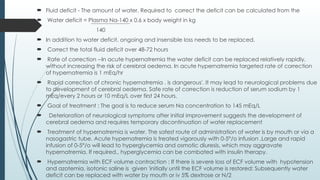
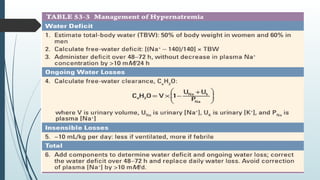
 Fluid deficit - The amount of water. Required to correct the deficit can be calculated from the
 Water deficit = Plasma Na-140 x 0.6 x body weight in kg
140
 In addition to water deficit, ongoing and insensible loss needs to be replaced.
 Correct the total fluid deficit over 48-72 hours
 Rate of correction --In acute hypernatremia the water deficit can be replaced relatively rapidly,
without increasing the risk of cerebral oedema. In acute hypernatremia targeted rate of correction
of hypernatremia is 1 mEq/hr
 Rapid correction of chronic hypernatremia . is dangerous'. It may leqd to neurological problems due
to development of cerebral oedema. Safe rate of correction is reduction of serum sodium by 1
mEq/every 2 hours or 10 mEq/L over first 24 hours.
 Goal of treatment : The goal is to reduce serum Na concentration to 145 mEq/L
 Deterioration of neurological symptoms after initial improvement suggests the development of
cerebral oedema and requires temporary discontinuation of water replacement
 Treatment of hypernatremia is water. The safest route of administration of water is by mouth or via a
nasogastric tube. Acute hypernatremia is treated vigorously with 0-5°/o infusion ,Large and rapid
infusion of 0-5°/o will lead to hyperglycemia and osmotic diuresis, which may aggravate
hypernatremia. If required., hyperglycemia can be combated with insulin therapy.
 Hypernatremia with ECF volume contraction : If there is severe loss of ECF volume with hypotension
and azotemia, isotonic saline is ·given 'initially until the ECF volume is restored: Subsequently water
deficit can be replaced with water by mouth or iv 5% dextrose or N/2
THANK YOU

sodium disorders hypo and hypernatremia.pptx

  • 1.
    HYPONATREMIA HYPERNATREMIA DISORDERS OF SERUMNA+ CONCENTRATION ARE CAUSED BY ABNORMALITIES IN WATER HOMEOSTASIS
  • 2.
    COMPOSITION OF BODYFLUIDS  WATER IS THE MOST ABUNDANT CONSTITUENT IN THE BODY (COMPRISING 60% OF BODY WEIGHT 42L H2O IN A 72 KF PERSON ) TOTAL BODY WATER INTRACELLULAR FLUID EXTRACELLULAR FLUID 2/3 (28L) 1/3 (14L) INTERSTITAL FLUID (EXTRAVASCULAR COMPARTMENT ) 3/4 OF ECF PLASMA INTRAVASCULAR COMPARTMENT 1/4 OF ECF SERUM OSMOLALITY = 2*NA+ + (BLOOD GLUCOSE )/18 + BUN/2.8 NORMAL SERUM OSMOLALITY 285-295 MOSM/KG OF WATER
  • 3.
     Water intakeand circulating AVP constitute the two key effectors in the defense of serum osmolality; defects in one or both of these two defense mechanisms cause most cases of hyponatremia and hypernatremia.
  • 4.
    HYPONATREMIA  Hyponatremia, whichis defined as a plasma Na+ concentration <135 mM
  • 5.
    HYPOVOLEMIC HYPONATREMIA HYPOVOLEMIA neurohumoralactivation increasing circulating levels of AVP RENAL CAUSES EXTRARENAL CAUSES an inappropriate loss of Na+-Cl gastrointestinal loss and insensible loss of leading to volume depletion and an water and Na+-Cl increase in circulating AVP absence of adequate fluid replacement urine Na+ concentration is typically >20 mM urine Na+ concentration is typically <20 mM EG. Vomiting , diarrhoea ,drainage sweating , burns preserve blood pressure vascular and baroreceptor V1A receptors increases water reabsorption via renal V2 receptors activation of V2 receptors can lead to hyponatremia in the setting of increased free water intake.
  • 6.
    RENAL CAUSES • PRIMARYADRENAL INSUFFICIENCY aldosterone deficiency leads to hyponatremia hypokalemia in a hypotensive /hypovolemic patient • SALT-LOSING NEPHROPATHIES Impaired renal tubular function (reflux nephropathy, interstitial nephropathies, post obstructive uropathy, medullary cystic disease, and the recovery phase of acute tubular necrosis) • DIURETICS Thiazides inhibiting Na+/K+/2Cl- loop diuretics inhibit Na+/K+ THIAZIDES CAUSE MORE PROFOUND HYPONATREMIA • OSMOTIC DIURESIS starvation or diabetic ketoacidosis and renal tubular acidosis where the associated glucose, bicarbonate loss leads to loss of Na+ • CEREBRAL SALT WASTING SYNDROME hyponatremia with clinical hypovolemia and inappropriate natriuresis
  • 7.
    HYPERVOLEMIC HYPONATREMIA Increase intotal-body Na+-Cl– that is accompanied by a proportionately greater increase in total-body water leading to a reduced plasma Na+ concentration. URINARY SODIUM >20MM Acute or chronic renal failure URINARY SODIUM <10 MM • congestive heart failure [CHF] ( cardiac dysfunction in CHF) • cirrhosis peripheral vasodilation in cirrhosis • nephrotic syndrome
  • 8.
    EUVOLEMIC HYPONATREMIA  severehypothyroidism - with correction after achieving a euthyroid state  secondary adrenal failure – Glucocorticoid deficiency  SIADH – seen with • pulmonary disease (e.g., pneumonia, tuberculosis, pleural effusion) • central nervous system (CNS) diseases (e.g., tumor, subarachnoid hemorrhage, meningitis) • Malignancies(small-cell lung carcinoma in 75% of cases  Drugs – • serotonin reuptake inhibitors (SSRIs)/TCAs/oxytocin • 5Cs –chlorpropamide ,cyclophosphamide,chlorpromazine,clofibrate,carbamazepine
  • 9.
    CLINICAL FEATURES OFHYPONATREMIA HYPONATREMIA water movement down the osmotic gradient from the hypotonic ECF to the ICF initial CNS response is an increase in interstitial pressure leading to shunting of ECF and solutes from the interstitial space into the cerebrospinal fluid and then on into the systemic circulation efflux of the major intracellular ions, Na+, K+, and Cl–, from brain cells decrease in tonicity cerebral edema Early symptoms can include nausea, headache, and vomiting Severe complications can rapidly evolve, including seizure activity, brainstem herniation, coma, and death Mild(130-134) Moderate(120-129) Severe (<120) Anorexia Personality changes drowsiness Headache Muscle cramps Diminshed reflexes nausea Muscular weakness convulsions vomiting Confusion coma lethargy ataxia death
  • 10.
    DIGNOSTIC EVALUATION OFHYPONATREMIA  Detailed drug history is particularly crucial  Assessment of volume status is obligatory for the classical diagnostic approach to hyponatremia  A screening chest x-ray or computed tomoraphy (CT) scanning of the thorax to detect a small-cell carcinoma of the lung  Laboratory investigation include - measurement of serum osmolality to exclude pseudohyponatremia  KFT(renal dysfunction and hyperkalemia indicating primary adrenal insufficiency or hypoaldosteronism  serum glucose(plasma Na+ concentration falls by ~1.6–2.4 mM for every 100-mg/dL increase in glucose, due to glucose-induced water efflux from cells)  Urinary electrolytes(uNa+<20-30mM indicates hypovolemic hyponatremia,uNa+>30mM implies SIADH  Urine osmolality(<100mosmol/kg implies polydipsia and >400 mOsm/kg indicates AVP excess  Thyroid ,pituitary and adrenal function test and cosyntropin stimulation test for primary adrenal insufficiency
  • 11.
    1. Plasma osmolality Low-True hyponatremia Normal or elevated- Pseudo hyponatremia or renal failure 2.Urine Osmolality <100 mOsm/kg or specific gravity < 1.003, diluted urine suggest primary polydypsia with normal water excretion > 100 mOsm/kg, other causes of hyponatremia in which water. excretion is impaired 3. Urine Sodium Concentration <15 mEqL effective volume depletion e.g. diarrhoea, Vomiting > 20 mEq/L SIADH (normo volemia) or renal salt wasting (diuretics, renal disease or hypoaldosteronism)
  • 12.
    TREATMENT OF HYPONATREMIA First, the presence and/or severity of symptoms determine the urgency and goals of therapy.  Patients with euvolemic hyponatremia due to SIAD, hypothyroidism, or secondary adrenal failure will respond to successful treatment of the underlying cause, with an increase in plasma Na+ concentration Hypervolemic hyponatremia improve by therapy of the underlying cardiomyopathy By using (ACE) inhibition Hypovolemic hyponatremia I.V hydration with isotonic NS rapid reduction in AVP brisk water diuresis text here euvolemic hyponatremia Respond to fluid restriction The urine-to plasma electrolyte ratio (urinary [Na+] + [K+]/plasma [Na+]) • ratio oof >1 should be more aggressively restricted (<500 mL/d) ratio of ~1 should be restricted to 500–700 mL/d • ratio <1 should be restricted to <1 L/d
  • 13.
    SIADH  If therapywith fluid restriction, potassium replacement, and/or increased solute intake fails  pharmacologic therapy – • some pt may respond to combined therapy with oral furosemide( inhibit the renal countercurrent mechanism and blunt urinary concentrating ability) 20 mg BD (higher doses), oral salt tablet(counter act diuretic-associated natriuresis) risk of hypokalemia present • Demeclocycline is a inhibitor of principal cells used ,Can be associated with a reduction in GFR, due to excessive natriuresis and/or direct renal toxicity; avoided in cirrhotic patients who are at higher risk of nephrotoxicity due to drug accumulation. • oral urea can also be used to manage SIAD, with comparable efficacy to AVP antagonists (vaptans); the increase in solute excretion with oral urea ingestion increases free water excretion, thus reducing the plasma Na+  AVP antagonists (vaptans) are highly effective in SIAD and in hypervolemic hyponatremia due to heart failure or cirrhosis, reliably increasing plasma Na+ concentration due to their “aquaretic” effects (augmentation of free water clearance • tolvaptan is currently the only oral V2 antagonist • Conivaptan, the only intravenous vaptan, is a mixed V1A /V2 antagonist • Aim for a gradual rise of sodium to <1 mEq/L every 2 hrs
  • 14.
    for acute symptomatichyponatremia include hypertonic 3% saline (513 mM) to acutely increase plasma Na+ con centration by 1–2 mM/h to a total of 4–6 mM; frequent monitoring of the serum sodium concentration (at least 4 to 6 hours interval initally), is necessary to ensure that the rate Na+ deficit = 0.6 × body weight × (target plasma Na+ concentration – starting plasma Na+ concentration) For chronic hyponatremia correction should be comparatively slow in (<6-8mM in the first 24 hrs and<6 mM in each subsequent 24 hr to avoid ODS The targeted rate of plasma sodium should not be greater than 0.5 to 1.9 mEq/L/hour • Raise the plasma Na by 10 -12 meq/L on the first day and less than 18 mEq/L over the first two days • Targeted correction should not exceed 8 mEq/L on any day of treatment • If the rate of correction is faster or rise in serum sodium is > 25 mEq/48 hours or correction is made until normonatremia (serum sodium 140 mEq/L) is achieved there is high risk of central pontine myelinosis.
  • 15.
    HYPERNATREMIA  Hypernatremia isdefined as an increase in the plasma Na+ concentration to >145 mM
  • 16.
    CLINICAL FEATURES OFHYPERNATREMIA  Altered mental status is the most frequent manifestation, ranging from mild confusion and lethargy to deep coma.  The sudden shrinkage of brain cells in acute hypernatremia(due to increased ECF osmolality) may lead to parenchymal or subarachnoid hemorrhages and/or subdural hematomas  Rarely, osmotic demyelination may occur in acute hypernatremia  Osmotic damage to muscle membranes can also lead to hypernatremic rhabdomyolysis.  Brain cells accommodate to a chronic increase in ECF osmolality (>48 h) by activating membrane transporters that mediate influx and intracellular accumulation of organic osmolytes (creatine, betaine, glutamate, myoinositol, and taurine); this results in an increase in ICF water and normalization of brain parenchymal volume. In consequence, patients with chronic hypernatremia are less likely to develop severe neurologic compromise
  • 17.
    DIAGNOSTIC EVALUATION OFHYPERNATREMIA  history should focus on the presence or absence of thirst, polyuria, and/or an extrarenal source for water loss, such as diarrhea  physical examination should include a detailed neurologic exam and an assessment of the ECFV  patients with large water deficit and/or a combined deficit in electrolytes and water may be hypovolemic( with reduced JVP and orthostasis)  daily fluid intake and daily urine output is also critical for the diagnosis and management of hypernatremia
  • 18.
    TREATMENT OF HYPERNATREMIA Correct underlying cause , be it drugs, hyperglycemia, hypercalcemia, hypokalemia, or diarrhea  Correct hypernatremia slowly to avoid cerebral edema, typically replacing the calculated free water deficit over 48 h  Notably, the plasma Na+ concentration should be corrected by no more than 10 mM/d, which may take longer than 48 h in patients with severe hypernatremia (>160 mM).  A rare exception is patients with acute hypernatremia <48 hrs due to sodium loading can be safely corrected at the rate of 1mM/hr  Water should ideally be administered by mouth or by nasogastric tube, as the most direct way to provide free water, i.e., water without electrolytes.  Patients can receive free water in dextrose-containing IV solutions, such as 5% dextrose (D5 W); blood glucose should be monitored in case hyperglycemia occurs.  Depending on the history, blood pressure, or clinical volume status, it may be appropriate to initially treat with hypotonic saline solutions (1/4 or 1/2 normal saline) Calculation of urinary electrolyte-free water clearance is required to estimate daily, ongoing loss of free water in patients with NDI or central DI, which should be replenished daily.
  • 19.
     Fluid deficit- The amount of water. Required to correct the deficit can be calculated from the  Water deficit = Plasma Na-140 x 0.6 x body weight in kg 140  In addition to water deficit, ongoing and insensible loss needs to be replaced.  Correct the total fluid deficit over 48-72 hours  Rate of correction --In acute hypernatremia the water deficit can be replaced relatively rapidly, without increasing the risk of cerebral oedema. In acute hypernatremia targeted rate of correction of hypernatremia is 1 mEq/hr  Rapid correction of chronic hypernatremia . is dangerous'. It may leqd to neurological problems due to development of cerebral oedema. Safe rate of correction is reduction of serum sodium by 1 mEq/every 2 hours or 10 mEq/L over first 24 hours.  Goal of treatment : The goal is to reduce serum Na concentration to 145 mEq/L  Deterioration of neurological symptoms after initial improvement suggests the development of cerebral oedema and requires temporary discontinuation of water replacement  Treatment of hypernatremia is water. The safest route of administration of water is by mouth or via a nasogastric tube. Acute hypernatremia is treated vigorously with 0-5°/o infusion ,Large and rapid infusion of 0-5°/o will lead to hyperglycemia and osmotic diuresis, which may aggravate hypernatremia. If required., hyperglycemia can be combated with insulin therapy.  Hypernatremia with ECF volume contraction : If there is severe loss of ECF volume with hypotension and azotemia, isotonic saline is ·given 'initially until the ECF volume is restored: Subsequently water deficit can be replaced with water by mouth or iv 5% dextrose or N/2
  • 21.