HYPERMETROPIA
Medicoach International Academy
Hypermetropia
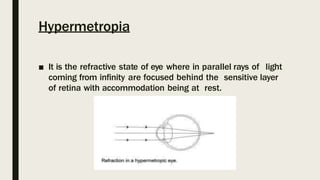
■ It is the refractive state of eye where in parallel rays of light
coming from infinity are focused behind the sensitive layer
of retina with accommodation being at rest.
Hypermetropia
Based on Anatomical Features
■ Axial, in which the axial length is too short for the refractive
power of the eye.
■ Refractive, in which the refractive system is underpowered
with respect to the axial length of the eye.
■ Further divided refractive hyperopia into:
■ Index hyperopia: in which one or more of the refractive indices of the
media are anomalous.
■ Curvature hyperopia: in which the increased radius of curvature of one or
more refractive surfaces produces a decrease in refractive power.
■ Anterior chamber hyperopia: in which decreased anterior chamber depth
decreases the refractive power of the eye.
■ Additional anatomical factors
1.absence of a refractive element (e.g.. Aphakia)
2.the displacement of a refractive element (e.g., lateral displacement of the
crystalline lens, producing partial aphakia).p
Based on degree
■ Low (0.00 to +3.00 D)
■ Medium (+3.12 to +5.00 D)
■ High (>+5.00 D)
Physiological & pathological
■ Simple
■ Pathological
■ Functional
Simple Hypermetropia
Commonest form
Results from normal biological variations in the
development of eyeball
Include axial and curvatural HM
May be hereditary
Pathological Hypermetropia
■ Anomalies lie outside the limits of biological variation
■ Acquired hypermetropia
■ Decrease curvature of outer lens fibers in old age
■ Cortical sclerosis –
■ Positional hypermetropia
■ Aphakia
■ Consecutive hypermetropia
Functional Hypermetropia
■ Results from paralysis of accommodation
■ Seen in patients with 3rd nerve paralysis &
internal
ophthalmoplegia
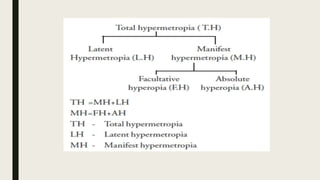
Total Hypermetropia
■ The sum of latent and manifest hyperopia. Manifest hyperopia may be
further divided into facultative and absolute hyperopia
■
■ Zero accommodation is exerted. (revealed only by cycloplegic
refraction)
Manifest Hypermetropia
■ Measured in the resting state of accommodation
■ Fount by normal non cycloplegic refraction
■ Corrected by the maximum plus lens that provides
the optimum distance visual acuity
Two types of manifest Hypermetropia.They are:-
■ Facultative hyperopia-Hyperopia that is overcome by active
axertion of accommodation but can be revealed by
noncycloplegic refraction.
■ Absolute hyperopia-Hyperopia that cannot be compensated
by active exertion of accommodation, that is the portion of
the refractive error that exceeds the amplitude of
accommodation
Latent Hypermetropia
■ That is masked by involuntary force of
accommodation which can be compensated by
accommodation and is not revealed by
noncycloplegic refraction
■ . A cycloplegic agent is necessary to uncover the full
amount.
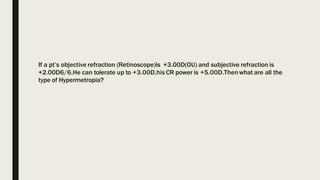
If a pt’s objective refraction (Retinoscope)is +3.00D(OU) and subjective refraction is
+2.00D6/6.He can tolerate up to +3.00D,his CR power is +5.00D.Thenwhat are all the
type of Hypermetropia?
Young children(<6 or 7yrs)
Some degreeIf symptoms of eye-strain are marked,we correct
as much of the total hypermetropia as possible,trying as far
as we can to relieve the accommodation
When there is spasm of accommodation we correct
the whole of the error
Some patients with hypermetropia do not initially tolerate
the full correction indicated by manifest refraction so we
under correct them
Exophoria hyperopia should be under correct by 1to 2D
Adults
If symptoms of eye-strain are marked,we correct as much of the
total hypermetropia as possible, trying as far as we can to relieve
the accommodation
When there is spasm of accommodation we correct the
whole of the error
Some patients with hypermetropia do not initially tolerate the
full correction indicated by manifest refraction so we under
correct them
Exophoria hyperopia should be under correct by 1to 2D
Patients with absolute hypermetropia are more likely to
accept nearly the full correction because they typically
experience immediate improvement in visual acuity
In pathological hypermetropia the underlying
cause rather than the hypermetropia is chief
concern
Mode Of Treatment
■ Spectacle
■ Contact Lens
■ Surgery
Spectacle
■ Basic principle
■ Prescribe convex lenses (Plus lenses) so that rays are brought
to focus on the retina
■ Advantages
Comfortable
Easier method
Less expensive
Safe idea
Contact Lens
■ Cosmetically good
■ Increased field ofview
■ Less magnification
■ Elimination of aberrations &prismatic effect
Refractive Surgery
Refractive surgery is not as effective as in myopia
■ TYPES
Hexagonal keratometry
Laser thermal keratoplasty
Photo refractivekeratectomy
LASIK
Phakic IOL and clear lens extraction
THANK YOU

HYPERMETROPIA .pdf

  • 1.
  • 2.
    Hypermetropia ■ It isthe refractive state of eye where in parallel rays of light coming from infinity are focused behind the sensitive layer of retina with accommodation being at rest.
  • 3.
  • 4.
    Based on AnatomicalFeatures ■ Axial, in which the axial length is too short for the refractive power of the eye. ■ Refractive, in which the refractive system is underpowered with respect to the axial length of the eye.
  • 5.
    ■ Further dividedrefractive hyperopia into: ■ Index hyperopia: in which one or more of the refractive indices of the media are anomalous. ■ Curvature hyperopia: in which the increased radius of curvature of one or more refractive surfaces produces a decrease in refractive power. ■ Anterior chamber hyperopia: in which decreased anterior chamber depth decreases the refractive power of the eye. ■ Additional anatomical factors 1.absence of a refractive element (e.g.. Aphakia) 2.the displacement of a refractive element (e.g., lateral displacement of the crystalline lens, producing partial aphakia).p
  • 6.
    Based on degree ■Low (0.00 to +3.00 D) ■ Medium (+3.12 to +5.00 D) ■ High (>+5.00 D)
  • 7.
    Physiological & pathological ■Simple ■ Pathological ■ Functional
  • 8.
    Simple Hypermetropia Commonest form Resultsfrom normal biological variations in the development of eyeball Include axial and curvatural HM May be hereditary
  • 9.
    Pathological Hypermetropia ■ Anomalieslie outside the limits of biological variation ■ Acquired hypermetropia ■ Decrease curvature of outer lens fibers in old age ■ Cortical sclerosis – ■ Positional hypermetropia ■ Aphakia ■ Consecutive hypermetropia
  • 10.
    Functional Hypermetropia ■ Resultsfrom paralysis of accommodation ■ Seen in patients with 3rd nerve paralysis & internal ophthalmoplegia
  • 11.
    Total Hypermetropia ■ Thesum of latent and manifest hyperopia. Manifest hyperopia may be further divided into facultative and absolute hyperopia ■ ■ Zero accommodation is exerted. (revealed only by cycloplegic refraction)
  • 12.
    Manifest Hypermetropia ■ Measuredin the resting state of accommodation ■ Fount by normal non cycloplegic refraction ■ Corrected by the maximum plus lens that provides the optimum distance visual acuity
  • 13.
    Two types ofmanifest Hypermetropia.They are:- ■ Facultative hyperopia-Hyperopia that is overcome by active axertion of accommodation but can be revealed by noncycloplegic refraction. ■ Absolute hyperopia-Hyperopia that cannot be compensated by active exertion of accommodation, that is the portion of the refractive error that exceeds the amplitude of accommodation
  • 14.
    Latent Hypermetropia ■ Thatis masked by involuntary force of accommodation which can be compensated by accommodation and is not revealed by noncycloplegic refraction ■ . A cycloplegic agent is necessary to uncover the full amount.
  • 16.
    If a pt’sobjective refraction (Retinoscope)is +3.00D(OU) and subjective refraction is +2.00D6/6.He can tolerate up to +3.00D,his CR power is +5.00D.Thenwhat are all the type of Hypermetropia?
  • 17.
    Young children(<6 or7yrs) Some degreeIf symptoms of eye-strain are marked,we correct as much of the total hypermetropia as possible,trying as far as we can to relieve the accommodation When there is spasm of accommodation we correct the whole of the error Some patients with hypermetropia do not initially tolerate the full correction indicated by manifest refraction so we under correct them Exophoria hyperopia should be under correct by 1to 2D
  • 18.
    Adults If symptoms ofeye-strain are marked,we correct as much of the total hypermetropia as possible, trying as far as we can to relieve the accommodation When there is spasm of accommodation we correct the whole of the error Some patients with hypermetropia do not initially tolerate the full correction indicated by manifest refraction so we under correct them Exophoria hyperopia should be under correct by 1to 2D
  • 19.
    Patients with absolutehypermetropia are more likely to accept nearly the full correction because they typically experience immediate improvement in visual acuity In pathological hypermetropia the underlying cause rather than the hypermetropia is chief concern
  • 20.
    Mode Of Treatment ■Spectacle ■ Contact Lens ■ Surgery
  • 21.
    Spectacle ■ Basic principle ■Prescribe convex lenses (Plus lenses) so that rays are brought to focus on the retina ■ Advantages Comfortable Easier method Less expensive Safe idea
  • 22.
    Contact Lens ■ Cosmeticallygood ■ Increased field ofview ■ Less magnification ■ Elimination of aberrations &prismatic effect
  • 23.
    Refractive Surgery Refractive surgeryis not as effective as in myopia ■ TYPES Hexagonal keratometry Laser thermal keratoplasty Photo refractivekeratectomy LASIK Phakic IOL and clear lens extraction
  • 24.