MAHARANA PRATAP COLLEGE OF 
TECHNOLOGY 
Hyper-threading 
B.E.(508) 
Submitted To :- Sarika Tyagi Submitted By:- Anmol 
Purohit 
Depart. :- C.S. Roll No. :- 0903CS121019
TO BE TACKLED 
• Introduction 
• Hyper-Threading Concepts 
• How Hyper Threading Works 
• Implementing Hyper-threading 
• Hyper-Threading Architecture 
• Applications 
• Advantages/Disadvantages 
• Conclusion 
• References
INTRODUCTION 
• Hyper-Threading Technology brings the simultaneous multi-threading 
approach to the Intel architecture that allows processors to work more 
efficiently. 
• This new technology enables the processor to execute two series, or 
threads, of instructions at the same time, thereby 
improving performance and system responsiveness while delivering 
performance headroom for the future. 
• Hyper-Threading Technology provides thread-level-parallelism (TLP) on 
each processor resulting in increased utilization of processor and 
execution resources. 
• Hyper-Threading Technology provides two logical processors in a single 
processor package.
HYPER-THREADING CONCEPT 
• At each point of time only a part of processor resources is 
used for execution of the program code. 
• Unused resources can also be loaded, for example, with 
parallel execution of another thread/application. 
• Extremely useful in desktop and server applications where 
many threads are used. 
4
HOW HYPER THREADING WORKS 
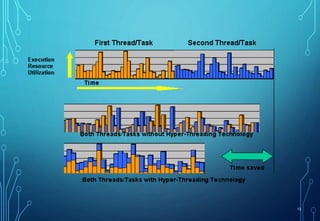
• A single processor supporting Hyper-Threading Technology presents 
itself to modern operating systems and applications as two virtual 
processors. The processor can work on two sets of tasks 
simultaneously, use resources that otherwise would sit idle, and get 
more work done in the same amount of time. 
• HT Technology takes advantage of the multithreading capability that's 
built in to Windows XP and many advanced applications. Multithreaded 
software divides its workloads into processes and threads that can be 
independently scheduled and dispatched. In a multiprocessor system, 
those threads execute on different processors.
IMPLEMENTING HYPER-THREADING 
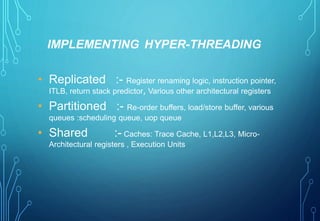
• Replicated :- Register renaming logic, instruction pointer, 
ITLB, return stack predictor, Various other architectural registers 
• Partitioned :- Re-order buffers, load/store buffer, various 
queues :scheduling queue, uop queue 
• Shared :- Caches: Trace Cache, L1,L2,L3, Micro- 
Architectural registers , Execution Units
REPLICATED RESOURCES 
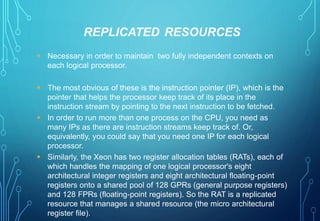
 Necessary in order to maintain two fully independent contexts on 
each logical processor. 
 The most obvious of these is the instruction pointer (IP), which is the 
pointer that helps the processor keep track of its place in the 
instruction stream by pointing to the next instruction to be fetched. 
 In order to run more than one process on the CPU, you need as 
many IPs as there are instruction streams keep track of. Or, 
equivalently, you could say that you need one IP for each logical 
processor. 
 Similarly, the Xeon has two register allocation tables (RATs), each of 
which handles the mapping of one logical processor's eight 
architectural integer registers and eight architectural floating-point 
registers onto a shared pool of 128 GPRs (general purpose registers) 
and 128 FPRs (floating-point registers). So the RAT is a replicated 
resource that manages a shared resource (the micro architectural 
register file).
PARTITIONED RESOURCES 
 Statically partitioned queue 
 Each queue is split in half 
 It’s resources solely dedicated 
to use of one logical processor
PARTITIONED RESOURCES 
 Dynamically partitioned queue 
 In a scheduling queue with 12 
entries, instead of assigning 
entries 0 through 5 to logical 
processor 0 and entries 6 
through 11 to logical processor 
1, the queue allows any logical 
processor to use any entry but 
it places a limit on the number 
of entries that any one logical 
processor can use. So in the 
case of a 12-entry scheduling 
queue, each logical processor 
can use no more than six of the 
entries.
SHARED RESOURCES 
• Shared resources are at the heart of hyper-threading; they're what 
makes the technique worthwhile. 
• The more resources that can be shared between logical processors, 
the more efficient hyper-threading can be at squeezing the maximum 
amount of computing power out of the minimum amount of die space. 
• A class of shared resources consists of the execution units: the 
integer units, floating-point units, and load-store unit. 
• Hyper-threading's greatest strength--shared resources--also turns out 
to be its greatest weakness, as well. 
• Problems arise when one thread monopolizes a crucial resource. The 
problem here is the exact same problem that we discussed with 
cooperative multi-tasking: one resource hog can ruin things for 
everyone else. Like a cooperative multitasking OS, the Xeon for the 
most part depends on each thread to play nicely and to refrain from 
monopolizing any of its shared resources.
HYPER-THREADING 
ARCHITECTURE 
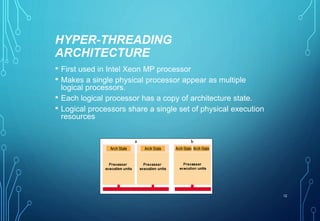
• First used in Intel Xeon MP processor 
• Makes a single physical processor appear as multiple 
logical processors. 
• Each logical processor has a copy of architecture state. 
• Logical processors share a single set of physical execution 
resources 
12
13
APPLICATION 
• The Intel Xeon processor with Hyper-Threading Technology is well-suited 
for servers and high-end scientific computing workstations, as 
well as demanding applications such as graphics, multimedia, and 
gaming. 
• Business Benefits
BUSINESS BENEFITS OF HYPER-THREADING 
TECHNOLOGY 
• Higher transaction rates for e-Businesses 
• Improved reaction and response times for end-users and 
customers. 
• Increased number of users that a server system can 
support 
• Handle increased server workloads 
• Compatibility with existing server applications and 
operating systems
ADVANTAGES 
• No performance loss if only one thread is active. Increased 
performance with multiple threads 
• Improved overall system performance 
• Increased number of users a platform can support 
• Improved throughput, because tasks run on separate threads 
• Improved reaction and response time 
• Increased number of transactions that can be executed 
16
DISADVANTAGES 
• To take advantage of hyper-threading performance, serial 
execution can not be used. 
• Threads are non-deterministic and involve extra design 
• Threads have increased overhead 
• Shared resource conflicts 
17
CONCLUSION 
• Intel’s Hyper-Threading Technology brings the concept of simultaneous 
multi-threading to the Intel Architecture. 
• It will become increasingly important going forward as it adds a new 
technique for obtaining additional performance for lower transistor and 
power costs. 
• The goal was to implement the technology at minimum cost while 
ensuring forward progress on logical processors, even if the other is 
stalled, and to deliver full performance even when there is only one 
active logical processor.
REFERENCES 
• Intel Technology Journal. Volume 6 Issue 1. February 14, 
2002 
• Intel Hyper-Threading Technology Review 
• www.digit-life. 
com/articles/pentium4xeonhyperthreading/ 
• HyperThreading Threads Its Way into Application 
• http://www.tomshardware.com/cpu/20021227/ 
• Introduction to Multithreading, Superthreading and 
Hyperthreading 
• http://www.arstechnica.com/paedia/h/hyperthreading/h 
yperthreading-1.html 
19
Thank you

Hyper threading

  • 1.
    MAHARANA PRATAP COLLEGEOF TECHNOLOGY Hyper-threading B.E.(508) Submitted To :- Sarika Tyagi Submitted By:- Anmol Purohit Depart. :- C.S. Roll No. :- 0903CS121019
  • 2.
    TO BE TACKLED • Introduction • Hyper-Threading Concepts • How Hyper Threading Works • Implementing Hyper-threading • Hyper-Threading Architecture • Applications • Advantages/Disadvantages • Conclusion • References
  • 3.
    INTRODUCTION • Hyper-ThreadingTechnology brings the simultaneous multi-threading approach to the Intel architecture that allows processors to work more efficiently. • This new technology enables the processor to execute two series, or threads, of instructions at the same time, thereby improving performance and system responsiveness while delivering performance headroom for the future. • Hyper-Threading Technology provides thread-level-parallelism (TLP) on each processor resulting in increased utilization of processor and execution resources. • Hyper-Threading Technology provides two logical processors in a single processor package.
  • 4.
    HYPER-THREADING CONCEPT •At each point of time only a part of processor resources is used for execution of the program code. • Unused resources can also be loaded, for example, with parallel execution of another thread/application. • Extremely useful in desktop and server applications where many threads are used. 4
  • 5.
    HOW HYPER THREADINGWORKS • A single processor supporting Hyper-Threading Technology presents itself to modern operating systems and applications as two virtual processors. The processor can work on two sets of tasks simultaneously, use resources that otherwise would sit idle, and get more work done in the same amount of time. • HT Technology takes advantage of the multithreading capability that's built in to Windows XP and many advanced applications. Multithreaded software divides its workloads into processes and threads that can be independently scheduled and dispatched. In a multiprocessor system, those threads execute on different processors.
  • 7.
    IMPLEMENTING HYPER-THREADING •Replicated :- Register renaming logic, instruction pointer, ITLB, return stack predictor, Various other architectural registers • Partitioned :- Re-order buffers, load/store buffer, various queues :scheduling queue, uop queue • Shared :- Caches: Trace Cache, L1,L2,L3, Micro- Architectural registers , Execution Units
  • 8.
    REPLICATED RESOURCES Necessary in order to maintain two fully independent contexts on each logical processor.  The most obvious of these is the instruction pointer (IP), which is the pointer that helps the processor keep track of its place in the instruction stream by pointing to the next instruction to be fetched.  In order to run more than one process on the CPU, you need as many IPs as there are instruction streams keep track of. Or, equivalently, you could say that you need one IP for each logical processor.  Similarly, the Xeon has two register allocation tables (RATs), each of which handles the mapping of one logical processor's eight architectural integer registers and eight architectural floating-point registers onto a shared pool of 128 GPRs (general purpose registers) and 128 FPRs (floating-point registers). So the RAT is a replicated resource that manages a shared resource (the micro architectural register file).
  • 9.
    PARTITIONED RESOURCES Statically partitioned queue  Each queue is split in half  It’s resources solely dedicated to use of one logical processor
  • 10.
    PARTITIONED RESOURCES Dynamically partitioned queue  In a scheduling queue with 12 entries, instead of assigning entries 0 through 5 to logical processor 0 and entries 6 through 11 to logical processor 1, the queue allows any logical processor to use any entry but it places a limit on the number of entries that any one logical processor can use. So in the case of a 12-entry scheduling queue, each logical processor can use no more than six of the entries.
  • 11.
    SHARED RESOURCES •Shared resources are at the heart of hyper-threading; they're what makes the technique worthwhile. • The more resources that can be shared between logical processors, the more efficient hyper-threading can be at squeezing the maximum amount of computing power out of the minimum amount of die space. • A class of shared resources consists of the execution units: the integer units, floating-point units, and load-store unit. • Hyper-threading's greatest strength--shared resources--also turns out to be its greatest weakness, as well. • Problems arise when one thread monopolizes a crucial resource. The problem here is the exact same problem that we discussed with cooperative multi-tasking: one resource hog can ruin things for everyone else. Like a cooperative multitasking OS, the Xeon for the most part depends on each thread to play nicely and to refrain from monopolizing any of its shared resources.
  • 12.
    HYPER-THREADING ARCHITECTURE •First used in Intel Xeon MP processor • Makes a single physical processor appear as multiple logical processors. • Each logical processor has a copy of architecture state. • Logical processors share a single set of physical execution resources 12
  • 13.
  • 14.
    APPLICATION • TheIntel Xeon processor with Hyper-Threading Technology is well-suited for servers and high-end scientific computing workstations, as well as demanding applications such as graphics, multimedia, and gaming. • Business Benefits
  • 15.
    BUSINESS BENEFITS OFHYPER-THREADING TECHNOLOGY • Higher transaction rates for e-Businesses • Improved reaction and response times for end-users and customers. • Increased number of users that a server system can support • Handle increased server workloads • Compatibility with existing server applications and operating systems
  • 16.
    ADVANTAGES • Noperformance loss if only one thread is active. Increased performance with multiple threads • Improved overall system performance • Increased number of users a platform can support • Improved throughput, because tasks run on separate threads • Improved reaction and response time • Increased number of transactions that can be executed 16
  • 17.
    DISADVANTAGES • Totake advantage of hyper-threading performance, serial execution can not be used. • Threads are non-deterministic and involve extra design • Threads have increased overhead • Shared resource conflicts 17
  • 18.
    CONCLUSION • Intel’sHyper-Threading Technology brings the concept of simultaneous multi-threading to the Intel Architecture. • It will become increasingly important going forward as it adds a new technique for obtaining additional performance for lower transistor and power costs. • The goal was to implement the technology at minimum cost while ensuring forward progress on logical processors, even if the other is stalled, and to deliver full performance even when there is only one active logical processor.
  • 19.
    REFERENCES • IntelTechnology Journal. Volume 6 Issue 1. February 14, 2002 • Intel Hyper-Threading Technology Review • www.digit-life. com/articles/pentium4xeonhyperthreading/ • HyperThreading Threads Its Way into Application • http://www.tomshardware.com/cpu/20021227/ • Introduction to Multithreading, Superthreading and Hyperthreading • http://www.arstechnica.com/paedia/h/hyperthreading/h yperthreading-1.html 19
  • 20.