HAWK EYE TECHNOLOGY
– An overview
By-
Ms. Ankita R. Khadatkar
6-ETB
OUTLINE
1. Introduction
2. History
3. How It Works
4. Visual representation
5. Accuracy
6. Applications
7. Further Developments
8. What Players Speak
9. References
10. Conclusion
INTRODUCTION
It is a vision processing system that uses the images from
five or six cameras placed around and high above the court
to triangulate the ball's flight and build up a 3D (picture)
of it
The cameras record the action at 60 frames a
second about double the speed of standard
commercial TV.
 Hawk-Eye picks up the exact spot where the ball
pitches. Hawk-Eye also measures the speed of the
ball from the bowler's hand
HISTORY
It was developed by engineers at Roke Manor Research
Limited in 2001; the patent being held by Paul Hawkins
and David Sherry
It first hit our screens in 2001 and has been helping
to unravel the mysteries of the lbw decision ever since
PRINCIPLE
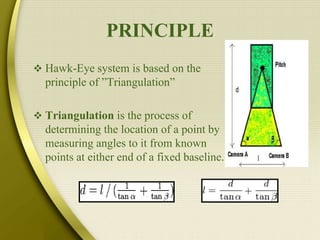
 Hawk-Eye system is based on the
principle of ”Triangulation”
 Triangulation is the process of
determining the location of a point by
measuring angles to it from known
points at either end of a fixed baseline.
WORKING
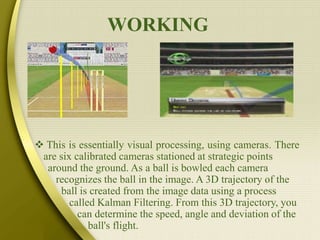
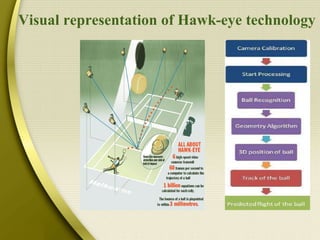
 This is essentially visual processing, using cameras. There
are six calibrated cameras stationed at strategic points
around the ground. As a ball is bowled each camera
recognizes the ball in the image. A 3D trajectory of the
ball is created from the image data using a process
called Kalman Filtering. From this 3D trajectory, you
can determine the speed, angle and deviation of the
ball's flight.
Visual representation of Hawk-eye technology
APPLICATIONS
1.It finds its application in different games like
cricket, tennis and snooker.
2.It has also been implemented in computer
games to give reality to the game.
3.It is basically used in cricket for giving L.B.W
decisions.
FURTHER DEVELOPMENTS
 Hawk-Eye is already working on implementing a
system for basketball
 The future of hawk-eye technology looks bright as
it has been used in various applications in a very
short duration after its introduction.
CONCLUSION
 After all the test that have been conducted on this
technology, it has always come out successful and it promises
to be a boon for the world of sports and now it is up to the
different councils to decide whether to use this technology
or not.
This technology has met the high reality and accuracy
features.
As the system runs in real time ,there is no extra
time required to see the visualizations and
graphics.
Hawk eye Technology

Hawk eye Technology

  • 1.
    HAWK EYE TECHNOLOGY –An overview By- Ms. Ankita R. Khadatkar 6-ETB
  • 2.
    OUTLINE 1. Introduction 2. History 3.How It Works 4. Visual representation 5. Accuracy 6. Applications 7. Further Developments 8. What Players Speak 9. References 10. Conclusion
  • 3.
    INTRODUCTION It is avision processing system that uses the images from five or six cameras placed around and high above the court to triangulate the ball's flight and build up a 3D (picture) of it The cameras record the action at 60 frames a second about double the speed of standard commercial TV.  Hawk-Eye picks up the exact spot where the ball pitches. Hawk-Eye also measures the speed of the ball from the bowler's hand
  • 4.
    HISTORY It was developedby engineers at Roke Manor Research Limited in 2001; the patent being held by Paul Hawkins and David Sherry It first hit our screens in 2001 and has been helping to unravel the mysteries of the lbw decision ever since
  • 5.
    PRINCIPLE  Hawk-Eye systemis based on the principle of ”Triangulation”  Triangulation is the process of determining the location of a point by measuring angles to it from known points at either end of a fixed baseline.
  • 6.
    WORKING  This isessentially visual processing, using cameras. There are six calibrated cameras stationed at strategic points around the ground. As a ball is bowled each camera recognizes the ball in the image. A 3D trajectory of the ball is created from the image data using a process called Kalman Filtering. From this 3D trajectory, you can determine the speed, angle and deviation of the ball's flight.
  • 7.
    Visual representation ofHawk-eye technology
  • 8.
    APPLICATIONS 1.It finds itsapplication in different games like cricket, tennis and snooker. 2.It has also been implemented in computer games to give reality to the game. 3.It is basically used in cricket for giving L.B.W decisions.
  • 9.
    FURTHER DEVELOPMENTS  Hawk-Eyeis already working on implementing a system for basketball  The future of hawk-eye technology looks bright as it has been used in various applications in a very short duration after its introduction.
  • 10.
    CONCLUSION  After allthe test that have been conducted on this technology, it has always come out successful and it promises to be a boon for the world of sports and now it is up to the different councils to decide whether to use this technology or not. This technology has met the high reality and accuracy features. As the system runs in real time ,there is no extra time required to see the visualizations and graphics.