Akansha Bhatnagar
1608210009
Computer Science and Engineering
2
What is Hyperautomation?
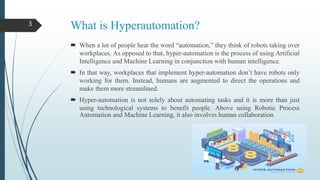
 When a lot of people hear the word “automation,” they think of robots taking over
workplaces. As opposed to that, hyper-automation is the process of using Artificial
Intelligence and Machine Learning in conjunction with human intelligence.
 In that way, workplaces that implement hyper-automation don’t have robots only
working for them. Instead, humans are augmented to direct the operations and
make them more streamlined.
 Hyper-automation is not solely about automating tasks and it is more than just
using technological systems to benefit people. Above using Robotic Process
Automation and Machine Learning, it also involves human collaboration.
3
What is Hyperautomation?
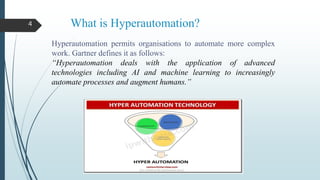
Hyperautomation permits organisations to automate more complex
work. Gartner defines it as follows:
“Hyperautomation deals with the application of advanced
technologies including AI and machine learning to increasingly
automate processes and augment humans.”
4
5
How is Hyperautomation different from regular
automation?
 Where automation can be the simple optimization of task processes (where you
set up a bot to perform a series of tasks) hyperautomation has an extra layer of
robotic ‘intelligence’ that makes the processes even smarter.
 You could say that where automation is the use of a robot’s arms to perform tasks
quicker and with less errors, hyperautomation also makes use of the robot’s brain
to perform those tasks in a smarter way.
 This ‘intelligent’ layer can include AI technologies in various forms. For example,
natural language processing (NPL), which lets bots interpret human speech,
optical character recognition (OCR), which lets bots convert images to readable
text, and machine learning (ML), which lets bots identify patterns in data.
6
What is Hyperautomation?
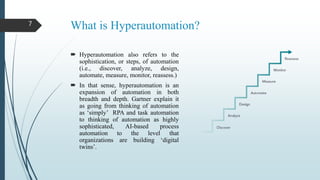
 Hyperautomation also refers to the
sophistication, or steps, of automation
(i.e., discover, analyze, design,
automate, measure, monitor, reassess.)
 In that sense, hyperautomation is an
expansion of automation in both
breadth and depth. Gartner explain it
as going from thinking of automation
as ‘simply’ RPA and task automation
to thinking of automation as highly
sophisticated, AI-based process
automation to the level that
organizations are building ‘digital
twins’.
7
Flavors of Hyperautomation
1.Robotic Process Automation(RPA)
 Robotics Process Automation(RPA) allows organizations to automate task just
like a human being was doing them across application and systems. Robotic
automation interacts with the existing IT architecture with no complex system
integration required.
 RPA can be used to automate workflow, infrastructure, back office process which
are labour intensive. These software bots can interact with an in-house
application, website, user portal, etc.
 The main goal of Robotics process automation process to replace repetitive and
boring clerical task performed by humans, with a virtual workforce.
8
Why Robotic Process Automation?
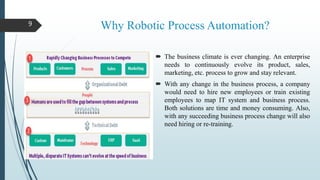
 The business climate is ever changing. An enterprise
needs to continuously evolve its product, sales,
marketing, etc. process to grow and stay relevant.
 With any change in the business process, a company
would need to hire new employees or train existing
employees to map IT system and business process.
Both solutions are time and money consuming. Also,
with any succeeding business process change will also
need hiring or re-training.
9
Entering of Robotic Process Automation
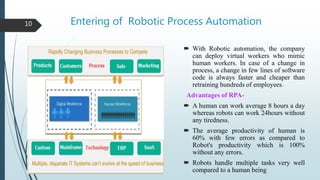
 With Robotic automation, the company
can deploy virtual workers who mimic
human workers. In case of a change in
process, a change in few lines of software
code is always faster and cheaper than
retraining hundreds of employees.
Advantages of RPA-
 A human can work average 8 hours a day
whereas robots can work 24hours without
any tiredness.
 The average productivity of human is
60% with few errors as compared to
Robot's productivity which is 100%
without any errors.
 Robots handle multiple tasks very well
compared to a human being
10
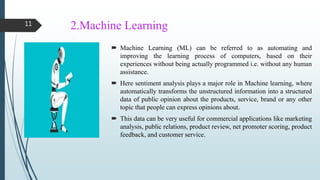
2.Machine Learning
 Machine Learning (ML) can be referred to as automating and
improving the learning process of computers, based on their
experiences without being actually programmed i.e. without any human
assistance.
 Here sentiment analysis plays a major role in Machine learning, where
automatically transforms the unstructured information into a structured
data of public opinion about the products, service, brand or any other
topic that people can express opinions about.
 This data can be very useful for commercial applications like marketing
analysis, public relations, product review, net promoter scoring, product
feedback, and customer service.
11
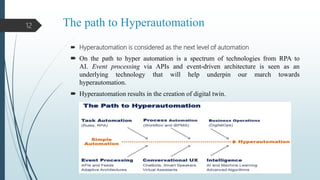
The path to Hyperautomation
 Hyperautomation is considered as the next level of automation
 On the path to hyper automation is a spectrum of technologies from RPA to
AI. Event processing via APIs and event-driven architecture is seen as an
underlying technology that will help underpin our march towards
hyperautomation.
 Hyperautomation results in the creation of digital twin.
12
What is Digital Twin?
 A digital twin is a digital replica of a living or non-living physical
entity. Digital twin refers to a digital replica of potential and actual
physical assets, processes, people, places, systems and devices that
can be used for various purposes.
 The digital representation provides both the elements and the
dynamics of how an Internet of things device operates and lives
throughout its life cycle.
 Digital twins integrate internet of things, artificial intelligence,
machine learning and software analytics with spatial network graphs
to create living digital simulation models that update and change as
their physical counterparts change.
 For example, a robotic manufacturing arm may contain a sensor that
records data about movement speed and direction while another
sensor captures information about internal and external heat.
13
What can we achieve by utilizing Hyperautomation?
 It’s important to first of all establish that the point of automation is to augment human
capabilities, not to replace them. Hyperautomation should in that sense not be seen as a threat
to the individual employee.
 “Robots aren’t here to take away our jobs, they’re here to give us a promotion.”
- Manjunath Bhat, Research Director at Gartner
 According to Gartner, “hyperautomation is an unavoidable market state in which
organizations must rapidly identify and automate all possible business
processes.”
 Businesses who have already invested in automation will probably already know the benefits
of optimizing tasks and processes through robots.
 For businesses who have yet to discover the benefits of automation, it might be useful to think
of automation as an electric beater for whisking eggs: It saves you from rather exhausting
work, and you’ll get better results faster.
14
What can we achieve by utilizing Hyperautomation?
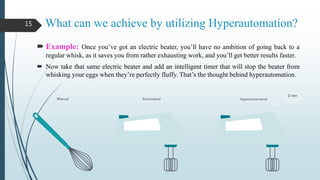
 Example: Once you’ve got an electric beater, you’ll have no ambition of going back to a
regular whisk, as it saves you from rather exhausting work, and you’ll get better results faster.
 Now take that same electric beater and add an intelligent timer that will stop the beater from
whisking your eggs when they’re perfectly fluffy. That’s the thought behind hyperautomation.
15
Hyperautomation unlocks maximum potential
for an automated enterprise
 Artificial intelligence capabilities such as machine learning (ML), natural language
processing (NLP), intelligent optical character recognition (OCR), and AI computer
vision, so robots can read, see, and process more work .
 Automated process discovery tools that look deeply into how your teams work
to show you what you can and should automate.
 Workforce engagement capability: ways to enable everyone in an organization to
contribute to automation. Involve not just the traditional RPA developers and
testers, but also involve your subject matter experts, business analysts, and
business users.
 Advanced analytics to measure and demonstrate the ROI of
automation and its impact based on business outcomes that matter to
your company.
16
How can we get started with hyperautomation?
 Hyperautomation requires selection of the right tools and technologies for the challenge at hand”
-Gartner
 ” What this means is that “organizations need the ability to reconfigure operations and supporting
processes in response to evolving needs and competitive threats in the market. A hyperautomated
future state can only be achieved through hyperagile working practices and tools.”
 We will use a tool or platform that is easy to use, interoperable scalable, and works across
platforms and systems.
 Finding a tool that speaks well with your people is, however, also crucial to the success of
hyperautomation. Today, most teams are built up of people with many different skills and
backgrounds, and finding a tool that can be easily used by all and collaborated within is
important.
 Unfortunately, most automation platforms today require their users to be able to write and read
code. Choosing a tool that eliminates this barrier can therefore give businesses a huge head start in
the automation race.
17
Benefits of Hyperautomation
 The primary benefit of hyper-automation is having an educated workforce that has
all the latest industry information. That information will allow employees to
perform their duties to the best of their abilities and quickly.
 Instead of employees focusing on repetitive tasks that waste their time, they will
focus on the more important details of their work. Their efforts and time will be
efficiently used in trying to solve bigger problems and contribute to the
workforce’s creative thinking.
 Employees will feel more satisfied and motivated about their work, which will
lead to greater productivity. The end result will be more revenue streaming in
because customer satisfaction might also increase when hyper-automation is used
effectively. Most importantly, using hyper-automation instead of regular
automation will promote sustainability.
 Regular automation risks a certain amount of jobs, whereas hyper-automation
encourages human intelligence augmentation in some of the tasks.
18
Benefits of Hyperautomation
 Manage the full cycle of automation at big scale, from discovering automation
opportunities to measuring the ROI.
 Enable people and robots to automate together, from basic processes to more
complex, long-running, end-to-end business processes.
 Rapidly identify and automate all possible business processes with an evolving
set of Al technologies.
 Empower everyone in the organization—business and IT—to automate and
contribute to the transformation without fear.
19
Thank You
20

Hyperautomation

  • 1.
  • 2.
  • 3.
    What is Hyperautomation? When a lot of people hear the word “automation,” they think of robots taking over workplaces. As opposed to that, hyper-automation is the process of using Artificial Intelligence and Machine Learning in conjunction with human intelligence.  In that way, workplaces that implement hyper-automation don’t have robots only working for them. Instead, humans are augmented to direct the operations and make them more streamlined.  Hyper-automation is not solely about automating tasks and it is more than just using technological systems to benefit people. Above using Robotic Process Automation and Machine Learning, it also involves human collaboration. 3
  • 4.
    What is Hyperautomation? Hyperautomationpermits organisations to automate more complex work. Gartner defines it as follows: “Hyperautomation deals with the application of advanced technologies including AI and machine learning to increasingly automate processes and augment humans.” 4
  • 5.
  • 6.
    How is Hyperautomationdifferent from regular automation?  Where automation can be the simple optimization of task processes (where you set up a bot to perform a series of tasks) hyperautomation has an extra layer of robotic ‘intelligence’ that makes the processes even smarter.  You could say that where automation is the use of a robot’s arms to perform tasks quicker and with less errors, hyperautomation also makes use of the robot’s brain to perform those tasks in a smarter way.  This ‘intelligent’ layer can include AI technologies in various forms. For example, natural language processing (NPL), which lets bots interpret human speech, optical character recognition (OCR), which lets bots convert images to readable text, and machine learning (ML), which lets bots identify patterns in data. 6
  • 7.
    What is Hyperautomation? Hyperautomation also refers to the sophistication, or steps, of automation (i.e., discover, analyze, design, automate, measure, monitor, reassess.)  In that sense, hyperautomation is an expansion of automation in both breadth and depth. Gartner explain it as going from thinking of automation as ‘simply’ RPA and task automation to thinking of automation as highly sophisticated, AI-based process automation to the level that organizations are building ‘digital twins’. 7
  • 8.
    Flavors of Hyperautomation 1.RoboticProcess Automation(RPA)  Robotics Process Automation(RPA) allows organizations to automate task just like a human being was doing them across application and systems. Robotic automation interacts with the existing IT architecture with no complex system integration required.  RPA can be used to automate workflow, infrastructure, back office process which are labour intensive. These software bots can interact with an in-house application, website, user portal, etc.  The main goal of Robotics process automation process to replace repetitive and boring clerical task performed by humans, with a virtual workforce. 8
  • 9.
    Why Robotic ProcessAutomation?  The business climate is ever changing. An enterprise needs to continuously evolve its product, sales, marketing, etc. process to grow and stay relevant.  With any change in the business process, a company would need to hire new employees or train existing employees to map IT system and business process. Both solutions are time and money consuming. Also, with any succeeding business process change will also need hiring or re-training. 9
  • 10.
    Entering of RoboticProcess Automation  With Robotic automation, the company can deploy virtual workers who mimic human workers. In case of a change in process, a change in few lines of software code is always faster and cheaper than retraining hundreds of employees. Advantages of RPA-  A human can work average 8 hours a day whereas robots can work 24hours without any tiredness.  The average productivity of human is 60% with few errors as compared to Robot's productivity which is 100% without any errors.  Robots handle multiple tasks very well compared to a human being 10
  • 11.
    2.Machine Learning  MachineLearning (ML) can be referred to as automating and improving the learning process of computers, based on their experiences without being actually programmed i.e. without any human assistance.  Here sentiment analysis plays a major role in Machine learning, where automatically transforms the unstructured information into a structured data of public opinion about the products, service, brand or any other topic that people can express opinions about.  This data can be very useful for commercial applications like marketing analysis, public relations, product review, net promoter scoring, product feedback, and customer service. 11
  • 12.
    The path toHyperautomation  Hyperautomation is considered as the next level of automation  On the path to hyper automation is a spectrum of technologies from RPA to AI. Event processing via APIs and event-driven architecture is seen as an underlying technology that will help underpin our march towards hyperautomation.  Hyperautomation results in the creation of digital twin. 12
  • 13.
    What is DigitalTwin?  A digital twin is a digital replica of a living or non-living physical entity. Digital twin refers to a digital replica of potential and actual physical assets, processes, people, places, systems and devices that can be used for various purposes.  The digital representation provides both the elements and the dynamics of how an Internet of things device operates and lives throughout its life cycle.  Digital twins integrate internet of things, artificial intelligence, machine learning and software analytics with spatial network graphs to create living digital simulation models that update and change as their physical counterparts change.  For example, a robotic manufacturing arm may contain a sensor that records data about movement speed and direction while another sensor captures information about internal and external heat. 13
  • 14.
    What can weachieve by utilizing Hyperautomation?  It’s important to first of all establish that the point of automation is to augment human capabilities, not to replace them. Hyperautomation should in that sense not be seen as a threat to the individual employee.  “Robots aren’t here to take away our jobs, they’re here to give us a promotion.” - Manjunath Bhat, Research Director at Gartner  According to Gartner, “hyperautomation is an unavoidable market state in which organizations must rapidly identify and automate all possible business processes.”  Businesses who have already invested in automation will probably already know the benefits of optimizing tasks and processes through robots.  For businesses who have yet to discover the benefits of automation, it might be useful to think of automation as an electric beater for whisking eggs: It saves you from rather exhausting work, and you’ll get better results faster. 14
  • 15.
    What can weachieve by utilizing Hyperautomation?  Example: Once you’ve got an electric beater, you’ll have no ambition of going back to a regular whisk, as it saves you from rather exhausting work, and you’ll get better results faster.  Now take that same electric beater and add an intelligent timer that will stop the beater from whisking your eggs when they’re perfectly fluffy. That’s the thought behind hyperautomation. 15
  • 16.
    Hyperautomation unlocks maximumpotential for an automated enterprise  Artificial intelligence capabilities such as machine learning (ML), natural language processing (NLP), intelligent optical character recognition (OCR), and AI computer vision, so robots can read, see, and process more work .  Automated process discovery tools that look deeply into how your teams work to show you what you can and should automate.  Workforce engagement capability: ways to enable everyone in an organization to contribute to automation. Involve not just the traditional RPA developers and testers, but also involve your subject matter experts, business analysts, and business users.  Advanced analytics to measure and demonstrate the ROI of automation and its impact based on business outcomes that matter to your company. 16
  • 17.
    How can weget started with hyperautomation?  Hyperautomation requires selection of the right tools and technologies for the challenge at hand” -Gartner  ” What this means is that “organizations need the ability to reconfigure operations and supporting processes in response to evolving needs and competitive threats in the market. A hyperautomated future state can only be achieved through hyperagile working practices and tools.”  We will use a tool or platform that is easy to use, interoperable scalable, and works across platforms and systems.  Finding a tool that speaks well with your people is, however, also crucial to the success of hyperautomation. Today, most teams are built up of people with many different skills and backgrounds, and finding a tool that can be easily used by all and collaborated within is important.  Unfortunately, most automation platforms today require their users to be able to write and read code. Choosing a tool that eliminates this barrier can therefore give businesses a huge head start in the automation race. 17
  • 18.
    Benefits of Hyperautomation The primary benefit of hyper-automation is having an educated workforce that has all the latest industry information. That information will allow employees to perform their duties to the best of their abilities and quickly.  Instead of employees focusing on repetitive tasks that waste their time, they will focus on the more important details of their work. Their efforts and time will be efficiently used in trying to solve bigger problems and contribute to the workforce’s creative thinking.  Employees will feel more satisfied and motivated about their work, which will lead to greater productivity. The end result will be more revenue streaming in because customer satisfaction might also increase when hyper-automation is used effectively. Most importantly, using hyper-automation instead of regular automation will promote sustainability.  Regular automation risks a certain amount of jobs, whereas hyper-automation encourages human intelligence augmentation in some of the tasks. 18
  • 19.
    Benefits of Hyperautomation Manage the full cycle of automation at big scale, from discovering automation opportunities to measuring the ROI.  Enable people and robots to automate together, from basic processes to more complex, long-running, end-to-end business processes.  Rapidly identify and automate all possible business processes with an evolving set of Al technologies.  Empower everyone in the organization—business and IT—to automate and contribute to the transformation without fear. 19
  • 20.