SIRISHA U 144G1A0486
WASIM AKRAM S 144G1A04B1
PRESENTED BY
 INTRODUCTION
 NETWORK EVOLUTION
 WHY GI-FI ??
 ARCHITECTURE OF GI-FI
 WORKING
 COMPARISION WITH WIFI
 FEATURES / ADVANTAGES
 APPLICATIONS
 TECHNOLOGY CONSIDERATIONS
 CONCLUSION
INDEX:
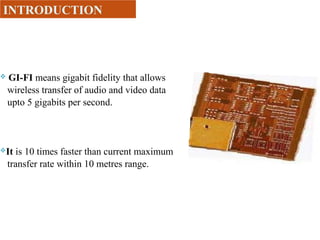
 GI-FI means gigabit fidelity that allows
wireless transfer of audio and video data
upto 5 gigabits per second.
It is 10 times faster than current maximum
transfer rate within 10 metres range.
INTRODUCTION
cables Optical fiber
Wireless access
Bluetooth
wifi
wimax
WHY GI FI
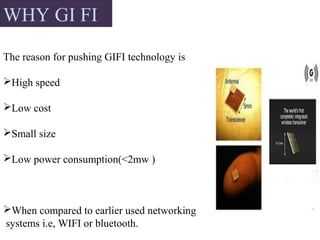
The reason for pushing GIFI technology is
High speed
Low cost
Small size
Low power consumption(<2mw )
When compared to earlier used networking
systems i.e, WIFI or bluetooth.
ARCHITECTURE OF GI-FI
The core component of gifi is the subscriber station.
Small antenna at the subscriber station which is
mounted on the roof.
It supports line of sight(LOS) operation.
It uses time division duplex for both
transmission and receving.
Convertion of data from IF range to RF 60
GHz range.
The income RF signal is first down converted
to an IF signal centered at 5GHz and then to
normal data.
Uses heterodyne principle to avoid leakages.
Finally data is transferred.
COMPARISIONS WITH WIFI
CHARACTERISTICS GI-FI WI-FI
DEVELOPMENT START 2004 1990
SPECIFICATION AUTHORITY NICTA IEEE
FREQUENCY 57-64 GHZ 2.4 GHZ
DATA TRANSFER RATE 5GBPS 11 MBPS
RANGE 10METERS 100 METERS
POWER UTILIZATION < 2MW 10 MW
PRIMARY DEVICES MOBILE PHONES PCS
SERVERS,.. ETC
PC’S ,SERVERS.ETC
 HIGH SECURITY
 HIGH SPEED DATA TRANSFER
 SMALL SIZE
 LOW POWER CONSUMPTION
 COST EFFECTIVE
TECHNICAL CONSIDERATIONS
•The GIFI integrated transceiver chip may be launched by
starting of next year by NICTA,AUSTRALIA.
•Due to low cost many companies like INTEL,LG,
PANASONIC ,SAMSUNG ,SONY and TOSHIBA are
looking forward to launch for low cost.
•An industrial effort to define specifiction for next
generation .
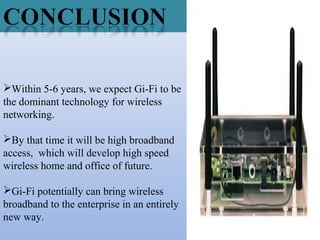
Within 5-6 years, we expect Gi-Fi to be
the dominant technology for wireless
networking.
By that time it will be high broadband
access, which will develop high speed
wireless home and office of future.
Gi-Fi potentially can bring wireless
broadband to the enterprise in an entirely
new way.
GIFI

GIFI

  • 2.
    SIRISHA U 144G1A0486 WASIMAKRAM S 144G1A04B1 PRESENTED BY
  • 3.
     INTRODUCTION  NETWORKEVOLUTION  WHY GI-FI ??  ARCHITECTURE OF GI-FI  WORKING  COMPARISION WITH WIFI  FEATURES / ADVANTAGES  APPLICATIONS  TECHNOLOGY CONSIDERATIONS  CONCLUSION INDEX:
  • 4.
     GI-FI meansgigabit fidelity that allows wireless transfer of audio and video data upto 5 gigabits per second. It is 10 times faster than current maximum transfer rate within 10 metres range. INTRODUCTION
  • 5.
    cables Optical fiber Wirelessaccess Bluetooth wifi wimax
  • 6.
    WHY GI FI Thereason for pushing GIFI technology is High speed Low cost Small size Low power consumption(<2mw ) When compared to earlier used networking systems i.e, WIFI or bluetooth.
  • 7.
    ARCHITECTURE OF GI-FI Thecore component of gifi is the subscriber station. Small antenna at the subscriber station which is mounted on the roof. It supports line of sight(LOS) operation.
  • 8.
    It uses timedivision duplex for both transmission and receving. Convertion of data from IF range to RF 60 GHz range. The income RF signal is first down converted to an IF signal centered at 5GHz and then to normal data. Uses heterodyne principle to avoid leakages. Finally data is transferred.
  • 9.
    COMPARISIONS WITH WIFI CHARACTERISTICSGI-FI WI-FI DEVELOPMENT START 2004 1990 SPECIFICATION AUTHORITY NICTA IEEE FREQUENCY 57-64 GHZ 2.4 GHZ DATA TRANSFER RATE 5GBPS 11 MBPS RANGE 10METERS 100 METERS POWER UTILIZATION < 2MW 10 MW PRIMARY DEVICES MOBILE PHONES PCS SERVERS,.. ETC PC’S ,SERVERS.ETC
  • 10.
     HIGH SECURITY HIGH SPEED DATA TRANSFER  SMALL SIZE  LOW POWER CONSUMPTION  COST EFFECTIVE
  • 12.
    TECHNICAL CONSIDERATIONS •The GIFIintegrated transceiver chip may be launched by starting of next year by NICTA,AUSTRALIA. •Due to low cost many companies like INTEL,LG, PANASONIC ,SAMSUNG ,SONY and TOSHIBA are looking forward to launch for low cost. •An industrial effort to define specifiction for next generation .
  • 13.
    Within 5-6 years,we expect Gi-Fi to be the dominant technology for wireless networking. By that time it will be high broadband access, which will develop high speed wireless home and office of future. Gi-Fi potentially can bring wireless broadband to the enterprise in an entirely new way.