AN TECHNICAL SEMINAR PRESENTATION ON
HYPER THREADING TECHNOLOGY
DEPARTMENT OF COMPUTER SCIENCE ENGINEERING
CONTENTS
 INTRODUCTION
 UTILIZATION OF PROCESSOR RESOURCES
 HYPER-THREADING TECHNOLOGY IMPROVES
PERFORMANCE
 MULTI-THREADED APPLICATIONS
 MULTIPROCESSOR PERFORMANCE ON A SINGLE
PROCESSOR
 HYPER-THREADING SPEEDS LINUX
 EACH PROGRAM HAS A MIND OF ITS OWN
 IMPLEMENTING HYPER-THREADING
 WORKING OF HYPERTHREADING
 WHAT HYPERTHREADING CAN (AND CAN'T) DO FOR YOU
 CONCLUTION
Hyper-Threading Technology offers:
 Improved overall system performance.
 Increased number of users a platform can support.
 Improved reaction and response time because tasks can be run
on separate threads.
 Increased number of transaction that can be executed.
 Compatibility with existing IA-32 software.
UTILIZATION
 Intel Hyper-Threading Technology improves performance of
multi-threaded applications by increasing the utilization of the
on-chip resources available in the Intel® NetBurst™
microarchitecture.
 The Intel NetBurst microarchitecture provides optimal
performance when executing a single instruction stream.
 A typical thread of code with a typical mix of Intel® IA-32-
based instructions, however, utilizes only about 35 percent of
the Intel NetBurst microarchitecture execution resources.
HYPER-THREADING TECHNOLOGY
IMPROVES PERFORMANCE
 Intel Hyper-Threading Technology offers better performance
improvement as additional processors are added.
 Multi-processor systems with Hyper-Threading Technology
can outperform multi-processor systems without Hyper-
Threading Technology.
MULTI-THREADED APPLICATIONS
 Virtually all contemporary operating systems (including
Microsoft Windows* and Linux*) divide their workload up
into processes and threads that can be independently scheduled
and dispatched.
 The same division of workload can be found in many high-
performance applications such as database engines, scientific
computation programs, engineering-workstation tools, and
multi-media programs.
MULTIPROCESSOR PERFORMANCE ON A
SINGLE PROCESSOR
 The Intel Xeon processor introduces a new technology called
Hyper-Threading (HT) that, to the operating system, makes a
single processor behave like two logical processors.
 When enabled, the technology allows the processor to execute
multiple threads simultaneously, in parallel within each
processor, which can yield significant performance
improvement.
 We set out to quantify just how much improvement you can
expect to see.
HYPER-THREADING SPEEDS
LINUX
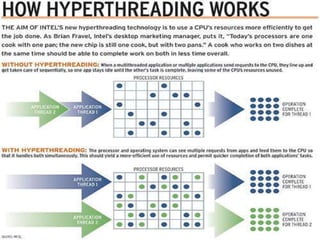
 Intel's Hyper-Threading Technology enables two logical
processors on a single physical processor by replicating,
partitioning, and sharing the resources within the Intel NetBurst
microarchitecture pipeline.
EACH PROGRAM HAS A MIND
OF ITS OWN
 The OS and system hardware not only cooperate to fool the
user about the true mechanics of multi-tasking, but they
cooperate to fool each running program as well.
 While the user thinks that all of the currently running programs
are being executed simultaneously, each of those programs
thinks that it has a monopoly on the CPU and memory.
IMPLEMENTING HYPER-THREADING
 Although hyper-threading might seem like a pretty large
departure from the kind of conventional, process-switching
multithreading done on a single-threaded CPU, it actually
doesn't add too much complexity to the hardware.
 Intel reports that adding hyper-threading to their Xeon
processor added only 5% to its die area.
WHAT HYPERTHREADING CAN
(AND CAN'T)DO FOR YOU
 The word alone sounds like a marketing tactic, an esoteric
feature designed to convince OEMs and end users to
upgrade to the latest and greatest Intel-based systems.
 And to some extent, hyperthreading is exactly that. With
returns diminishing on increased clock speeds and
memory caches for the average user, But at the same time,
hyperthreading solves a real computing problem.
CONCLUSION
 Intel Xeon Hyper-Threading is definitely having a positive
impact on Linux kernel and multithreaded applications.
 The speed-up from Hyper-Threading could be as high as
30% in stock kernel 2.4.19, to 51% in kernel 2.5.32 due to
drastic changes in the scheduler run queue's support and
Hyper-Threading awareness.
 Today with Hyper-Threading Technology, processor-level
threading can be utilized which offers more efficient use
of processor resources for greater parallelism and
improved performance on today's multi-threaded software.
Thanks

mech_Hyper_Threading_ppt[1].pptx Computer engineering

  • 1.
    AN TECHNICAL SEMINARPRESENTATION ON HYPER THREADING TECHNOLOGY DEPARTMENT OF COMPUTER SCIENCE ENGINEERING
  • 2.
    CONTENTS  INTRODUCTION  UTILIZATIONOF PROCESSOR RESOURCES  HYPER-THREADING TECHNOLOGY IMPROVES PERFORMANCE  MULTI-THREADED APPLICATIONS  MULTIPROCESSOR PERFORMANCE ON A SINGLE PROCESSOR  HYPER-THREADING SPEEDS LINUX  EACH PROGRAM HAS A MIND OF ITS OWN  IMPLEMENTING HYPER-THREADING  WORKING OF HYPERTHREADING  WHAT HYPERTHREADING CAN (AND CAN'T) DO FOR YOU  CONCLUTION
  • 3.
    Hyper-Threading Technology offers: Improved overall system performance.  Increased number of users a platform can support.  Improved reaction and response time because tasks can be run on separate threads.  Increased number of transaction that can be executed.  Compatibility with existing IA-32 software.
  • 4.
    UTILIZATION  Intel Hyper-ThreadingTechnology improves performance of multi-threaded applications by increasing the utilization of the on-chip resources available in the Intel® NetBurst™ microarchitecture.  The Intel NetBurst microarchitecture provides optimal performance when executing a single instruction stream.  A typical thread of code with a typical mix of Intel® IA-32- based instructions, however, utilizes only about 35 percent of the Intel NetBurst microarchitecture execution resources.
  • 5.
    HYPER-THREADING TECHNOLOGY IMPROVES PERFORMANCE Intel Hyper-Threading Technology offers better performance improvement as additional processors are added.  Multi-processor systems with Hyper-Threading Technology can outperform multi-processor systems without Hyper- Threading Technology.
  • 6.
    MULTI-THREADED APPLICATIONS  Virtuallyall contemporary operating systems (including Microsoft Windows* and Linux*) divide their workload up into processes and threads that can be independently scheduled and dispatched.  The same division of workload can be found in many high- performance applications such as database engines, scientific computation programs, engineering-workstation tools, and multi-media programs.
  • 7.
    MULTIPROCESSOR PERFORMANCE ONA SINGLE PROCESSOR  The Intel Xeon processor introduces a new technology called Hyper-Threading (HT) that, to the operating system, makes a single processor behave like two logical processors.  When enabled, the technology allows the processor to execute multiple threads simultaneously, in parallel within each processor, which can yield significant performance improvement.  We set out to quantify just how much improvement you can expect to see.
  • 8.
    HYPER-THREADING SPEEDS LINUX  Intel'sHyper-Threading Technology enables two logical processors on a single physical processor by replicating, partitioning, and sharing the resources within the Intel NetBurst microarchitecture pipeline.
  • 9.
    EACH PROGRAM HASA MIND OF ITS OWN  The OS and system hardware not only cooperate to fool the user about the true mechanics of multi-tasking, but they cooperate to fool each running program as well.  While the user thinks that all of the currently running programs are being executed simultaneously, each of those programs thinks that it has a monopoly on the CPU and memory.
  • 10.
    IMPLEMENTING HYPER-THREADING  Althoughhyper-threading might seem like a pretty large departure from the kind of conventional, process-switching multithreading done on a single-threaded CPU, it actually doesn't add too much complexity to the hardware.  Intel reports that adding hyper-threading to their Xeon processor added only 5% to its die area.
  • 12.
    WHAT HYPERTHREADING CAN (ANDCAN'T)DO FOR YOU  The word alone sounds like a marketing tactic, an esoteric feature designed to convince OEMs and end users to upgrade to the latest and greatest Intel-based systems.  And to some extent, hyperthreading is exactly that. With returns diminishing on increased clock speeds and memory caches for the average user, But at the same time, hyperthreading solves a real computing problem.
  • 13.
    CONCLUSION  Intel XeonHyper-Threading is definitely having a positive impact on Linux kernel and multithreaded applications.  The speed-up from Hyper-Threading could be as high as 30% in stock kernel 2.4.19, to 51% in kernel 2.5.32 due to drastic changes in the scheduler run queue's support and Hyper-Threading awareness.  Today with Hyper-Threading Technology, processor-level threading can be utilized which offers more efficient use of processor resources for greater parallelism and improved performance on today's multi-threaded software.
  • 14.