DISASTER READINESS AND
RISK REDUCTION
SHS CORE SUBJECT
80 HOURSE/SEMESTER
PREREQUISITE: GRADE 3 – 10 SCIENCE
Sir Dexter B. Cargullo
CHS,Tabaco City
Earthquake
Hazards
WHAT IS AN EARTHQUAKE?
“The perceptible shaking of the surface of the
Earth, resulting from sudden release of energy in
the Earth’s crust that creates seismic waves.”
(United States Geological Science-USGS)
The Earth
Our planet is DYNAMIC
The outermost layer of the earth is
broken into pieces. These pieces
called “plates” are moving, away or
toward each other.
How Do Plates Move?
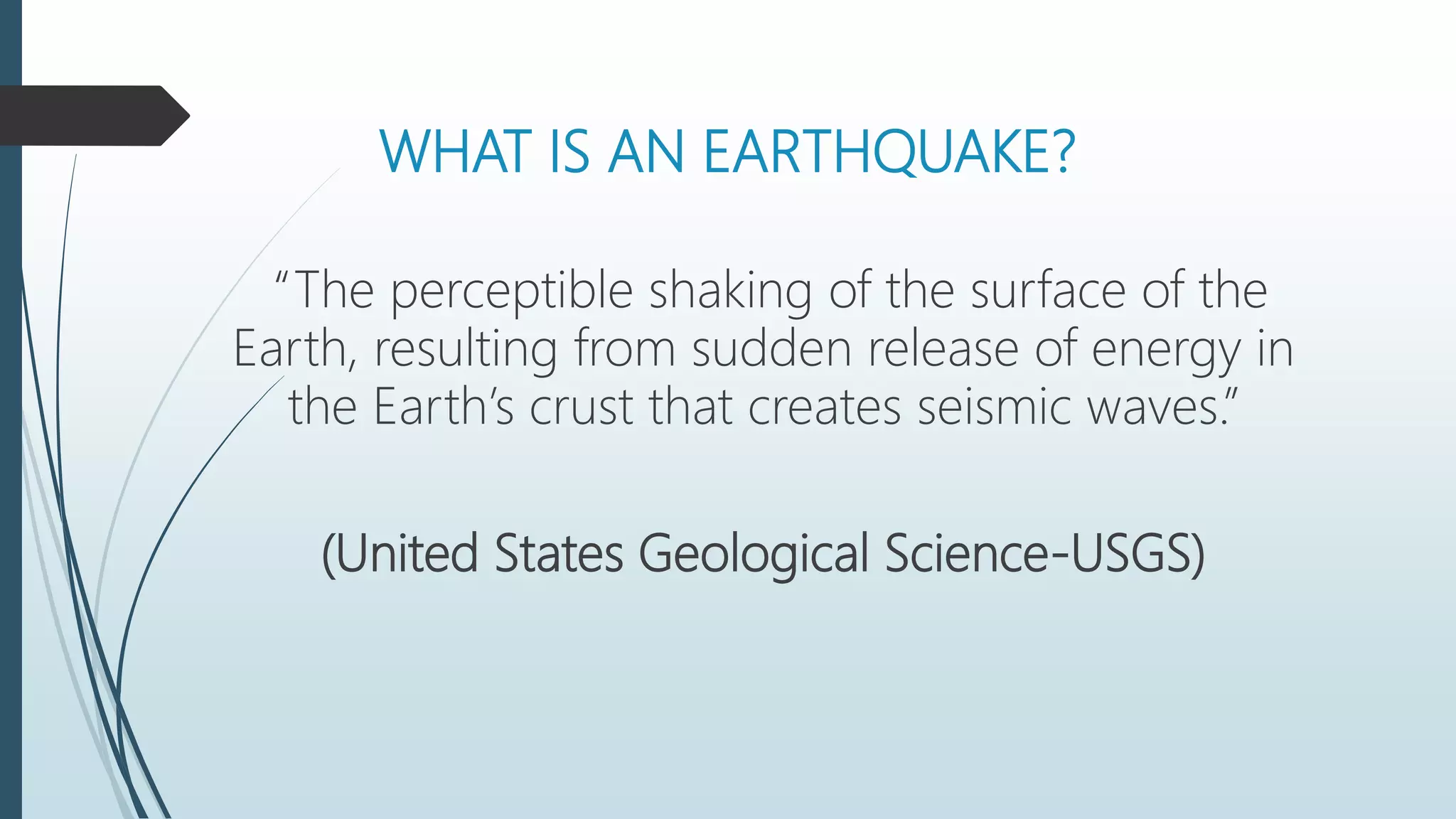
New parts of a plate rise because they are
warm and the plate is thin. As hot magma
rises to the surface at spreading ridges and
forms new crust, the new crust pushes the
rest of a plate out of its way. This is called
ridge push.
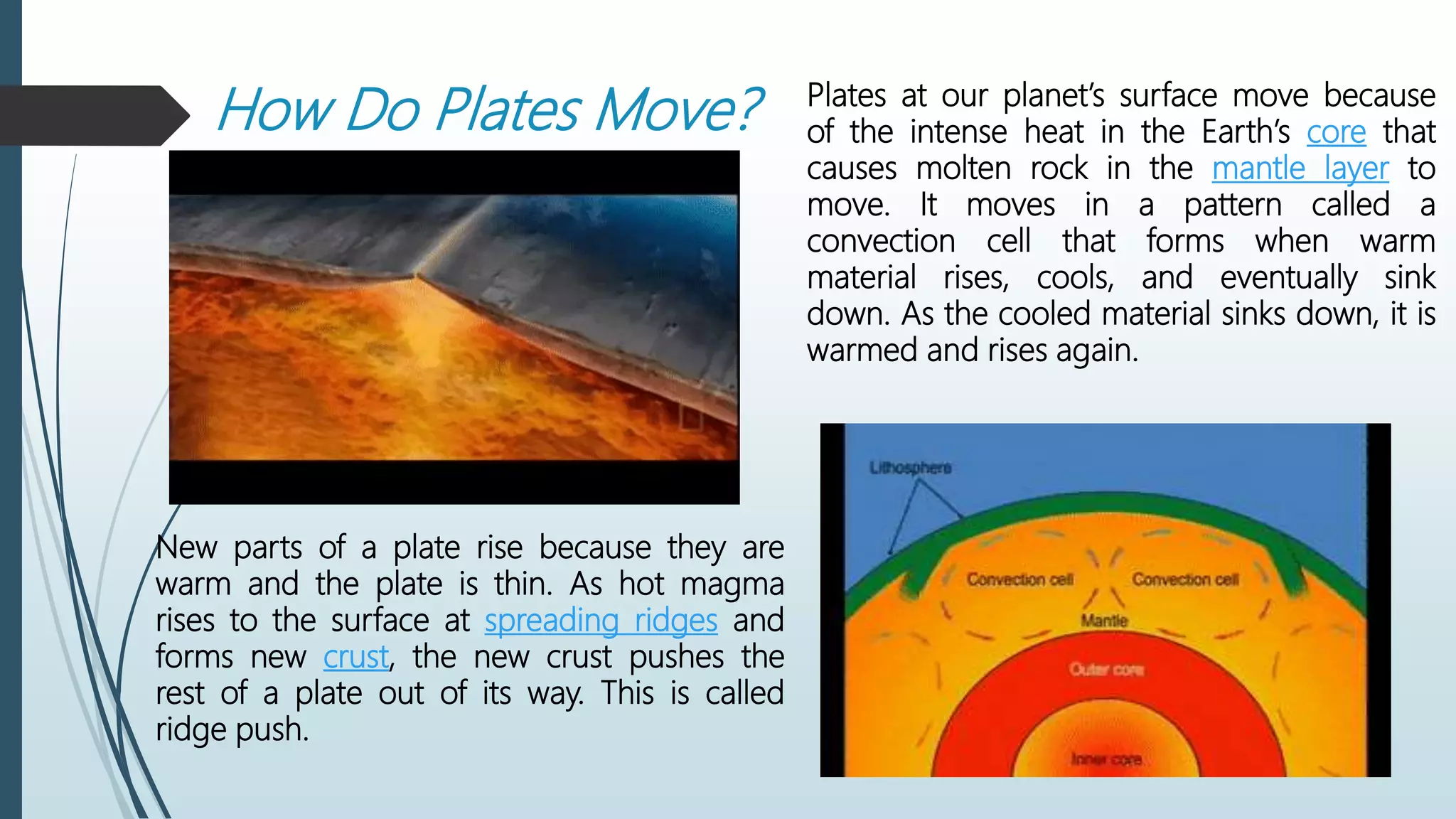
Plates at our planet’s surface move because
of the intense heat in the Earth’s core that
causes molten rock in the mantle layer to
move. It moves in a pattern called a
convection cell that forms when warm
material rises, cools, and eventually sink
down. As the cooled material sinks down, it is
warmed and rises again.
Types of Natural Earthquakes
1.Tectonic
- Earthquake produces by sudden movement along
faults and plate boundaries.
2. Volcanic
- Earthquakes produces by movement of magma
beneath volcanoes.
Ways of describing the strength of an earthquake:
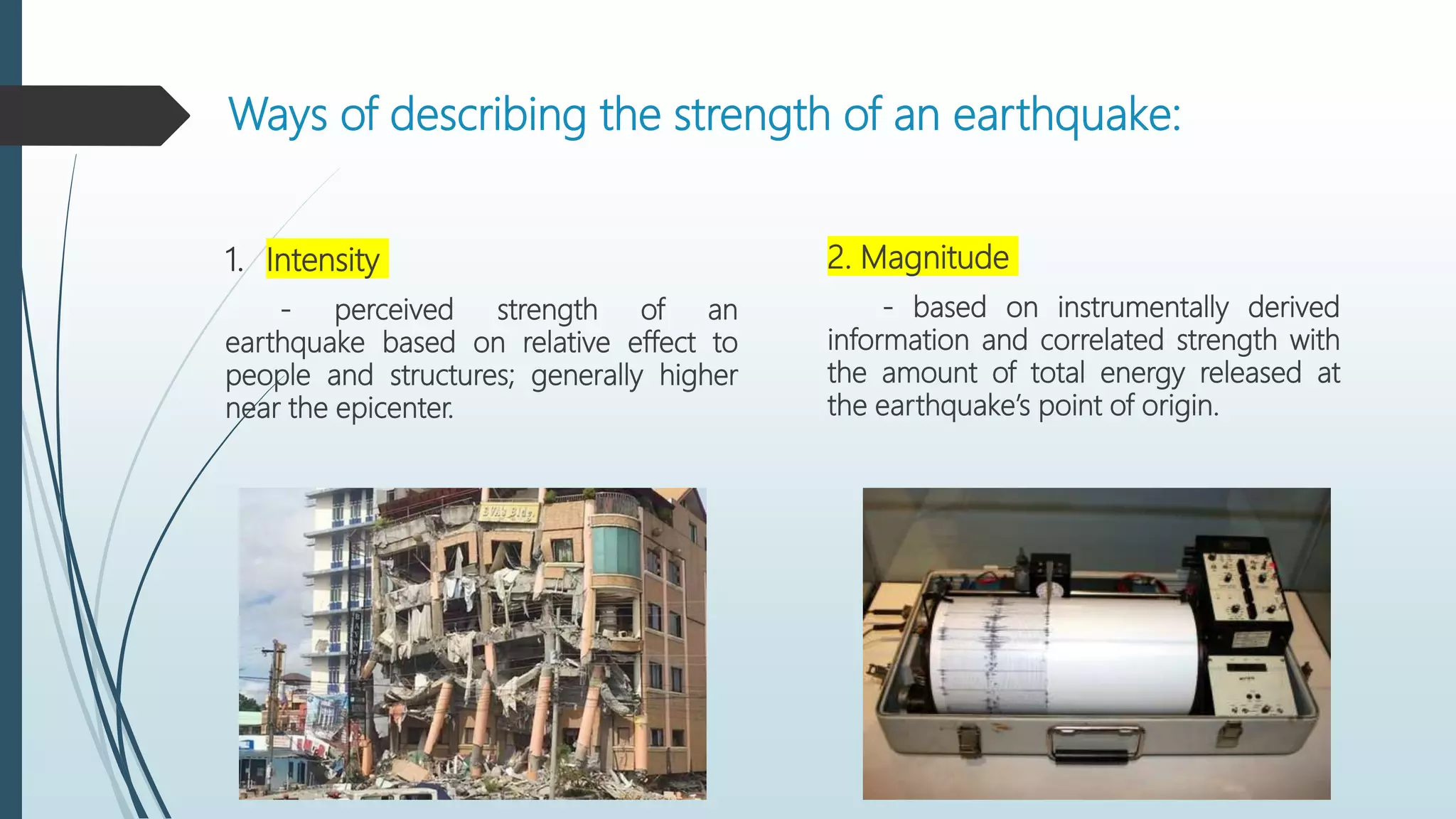
1. Intensity
- perceived strength of an
earthquake based on relative effect to
people and structures; generally higher
near the epicenter.
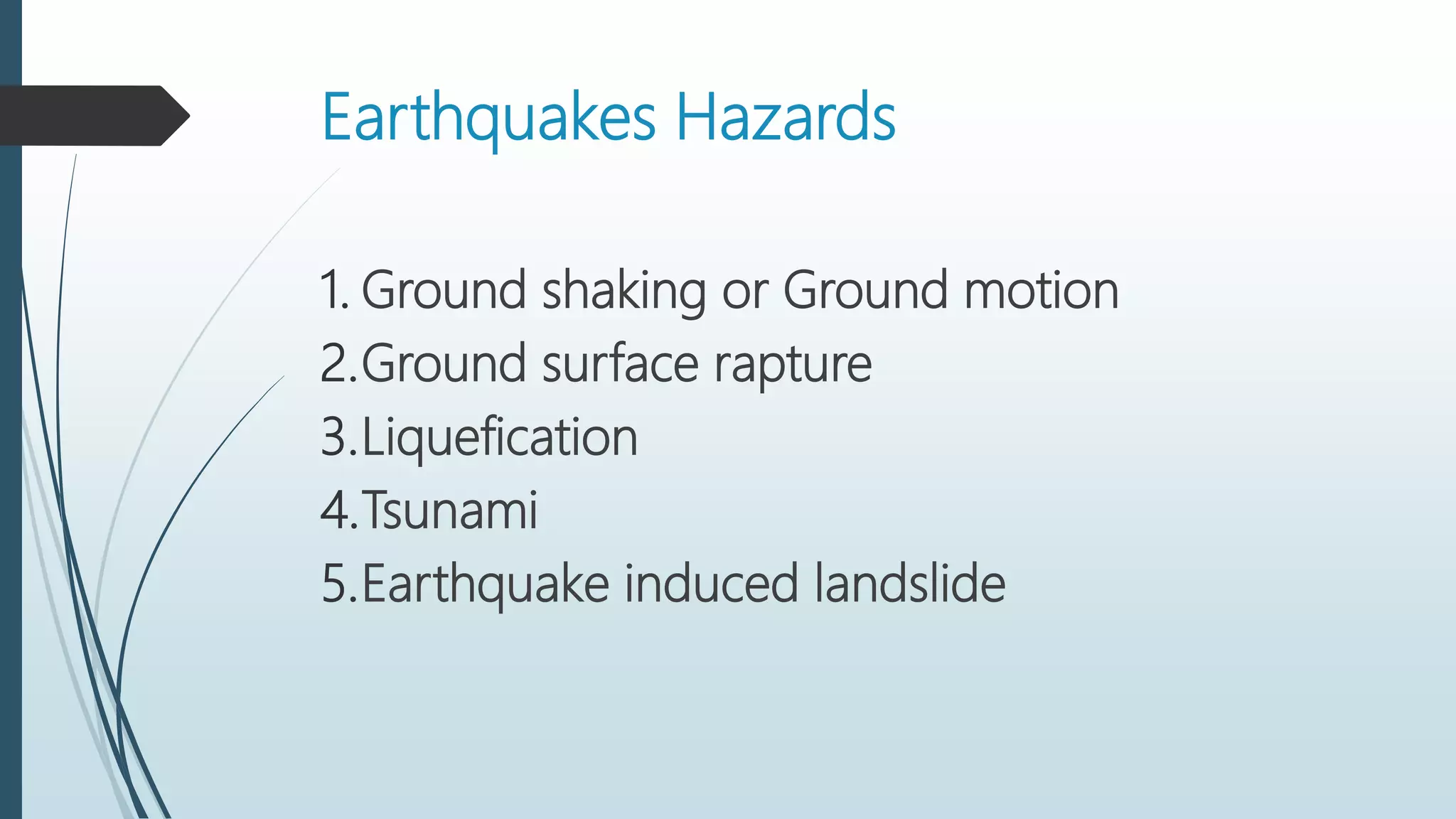
2. Magnitude
- based on instrumentally derived
information and correlated strength with
the amount of total energy released at
the earthquake’s point of origin.
Earthquakes Hazards
1. Ground shaking or Ground motion
2.Ground surface rapture
3.Liquefication
4.Tsunami
5.Earthquake induced landslide
Ground Shaking (Vibration)
It refers to what we feel when energy built up by
the application of stress to the lithosphere is
released by faulting during earthquake.
Technically, it refers to the disruptive up and
down and sideways motion experienced during
an earthquake.
How Earthquake Vibrations are Generated?
Most natural earthquakes are cased by sudden slippage
along fault zone. A fault is a fracture on which one
body of rock slides past another.
Slippage along a fault is hindered because there are
irregularities on the fault plane. If it were smooth, blocks
on opposite sides of fault will just slide past each other
continuously.
How Seismic Movement produced
Earthquake Waves
Youtube:
How Seismic
Movement
produced
Earthquake
Waves
Types of Seismic Waves
 Primary Waves
The fastest seismic waves are called primary waves, or P waves.
These waves are the first to reach any particular location after an
earthquake occurs. Primary waves travel through Earth’s crust at an
average speed of about 5 kilometers per second (3 mi/s). Primary
waves can travel through solids, liquids, and gases. As they pass
through a material, the particles of the material are slightly pushed
together and pulled apart.
Buildings also experience this push and pull as primary waves
pass through the ground they are built on.
Types of Seismic Waves
 Secondary Waves
Secondary waves are the second seismic waves to arrive at any
particular location after an earthquake, though they start at the
same time as primary waves. Secondary waves travel through
Earth’s interior at about half the speed of primary waves. As they
pass through a material, the material’s particles are shaken up and
down or from side to side, shaking small buildings back and forth
as they pass.
Secondary waves can travel through rock, but unlike primary
waves they cannot travel through liquids or gases.
Types of Seismic Waves
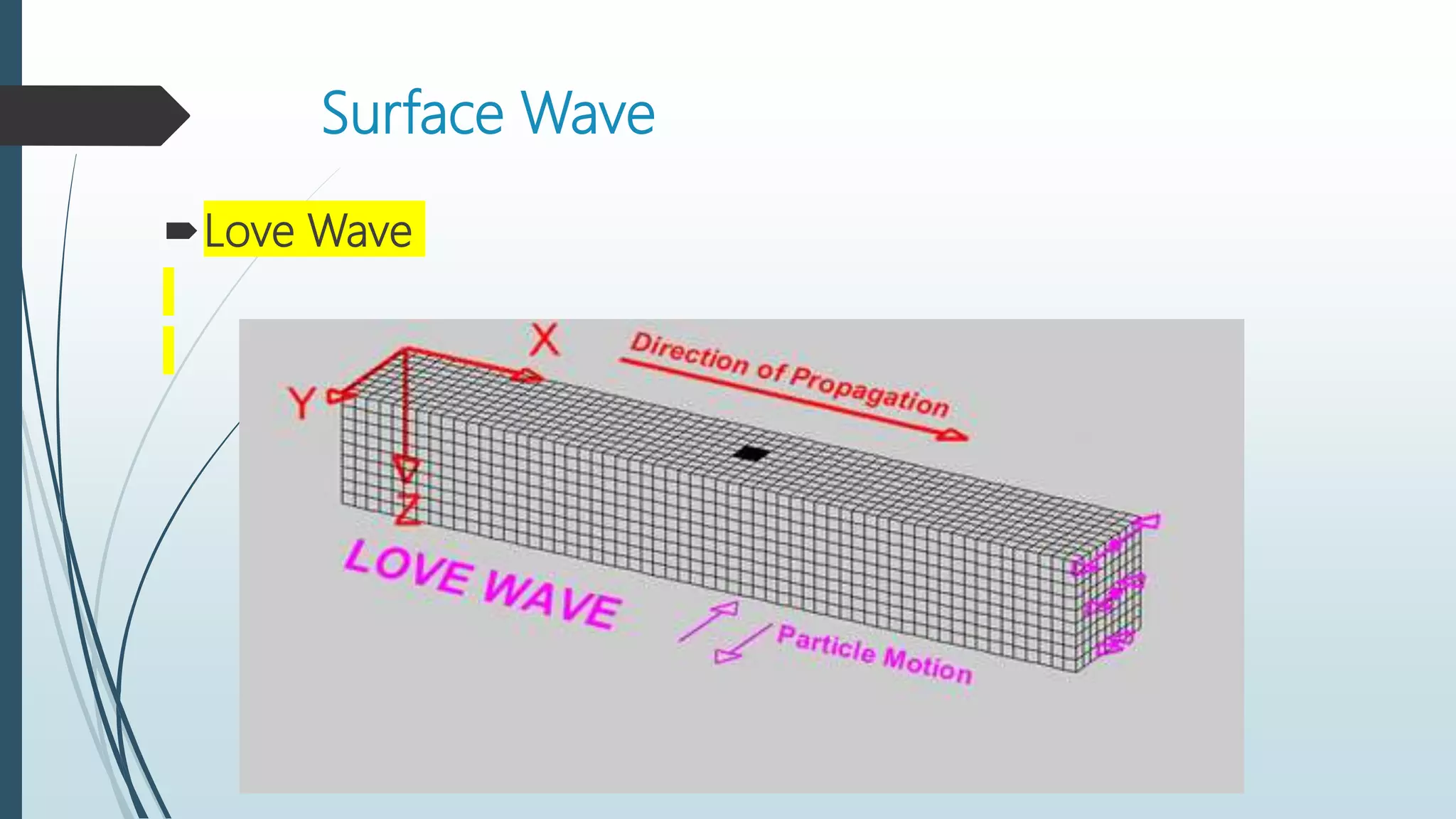
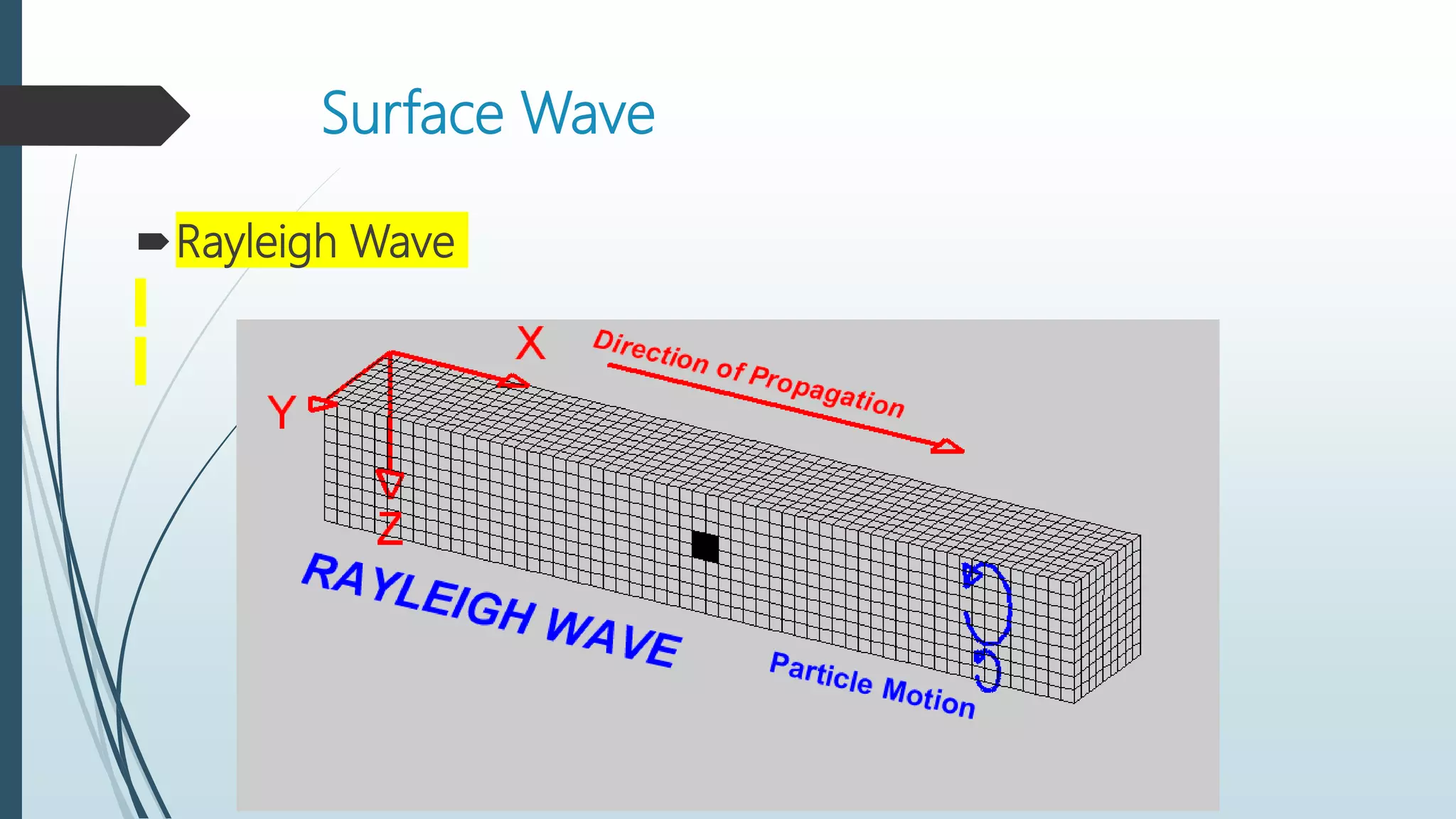
 Surface Waves
Surface waves are seismic waves that move along Earth’s
surface, not through its interior. They make the ground roll up
and down or shake from side to side. Surface waves cause the
largest ground movements and the most damage. Surface
waves travel more slowly than the other types of seismic waves.
Surface Wave
Love Wave
Surface Wave
Rayleigh Wave
How Ground Shaking is Measured?
 The strength of ground shaking is measured in terms of:
1. Velocity
2. Acceleration
3. Frequency content of shaking
4. Duration (How long the shaking continues)
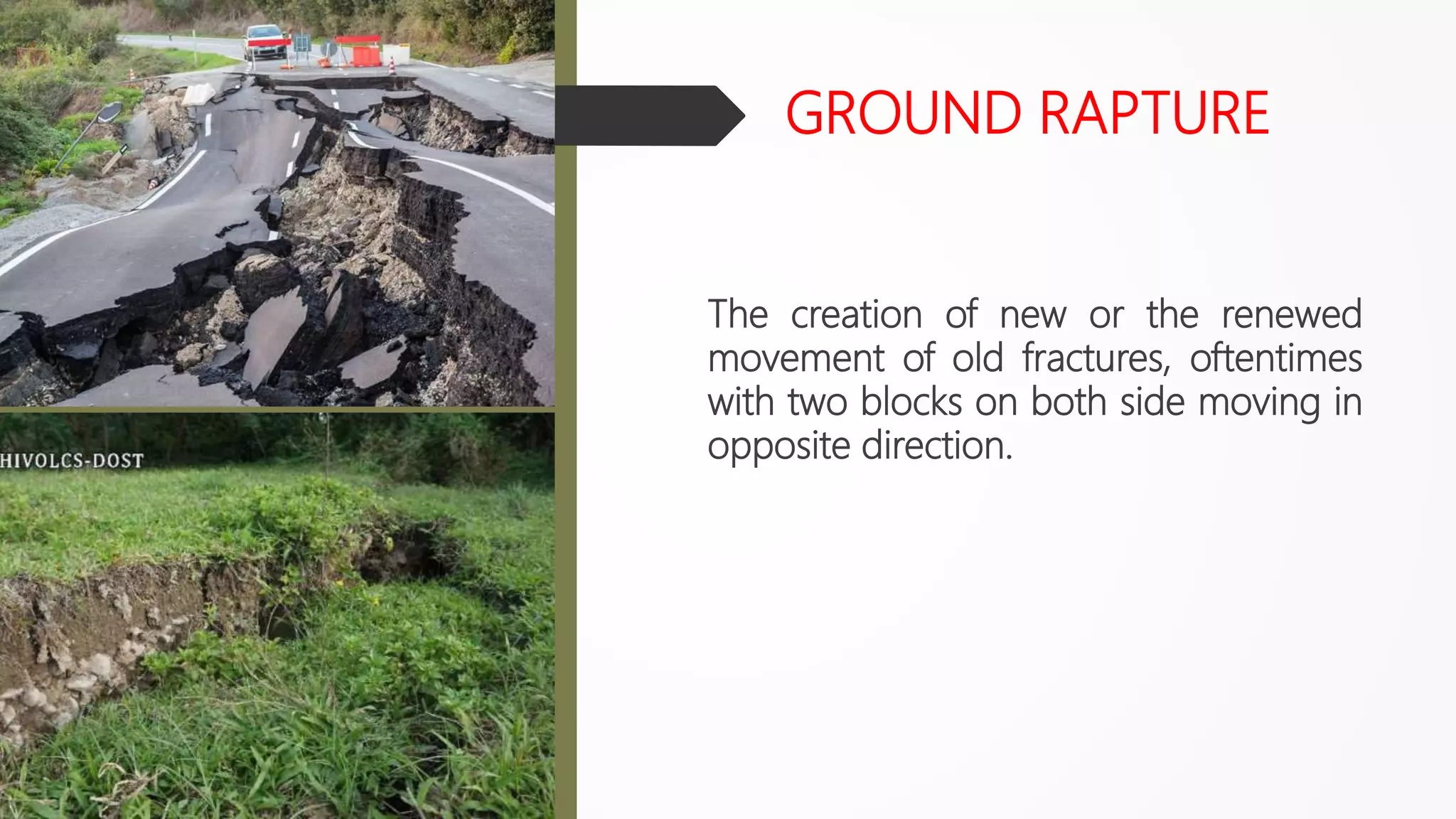
GROUND RAPTURE
The creation of new or the renewed
movement of old fractures, oftentimes
with two blocks on both side moving in
opposite direction.
How Ground Raptures Form
 An earthquake is generated when fault moves, as its frictional
resistance could not match the large amount of accumulated
stress related to plate motion.
 The lithosphere breaks when its strength is overcome by the
large amount of stress applied. Rock failure that involves the
slipping of lithosphere blocks past each other is called faulting.
 When an earthquake is strong enough, faulting initiated at
depths may breach the earth 'surface to from ground raptures.
Liquefaction
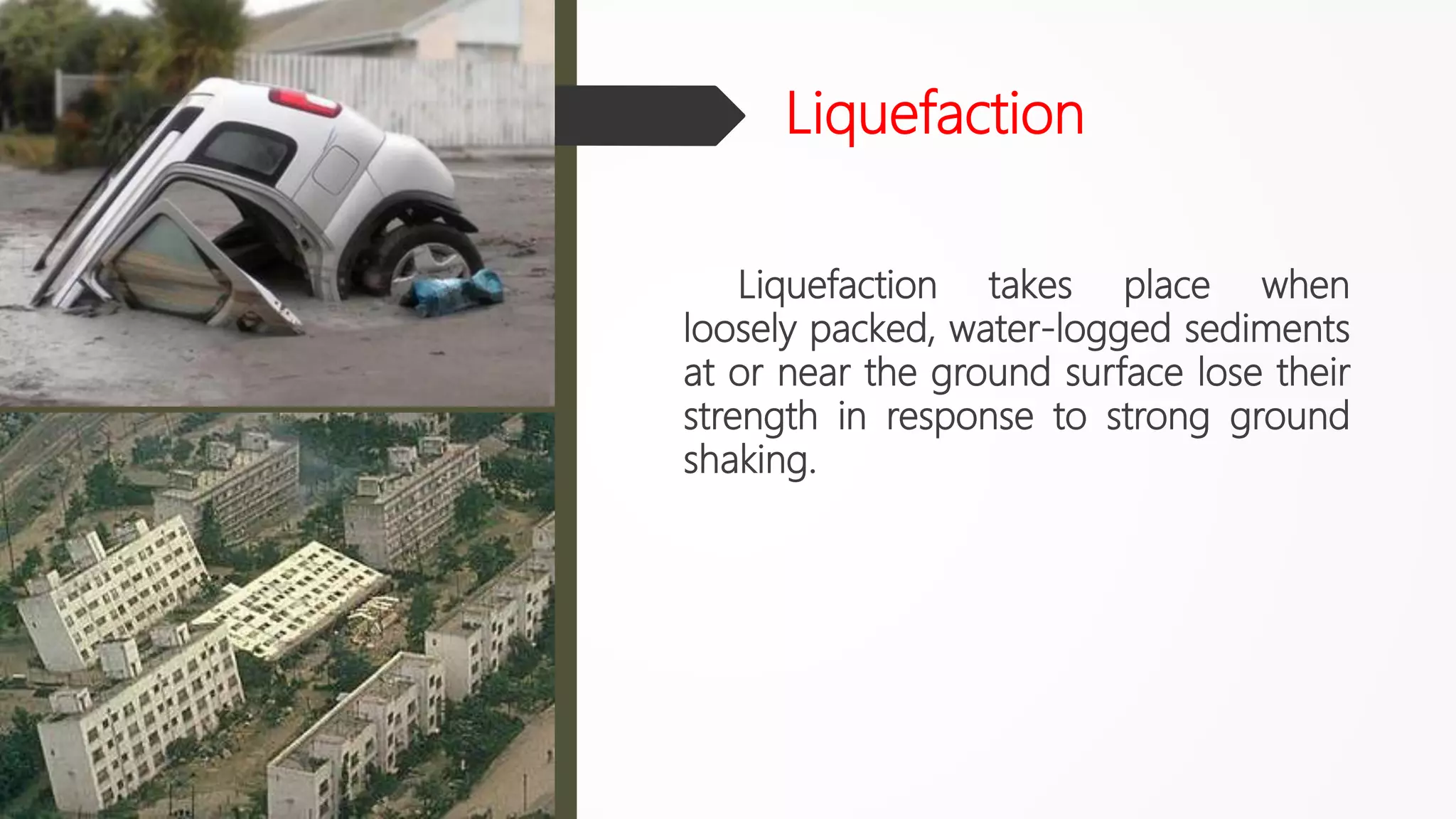
Liquefaction takes place when
loosely packed, water-logged sediments
at or near the ground surface lose their
strength in response to strong ground
shaking.
How Does Liquefaction Occur?
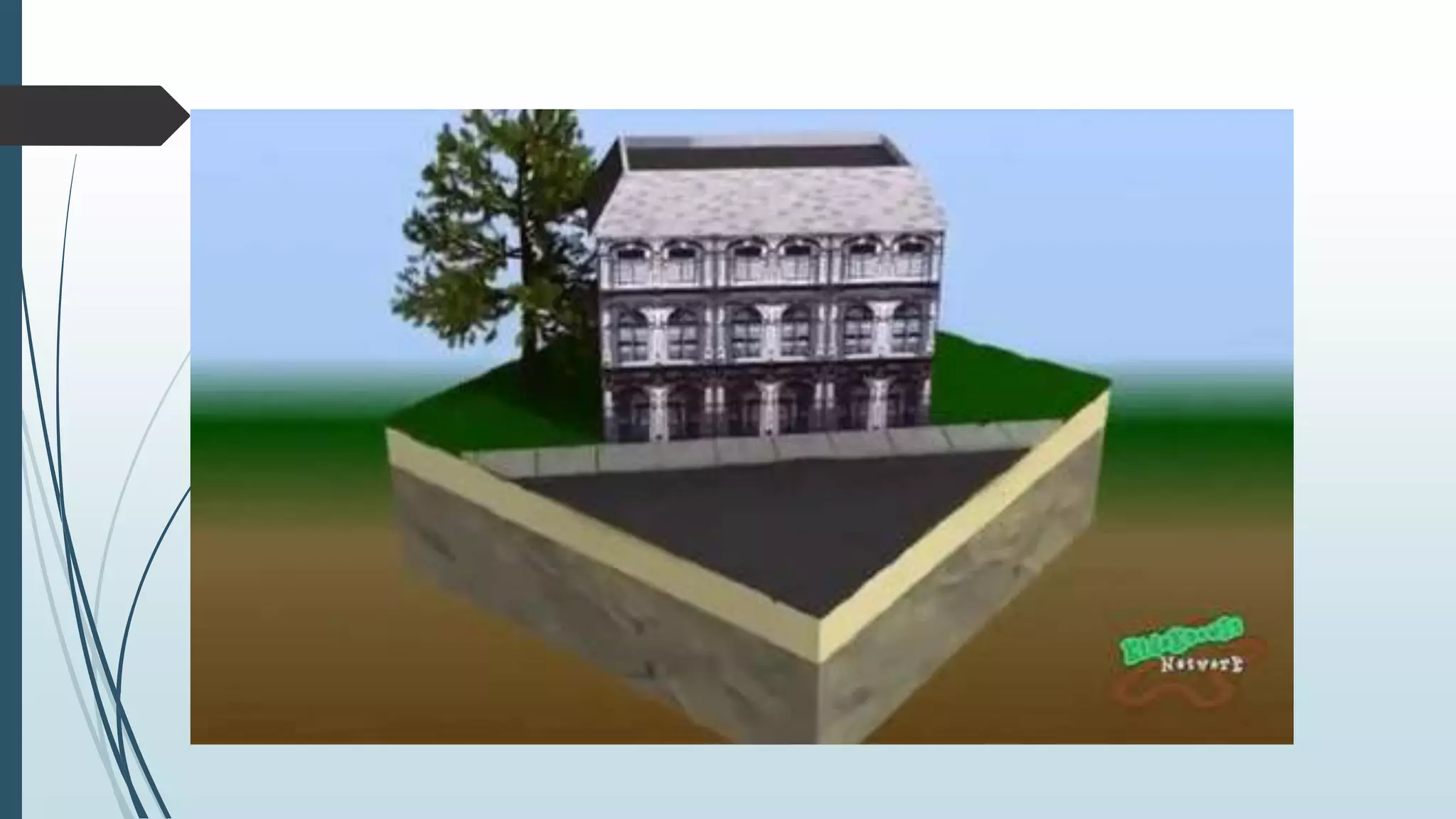
 When the ground shakes, some areas especially those made of wet fine sand are
subjected to liquefaction.
 The shaking caused by the passing of seismic waves, mainly shear or S-wave,
causes loss of equilibrium or disturbance of the granular structure.
 Vibration rearranges sand particles from a loose arrangement of grains into more
compact state.
 This results in increased pore pressure between grains. Once pressure exceeds
the weight of overlying material, water is released and cause the sediment grains
to separate as they are pushed apart.
 The sediments become more mobile and attain a jelly-like consistency. From a
solid state, the sediments are transformed into a liquefied state due to increase in
pore-water pressure.
Types of Liquefaction Features
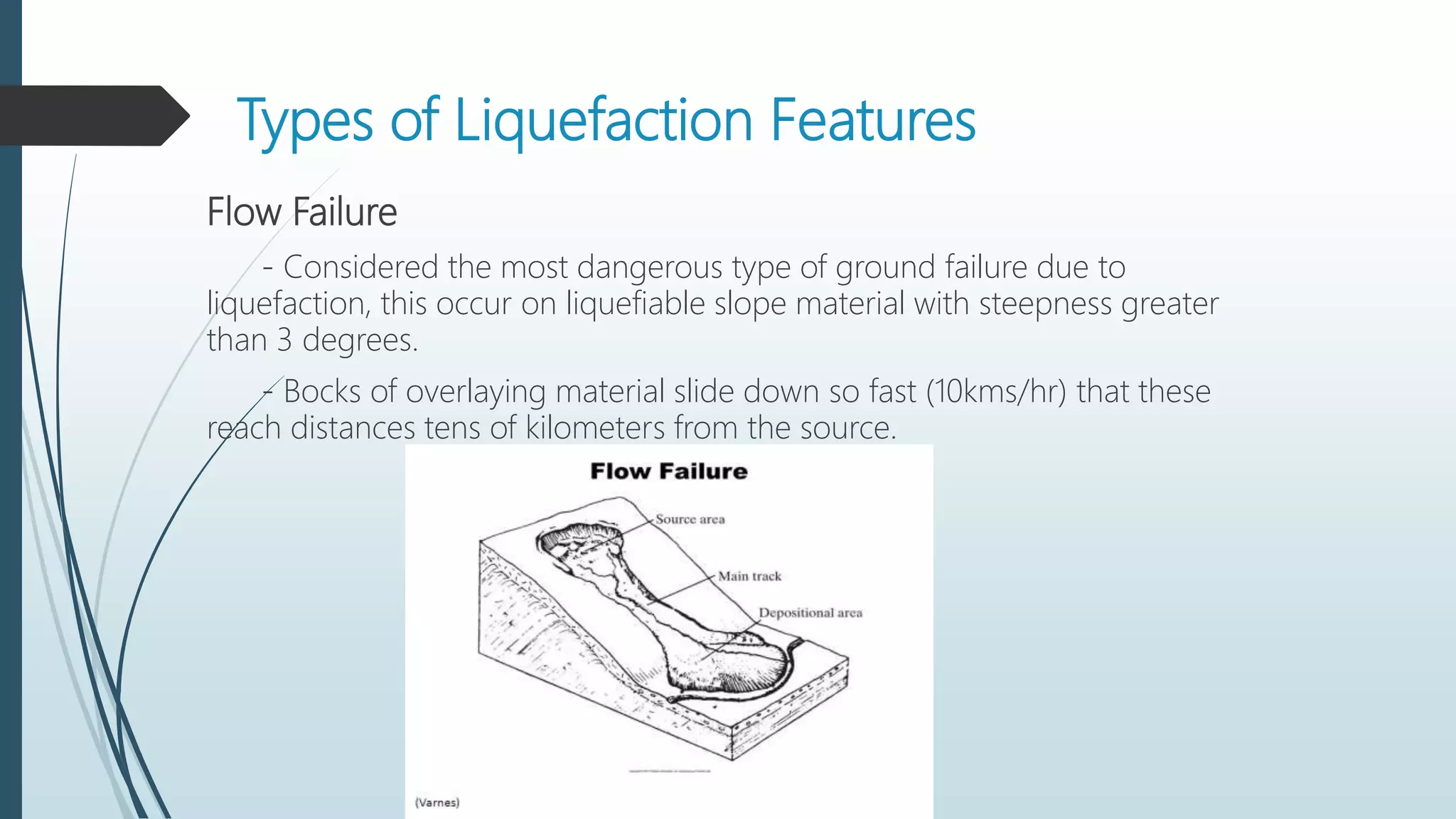
Flow Failure
- Considered the most dangerous type of ground failure due to
liquefaction, this occur on liquefiable slope material with steepness greater
than 3 degrees.
- Bocks of overlaying material slide down so fast (10kms/hr) that these
reach distances tens of kilometers from the source.
Types of Liquefaction Features
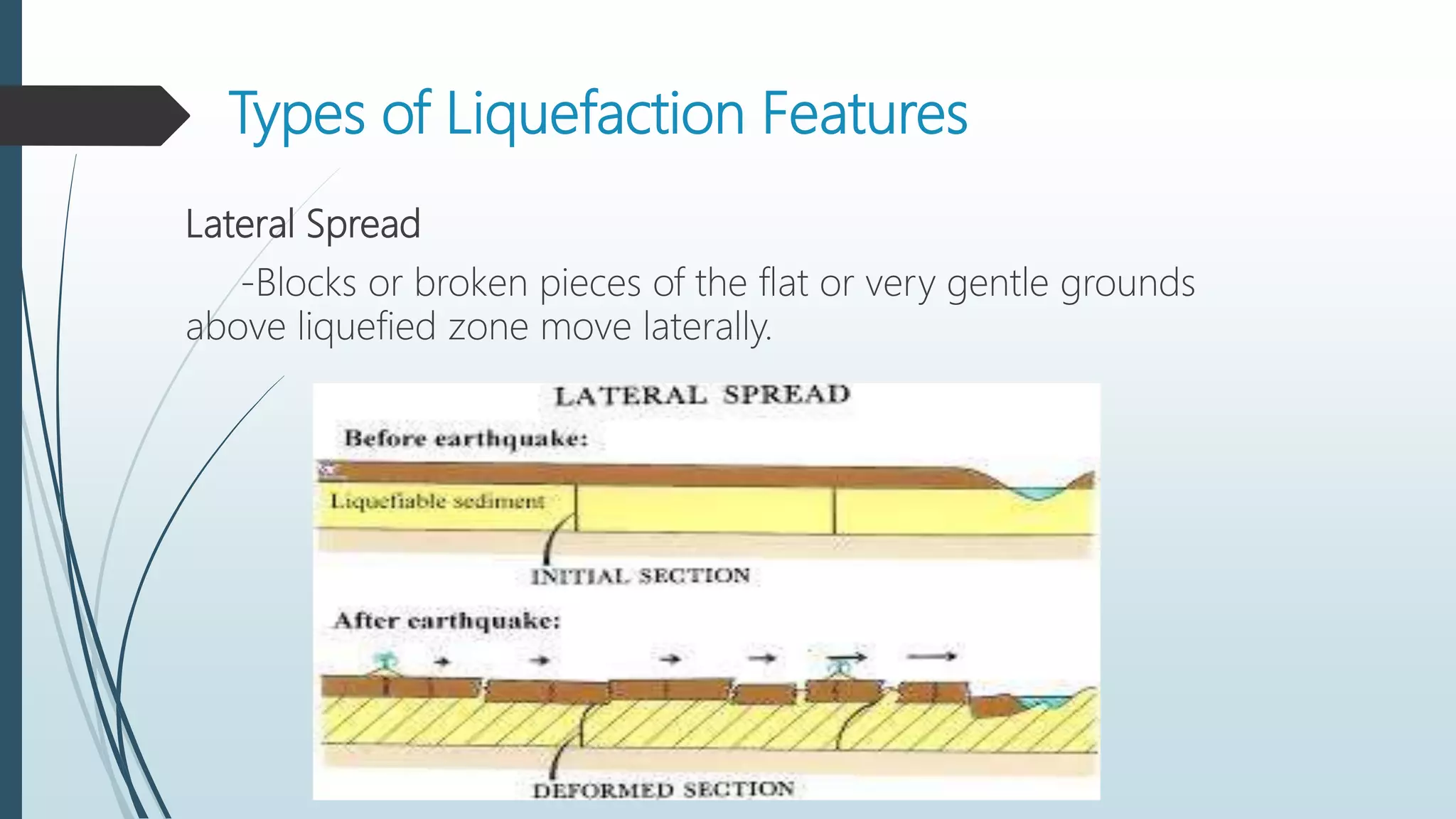
Lateral Spread
-Blocks or broken pieces of the flat or very gentle grounds
above liquefied zone move laterally.
Types of Liquefaction Features
Ground Oscillation
- Due to the flat or nearly flat slope, the ground is unable to spreads
and instead oscillates like a wave. Water and wet sand are ejected through
the fissures that form conical-shape mounds of sand at the surface.
Types of Liquefaction Features
Loss of Bearing Strength
- Loss of strength of sediments resulting in
tilting of houses and floating of buoyant
structures that are anchored on the liquefied
zone.
Earthquake-Induced
Landslide
Why Landslide Occur
 A change in the stability of a slope can be caused by a number of factors acting
together or alone.
1. Removal of Support – at the based of a slope which may be due to erosion at the toe
of a slope by rivers or ocean waves.
2. Groundwater (pore water) pressure – during sudden changes in he water level of
bodies of water adjacent to a slope also acts to destabilize it.
3. Volcanic Eruption. Bulging of slopes and the force of volcanic material ejection or
emission may also contribute to slope instability.
4. Intense rainfall
5. Snowmelt
6. Human Intervention
7. Earthquakes
Types of Landslide
Topples
- Occur suddenly when a massive part of every steep slopes break
loose and rotate forward.
Types of Landslide
Rock Falls
- Involve chunks of detached rock that fall freely from some distance or
bounce and roll down the steep slope.
Types of
Landslide
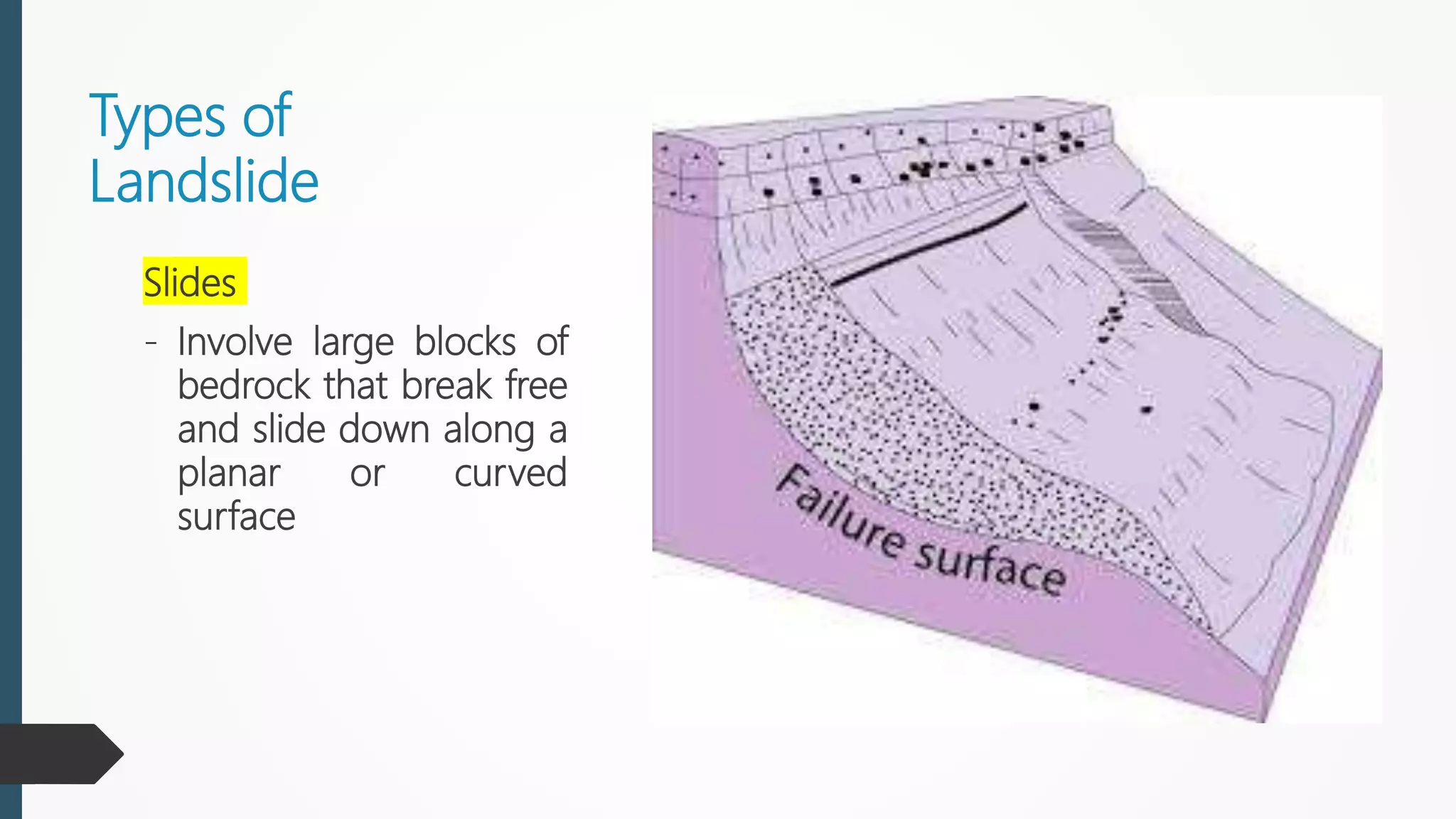
Slides
- Involve large blocks of
bedrock that break free
and slide down along a
planar or curved
surface
Types of
Landslide
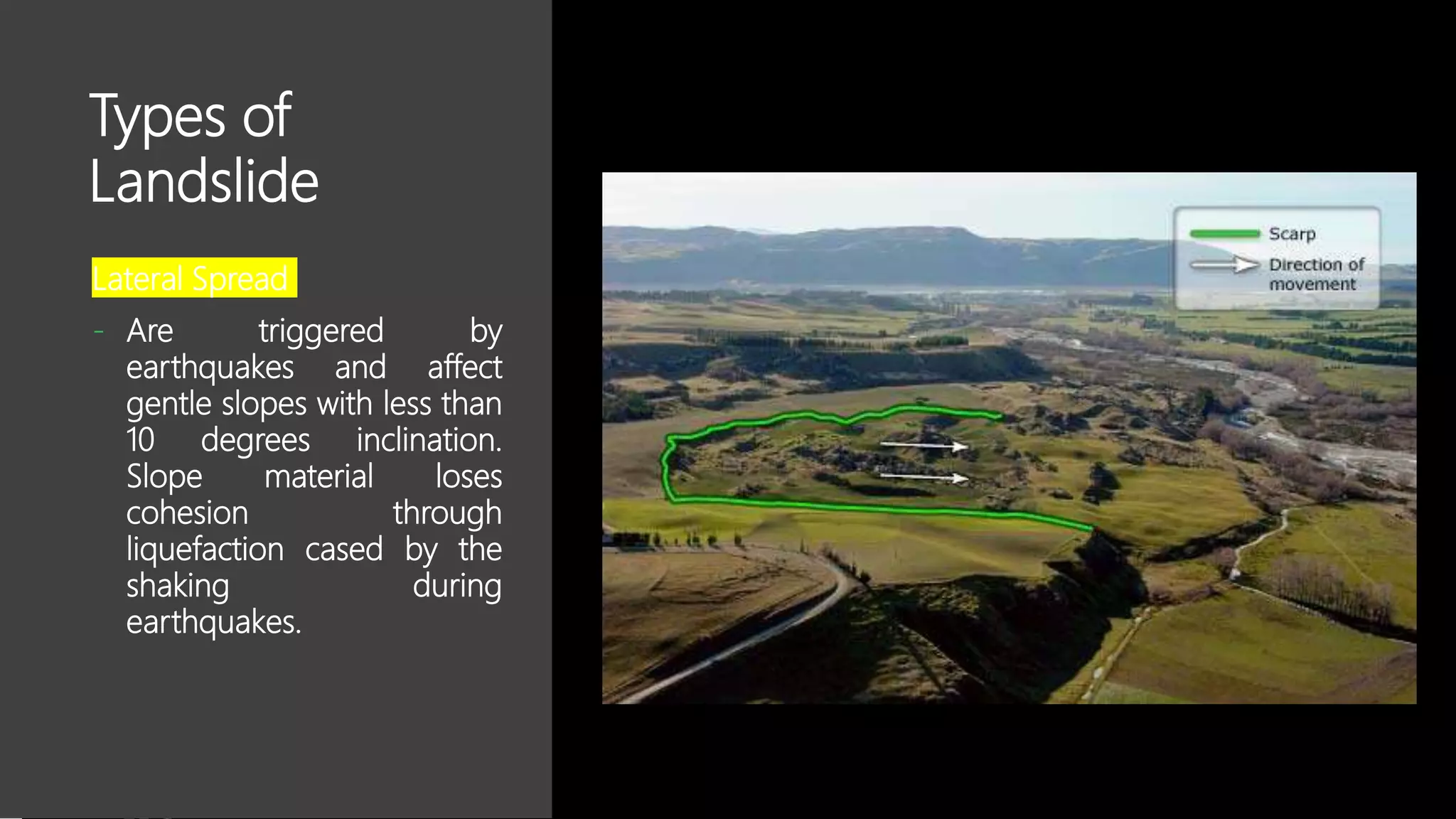
Lateral Spread
- Are triggered by
earthquakes and affect
gentle slopes with less than
10 degrees inclination.
Slope material loses
cohesion through
liquefaction cased by the
shaking during
earthquakes.
Types of Landslide
Flows
- Involve downslope motion of fine grained clay, silt, and fine sand made
mobile by water saturation. These flows include mudflows and earthflows
and are common during rainy season.
Landslide Warning Signs
1. Springs, seeps, or saturated ground in areas that have not typically been
wet before.
2. New cracks or unusual bulges in the ground, street pavements or
sidewalks.
3. Soil moving away from foundations.
4. Ancillary structures such as decks and patios tilting and/or moving relative
to the main house.
5. Tilting or cracking of concrete floors and foundations.
6. Broken water lines and other underground utilities.
7. Leaning telephone poles, trees, retaining walls or fences.
Landslide Warning Signs
8. Offset fence lines.
9. Sunken or down-dropped road beds.
10. Rapid increase in creek water levels, possibly accompanied by increased
turbidity (soil content).
11. Sudden decrease in creek water levels though rain is still falling or just
recently stopped.
12. Sticking doors and windows, and visible open spaces indicating jambs
and frames out of plumb.
13. A faint rumbling sound that increases in volume is noticeable as the
landslide nears.
14. Unusual sounds, such as trees cracking or boulders knocking together,
might indicate moving debris.
Areas that are generally prone to landslide
hazards:
1. On existing old landslides.
2. On or at the base of slopes.
3. In or at the base of minor drainage hollows.
4. At the base or top of an old fill slope.
5. At the base or top of a steep cut slope.
6. Developed hillsides where leach field septic systems are used
What To Do Before a Landslide
 Do not build near steep slopes, close to mountain edges, near
drainage ways, or natural erosion valleys.
 Get a ground assessment of your property.
 Contact local officials, state geological surveys or departments
of natural resources, and university departments of geology.
Landslides occur where they have before, and in identifiable
hazard locations. Ask for information on landslides in your area,
specific information on areas vulnerable to landslides, and
request a professional referral for a very detailed site analysis of
your property, and corrective measures you can take, if
necessary.
What To Do Before a Landslide
 Watch the patterns of storm-water drainage near your home, and note the
places where runoff water converges, increasing flow in channels. These
are areas to avoid during a storm.
 Learn about the emergency-response and evacuation plans for your area.
Develop your own emergency plan for your family or business.
 Minimize home hazards:
• Have flexible pipe fittings installed to avoid gas or water leaks, as flexible fittings
are more resistant to breakage (only the gas company or professionals should
install gas fittings).
• Plant ground cover on slopes and build retaining walls.
• In mudflow areas, build channels or deflection walls to direct the flow around
buildings. Remember: If you build walls to divert debris flow and the flow lands on
a neighbor's property, you may be liable for damages.
What To Do During a Landslide
 Stay alert and awake. Many debris-flow fatalities occur when people are
sleeping. Listen to a NOAA Weather Radio or portable, battery-powered
radio or television for warnings of intense rainfall. Be aware that intense,
short bursts of rain may be particularly dangerous, especially after
longer periods of heavy rainfall and damp weather.
 If you are in areas susceptible to landslides and debris flows, consider
leaving if it is safe to do so. Remember that driving during an intense
storm can be hazardous. If you remain at home, move to a second story
if possible. Staying out of the path of a landslide or debris flow saves
lives.
 Listen for any unusual sounds that might indicate moving debris, such as
trees cracking or boulders knocking together. A trickle of flowing or
falling mud or debris may precede larger landslides. Moving debris can
flow quickly and sometimes without warning.
What To Do During a Landslide
 If you are near a stream or channel, be alert for any sudden
increase or decrease in water flow and for a change from clear to
muddy water. Such changes may indicate landslide activity
upstream, so be prepared to move quickly. Don't delay! Save
yourself, not your belongings.
 Be especially alert when driving. Bridges may be washed out, and
culverts overtopped. Do not cross flooding streams!! Turn Around,
Don't Drown®!. Embankments along roadsides are particularly
susceptible to landslides. Watch the road for collapsed pavement,
mud, fallen rocks, and other indications of possible debris flows.
 Be aware that strong shaking from earthquakes can induce or
intensify the effects of landslides.
What To Do After a Landslide
1. Stay away from the slide area. There may be danger of additional slides.
2. Listen to local radio or television stations for the latest emergency
information.
3. Watch for flooding, which may occur after a landslide or debris flow. Floods
sometimes follow landslides and debris flows because they may both be
started by the same event.
4. Check for injured and trapped persons near the slide, without entering the
direct slide area. Direct rescuers to their locations.
5. Help a neighbor who may require special assistance - infants, elderly people,
and people with disabilities. Elderly people and people with disabilities may
require additional assistance. People who care for them or who have large
families may need additional assistance in emergency situations.
What To Do After a Landslide
6. Look for and report broken utility lines and damaged roadways and
railways to appropriate authorities. Reporting potential hazards will get the
utilities turned off as quickly as possible, preventing further hazard and
injury.
7. Check the building foundation, chimney, and surrounding land for damage.
Damage to foundations, chimneys, or surrounding land may help you
assess the safety of the area.
8. Replant damaged ground as soon as possible since erosion caused by loss
of ground cover can lead to flash flooding and additional landslides in the
near future.
9. Seek advice from a geotechnical expert for evaluating landslide hazards or
designing corrective techniques to reduce landslide risk. A professional will
be able to advise you of the best ways to prevent or reduce landslide risk,
without creating further hazard.
Tsunamis
 Travel 20-30 miles per hour with waves 10-
100 feet high.
 Causes flooding and disrupt transportation,
power, communications, and the water
supply.
Tsunami Generation
 A tsunami may occur when ocean water is displaced
suddenly causing the formation of waves that reach the
shore in large heights. The movement of an offshore fault
during an earthquake may trigger displacement of ocean
water if accompanied by an uplift of the seabed.
 This causes a piece of seabed to be pushed up unto the
overlying ocean. The water above is displaced or pushed up,
triggering waves to be formed.
Causes of Tsunami
 Landslide
 Volcanic eruption or explosion
 Meteorite Impact
Signs of Impending Tsunami
 Drawback - when the ocean recedes drastically or the water level falls
unusually along the shoreline.
 Change in Animal Behavior
 Sound similar to incoming train
IF YOU ARE UNDER A TSUNAMI WARNING:
 First, protect yourself from an Earthquake. Drop, Cover, then Hold
On.
 Get to high ground as far inland as possible.
 Be alert to signs of a tsunami, such as a sudden rise or draining of
ocean waters.
 Listen to emergency information and alerts.
 Evacuate: DO NOT wait! Leave as soon as you see any natural
signs of a tsunami or receive an official tsunami warning.
 If you are in a boat, go out to sea.
HOW TO STAY SAFE WHEN A TSUNAMI
THREATENS
Prepare NOW
 If you live near, or regularly visit a coastal area, learn about the risk of
tsunami in the area. Some at-risk communities have maps with evacuation
zones and routes. If you are a visitor, ask about community plans.
 Learn the signs of a potential tsunami, such as an earthquake, a loud roar
from the ocean, or unusual ocean behavior, such as a sudden rise or wall of
water or sudden draining of water showing the ocean floor.
 Know and practice community evacuation plans and map out your routes
from home, work, and play. Pick shelters 100 feet or more above sea level, or
at least one mile inland.
HOW TO STAY SAFE WHEN A TSUNAMI
THREATENS
Prepare NOW
 Create a family emergency communication plan that has an out-of-state contact.
Plan where to meet if you get separated.
 Sign up for your community’s warning system. The Emergency Alert System (EAS)
and National Oceanic and Atmospheric Administration (NOAA) Weather Radio also
provide emergency alerts.
 Consider earthquake insurance and a flood insurance policy through the National
Flood Insurance Program (NFIP). Standard homeowner’s insurance does not cover
flood or earthquake damage
HOW TO STAY SAFE WHEN A TSUNAMI
THREATENS
Survive DURING
 If you are in a tsunami area and there is an earthquake, then first protect
yourself from the earthquake. Drop, Cover, and Hold On. Drop to your
hands and knees. Cover your head and neck with your arms. Hold on to any
sturdy furniture until the shaking stops. Crawl only if you can reach better
cover, but do not go through an area with more debris.
 When the shaking stops, if there are natural signs or official warnings of a
tsunami, then move immediately to a safe place as high and as far inland as
possible. Listen to the authorities, but do not wait for tsunami warnings and
evacuation orders.
HOW TO STAY SAFE WHEN A TSUNAMI
THREATENS
Survive DURING
 If you are outside of the tsunami hazard zone and receive a warning,
then stay where you are unless officials tell you otherwise.
 Leave immediately if you are told to do so. Evacuation routes are
often marked by a wave with an arrow in the direction of higher
ground.
 If you are in the water, then grab onto something that floats, such as a
raft, tree trunk, or door.
 If you are in a boat, then face the direction of the waves and head out
to sea. If you are in a harbor, then go inland.
HOW TO STAY SAFE WHEN A TSUNAMI
THREATENS
Be Safe AFTER
 Listen to local alerts and authorities for information on areas to
avoid and shelter locations.
 Avoid wading in floodwater, which can contain dangerous
debris. Water may be deeper than it appears.
 Be aware of the risk of electrocution. Underground or downed
power lines can electrically charge water. Do not touch electrical
equipment if it is wet or if you are standing in water.
HOW TO STAY SAFE WHEN A TSUNAMI
THREATENS
Be Safe AFTER
 Stay away from damaged buildings, roads, and bridges.
 Document property damage with photographs. Conduct an
inventory and contact your insurance company for assistance.
 Save phone calls for emergencies. Phone systems are often
down or busy after a disaster. Use text messages or social media
to communicate with family and friends.
What Should I Do Before, During, And
After An Earthquake?
 What to Do Before an Earthquake
1. Make sure you have a fire extinguisher, first aid kit, a battery-powered radio, a
flashlight, and extra batteries at home.
2. Learn first aid.
3. Learn how to turn off the gas, water, and electricity.
4. Make up a plan of where to meet your family after an earthquake.
5. Don't leave heavy objects on shelves (they'll fall during a quake).
6. Anchor heavy furniture, cupboards, and appliances to the walls or floor.
7. Learn the earthquake plan at your school or workplace.
What Should I Do Before, During, And
After An Earthquake?
 What to Do During an Earthquake
DROP to the ground; take COVER by getting under a sturdy table or other piece of furniture;
and HOLD ON until the shaking stops. If there isn’t a table or desk near you, cover your face
and head with your arms and crouch in an inside corner of the building.
1. Stay calm! If you're indoors, stay inside. If you're outside, stay outside.
2. If you're indoors, stand against a wall near the center of the building, stand in a
doorway, or crawl under heavy furniture (a desk or table). Stay away from windows
and outside doors.
3. If you're outdoors, stay in the open away from power lines or anything that might
fall. Stay away from buildings (stuff might fall off the building or the building could
fall on you).
4. Don't use matches, candles, or any flame. Broken gas lines and fire don't mix.
5. If you're in a car, stop the car and stay inside the car until the earthquake stops.
6. Don't use elevators (they'll probably get stuck anyway).
What Should I Do Before, During, And
After An Earthquake?
 What to Do After an Earthquake
1. Check yourself and others for injuries. Provide first aid for anyone who needs
it.
2. Check water, gas, and electric lines for damage. If any are damaged, shut off
the valves. Check for the smell of gas. If you smell it, open all the windows and
doors, leave immediately, and report it to the authorities (use someone else's
phone).
3. Turn on the radio. Don't use the phone unless it's an emergency.
4. Stay out of damaged buildings.
5. Be careful around broken glass and debris. Wear boots or sturdy shoes to keep
from cutting your feet.
What Should I Do Before, During, And
After An Earthquake?
 What to Do After an Earthquake
6. Be careful of chimneys (they may fall on you).
7. Stay away from beaches. Tsunamis and seiches sometimes hit after the
ground has stopped shaking.
8. Stay away from damaged areas.
9. If you're at school or work, follow the emergency plan or the instructions of
the person in charge.
10. Expect aftershocks.
References:
BOOK: DRRR (Rolly Rimando and Josefina Belen)
https://www.usgs.gov/natural-hazards/landslide-hazards/science/landslide-
preparedness?qt-science_center_objects=0#qt-science_center_objects
https://www.ready.gov/tsunamis
https://www.redcross.org/get-help/how-to-prepare-for-emergencies/types-of-
emergencies/tsunami.html
https://edition.cnn.com/2016/11/13/world/tsunami-what-to-do/index.html
http://www.geo.mtu.edu/UPSeis/bda.html
https://www.ses.vic.gov.au/get-ready/quakesafe/what-to-do-in-an-earthquake
https://www.phivolcs.dost.gov.ph/index.php/tsunami/tsunami-advisory-and-warning3

DRRR - Earthquake Hazards

  • 1.
    DISASTER READINESS AND RISKREDUCTION SHS CORE SUBJECT 80 HOURSE/SEMESTER PREREQUISITE: GRADE 3 – 10 SCIENCE Sir Dexter B. Cargullo CHS,Tabaco City
  • 2.
  • 3.
    WHAT IS ANEARTHQUAKE? “The perceptible shaking of the surface of the Earth, resulting from sudden release of energy in the Earth’s crust that creates seismic waves.” (United States Geological Science-USGS)
  • 4.
    The Earth Our planetis DYNAMIC The outermost layer of the earth is broken into pieces. These pieces called “plates” are moving, away or toward each other.
  • 5.
    How Do PlatesMove? New parts of a plate rise because they are warm and the plate is thin. As hot magma rises to the surface at spreading ridges and forms new crust, the new crust pushes the rest of a plate out of its way. This is called ridge push. Plates at our planet’s surface move because of the intense heat in the Earth’s core that causes molten rock in the mantle layer to move. It moves in a pattern called a convection cell that forms when warm material rises, cools, and eventually sink down. As the cooled material sinks down, it is warmed and rises again.
  • 6.
    Types of NaturalEarthquakes 1.Tectonic - Earthquake produces by sudden movement along faults and plate boundaries. 2. Volcanic - Earthquakes produces by movement of magma beneath volcanoes.
  • 7.
    Ways of describingthe strength of an earthquake: 1. Intensity - perceived strength of an earthquake based on relative effect to people and structures; generally higher near the epicenter. 2. Magnitude - based on instrumentally derived information and correlated strength with the amount of total energy released at the earthquake’s point of origin.
  • 8.
    Earthquakes Hazards 1. Groundshaking or Ground motion 2.Ground surface rapture 3.Liquefication 4.Tsunami 5.Earthquake induced landslide
  • 9.
    Ground Shaking (Vibration) Itrefers to what we feel when energy built up by the application of stress to the lithosphere is released by faulting during earthquake. Technically, it refers to the disruptive up and down and sideways motion experienced during an earthquake.
  • 10.
    How Earthquake Vibrationsare Generated? Most natural earthquakes are cased by sudden slippage along fault zone. A fault is a fracture on which one body of rock slides past another. Slippage along a fault is hindered because there are irregularities on the fault plane. If it were smooth, blocks on opposite sides of fault will just slide past each other continuously.
  • 12.
    How Seismic Movementproduced Earthquake Waves Youtube: How Seismic Movement produced Earthquake Waves
  • 13.
    Types of SeismicWaves  Primary Waves The fastest seismic waves are called primary waves, or P waves. These waves are the first to reach any particular location after an earthquake occurs. Primary waves travel through Earth’s crust at an average speed of about 5 kilometers per second (3 mi/s). Primary waves can travel through solids, liquids, and gases. As they pass through a material, the particles of the material are slightly pushed together and pulled apart. Buildings also experience this push and pull as primary waves pass through the ground they are built on.
  • 15.
    Types of SeismicWaves  Secondary Waves Secondary waves are the second seismic waves to arrive at any particular location after an earthquake, though they start at the same time as primary waves. Secondary waves travel through Earth’s interior at about half the speed of primary waves. As they pass through a material, the material’s particles are shaken up and down or from side to side, shaking small buildings back and forth as they pass. Secondary waves can travel through rock, but unlike primary waves they cannot travel through liquids or gases.
  • 17.
    Types of SeismicWaves  Surface Waves Surface waves are seismic waves that move along Earth’s surface, not through its interior. They make the ground roll up and down or shake from side to side. Surface waves cause the largest ground movements and the most damage. Surface waves travel more slowly than the other types of seismic waves.
  • 18.
  • 19.
  • 20.
    How Ground Shakingis Measured?  The strength of ground shaking is measured in terms of: 1. Velocity 2. Acceleration 3. Frequency content of shaking 4. Duration (How long the shaking continues)
  • 21.
    GROUND RAPTURE The creationof new or the renewed movement of old fractures, oftentimes with two blocks on both side moving in opposite direction.
  • 22.
    How Ground RapturesForm  An earthquake is generated when fault moves, as its frictional resistance could not match the large amount of accumulated stress related to plate motion.  The lithosphere breaks when its strength is overcome by the large amount of stress applied. Rock failure that involves the slipping of lithosphere blocks past each other is called faulting.  When an earthquake is strong enough, faulting initiated at depths may breach the earth 'surface to from ground raptures.
  • 23.
    Liquefaction Liquefaction takes placewhen loosely packed, water-logged sediments at or near the ground surface lose their strength in response to strong ground shaking.
  • 25.
    How Does LiquefactionOccur?  When the ground shakes, some areas especially those made of wet fine sand are subjected to liquefaction.  The shaking caused by the passing of seismic waves, mainly shear or S-wave, causes loss of equilibrium or disturbance of the granular structure.  Vibration rearranges sand particles from a loose arrangement of grains into more compact state.  This results in increased pore pressure between grains. Once pressure exceeds the weight of overlying material, water is released and cause the sediment grains to separate as they are pushed apart.  The sediments become more mobile and attain a jelly-like consistency. From a solid state, the sediments are transformed into a liquefied state due to increase in pore-water pressure.
  • 26.
    Types of LiquefactionFeatures Flow Failure - Considered the most dangerous type of ground failure due to liquefaction, this occur on liquefiable slope material with steepness greater than 3 degrees. - Bocks of overlaying material slide down so fast (10kms/hr) that these reach distances tens of kilometers from the source.
  • 27.
    Types of LiquefactionFeatures Lateral Spread -Blocks or broken pieces of the flat or very gentle grounds above liquefied zone move laterally.
  • 28.
    Types of LiquefactionFeatures Ground Oscillation - Due to the flat or nearly flat slope, the ground is unable to spreads and instead oscillates like a wave. Water and wet sand are ejected through the fissures that form conical-shape mounds of sand at the surface.
  • 29.
    Types of LiquefactionFeatures Loss of Bearing Strength - Loss of strength of sediments resulting in tilting of houses and floating of buoyant structures that are anchored on the liquefied zone.
  • 30.
  • 31.
    Why Landslide Occur A change in the stability of a slope can be caused by a number of factors acting together or alone. 1. Removal of Support – at the based of a slope which may be due to erosion at the toe of a slope by rivers or ocean waves. 2. Groundwater (pore water) pressure – during sudden changes in he water level of bodies of water adjacent to a slope also acts to destabilize it. 3. Volcanic Eruption. Bulging of slopes and the force of volcanic material ejection or emission may also contribute to slope instability. 4. Intense rainfall 5. Snowmelt 6. Human Intervention 7. Earthquakes
  • 32.
    Types of Landslide Topples -Occur suddenly when a massive part of every steep slopes break loose and rotate forward.
  • 33.
    Types of Landslide RockFalls - Involve chunks of detached rock that fall freely from some distance or bounce and roll down the steep slope.
  • 34.
    Types of Landslide Slides - Involvelarge blocks of bedrock that break free and slide down along a planar or curved surface
  • 35.
    Types of Landslide Lateral Spread -Are triggered by earthquakes and affect gentle slopes with less than 10 degrees inclination. Slope material loses cohesion through liquefaction cased by the shaking during earthquakes.
  • 36.
    Types of Landslide Flows -Involve downslope motion of fine grained clay, silt, and fine sand made mobile by water saturation. These flows include mudflows and earthflows and are common during rainy season.
  • 37.
    Landslide Warning Signs 1.Springs, seeps, or saturated ground in areas that have not typically been wet before. 2. New cracks or unusual bulges in the ground, street pavements or sidewalks. 3. Soil moving away from foundations. 4. Ancillary structures such as decks and patios tilting and/or moving relative to the main house. 5. Tilting or cracking of concrete floors and foundations. 6. Broken water lines and other underground utilities. 7. Leaning telephone poles, trees, retaining walls or fences.
  • 38.
    Landslide Warning Signs 8.Offset fence lines. 9. Sunken or down-dropped road beds. 10. Rapid increase in creek water levels, possibly accompanied by increased turbidity (soil content). 11. Sudden decrease in creek water levels though rain is still falling or just recently stopped. 12. Sticking doors and windows, and visible open spaces indicating jambs and frames out of plumb. 13. A faint rumbling sound that increases in volume is noticeable as the landslide nears. 14. Unusual sounds, such as trees cracking or boulders knocking together, might indicate moving debris.
  • 39.
    Areas that aregenerally prone to landslide hazards: 1. On existing old landslides. 2. On or at the base of slopes. 3. In or at the base of minor drainage hollows. 4. At the base or top of an old fill slope. 5. At the base or top of a steep cut slope. 6. Developed hillsides where leach field septic systems are used
  • 40.
    What To DoBefore a Landslide  Do not build near steep slopes, close to mountain edges, near drainage ways, or natural erosion valleys.  Get a ground assessment of your property.  Contact local officials, state geological surveys or departments of natural resources, and university departments of geology. Landslides occur where they have before, and in identifiable hazard locations. Ask for information on landslides in your area, specific information on areas vulnerable to landslides, and request a professional referral for a very detailed site analysis of your property, and corrective measures you can take, if necessary.
  • 41.
    What To DoBefore a Landslide  Watch the patterns of storm-water drainage near your home, and note the places where runoff water converges, increasing flow in channels. These are areas to avoid during a storm.  Learn about the emergency-response and evacuation plans for your area. Develop your own emergency plan for your family or business.  Minimize home hazards: • Have flexible pipe fittings installed to avoid gas or water leaks, as flexible fittings are more resistant to breakage (only the gas company or professionals should install gas fittings). • Plant ground cover on slopes and build retaining walls. • In mudflow areas, build channels or deflection walls to direct the flow around buildings. Remember: If you build walls to divert debris flow and the flow lands on a neighbor's property, you may be liable for damages.
  • 42.
    What To DoDuring a Landslide  Stay alert and awake. Many debris-flow fatalities occur when people are sleeping. Listen to a NOAA Weather Radio or portable, battery-powered radio or television for warnings of intense rainfall. Be aware that intense, short bursts of rain may be particularly dangerous, especially after longer periods of heavy rainfall and damp weather.  If you are in areas susceptible to landslides and debris flows, consider leaving if it is safe to do so. Remember that driving during an intense storm can be hazardous. If you remain at home, move to a second story if possible. Staying out of the path of a landslide or debris flow saves lives.  Listen for any unusual sounds that might indicate moving debris, such as trees cracking or boulders knocking together. A trickle of flowing or falling mud or debris may precede larger landslides. Moving debris can flow quickly and sometimes without warning.
  • 43.
    What To DoDuring a Landslide  If you are near a stream or channel, be alert for any sudden increase or decrease in water flow and for a change from clear to muddy water. Such changes may indicate landslide activity upstream, so be prepared to move quickly. Don't delay! Save yourself, not your belongings.  Be especially alert when driving. Bridges may be washed out, and culverts overtopped. Do not cross flooding streams!! Turn Around, Don't Drown®!. Embankments along roadsides are particularly susceptible to landslides. Watch the road for collapsed pavement, mud, fallen rocks, and other indications of possible debris flows.  Be aware that strong shaking from earthquakes can induce or intensify the effects of landslides.
  • 44.
    What To DoAfter a Landslide 1. Stay away from the slide area. There may be danger of additional slides. 2. Listen to local radio or television stations for the latest emergency information. 3. Watch for flooding, which may occur after a landslide or debris flow. Floods sometimes follow landslides and debris flows because they may both be started by the same event. 4. Check for injured and trapped persons near the slide, without entering the direct slide area. Direct rescuers to their locations. 5. Help a neighbor who may require special assistance - infants, elderly people, and people with disabilities. Elderly people and people with disabilities may require additional assistance. People who care for them or who have large families may need additional assistance in emergency situations.
  • 45.
    What To DoAfter a Landslide 6. Look for and report broken utility lines and damaged roadways and railways to appropriate authorities. Reporting potential hazards will get the utilities turned off as quickly as possible, preventing further hazard and injury. 7. Check the building foundation, chimney, and surrounding land for damage. Damage to foundations, chimneys, or surrounding land may help you assess the safety of the area. 8. Replant damaged ground as soon as possible since erosion caused by loss of ground cover can lead to flash flooding and additional landslides in the near future. 9. Seek advice from a geotechnical expert for evaluating landslide hazards or designing corrective techniques to reduce landslide risk. A professional will be able to advise you of the best ways to prevent or reduce landslide risk, without creating further hazard.
  • 46.
    Tsunamis  Travel 20-30miles per hour with waves 10- 100 feet high.  Causes flooding and disrupt transportation, power, communications, and the water supply.
  • 47.
    Tsunami Generation  Atsunami may occur when ocean water is displaced suddenly causing the formation of waves that reach the shore in large heights. The movement of an offshore fault during an earthquake may trigger displacement of ocean water if accompanied by an uplift of the seabed.  This causes a piece of seabed to be pushed up unto the overlying ocean. The water above is displaced or pushed up, triggering waves to be formed.
  • 49.
    Causes of Tsunami Landslide  Volcanic eruption or explosion  Meteorite Impact
  • 50.
    Signs of ImpendingTsunami  Drawback - when the ocean recedes drastically or the water level falls unusually along the shoreline.  Change in Animal Behavior  Sound similar to incoming train
  • 51.
    IF YOU AREUNDER A TSUNAMI WARNING:  First, protect yourself from an Earthquake. Drop, Cover, then Hold On.  Get to high ground as far inland as possible.  Be alert to signs of a tsunami, such as a sudden rise or draining of ocean waters.  Listen to emergency information and alerts.  Evacuate: DO NOT wait! Leave as soon as you see any natural signs of a tsunami or receive an official tsunami warning.  If you are in a boat, go out to sea.
  • 52.
    HOW TO STAYSAFE WHEN A TSUNAMI THREATENS Prepare NOW  If you live near, or regularly visit a coastal area, learn about the risk of tsunami in the area. Some at-risk communities have maps with evacuation zones and routes. If you are a visitor, ask about community plans.  Learn the signs of a potential tsunami, such as an earthquake, a loud roar from the ocean, or unusual ocean behavior, such as a sudden rise or wall of water or sudden draining of water showing the ocean floor.  Know and practice community evacuation plans and map out your routes from home, work, and play. Pick shelters 100 feet or more above sea level, or at least one mile inland.
  • 53.
    HOW TO STAYSAFE WHEN A TSUNAMI THREATENS Prepare NOW  Create a family emergency communication plan that has an out-of-state contact. Plan where to meet if you get separated.  Sign up for your community’s warning system. The Emergency Alert System (EAS) and National Oceanic and Atmospheric Administration (NOAA) Weather Radio also provide emergency alerts.  Consider earthquake insurance and a flood insurance policy through the National Flood Insurance Program (NFIP). Standard homeowner’s insurance does not cover flood or earthquake damage
  • 54.
    HOW TO STAYSAFE WHEN A TSUNAMI THREATENS Survive DURING  If you are in a tsunami area and there is an earthquake, then first protect yourself from the earthquake. Drop, Cover, and Hold On. Drop to your hands and knees. Cover your head and neck with your arms. Hold on to any sturdy furniture until the shaking stops. Crawl only if you can reach better cover, but do not go through an area with more debris.  When the shaking stops, if there are natural signs or official warnings of a tsunami, then move immediately to a safe place as high and as far inland as possible. Listen to the authorities, but do not wait for tsunami warnings and evacuation orders.
  • 55.
    HOW TO STAYSAFE WHEN A TSUNAMI THREATENS Survive DURING  If you are outside of the tsunami hazard zone and receive a warning, then stay where you are unless officials tell you otherwise.  Leave immediately if you are told to do so. Evacuation routes are often marked by a wave with an arrow in the direction of higher ground.  If you are in the water, then grab onto something that floats, such as a raft, tree trunk, or door.  If you are in a boat, then face the direction of the waves and head out to sea. If you are in a harbor, then go inland.
  • 56.
    HOW TO STAYSAFE WHEN A TSUNAMI THREATENS Be Safe AFTER  Listen to local alerts and authorities for information on areas to avoid and shelter locations.  Avoid wading in floodwater, which can contain dangerous debris. Water may be deeper than it appears.  Be aware of the risk of electrocution. Underground or downed power lines can electrically charge water. Do not touch electrical equipment if it is wet or if you are standing in water.
  • 57.
    HOW TO STAYSAFE WHEN A TSUNAMI THREATENS Be Safe AFTER  Stay away from damaged buildings, roads, and bridges.  Document property damage with photographs. Conduct an inventory and contact your insurance company for assistance.  Save phone calls for emergencies. Phone systems are often down or busy after a disaster. Use text messages or social media to communicate with family and friends.
  • 58.
    What Should IDo Before, During, And After An Earthquake?  What to Do Before an Earthquake 1. Make sure you have a fire extinguisher, first aid kit, a battery-powered radio, a flashlight, and extra batteries at home. 2. Learn first aid. 3. Learn how to turn off the gas, water, and electricity. 4. Make up a plan of where to meet your family after an earthquake. 5. Don't leave heavy objects on shelves (they'll fall during a quake). 6. Anchor heavy furniture, cupboards, and appliances to the walls or floor. 7. Learn the earthquake plan at your school or workplace.
  • 59.
    What Should IDo Before, During, And After An Earthquake?  What to Do During an Earthquake DROP to the ground; take COVER by getting under a sturdy table or other piece of furniture; and HOLD ON until the shaking stops. If there isn’t a table or desk near you, cover your face and head with your arms and crouch in an inside corner of the building. 1. Stay calm! If you're indoors, stay inside. If you're outside, stay outside. 2. If you're indoors, stand against a wall near the center of the building, stand in a doorway, or crawl under heavy furniture (a desk or table). Stay away from windows and outside doors. 3. If you're outdoors, stay in the open away from power lines or anything that might fall. Stay away from buildings (stuff might fall off the building or the building could fall on you). 4. Don't use matches, candles, or any flame. Broken gas lines and fire don't mix. 5. If you're in a car, stop the car and stay inside the car until the earthquake stops. 6. Don't use elevators (they'll probably get stuck anyway).
  • 60.
    What Should IDo Before, During, And After An Earthquake?  What to Do After an Earthquake 1. Check yourself and others for injuries. Provide first aid for anyone who needs it. 2. Check water, gas, and electric lines for damage. If any are damaged, shut off the valves. Check for the smell of gas. If you smell it, open all the windows and doors, leave immediately, and report it to the authorities (use someone else's phone). 3. Turn on the radio. Don't use the phone unless it's an emergency. 4. Stay out of damaged buildings. 5. Be careful around broken glass and debris. Wear boots or sturdy shoes to keep from cutting your feet.
  • 61.
    What Should IDo Before, During, And After An Earthquake?  What to Do After an Earthquake 6. Be careful of chimneys (they may fall on you). 7. Stay away from beaches. Tsunamis and seiches sometimes hit after the ground has stopped shaking. 8. Stay away from damaged areas. 9. If you're at school or work, follow the emergency plan or the instructions of the person in charge. 10. Expect aftershocks.
  • 62.
    References: BOOK: DRRR (RollyRimando and Josefina Belen) https://www.usgs.gov/natural-hazards/landslide-hazards/science/landslide- preparedness?qt-science_center_objects=0#qt-science_center_objects https://www.ready.gov/tsunamis https://www.redcross.org/get-help/how-to-prepare-for-emergencies/types-of- emergencies/tsunami.html https://edition.cnn.com/2016/11/13/world/tsunami-what-to-do/index.html http://www.geo.mtu.edu/UPSeis/bda.html https://www.ses.vic.gov.au/get-ready/quakesafe/what-to-do-in-an-earthquake https://www.phivolcs.dost.gov.ph/index.php/tsunami/tsunami-advisory-and-warning3

Editor's Notes

  • #4 Why earthquake exists? What causes the earthquake?