Understanding typhoons
What you COMMONLY
EXPERIENCE DURING
TYPHOONS?
According to Philippine Atmospheric,
Geophysical, and Astronomical services
Administration (PAG-ASA), about 20 tropical
cyclones/typhoons enter the Philippine Area
of Responsibility (PAR) each year.
What is a typhoon?
Winds in typhoon move in a certain direction;
they go around a central area.
The appearance of the clouds in a typhoon are
in a spiral arrangement; they are being blown by
winds in a counter-clockwise direction.
Tropical Cyclone
 Is a system of thunderstorms that are moving around a center.
 As the winds intensify or weaken, the category is upgraded or
downgraded accordingly.
 Bagyo is called tropical cyclone by scientists in the Philippines.
Category Maximum wind speed
kilometers per hour
(kph)
Tropical depression 63
Tropical storm 64-118
Typhoon 119-200
Supertyphoon Greater than 200
We hear weathercasters talk about
typhoons, hurricanes and cyclones
So what’s the difference?
Typhoons, Hurricanes and Cyclones
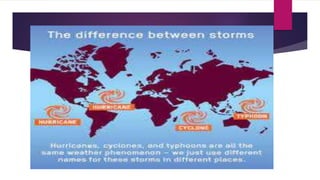
 Typhoons, cyclones and hurricanes are the same weather phenomenon-
the difference is the geographical area where they occur. They are
tropical cyclones with regionally specific names.
 The term typhoon is used only in the NORTHWESTERN part of the
Pacific Ocean.
 Cyclones occur in the South Pacific and Indian Ocean
 In the NORTHEASTERN part of the Pacific Ocean and in the Northern
part of the Atlantic Ocean, the equivalent is hurricane.
 Thus, a hurricane on one side of the Pacific Ocean will be called a
typhoon if it crosses into the other side.
Development of Typhoon
 All tropical storms form along the Intertropical
Convergence Zone (ITCZ). The ITCZ is found near the
equator encircling the Earth. In this area, the trade winds
of the North and the South Hemispheres come together.
 The ITCZ, one experiences high cloudiness, heavy rainfall,
and frequent thunderstorms – the perfect recipe for
tropical storms to form.
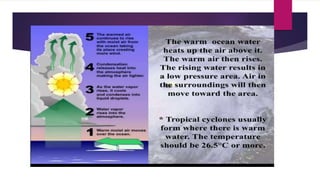
 Typhoon develop over tropical waters (between 8 and 20
degrees latitude), in areas of high humidity, light winds,
and warm sea surface temperatures (typically 26.5 degrees
Celsius or greater.)
 The combination of heat and humidity resulting from the
warm ocean waters provides the tremendous amount of
energy they posses.
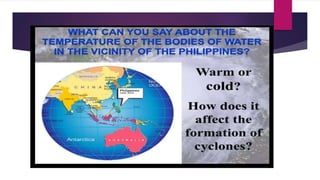
Philippine Area of Responsibility
(PAR)
Typhoons that enter the PAR usually
develop over warm waters located
between 5 and 8 degrees south
It covers between 5 and 25 degrees
south
Understanding typhoonstyphoontyphoontyphoon

Understanding typhoonstyphoontyphoontyphoon

  • 1.
  • 2.
  • 3.
    According to PhilippineAtmospheric, Geophysical, and Astronomical services Administration (PAG-ASA), about 20 tropical cyclones/typhoons enter the Philippine Area of Responsibility (PAR) each year.
  • 4.
    What is atyphoon? Winds in typhoon move in a certain direction; they go around a central area. The appearance of the clouds in a typhoon are in a spiral arrangement; they are being blown by winds in a counter-clockwise direction.
  • 5.
    Tropical Cyclone  Isa system of thunderstorms that are moving around a center.  As the winds intensify or weaken, the category is upgraded or downgraded accordingly.  Bagyo is called tropical cyclone by scientists in the Philippines.
  • 6.
    Category Maximum windspeed kilometers per hour (kph) Tropical depression 63 Tropical storm 64-118 Typhoon 119-200 Supertyphoon Greater than 200
  • 7.
    We hear weathercasterstalk about typhoons, hurricanes and cyclones So what’s the difference?
  • 8.
    Typhoons, Hurricanes andCyclones  Typhoons, cyclones and hurricanes are the same weather phenomenon- the difference is the geographical area where they occur. They are tropical cyclones with regionally specific names.  The term typhoon is used only in the NORTHWESTERN part of the Pacific Ocean.  Cyclones occur in the South Pacific and Indian Ocean  In the NORTHEASTERN part of the Pacific Ocean and in the Northern part of the Atlantic Ocean, the equivalent is hurricane.  Thus, a hurricane on one side of the Pacific Ocean will be called a typhoon if it crosses into the other side.
  • 13.
    Development of Typhoon All tropical storms form along the Intertropical Convergence Zone (ITCZ). The ITCZ is found near the equator encircling the Earth. In this area, the trade winds of the North and the South Hemispheres come together.  The ITCZ, one experiences high cloudiness, heavy rainfall, and frequent thunderstorms – the perfect recipe for tropical storms to form.
  • 14.
     Typhoon developover tropical waters (between 8 and 20 degrees latitude), in areas of high humidity, light winds, and warm sea surface temperatures (typically 26.5 degrees Celsius or greater.)  The combination of heat and humidity resulting from the warm ocean waters provides the tremendous amount of energy they posses.
  • 15.
    Philippine Area ofResponsibility (PAR) Typhoons that enter the PAR usually develop over warm waters located between 5 and 8 degrees south It covers between 5 and 25 degrees south