HYDRAULIC ASSISTED
BRIDGE
Ishan Kossambe
13MCD0038
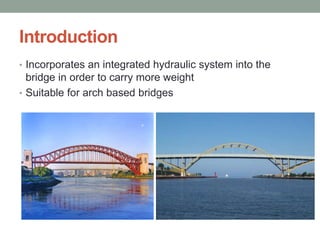
Introduction
• Incorporates an integrated hydraulic system into the
bridge in order to carry more weight
• Suitable for arch based bridges
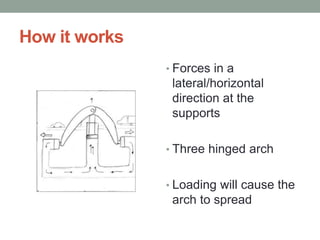
How it works
• Forces in a
lateral/horizontal
direction at the
supports
• Three hinged arch
• Loading will cause the
arch to spread
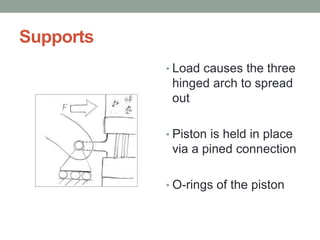
Supports
• Load causes the three
hinged arch to spread
out
• Piston is held in place
via a pined connection
• O-rings of the piston
Mid-Span of Bridge
• The high pressure hydraulic fluid causes another piston to
become raised
• Counteracting the load
• Calibration and calculation is required by changing the
diameter of the piston and shafts
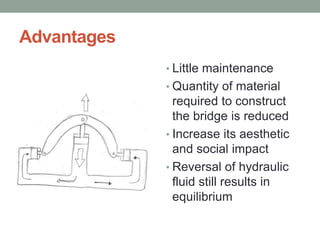
Advantages
• Little maintenance
• Quantity of material
required to construct
the bridge is reduced
• Increase its aesthetic
and social impact
• Reversal of hydraulic
fluid still results in
equilibrium
Disadvantages
• Vertical hydraulic column being required to be located in
the center of the arch
• Vertical column type hydraulic bridges may never be used
in arch bridges required to span gaps which are very high
in the context of the altitude of the locale.
• Failure by very high force
Overcoming the Disadvantages
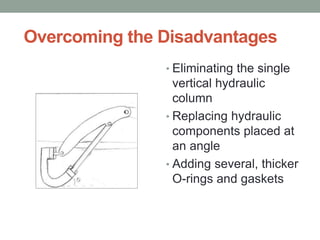
• Eliminating the single
vertical hydraulic
column
• Replacing hydraulic
components placed at
an angle
• Adding several, thicker
O-rings and gaskets
Potential Applications
• Pedestrian Footbridges
• Water Transportation
• Vehicular Transportation
• Light Vehicles
• Freight Vehicles
• Railway Transportation
Moving Bridges
• Drawbridge
• Bascule bridge
• Curling bridge
• Vertical-lift bridge
• Retractable bridge
• Tilt bridge
Hydraulic Systems for Movable
Bridges
•Objectives
• Ability to handle varying loads
• Smooth acceleration and deceleration
• Positive locking in any position
Hydraulic Cylinders
• Two per span
• Tie rod and welded
• Intermediate trunnion
and spherical bearing
clevis both ends
• The national fluid power
association (NFPA)
established a standard
for tie rod type hydraulic
cylinders
• Tie rods should be
inspected for corrosion
damage
Counterbalance Valves
• Varying loads, wind makes it unbalanced and causes run
away
• A counterbalance valve keeps this condition in check
• Holding the bridge firmly in any position
• Acts as a check valve
Proportional Valves
• Smooth acceleration and deceleration
• Gradually increasing or decreasing the amount of flow to
the cylinders
• The use of servo valves for this task is not recommended
• 0 - 9 volts dc/800 milliamps
Hydraulic Pump
• Variable volume-bent axis-piston type pump
• Strong suction capability and greater dirt tolerance, make
them a good choice for movable bridge
• Pumps which require a boost or supercharge only add
complexity to the design
• Horsepower limiter
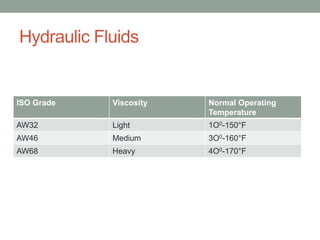
Hydraulic Fluids
ISO Grade Viscosity Normal Operating
Temperature
AW32 Light 1O0-150°F
AW46 Medium 3O0-160°F
AW68 Heavy 4O0-170°F
Care to be Taken While Designing
• Pumps and motors should be accessible for work
• Vibration mounts and hoses to isolate pump VIBRATION
• The use of ANSI standard bolt pattern sub plate mounted
valves
• Drilled manifolds to minimize piping and fittings
• Filters which are easy to change with good clogging
indicators
• Straight thread "o” ring ports and fittings
• Large access covers for reservoirs
The Rolling Bridge
• Completed in 2004 as part of the Grand Union
Canal office & retail development project at Paddington
Basin, London.
• Despite the connotation of its name, it is more accurately
described as "curling".
• Designed by SKM Anthony Hunt with Packman Lucas,
and built by Littlehampton Welding Ltd.
• The Hydraulic design and development was done by
Primary Fluid Power Ltd in the North West.
• In 2005, the bridge won the British Structural Steel Design
Award.
References
• http://en.wikipedia.org/
• http://www.designingbuildings.co.uk/wiki/Hydraulic_Assist
ed_Bridges
• www.youtube.com
• Hydraulic systems for movable bridges by Michael A.
Henley

Hydraulic assisted bridges

  • 1.
  • 2.
    Introduction • Incorporates anintegrated hydraulic system into the bridge in order to carry more weight • Suitable for arch based bridges
  • 3.
    How it works •Forces in a lateral/horizontal direction at the supports • Three hinged arch • Loading will cause the arch to spread
  • 4.
    Supports • Load causesthe three hinged arch to spread out • Piston is held in place via a pined connection • O-rings of the piston
  • 5.
    Mid-Span of Bridge •The high pressure hydraulic fluid causes another piston to become raised • Counteracting the load • Calibration and calculation is required by changing the diameter of the piston and shafts
  • 6.
    Advantages • Little maintenance •Quantity of material required to construct the bridge is reduced • Increase its aesthetic and social impact • Reversal of hydraulic fluid still results in equilibrium
  • 7.
    Disadvantages • Vertical hydrauliccolumn being required to be located in the center of the arch • Vertical column type hydraulic bridges may never be used in arch bridges required to span gaps which are very high in the context of the altitude of the locale. • Failure by very high force
  • 8.
    Overcoming the Disadvantages •Eliminating the single vertical hydraulic column • Replacing hydraulic components placed at an angle • Adding several, thicker O-rings and gaskets
  • 9.
    Potential Applications • PedestrianFootbridges • Water Transportation • Vehicular Transportation • Light Vehicles • Freight Vehicles • Railway Transportation
  • 10.
    Moving Bridges • Drawbridge •Bascule bridge • Curling bridge • Vertical-lift bridge • Retractable bridge • Tilt bridge
  • 11.
    Hydraulic Systems forMovable Bridges •Objectives • Ability to handle varying loads • Smooth acceleration and deceleration • Positive locking in any position
  • 12.
    Hydraulic Cylinders • Twoper span • Tie rod and welded • Intermediate trunnion and spherical bearing clevis both ends • The national fluid power association (NFPA) established a standard for tie rod type hydraulic cylinders • Tie rods should be inspected for corrosion damage
  • 13.
    Counterbalance Valves • Varyingloads, wind makes it unbalanced and causes run away • A counterbalance valve keeps this condition in check • Holding the bridge firmly in any position • Acts as a check valve
  • 14.
    Proportional Valves • Smoothacceleration and deceleration • Gradually increasing or decreasing the amount of flow to the cylinders • The use of servo valves for this task is not recommended • 0 - 9 volts dc/800 milliamps
  • 15.
    Hydraulic Pump • Variablevolume-bent axis-piston type pump • Strong suction capability and greater dirt tolerance, make them a good choice for movable bridge • Pumps which require a boost or supercharge only add complexity to the design • Horsepower limiter
  • 16.
    Hydraulic Fluids ISO GradeViscosity Normal Operating Temperature AW32 Light 1O0-150°F AW46 Medium 3O0-160°F AW68 Heavy 4O0-170°F
  • 17.
    Care to beTaken While Designing • Pumps and motors should be accessible for work • Vibration mounts and hoses to isolate pump VIBRATION • The use of ANSI standard bolt pattern sub plate mounted valves • Drilled manifolds to minimize piping and fittings • Filters which are easy to change with good clogging indicators • Straight thread "o” ring ports and fittings • Large access covers for reservoirs
  • 18.
    The Rolling Bridge •Completed in 2004 as part of the Grand Union Canal office & retail development project at Paddington Basin, London. • Despite the connotation of its name, it is more accurately described as "curling". • Designed by SKM Anthony Hunt with Packman Lucas, and built by Littlehampton Welding Ltd. • The Hydraulic design and development was done by Primary Fluid Power Ltd in the North West. • In 2005, the bridge won the British Structural Steel Design Award.
  • 19.
    References • http://en.wikipedia.org/ • http://www.designingbuildings.co.uk/wiki/Hydraulic_Assist ed_Bridges •www.youtube.com • Hydraulic systems for movable bridges by Michael A. Henley