Hydrogen
Hydrogen is thefirst element in the periodic table.
Hydrogen has the simplest atomic structure.
In atomic form it consists of only one proton and one
electron
In elemental form it exists as a diatomic (H2) molecule
called dihydrogen.
3.
Position of Hydrogenin the Periodic Table
Hydrogen has electronic configuration 1s1
which is similar to
the outer electronic configuration (ns1
) of alkali metals
It is short by one electron to the noble gas configuration i.e.,
1s2
(He)
Hydrogen lose one electron to form unipositive ions and
which gain one electron to form uninegative ion
It has a very high ionization enthalpy(1312 kJ mol–1
)
compared to halogens.
It has less reactivity compared to halogens.
4.
It forms adiatomic molecule which combines with elements
to form hydrides and a large number of covalent compounds.
Hydrogen resembles both with alkali metals and halogens.
Loss of the electron from hydrogen atom results in
nucleus(H+
) of size -1.5 X10⁻³
pm which is very small size .
Thus H+
does not exist freely and is always associated with
other atoms or molecules .
Because of its unique behaviour it is placed separately in the
periodic table
5.
Dihydrogen(H2)
Occurrence
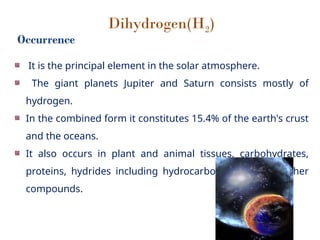
It is theprincipal element in the solar atmosphere.
The giant planets Jupiter and Saturn consists mostly of
hydrogen.
In the combined form it constitutes 15.4% of the earth's crust
and the oceans.
It also occurs in plant and animal tissues, carbohydrates,
proteins, hydrides including hydrocarbons and many other
compounds.
6.
Isotopes of Hydrogen
Hydrogenhas three isotopes:
• Protium(1
1H )has no neutrons
• Deuterium(2
1H or D) has one neutron
• Tritium(3
1h or T ) has two neutrons
7.
Ordinary hydrogen, protium,has no neutrons, deuterium
(also known as heavy hydrogen) has one and tritium has
two neutrons in the nucleus.
The tritium concentration is about one atom per 1018
atoms
of protium.
Of all these isotopes tritium is radioactive and emits low
energy β–
particles.
These isotopes have almost the same chemical properties.
The only difference is in their rates of reactions due to their
different enthalpy of bond dissociation.
8.
Preparation of Dihydrogen
LaboratoryPreparation of Dihydrogen
It is prepared by the reaction of granulated zinc with dilute
hydrochloric acid
Zn + 2H+
Zn
→ 2+
+ H2
It is also prepared by the reaction of zinc with aqueous alkali
Zn + 2NaOH Na
→ 2ZnO2 + H2
Sodium zincate
9.
Commercial Production ofDihydrogen
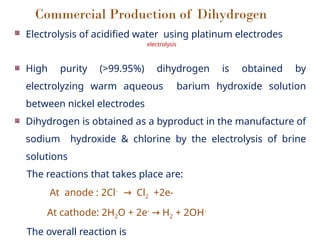
Electrolysis of acidified water using platinum electrodes
electrolysis
High purity (>99.95%) dihydrogen is obtained by
electrolyzing warm aqueous barium hydroxide solution
between nickel electrodes
Dihydrogen is obtained as a byproduct in the manufacture of
sodium hydroxide & chlorine by the electrolysis of brine
solutions
The reactions that takes place are:
At anode : 2Cl-
Cl
→ 2 +2e-
At cathode: 2H2O + 2e-
H
→ 2 + 2OH-
The overall reaction is
10.
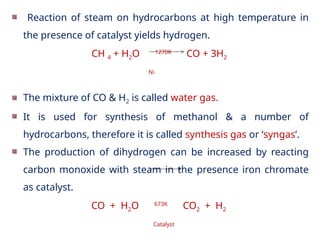
Reaction of steamon hydrocarbons at high temperature in
the presence of catalyst yields hydrogen.
CH 4 + H2O 1270K
CO + 3H2
Ni
The mixture of CO & H2 is called water gas.
It is used for synthesis of methanol & a number of
hydrocarbons, therefore it is called synthesis gas or ‘syngas’.
The production of dihydrogen can be increased by reacting
carbon monoxide with steam in the presence iron chromate
as catalyst.
CO + H2O 673K
CO2 + H2
Catalyst
11.
Properties of Dihydrogen
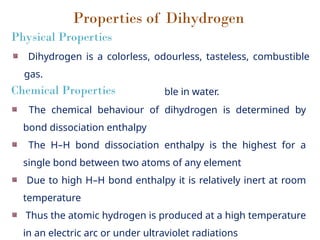
PhysicalProperties
Dihydrogen is a colorless, odourless, tasteless, combustible
gas.
It is lighter than air and insoluble in water.
Chemical Properties
The chemical behaviour of dihydrogen is determined by
bond dissociation enthalpy
The H–H bond dissociation enthalpy is the highest for a
single bond between two atoms of any element
Due to high H–H bond enthalpy it is relatively inert at room
temperature
Thus the atomic hydrogen is produced at a high temperature
in an electric arc or under ultraviolet radiations
12.
It accomplishes reactionsby
• loss of the only electron to give H+
• gain of an electron to form H–
• sharing electrons to form a single covalent bond.
13.
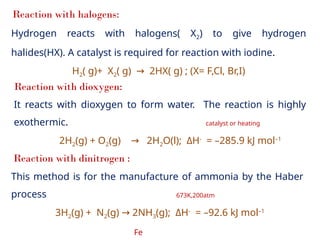
Reaction with halogens:
Hydrogenreacts with halogens( X2) to give hydrogen
halides(HX). A catalyst is required for reaction with iodine.
H2( g)+ X2( g) 2HX( g) ; (X= F,Cl, Br,I)
→
Reaction with dioxygen:
It reacts with dioxygen to form water. The reaction is highly
exothermic. catalyst or heating
2H2(g) + O2(g) 2H
→ 2O(l); ΔH-
= –285.9 kJ mol–1
Reaction with dinitrogen :
This method is for the manufacture of ammonia by the Haber
process 673K,200atm
3H2(g) + N2(g) 2NH
→ 3(g); ΔH-
= –92.6 kJ mol–1
Fe
14.
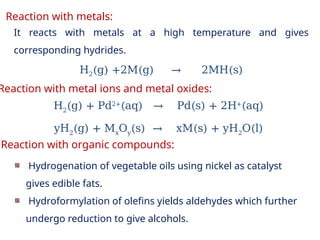
Reaction with metals:
Itreacts with metals at a high temperature and gives
corresponding hydrides.
H2(g) +2M(g) → 2MH(s)
Reaction with metal ions and metal oxides:
H2
(g) + Pd2+
(aq) → Pd(s) + 2H+
(aq)
yH2
(g) + Mx
Oy
(s) → xM(s) + yH2
O(l)
Reaction with organic compounds:
Hydrogenation of vegetable oils using nickel as catalyst
gives edible fats.
Hydroformylation of olefins yields aldehydes which further
undergo reduction to give alcohols.
15.
Uses of Dihydrogen
Thelargest use of dihydrogen is in the
synthesis of ammonia
Dihydrogen is used in the manufacture of
vanaspati fat.
It is used in the manufacture of bulk organic
chemicals, particularly methanol.
CO + 2H2
catalyst cobalt
CH3OH
It is widely used for the manufacture of metal
hydrides.
It is used for the preparation of hydrogen
chloride, a highly useful chemical.
16.
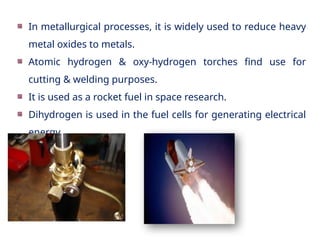
In metallurgical processes,it is widely used to reduce heavy
metal oxides to metals.
Atomic hydrogen & oxy-hydrogen torches find use for
cutting & welding purposes.
It is used as a rocket fuel in space research.
Dihydrogen is used in the fuel cells for generating electrical
energy.
17.
Hydrides
Dihydrogen combines somemetals except noble gases at a
high temperature to form a compound called a hydride.
If E is the symbol of an element then hydride can be
expressed as EHX (e.g. MgH2) or EmHn (e.g. B2H6).
The hydrides are categorized into three types:
Ionic or saline or salt like hydrides
Covalent or molecular hydrides
Metallic or non-stoichiometric hydrides
18.
Ionic Hydrides
These arestoichiometric compounds of dihydrogen formed
with most of the s-block elements which are highly
electropositive in character.
Covalent character is found in the lighter metal hydrides
(e.g. LiH, BeH2 & MgH2).
The ionic hydrides are crystalline, non-volatile & non-
conducting in solid state.
Their melts conduct electricity & on electrolysis liberate
dihydrogen gas at anode, which confirms the existence of H-
ion.
2H-
(melt) anode
H2+2e-
Saline hydrides react violently with water producing
19.
Covalent Hydrides
Dihydrogen formsmolecular compounds with most of the p-
block elements.
Eg: CH4, NH3, H2O & HF
Hydrogen compounds of non metals have also been
considered as hydrides.
They are volatile compounds.
Molecular hydrides are again classified according to the
relative number of electrons & bonds in their Lewis structure
• Electron-deficient
• Electron-precise
• Electron-rich hydrides
20.
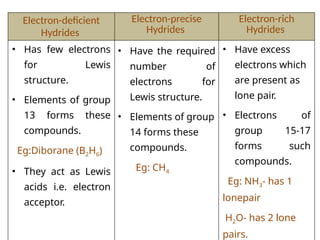
Electron-deficient
Hydrides
Electron-precise
Hydrides
Electron-rich
Hydrides
• Has fewelectrons
for Lewis
structure.
• Elements of group
13 forms these
compounds.
Eg:Diborane (B2H6)
• They act as Lewis
acids i.e. electron
acceptor.
• Have the required
number of
electrons for
Lewis structure.
• Elements of group
14 forms these
compounds.
Eg: CH4
• Have excess
electrons which
are present as
lone pair.
• Electrons of
group 15-17
forms such
compounds.
Eg: NH3- has 1
lonepair
H2O- has 2 lone
pairs.
21.
Metallic Hydrides
These areformed by d-block & f-block elements but 7,8 & 9
group elements do not form hydride.
These hydrides conduct heat & electricity but not as
efficiently as their parent metals.
They are almost non-stoichiometric which are deficient in
hydrogen. Eg: LaH2.87 and YbH2.55.
Law of constant composition does not hold good.
The property of absorption of hydrogen on transition metal
is widely used in catalytic reduction/hydrogenation reactions
for the preparation of large number of compounds.
Some of the metals can accommodate a very large volume
of hydrogen & can be used as its storage media.
22.
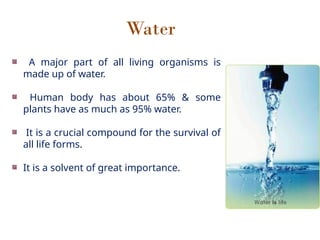
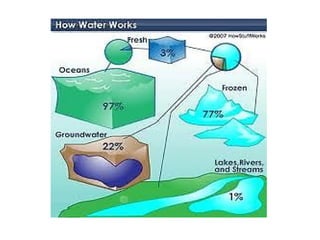
Water
A major partof all living organisms is
made up of water.
Human body has about 65% & some
plants have as much as 95% water.
It is a crucial compound for the survival of
all life forms.
It is a solvent of great importance.
24.
Physical Properties ofWater
It is a colorless & tasteless liquid.
The unusual properties of water in the condensed phase
(liquid & solid) are due to the presence of extensive
hydrogen bonding between water molecules.
Water has a higher specific heat, thermal conductivity,
surface tension, dipole moment & dielectric constant when
compared to other liquids.
25.
The high heatof vaporization and heat capacity are
responsible for moderation of the climate and body
temperature of living beings
It is an excellent solvent for transportation of ions &
molecules required for plant & animal metabolism.
Due to hydrogen bonding with polar molecules, even
covalent compounds like alcohol & carbohydrates dissolve
in water.
26.
Structure of
Water
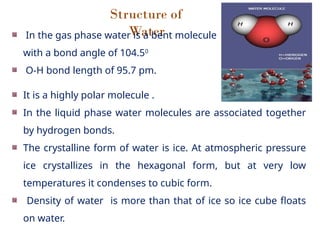
In thegas phase water is a bent molecule
with a bond angle of 104.50
O-H bond length of 95.7 pm.
It is a highly polar molecule .
In the liquid phase water molecules are associated together
by hydrogen bonds.
The crystalline form of water is ice. At atmospheric pressure
ice crystallizes in the hexagonal form, but at very low
temperatures it condenses to cubic form.
Density of water is more than that of ice so ice cube floats
on water.
27.
Structure of
Ice
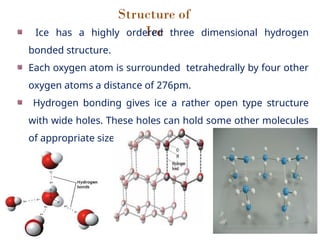
Ice hasa highly ordered three dimensional hydrogen
bonded structure.
Each oxygen atom is surrounded tetrahedrally by four other
oxygen atoms a distance of 276pm.
Hydrogen bonding gives ice a rather open type structure
with wide holes. These holes can hold some other molecules
of appropriate size interstitially.
28.
Chemical Properties ofIce
Amphoteric Nature:
It behaves as an amphoteric substance i.e it acts as an acid as
well as a base.
In the Bronsted sense it acts an acid with NH3 and a base with
H2S.
H2O+ NH3 OH-
+ NH4
+
H2O+ H2S H3O+
+ HS-
The auto-protolysis (self- ionization) of water takes place as
follows:
H2O +H2O H3O+
+OH-
29.
Redox Reactions InvolvingWater:
Water can be easily reduced to dihydrogen by highly
electropositive metals. It is a great source of dihydrogen.
2H2O +2Na 2NaOH +H
→ 2
Water is oxidised to O2 during photosynthesis.
6CO2 +12H2O C
→ 6H12O6 + 6H2O +6O2
With fluorine also it is oxidised to O2.
2F2 + 2H2O 4H
→ +
+ 4F-
+O2
30.
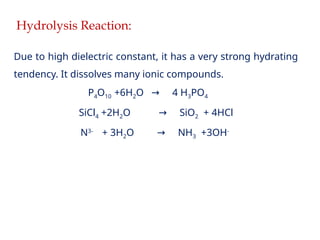
Hydrolysis Reaction:
Due tohigh dielectric constant, it has a very strong hydrating
tendency. It dissolves many ionic compounds.
P4O10 +6H2O 4 H
→ 3PO4
SiCl4 +2H2O SiO
→ 2 + 4HCl
N3-
+ 3H2O NH
→ 3 +3OH-
31.
Hydrates Formation:
Many saltscan be crystallized as hydrated salts from aqueous
solutions.
• Coordinated Water
Eg: 3Cl-
• Interstitial Water
Eg:BaCl2.2H2O
• Hydrogen-bonded Water
Eg:[Cu(H2O)4]2+
SO4
2-
.H2O in CuSO4.5H2O
32.
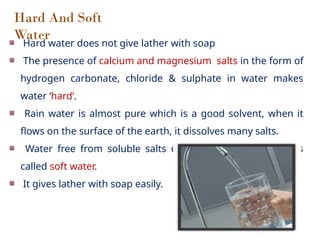
Hard And Soft
Water
Hardwater does not give lather with soap
The presence of calcium and magnesium salts in the form of
hydrogen carbonate, chloride & sulphate in water makes
water ‘hard’.
Rain water is almost pure which is a good solvent, when it
flows on the surface of the earth, it dissolves many salts.
Water free from soluble salts of calcium & magnesium is
called soft water.
It gives lather with soap easily.
33.
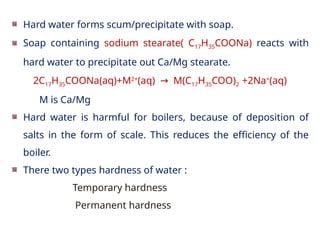
Hard water formsscum/precipitate with soap.
Soap containing sodium stearate( C17H35COONa) reacts with
hard water to precipitate out Ca/Mg stearate.
2C17H35COONa(aq)+M2+
(aq) M(C
→ 17H35COO)2 +2Na+
(aq)
M is Ca/Mg
Hard water is harmful for boilers, because of deposition of
salts in the form of scale. This reduces the efficiency of the
boiler.
There two types hardness of water :
Temporary hardness
Permanent hardness
34.
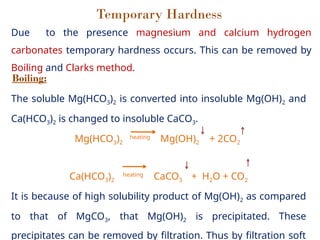
Temporary Hardness
Due tothe presence magnesium and calcium hydrogen
carbonates temporary hardness occurs. This can be removed by
Boiling and Clarks method.
Boiling:
The soluble Mg(HCO3)2 is converted into insoluble Mg(OH)2 and
Ca(HCO3)2 is changed to insoluble CaCO3.
Mg(HCO3)2
heating
Mg(OH)2 + 2CO2
Ca(HCO3)2
heating
CaCO3 + H2O + CO2
It is because of high solubility product of Mg(OH)2 as compared
to that of MgCO3, that Mg(OH)2 is precipitated. These
precipitates can be removed by filtration. Thus by filtration soft
35.
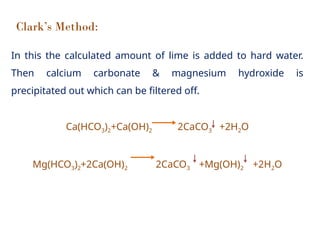
Clark’s Method:
In thisthe calculated amount of lime is added to hard water.
Then calcium carbonate & magnesium hydroxide is
precipitated out which can be filtered off.
Ca(HCO3)2+Ca(OH)2 2CaCO3 +2H2O
Mg(HCO3)2+2Ca(OH)2 2CaCO3 +Mg(OH)2 +2H2O
36.
Permanent Hardness
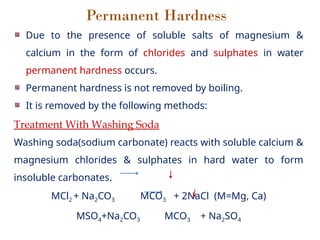
Due tothe presence of soluble salts of magnesium &
calcium in the form of chlorides and sulphates in water
permanent hardness occurs.
Permanent hardness is not removed by boiling.
It is removed by the following methods:
Treatment With Washing Soda
Washing soda(sodium carbonate) reacts with soluble calcium &
magnesium chlorides & sulphates in hard water to form
insoluble carbonates.
MCl2 + Na2CO3 MCO3 + 2NaCl (M=Mg, Ca)
MSO4+Na2CO3 MCO3 + Na2SO4
37.
Calgon’s Method:
Sodium hexametaphosphate (Na6P6O18) is called ‘calgon’.
When added to hard water then
Na6P6O18 2Na+
+Na4P6O18
2-
(M=Mg, Ca)
M2+
+Na4P6O18
2-
[Na2MP6O18]2-
+2Na+
Ion Exchange Method:
Hydrated sodium aluminum silicate is zeolite. Thus Sodium
aluminum silicate () is written as NaZ. When this is added to
hard water then exchange reactions take place
2NaZ(s)+M2+
(aq) MZ2(s)+2Na+
(aq) (M=Mg, Ca)
This method is also called zeolite or permutit process
38.
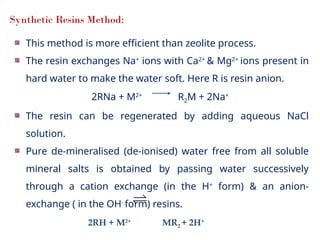
Synthetic Resins Method:
Thismethod is more efficient than zeolite process.
The resin exchanges Na+
ions with Ca2+
& Mg2+
ions present in
hard water to make the water soft. Here R is resin anion.
2RNa + M2+
R2M + 2Na+
The resin can be regenerated by adding aqueous NaCl
solution.
Pure de-mineralised (de-ionised) water free from all soluble
mineral salts is obtained by passing water successively
through a cation exchange (in the H+
form) & an anion-
exchange ( in the OH-
form) resins.
2RH + M2+
MR2 + 2H+
39.
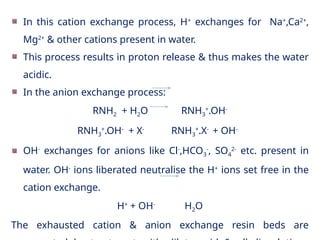
In this cationexchange process, H+
exchanges for Na+
,Ca2+
,
Mg2+
& other cations present in water.
This process results in proton release & thus makes the water
acidic.
In the anion exchange process:
RNH2 + H2O RNH3
+
.OH-
RNH3
+
.OH-
+ X-
RNH3
+
.X-
+ OH-
OH-
exchanges for anions like Cl-
,HCO3
-
, SO4
2-
etc. present in
water. OH-
ions liberated neutralise the H+
ions set free in the
cation exchange.
H+
+ OH-
H2O
The exhausted cation & anion exchange resin beds are
40.
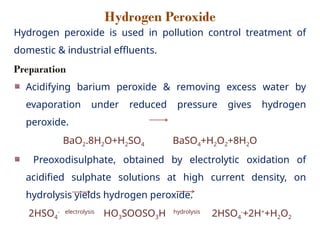
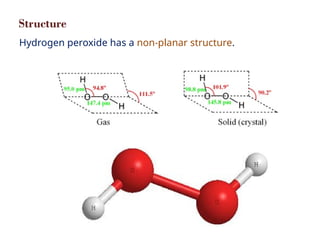
Hydrogen Peroxide
Hydrogen peroxideis used in pollution control treatment of
domestic & industrial effluents.
Preparation
Acidifying barium peroxide & removing excess water by
evaporation under reduced pressure gives hydrogen
peroxide.
BaO2.8H2O+H2SO4 BaSO4+H2O2+8H2O
Preoxodisulphate, obtained by electrolytic oxidation of
acidified sulphate solutions at high current density, on
hydrolysis yields hydrogen peroxide.
2HSO4
- electrolysis
HO3SOOSO3H hydrolysis
2HSO4
-
+2H+
+H2O2
41.
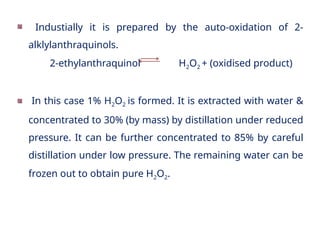
Industially it isprepared by the auto-oxidation of 2-
alklylanthraquinols.
2-ethylanthraquinol H2O2 + (oxidised product)
In this case 1% H2O2 is formed. It is extracted with water &
concentrated to 30% (by mass) by distillation under reduced
pressure. It can be further concentrated to 85% by careful
distillation under low pressure. The remaining water can be
frozen out to obtain pure H2O2.
42.
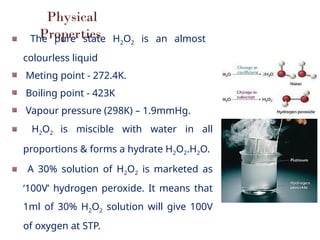
Physical
Properties
The pure stateH2O2 is an almost
colourless liquid
Meting point - 272.4K.
Boiling point - 423K
Vapour pressure (298K) – 1.9mmHg.
H2O2 is miscible with water in all
proportions & forms a hydrate H2O2.H2O.
A 30% solution of H2O2 is marketed as
‘100V’ hydrogen peroxide. It means that
1ml of 30% H2O2 solution will give 100V
of oxygen at STP.
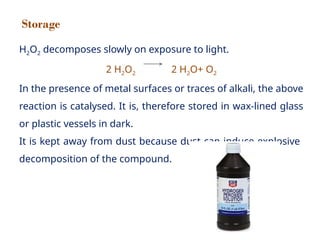
H2O2 decomposes slowlyon exposure to light.
2 H2O2 2 H2O+ O2
In the presence of metal surfaces or traces of alkali, the above
reaction is catalysed. It is, therefore stored in wax-lined glass
or plastic vessels in dark.
It is kept away from dust because dust can induce explosive
decomposition of the compound.
Storage
46.
It is usedas hair bleach & as a mild disinfectant. As an
antiseptic it is sold in the market as perhydrol.
It is used to manufacture chemicals like sodium perborate &
per-carbonate, which are used in high quality detergents.
It is used in the synthesis of hydroquinone, tartaric acid &
certain food products & pharmaceuticals etc.
It is employed in the industries as bleaching agent for
textiles, paper pulp, leather, oils, fats etc.
It is also used in environmental chemistry
Uses
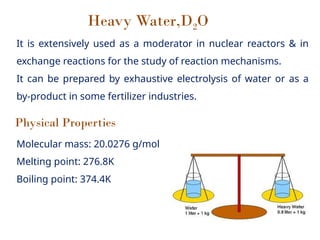
47.
Molecular mass: 20.0276g/mol
Melting point: 276.8K
Boiling point: 374.4K
Physical Properties
It is extensively used as a moderator in nuclear reactors & in
exchange reactions for the study of reaction mechanisms.
It can be prepared by exhaustive electrolysis of water or as a
by-product in some fertilizer industries.
Heavy Water,D2O
48.
Uses
It is usedfor the preparation of other deuterium
compounds.
Eg: CaC2 + 2D2O C
→ 2D2 + Ca(OD)2
SO3 + D2O D
→ 2SO4
Al4C3 + 12D2O 3CD
→ 4 + 4Al(OD)3
49.
Dihydrogen as Fuel
Dihydrogenreleases large quantities of heat on combustion.
Dihydrogen can release more energy than petrol's.
The basic principle of hydrogen economy is the
transportation & storage of energy in the form of liquid or
gaseous dihydrogen.
Energy is transmitted in the form of dihydrogen & not as
electric power.
It is also used in fuel cells for generation of electric power.
Hydrogen Economy

![Hydrates Formation:
Many salts can be crystallized as hydrated salts from aqueous
solutions.
• Coordinated Water
Eg: 3Cl-
• Interstitial Water
Eg:BaCl2.2H2O
• Hydrogen-bonded Water
Eg:[Cu(H2O)4]2+
SO4
2-
.H2O in CuSO4.5H2O](https://image.slidesharecdn.com/9-250524113756-c193f8e1/85/9-Hydrogen-pptx-suitable-for-class-12-cbse-31-320.jpg)
![Calgon’s Method:
Sodium hexa metaphosphate (Na6P6O18) is called ‘calgon’.
When added to hard water then
Na6P6O18 2Na+
+Na4P6O18
2-
(M=Mg, Ca)
M2+
+Na4P6O18
2-
[Na2MP6O18]2-
+2Na+
Ion Exchange Method:
Hydrated sodium aluminum silicate is zeolite. Thus Sodium
aluminum silicate () is written as NaZ. When this is added to
hard water then exchange reactions take place
2NaZ(s)+M2+
(aq) MZ2(s)+2Na+
(aq) (M=Mg, Ca)
This method is also called zeolite or permutit process](https://image.slidesharecdn.com/9-250524113756-c193f8e1/85/9-Hydrogen-pptx-suitable-for-class-12-cbse-37-320.jpg)