


Sakshi Institute of Technology and Management
Myana, Guna-MP-India
A
Seminar report
Study of hydroelectric power plant
Presented By
Ramkumar ojha
(0954cs121042(ME))
B.E., 6th Semester
Under the Guidance of
Prof. Neeraj sharma
Associate Professor
Department of Mechanical Engineering
Sakshi Institute of Technology and Management
Session: 2012-2016
Content of Slides
 Introduction
 Selection of side
 Classification
 Electricity generation
 Working of power plant
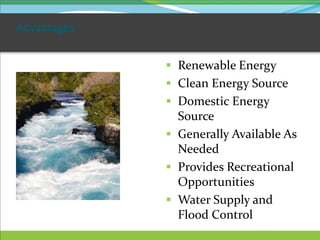
 Advantages
 Disadvantage
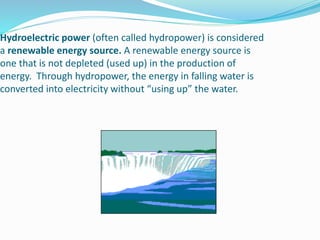
Hydroelectric power (often called hydropower) is considered
a renewable energy source. A renewable energy source is
one that is not depleted (used up) in the production of
energy. Through hydropower, the energy in falling water is
converted into electricity without “using up” the water.
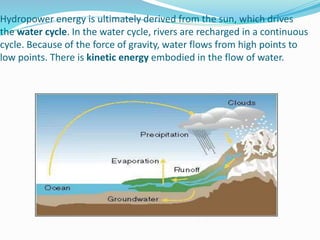
Hydropower energy is ultimately derived from the sun, which drives
the water cycle. In the water cycle, rivers are recharged in a continuous
cycle. Because of the force of gravity, water flows from high points to
low points. There is kinetic energy embodied in the flow of water.
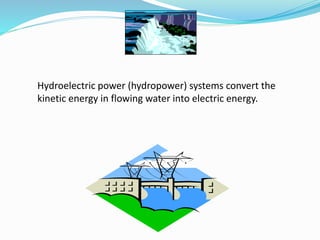
Hydroelectric power (hydropower) systems convert the
kinetic energy in flowing water into electric energy.
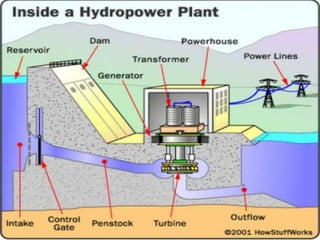
 Element of Hydroelectric power plant
 1.Reservior
 2.Dam
 3.Genrator
 4.Transformer
 5.power house
 6.Turbin
 7.Power lines
 8.Pen strock.
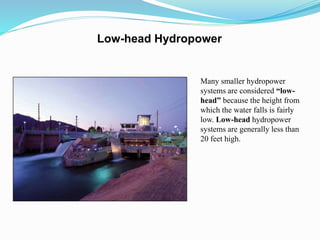
Many smaller hydropower
systems are considered “low-
head” because the height from
which the water falls is fairly
low. Low-head hydropower
systems are generally less than
20 feet high.
Low-head Hydropower
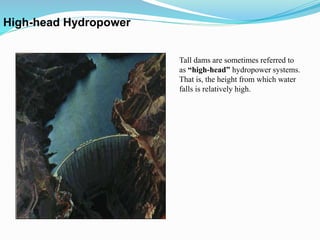
Tall dams are sometimes referred to
as “high-head” hydropower systems.
That is, the height from which water
falls is relatively high.
High-head Hydropower
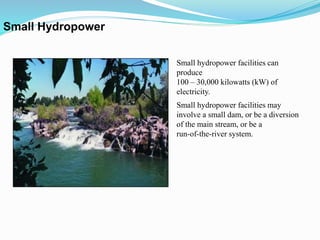
Small Hydropower
Small hydropower facilities can
produce
100 – 30,000 kilowatts (kW) of
electricity.
Small hydropower facilities may
involve a small dam, or be a diversion
of the main stream, or be a
run-of-the-river system.
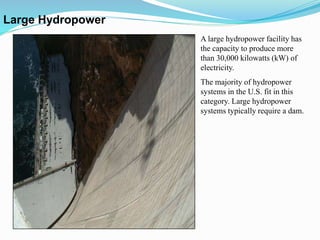
A large hydropower facility has
the capacity to produce more
than 30,000 kilowatts (kW) of
electricity.
The majority of hydropower
systems in the U.S. fit in this
category. Large hydropower
systems typically require a dam.
Large Hydropower
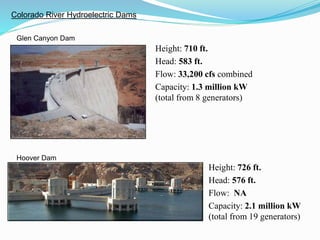
Colorado River Hydroelectric Dams
Height: 710 ft.
Head: 583 ft.
Flow: 33,200 cfs combined
Capacity: 1.3 million kW
(total from 8 generators)
Height: 726 ft.
Head: 576 ft.
Flow: NA
Capacity: 2.1 million kW
(total from 19 generators)
Hoover Dam
Glen Canyon Dam
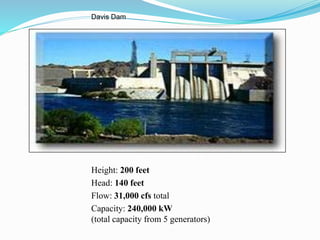
Davis Dam
Height: 200 feet
Head: 140 feet
Flow: 31,000 cfs total
Capacity: 240,000 kW
(total capacity from 5 generators)
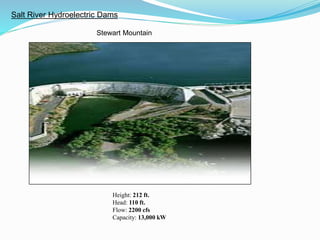
Stewart Mountain
Height: 212 ft.
Head: 110 ft.
Flow: 2200 cfs
Capacity: 13,000 kW
Salt River Hydroelectric Dams
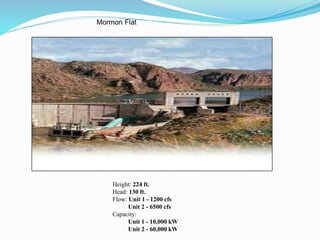
Mormon Flat
Height: 224 ft.
Head: 130 ft.
Flow: Unit 1 - 1200 cfs
Unit 2 - 6500 cfs
Capacity:
Unit 1 - 10,000 kW
Unit 2 - 60,000 kW
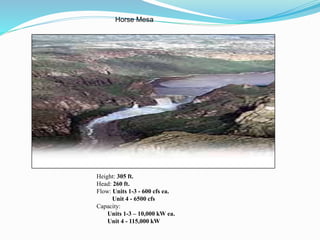
Horse Mesa
Height: 305 ft.
Head: 260 ft.
Flow: Units 1-3 - 600 cfs ea.
Unit 4 - 6500 cfs
Capacity:
Units 1-3 – 10,000 kW ea.
Unit 4 - 115,000 kW
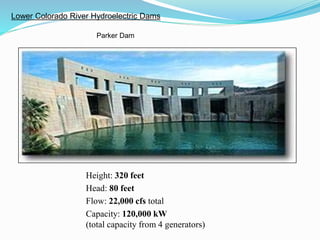
Parker Dam
Height: 320 feet
Head: 80 feet
Flow: 22,000 cfs total
Capacity: 120,000 kW
(total capacity from 4 generators)
Lower Colorado River Hydroelectric Dams
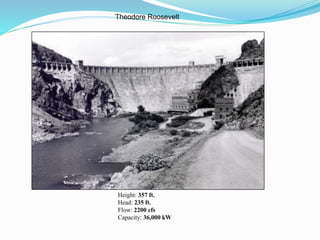
Theodore Roosevelt
Height: 357 ft.
Head: 235 ft.
Flow: 2200 cfs
Capacity: 36,000 kW
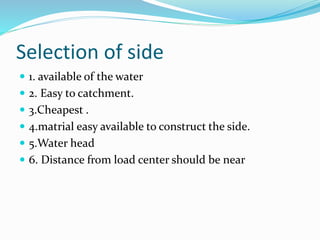
Selection of side
 1. available of the water
 2. Easy to catchment.
 3.Cheapest .
 4.matrial easy available to construct the side.
 5.Water head
 6. Distance from load center should be near
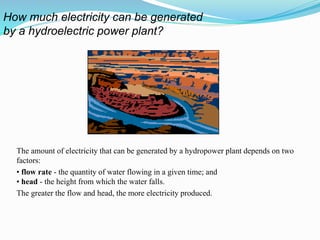
The amount of electricity that can be generated by a hydropower plant depends on two
factors:
• flow rate - the quantity of water flowing in a given time; and
• head - the height from which the water falls.
The greater the flow and head, the more electricity produced.
How much electricity can be generated
by a hydroelectric power plant?
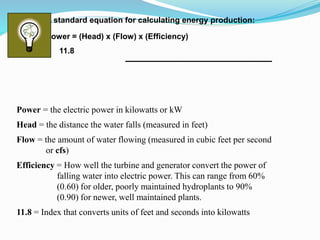
Power = the electric power in kilowatts or kW
Head = the distance the water falls (measured in feet)
Flow = the amount of water flowing (measured in cubic feet per second
or cfs)
Efficiency = How well the turbine and generator convert the power of
falling water into electric power. This can range from 60%
(0.60) for older, poorly maintained hydroplants to 90%
(0.90) for newer, well maintained plants.
11.8 = Index that converts units of feet and seconds into kilowatts
A standard equation for calculating energy production:
Power = (Head) x (Flow) x (Efficiency)
11.8
The NEED Project 2014
Advantages
 Renewable Energy
 Clean Energy Source
 Domestic Energy
Source
 Generally Available As
Needed
 Provides Recreational
Opportunities
 Water Supply and
Flood Control
Disadvantage
 1. Initial cost very high.
 2. Large area required.
 3. The reservoir of water for hydroelectric power
releases a large amount of carbon dioxide and methane
.
 4. Changing the river pathway and shortage of water
can cause serious disputes between people .
THANK YOU

Hydroelectric power plant

  • 1.
    Sakshi Institute ofTechnology and Management Myana, Guna-MP-India A Seminar report Study of hydroelectric power plant Presented By Ramkumar ojha (0954cs121042(ME)) B.E., 6th Semester Under the Guidance of Prof. Neeraj sharma Associate Professor Department of Mechanical Engineering Sakshi Institute of Technology and Management Session: 2012-2016
  • 2.
    Content of Slides Introduction  Selection of side  Classification  Electricity generation  Working of power plant  Advantages  Disadvantage
  • 3.
    Hydroelectric power (oftencalled hydropower) is considered a renewable energy source. A renewable energy source is one that is not depleted (used up) in the production of energy. Through hydropower, the energy in falling water is converted into electricity without “using up” the water.
  • 4.
    Hydropower energy isultimately derived from the sun, which drives the water cycle. In the water cycle, rivers are recharged in a continuous cycle. Because of the force of gravity, water flows from high points to low points. There is kinetic energy embodied in the flow of water.
  • 5.
    Hydroelectric power (hydropower)systems convert the kinetic energy in flowing water into electric energy.
  • 6.
     Element ofHydroelectric power plant  1.Reservior  2.Dam  3.Genrator  4.Transformer  5.power house  6.Turbin  7.Power lines  8.Pen strock.
  • 7.
    Many smaller hydropower systemsare considered “low- head” because the height from which the water falls is fairly low. Low-head hydropower systems are generally less than 20 feet high. Low-head Hydropower
  • 8.
    Tall dams aresometimes referred to as “high-head” hydropower systems. That is, the height from which water falls is relatively high. High-head Hydropower
  • 9.
    Small Hydropower Small hydropowerfacilities can produce 100 – 30,000 kilowatts (kW) of electricity. Small hydropower facilities may involve a small dam, or be a diversion of the main stream, or be a run-of-the-river system.
  • 10.
    A large hydropowerfacility has the capacity to produce more than 30,000 kilowatts (kW) of electricity. The majority of hydropower systems in the U.S. fit in this category. Large hydropower systems typically require a dam. Large Hydropower
  • 11.
    Colorado River HydroelectricDams Height: 710 ft. Head: 583 ft. Flow: 33,200 cfs combined Capacity: 1.3 million kW (total from 8 generators) Height: 726 ft. Head: 576 ft. Flow: NA Capacity: 2.1 million kW (total from 19 generators) Hoover Dam Glen Canyon Dam
  • 12.
    Davis Dam Height: 200feet Head: 140 feet Flow: 31,000 cfs total Capacity: 240,000 kW (total capacity from 5 generators)
  • 13.
    Stewart Mountain Height: 212ft. Head: 110 ft. Flow: 2200 cfs Capacity: 13,000 kW Salt River Hydroelectric Dams
  • 14.
    Mormon Flat Height: 224ft. Head: 130 ft. Flow: Unit 1 - 1200 cfs Unit 2 - 6500 cfs Capacity: Unit 1 - 10,000 kW Unit 2 - 60,000 kW
  • 15.
    Horse Mesa Height: 305ft. Head: 260 ft. Flow: Units 1-3 - 600 cfs ea. Unit 4 - 6500 cfs Capacity: Units 1-3 – 10,000 kW ea. Unit 4 - 115,000 kW
  • 16.
    Parker Dam Height: 320feet Head: 80 feet Flow: 22,000 cfs total Capacity: 120,000 kW (total capacity from 4 generators) Lower Colorado River Hydroelectric Dams
  • 17.
    Theodore Roosevelt Height: 357ft. Head: 235 ft. Flow: 2200 cfs Capacity: 36,000 kW
  • 18.
    Selection of side 1. available of the water  2. Easy to catchment.  3.Cheapest .  4.matrial easy available to construct the side.  5.Water head  6. Distance from load center should be near
  • 19.
    The amount ofelectricity that can be generated by a hydropower plant depends on two factors: • flow rate - the quantity of water flowing in a given time; and • head - the height from which the water falls. The greater the flow and head, the more electricity produced. How much electricity can be generated by a hydroelectric power plant?
  • 20.
    Power = theelectric power in kilowatts or kW Head = the distance the water falls (measured in feet) Flow = the amount of water flowing (measured in cubic feet per second or cfs) Efficiency = How well the turbine and generator convert the power of falling water into electric power. This can range from 60% (0.60) for older, poorly maintained hydroplants to 90% (0.90) for newer, well maintained plants. 11.8 = Index that converts units of feet and seconds into kilowatts A standard equation for calculating energy production: Power = (Head) x (Flow) x (Efficiency) 11.8
  • 21.
  • 22.
    Advantages  Renewable Energy Clean Energy Source  Domestic Energy Source  Generally Available As Needed  Provides Recreational Opportunities  Water Supply and Flood Control
  • 23.
    Disadvantage  1. Initialcost very high.  2. Large area required.  3. The reservoir of water for hydroelectric power releases a large amount of carbon dioxide and methane .  4. Changing the river pathway and shortage of water can cause serious disputes between people .
  • 24.

Editor's Notes

  • #22 So just how do we get electricity from water? Controlled flowing water is the power source used to turn a propeller-like piece called a turbine. The turbine then turns a metal shaft in an electric generator, which is the device that produces electricity. The idea is to build a dam on a large river that has a large drop in elevation. There are not many hydroelectric plants in Kansas or Florida where rivers travel on flat land. The dam stores lots of water behind it in the reservoir. Near the bottom of the dam wall there is a water intake. Gravity causes it to fall through the penstock inside the dam. At the end of the penstock there is a turbine propeller, which is turned by the moving water. The shaft from the turbine goes up into the generator, which produces the power. Power lines are connected to the generator that carry electricity to your home and mine. The water continues past the propeller through the tailrace into the river past the dam and exits with great force.
  • #23 Hydropower is a fueled by water, so it's a clean fuel source. Hydropower doesn't pollute the air like power plants that burn fossil fuels, such as coal or natural gas. Hydropower is a domestic source of energy, produced in the United States. Hydropower relies on the water cycle, which is driven by the sun, thus it's a renewable power source.