A
Technical Seminar report on
Hydro power plant
Submitted in partial fulfillment of the requirement
For the award of the degree of
Bachelor of Technology
In
ELECTRICAL AND ELECTRONICS ENGINEERING
BY
V.VINAY
16705A0248
Under the esteemed guidance of
Mr. S.S.DEEKSHITM.Tech
Assistant professor
Department of EEE
DEPARTMENT OF ELECTRICAL AND ELECTRONICS ENGINEERING
ANNAMACHARYA INSTITUTE OF TECHNOLOGY AND SCIENCES
(AN AUTONOMOUS INSTITUTION)
Affiliated To Jawaharlal Nehru Technological University, Anantapur
Approved by A.I.C.T.E, New Delhi
Institute Accredited by NBA & NAAC, Bangalore
New Boyanapalli, RAJAMPET-516216, Kadapa(dt), A.P.
CONTENTS:
 Introduction
 Layout of Hydro power plant
 Construction and Working
 Classifications of Hydro power plant
 Advantages
 Disadvantages
 Conclusion
Introduction
Power system mainly contains three parts namely
generation, transmission and distribution. Generation means
how to generate electricity from the available source and
there are various methods to generate electricity but in this
article we only focused on generation of electricity by the
means of hydro or water (hydro power plant). As we know
that the power plant is defined as the place where power is
generated from a given source, so here the source is hydro
that’s why we called it hydro power plant.
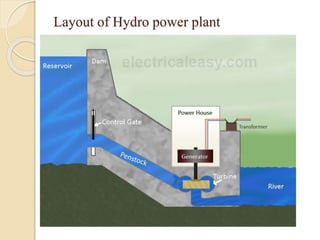
Layout of Hydro power plant
Construction And Working
 For construction of hydro power plant first we choose the area where the
water is sufficient to reserve and no any crisis of water and suitable to build
a dam, then we construct the dam.
 The main function of dam is to stop the flow of water and reserve the water
in reservoir.
 Mainly dam is situated at a good height to increase the force of water.
Reservoir stocks up lots of water which is employed to generate power by
means of turbines.
 After that Penstock, the pipe which is connected between dam and turbine
blades and most important purpose of the penstock is to enlarge the kinetic
energy of water that’s why this pipe is made up of extremely well-built
material which carry on the pressure of water
 After that Penstock, the pipe which is connected between dam and
turbine blades and most important purpose of the penstock is to
enlarge the kinetic energy of water that’s why this pipe is made up
of extremely well-built material which carry on the pressure of
water
 To control the pressure of water means increase or decrease water
pressure whenever required, we use a valve. Storage tank comes in
picture when the some reason the pressure of water in reservoir is
decreases then we use storage tank it is directly connected to
penstock and use only in emergency condition.
 As we know that the turbine is an engine that transfers energy of
fluid into mechanical energy which is coupled with generator and
generator converts mechanical energy into electrical energy which
we utilize at the end
Dam and Reservoir:
The dam is constructed on a large river in hilly areas to ensure
sufficient water storage at height. The dam forms a large reservoir
behind it. The height of water level (called as water head) in the
reservoir determines how much of potential energy is stored in it.
Control Gate:
Water from the reservoir is allowed to flow through the penstock to
the turbine. The amount of water which is to be released in the
penstock can be controlled by a control gate. When the control gate
is fully opened, maximum amount of water is released through the
penstock.
Penstock:
A penstock is a huge steel pipe which carries water from the
reservoir to the turbine. Potential energy of the water is converted
into kinetic energy as it flows down through the penstock due to
gravity.
Water Turbine:
Water from the penstock is taken into the water turbine. The
turbine is mechanically coupled to an electric generator. Kinetic
energy of the water drives the turbine and consequently the
generator gets driven
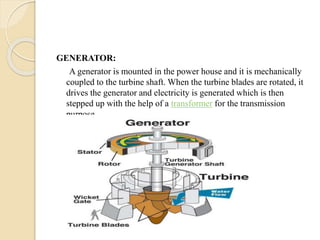
GENERATOR:
A generator is mounted in the power house and it is mechanically
coupled to the turbine shaft. When the turbine blades are rotated, it
drives the generator and electricity is generated which is then
stepped up with the help of a transformer for the transmission
purpose.
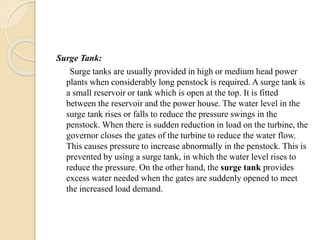
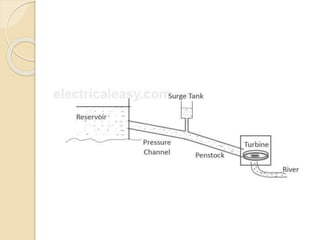
Surge Tank:
Surge tanks are usually provided in high or medium head power
plants when considerably long penstock is required. A surge tank is
a small reservoir or tank which is open at the top. It is fitted
between the reservoir and the power house. The water level in the
surge tank rises or falls to reduce the pressure swings in the
penstock. When there is sudden reduction in load on the turbine, the
governor closes the gates of the turbine to reduce the water flow.
This causes pressure to increase abnormally in the penstock. This is
prevented by using a surge tank, in which the water level rises to
reduce the pressure. On the other hand, the surge tank provides
excess water needed when the gates are suddenly opened to meet
the increased load demand.
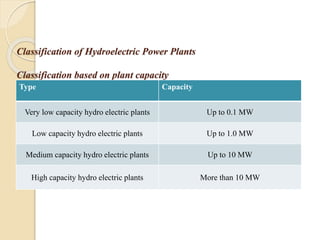
Classification of Hydroelectric Power Plants
Classification based on plant capacity
Type Capacity
Very low capacity hydro electric plants Up to 0.1 MW
Low capacity hydro electric plants Up to 1.0 MW
Medium capacity hydro electric plants Up to 10 MW
High capacity hydro electric plants More than 10 MW
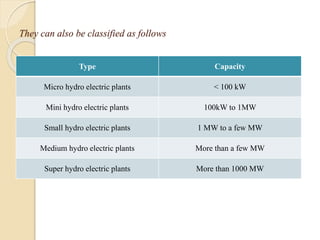
They can also be classified as follows
Type Capacity
Micro hydro electric plants < 100 kW
Mini hydro electric plants 100kW to 1MW
Small hydro electric plants 1 MW to a few MW
Medium hydro electric plants More than a few MW
Super hydro electric plants More than 1000 MW
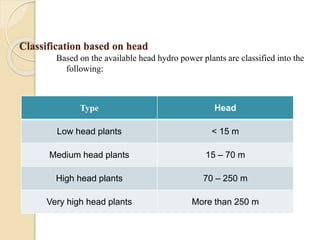
Classification based on head
Based on the available head hydro power plants are classified into the
following:
Type Head
Low head plants < 15 m
Medium head plants 15 – 70 m
High head plants 70 – 250 m
Very high head plants More than 250 m
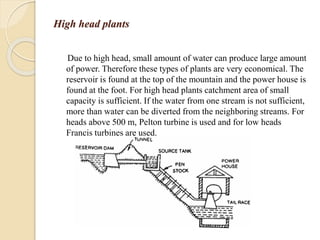
High head plants
Due to high head, small amount of water can produce large amount
of power. Therefore these types of plants are very economical. The
reservoir is found at the top of the mountain and the power house is
found at the foot. For high head plants catchment area of small
capacity is sufficient. If the water from one stream is not sufficient,
more than water can be diverted from the neighboring streams. For
heads above 500 m, Pelton turbine is used and for low heads
Francis turbines are used.
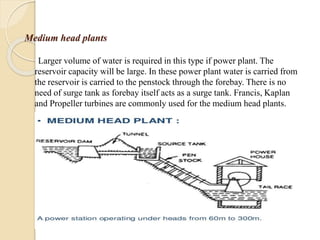
Medium head plants
Larger volume of water is required in this type if power plant. The
reservoir capacity will be large. In these power plant water is carried from
the reservoir is carried to the penstock through the forebay. There is no
need of surge tank as forebay itself acts as a surge tank. Francis, Kaplan
and Propeller turbines are commonly used for the medium head plants.
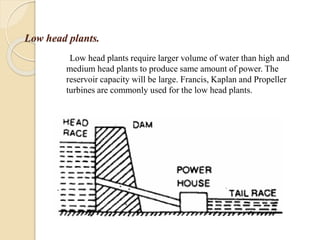
Low head plants.
Low head plants require larger volume of water than high and
medium head plants to produce same amount of power. The
reservoir capacity will be large. Francis, Kaplan and Propeller
turbines are commonly used for the low head plants.
Advantages Of A Hydroelectric Power Plant
 No fuel is required as potential energy is stored water is used for
electricity generation
 Neat and clean source of energy
 Very small running charges - as water is available free of cost
 Comparatively less maintenance is required and has longer life
 Serves other purposes too, such as irrigation
Disadvantages
 Very high capital cost due to construction of dam
 High cost of transmission – as hydro plants are located in hilly areas
which are quite away from the consumers
CONCLUSION
 Hydroelectric power was one of the first renewable sources of
energy, and therefore the most developed currently.
 Overtime other renewable sources of energy will develop and
become competitive, offering a wider variety of affordable
renewable energy.
 Hydroelectric market growth in the United States seems to have
reached a plateau and is unlikely to see significant growth in the
future.
Naveen
Naveen

Naveen

  • 1.
    A Technical Seminar reporton Hydro power plant Submitted in partial fulfillment of the requirement For the award of the degree of Bachelor of Technology In ELECTRICAL AND ELECTRONICS ENGINEERING BY V.VINAY 16705A0248 Under the esteemed guidance of Mr. S.S.DEEKSHITM.Tech Assistant professor Department of EEE DEPARTMENT OF ELECTRICAL AND ELECTRONICS ENGINEERING ANNAMACHARYA INSTITUTE OF TECHNOLOGY AND SCIENCES (AN AUTONOMOUS INSTITUTION) Affiliated To Jawaharlal Nehru Technological University, Anantapur Approved by A.I.C.T.E, New Delhi Institute Accredited by NBA & NAAC, Bangalore New Boyanapalli, RAJAMPET-516216, Kadapa(dt), A.P.
  • 2.
    CONTENTS:  Introduction  Layoutof Hydro power plant  Construction and Working  Classifications of Hydro power plant  Advantages  Disadvantages  Conclusion
  • 3.
    Introduction Power system mainlycontains three parts namely generation, transmission and distribution. Generation means how to generate electricity from the available source and there are various methods to generate electricity but in this article we only focused on generation of electricity by the means of hydro or water (hydro power plant). As we know that the power plant is defined as the place where power is generated from a given source, so here the source is hydro that’s why we called it hydro power plant.
  • 4.
    Layout of Hydropower plant
  • 5.
    Construction And Working For construction of hydro power plant first we choose the area where the water is sufficient to reserve and no any crisis of water and suitable to build a dam, then we construct the dam.  The main function of dam is to stop the flow of water and reserve the water in reservoir.  Mainly dam is situated at a good height to increase the force of water. Reservoir stocks up lots of water which is employed to generate power by means of turbines.  After that Penstock, the pipe which is connected between dam and turbine blades and most important purpose of the penstock is to enlarge the kinetic energy of water that’s why this pipe is made up of extremely well-built material which carry on the pressure of water
  • 6.
     After thatPenstock, the pipe which is connected between dam and turbine blades and most important purpose of the penstock is to enlarge the kinetic energy of water that’s why this pipe is made up of extremely well-built material which carry on the pressure of water  To control the pressure of water means increase or decrease water pressure whenever required, we use a valve. Storage tank comes in picture when the some reason the pressure of water in reservoir is decreases then we use storage tank it is directly connected to penstock and use only in emergency condition.  As we know that the turbine is an engine that transfers energy of fluid into mechanical energy which is coupled with generator and generator converts mechanical energy into electrical energy which we utilize at the end
  • 7.
    Dam and Reservoir: Thedam is constructed on a large river in hilly areas to ensure sufficient water storage at height. The dam forms a large reservoir behind it. The height of water level (called as water head) in the reservoir determines how much of potential energy is stored in it. Control Gate: Water from the reservoir is allowed to flow through the penstock to the turbine. The amount of water which is to be released in the penstock can be controlled by a control gate. When the control gate is fully opened, maximum amount of water is released through the penstock.
  • 8.
    Penstock: A penstock isa huge steel pipe which carries water from the reservoir to the turbine. Potential energy of the water is converted into kinetic energy as it flows down through the penstock due to gravity. Water Turbine: Water from the penstock is taken into the water turbine. The turbine is mechanically coupled to an electric generator. Kinetic energy of the water drives the turbine and consequently the generator gets driven
  • 9.
    GENERATOR: A generator ismounted in the power house and it is mechanically coupled to the turbine shaft. When the turbine blades are rotated, it drives the generator and electricity is generated which is then stepped up with the help of a transformer for the transmission purpose.
  • 10.
    Surge Tank: Surge tanksare usually provided in high or medium head power plants when considerably long penstock is required. A surge tank is a small reservoir or tank which is open at the top. It is fitted between the reservoir and the power house. The water level in the surge tank rises or falls to reduce the pressure swings in the penstock. When there is sudden reduction in load on the turbine, the governor closes the gates of the turbine to reduce the water flow. This causes pressure to increase abnormally in the penstock. This is prevented by using a surge tank, in which the water level rises to reduce the pressure. On the other hand, the surge tank provides excess water needed when the gates are suddenly opened to meet the increased load demand.
  • 12.
    Classification of HydroelectricPower Plants Classification based on plant capacity Type Capacity Very low capacity hydro electric plants Up to 0.1 MW Low capacity hydro electric plants Up to 1.0 MW Medium capacity hydro electric plants Up to 10 MW High capacity hydro electric plants More than 10 MW
  • 13.
    They can alsobe classified as follows Type Capacity Micro hydro electric plants < 100 kW Mini hydro electric plants 100kW to 1MW Small hydro electric plants 1 MW to a few MW Medium hydro electric plants More than a few MW Super hydro electric plants More than 1000 MW
  • 14.
    Classification based onhead Based on the available head hydro power plants are classified into the following: Type Head Low head plants < 15 m Medium head plants 15 – 70 m High head plants 70 – 250 m Very high head plants More than 250 m
  • 15.
    High head plants Dueto high head, small amount of water can produce large amount of power. Therefore these types of plants are very economical. The reservoir is found at the top of the mountain and the power house is found at the foot. For high head plants catchment area of small capacity is sufficient. If the water from one stream is not sufficient, more than water can be diverted from the neighboring streams. For heads above 500 m, Pelton turbine is used and for low heads Francis turbines are used.
  • 16.
    Medium head plants Largervolume of water is required in this type if power plant. The reservoir capacity will be large. In these power plant water is carried from the reservoir is carried to the penstock through the forebay. There is no need of surge tank as forebay itself acts as a surge tank. Francis, Kaplan and Propeller turbines are commonly used for the medium head plants.
  • 17.
    Low head plants. Lowhead plants require larger volume of water than high and medium head plants to produce same amount of power. The reservoir capacity will be large. Francis, Kaplan and Propeller turbines are commonly used for the low head plants.
  • 18.
    Advantages Of AHydroelectric Power Plant  No fuel is required as potential energy is stored water is used for electricity generation  Neat and clean source of energy  Very small running charges - as water is available free of cost  Comparatively less maintenance is required and has longer life  Serves other purposes too, such as irrigation Disadvantages  Very high capital cost due to construction of dam  High cost of transmission – as hydro plants are located in hilly areas which are quite away from the consumers
  • 19.
    CONCLUSION  Hydroelectric powerwas one of the first renewable sources of energy, and therefore the most developed currently.  Overtime other renewable sources of energy will develop and become competitive, offering a wider variety of affordable renewable energy.  Hydroelectric market growth in the United States seems to have reached a plateau and is unlikely to see significant growth in the future.