HYDRO ELECTRIC POWER
PLANT
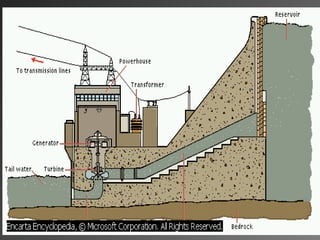
 In hydroelectric power station potential and
kinetic energy of stored water is converted
into electric energy .
 For hydro power station factors like
rainfall,steam flow available head and
storage facilities are studied.
 25% of electricity generation capacity in
world is provided by hydel power plant.
 In the countries like Norvey 99% electricity
is produced by hydelpowerplant.
INTRODUCTION
 4% of the total hydel energy potential in world
is in India.
 In India 25.32% of total electricity generation
capacity is produced by hydel power plant.
 As per rocords of March-2000 23,816 MW
electricity was generated by hydel power plant.
 It is increasing day by day because of the
institutes like National Hydro Power
Corporation Limited(NHPCL).
PURPOSES OF HYDROPROJECT
 For irrigation of agricultural land.
 For fisheries and tourism.
 For flood control.
 For civil water supply.
 For generation of electricity.
BASIC ELEMENTS OF HYDEL POWER
PLANT
PRIMARY ELEMENT’S
 CATCHMENT AREA
 RESERVOIR
 DAM
 PRIME MOVERS
 DRAFT TUBES
 POWER HOUSE & EQUIPMENT
SAFETY DEVICE’S
 SPILL WAY’S
 SURGE TANK
 TRASH RACK
CATCHMENT AREA
The whole area behind the clam training into a
stream as river across which the dam has been
built at suitable place is called catchments area
RESERVOIR
A reservoir is employed to store water which is
further utilized to generate power by running
the hydroelectric turbines.
DAM
A dam is a barrier which confines or raise water
for storage or diversion to create a hydraulic
head. Dam’s are generally made of concrete,
Stone masory, Rockfill or Timber
TURBINE
Turbine is a very light fan like structure having many
number’s of blades . It has an ability to rotate on its
axis when water passes through it.
GENERATOR
Generator is a device in which when there is rotation
of coil between the strong Magnetic Field then it
produces an Alternating Current.
DRAFT TUBES Draft Tube is an empty structure
made beneath the Turbine. It serves following
purpose’s
 It allows the turbine to be set above tail water level
without loss of head, to facilitate inspection and
maintenance.
 It regains by diffuser action , the major portion of the
kinetic energy delivered to it from the runner.
 It increases the output power.
 It increases the efficiency of Hydro Power Plant.
PENSTOCK
Penstock is the connecting pipe between the dam &
the turbine house. It helps to increase the kinetic
energy of the water coming from the dam and is made
up of a very strong material which can sustain the
high pressure of water.
POWER HOUSE & EQUIPMENT
Some more components are required for the proper,
user friendly & smooth functioning of the power plant.
These components are as follow
VALVE :- This the instrument which is used to control
the pressure of flow of water .
PUMPS :- This device is used to send water
or any fluid from lower potential to higher
potential.
SAFETY DEVICE’S
Spill Way’s
Spill Way’s is a kind of canal provided besides
the dam. It is used to arrange the excess of
accumulation of water on the dam because
excess accumulation of water may damage the
dam structure
SURGE TANK
When there is a sudden close or decrease in
pressure due to control valve then there is a back flow
of water. This creates a high pressure zone in the
penstock due to which it may burst . This effect is
known as WATER HAMMERING EFFECT . To avoid
this a tank is attached to the penstock which stores
water in it . This tank is called as Surge Tank.
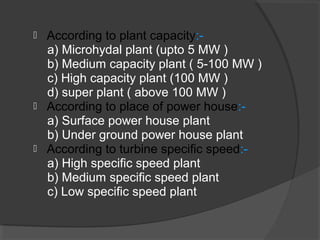
 According to plant capacity:-
a) Microhydal plant (upto 5 MW )
b) Medium capacity plant ( 5-100 MW )
c) High capacity plant (100 MW )
d) super plant ( above 100 MW )
 According to place of power house:-
a) Surface power house plant
b) Under ground power house plant
 According to turbine specific speed:-
a) High specific speed plant
b) Medium specific speed plant
c) Low specific speed plant
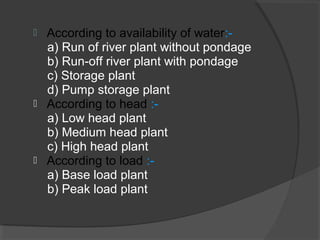
 According to availability of water:-
a) Run of river plant without pondage
b) Run-off river plant with pondage
c) Storage plant
d) Pump storage plant
 According to head :-
a) Low head plant
b) Medium head plant
c) High head plant
 According to load :-
a) Base load plant
b) Peak load plant
WORKING OF HYDRO
POWER PLANT
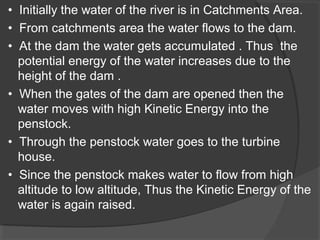
• Initially the water of the river is in Catchments Area.
• From catchments area the water flows to the dam.
• At the dam the water gets accumulated . Thus the
potential energy of the water increases due to the
height of the dam .
• When the gates of the dam are opened then the
water moves with high Kinetic Energy into the
penstock.
• Through the penstock water goes to the turbine
house.
• Since the penstock makes water to flow from high
altitude to low altitude, Thus the Kinetic Energy of the
water is again raised.
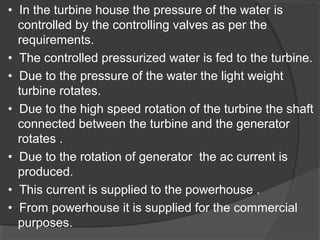
• In the turbine house the pressure of the water is
controlled by the controlling valves as per the
requirements.
• The controlled pressurized water is fed to the turbine.
• Due to the pressure of the water the light weight
turbine rotates.
• Due to the high speed rotation of the turbine the shaft
connected between the turbine and the generator
rotates .
• Due to the rotation of generator the ac current is
produced.
• This current is supplied to the powerhouse .
• From powerhouse it is supplied for the commercial
purposes.
WATER TURBINES USED IN
HYDEL POWER PLANT
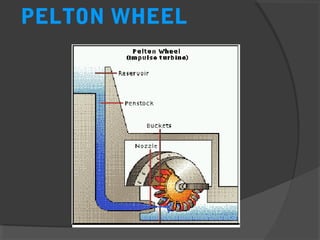
 PELTON TURBINE
 FRANCIS TURBINE
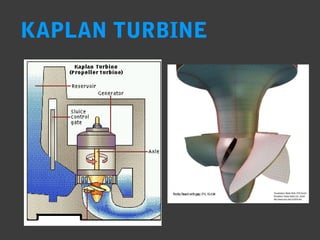
 KAPLAN TURBINE
PELTON WHEEL
KAPLAN TURBINE
ADVANTAGES OF HYDRO POWER
PLANT
 This plant is free from pollution.
 Its operation and maintenance cost is less.
 It has no stand by losses.
 Unit cost of power is less.
 Hydraulic turbines can be started speedily.
 The plant has longer service life.
 No fuel is required.
 No change in efficiency with the age.
Disadvantages of hydro
power plant
 Initial cost of dam and plant is high.
 The availability of power from it is not
much reliable.
 Loss of forest creates environmental
problems.
 Due to evaporation , considerable water is
lost.
 Time required for construction of
hydroproject is more.
AUXILIARIES ATTACHED
WITH HYDEL POWER
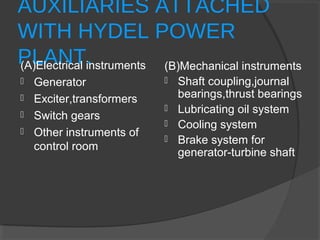
PLANT.(A)Electrical instruments
 Generator
 Exciter,transformers
 Switch gears
 Other instruments of
control room
(B)Mechanical instruments
 Shaft coupling,journal
bearings,thrust bearings
 Lubricating oil system
 Cooling system
 Brake system for
generator-turbine shaft
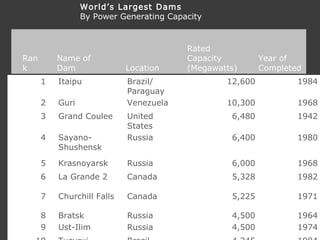
1 Itaipu Brazil/
Paraguay
12,600 1984
2 Guri Venezuela 10,300 1968
3 Grand Coulee United
States
6,480 1942
4 Sayano-
Shushensk
Russia 6,400 1980
5 Krasnoyarsk Russia 6,000 1968
6 La Grande 2 Canada 5,328 1982
7 Churchill Falls Canada 5,225 1971
8 Bratsk Russia 4,500 1964
9 Ust-Ilim Russia 4,500 1974
Ran
k
Name of
Dam Location
Rated
Capacity
(Megawatts)
Year of
Completed
World’s Largest Dams
By Power Generating Capacity
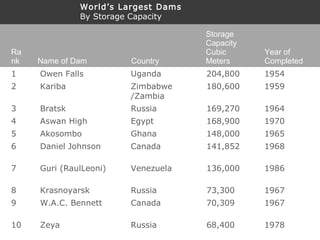
1 Owen Falls Uganda 204,800 1954
2 Kariba Zimbabwe
/Zambia
180,600 1959
3 Bratsk Russia 169,270 1964
4 Aswan High Egypt 168,900 1970
5 Akosombo Ghana 148,000 1965
6 Daniel Johnson Canada 141,852 1968
7 Guri (RaulLeoni) Venezuela 136,000 1986
8 Krasnoyarsk Russia 73,300 1967
9 W.A.C. Bennett Canada 70,309 1967
10 Zeya Russia 68,400 1978
Ra
nk Name of Dam Country
Storage
Capacity
Cubic
Meters
Year of
Completed
World’s Largest Dams
By Storage Capacity
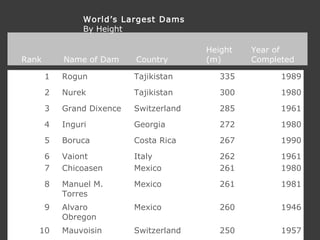
1 Rogun Tajikistan 335 1989
2 Nurek Tajikistan 300 1980
3 Grand Dixence Switzerland 285 1961
4 Inguri Georgia 272 1980
5 Boruca Costa Rica 267 1990
6 Vaiont Italy 262 1961
7 Chicoasen Mexico 261 1980
8 Manuel M.
Torres
Mexico 261 1981
9 Alvaro
Obregon
Mexico 260 1946
10 Mauvoisin Switzerland 250 1957
Rank Name of Dam Country
Height
(m)
Year of
Completed
World’s Largest Dams
By Height

Hydro electric power plant ppt

  • 1.
  • 2.
     In hydroelectricpower station potential and kinetic energy of stored water is converted into electric energy .  For hydro power station factors like rainfall,steam flow available head and storage facilities are studied.  25% of electricity generation capacity in world is provided by hydel power plant.  In the countries like Norvey 99% electricity is produced by hydelpowerplant. INTRODUCTION
  • 3.
     4% ofthe total hydel energy potential in world is in India.  In India 25.32% of total electricity generation capacity is produced by hydel power plant.  As per rocords of March-2000 23,816 MW electricity was generated by hydel power plant.  It is increasing day by day because of the institutes like National Hydro Power Corporation Limited(NHPCL).
  • 4.
    PURPOSES OF HYDROPROJECT For irrigation of agricultural land.  For fisheries and tourism.  For flood control.  For civil water supply.  For generation of electricity.
  • 5.
    BASIC ELEMENTS OFHYDEL POWER PLANT PRIMARY ELEMENT’S  CATCHMENT AREA  RESERVOIR  DAM  PRIME MOVERS  DRAFT TUBES  POWER HOUSE & EQUIPMENT SAFETY DEVICE’S  SPILL WAY’S  SURGE TANK  TRASH RACK
  • 6.
    CATCHMENT AREA The wholearea behind the clam training into a stream as river across which the dam has been built at suitable place is called catchments area RESERVOIR A reservoir is employed to store water which is further utilized to generate power by running the hydroelectric turbines. DAM A dam is a barrier which confines or raise water for storage or diversion to create a hydraulic head. Dam’s are generally made of concrete, Stone masory, Rockfill or Timber
  • 7.
    TURBINE Turbine is avery light fan like structure having many number’s of blades . It has an ability to rotate on its axis when water passes through it. GENERATOR Generator is a device in which when there is rotation of coil between the strong Magnetic Field then it produces an Alternating Current. DRAFT TUBES Draft Tube is an empty structure made beneath the Turbine. It serves following purpose’s
  • 8.
     It allowsthe turbine to be set above tail water level without loss of head, to facilitate inspection and maintenance.  It regains by diffuser action , the major portion of the kinetic energy delivered to it from the runner.  It increases the output power.  It increases the efficiency of Hydro Power Plant. PENSTOCK Penstock is the connecting pipe between the dam & the turbine house. It helps to increase the kinetic energy of the water coming from the dam and is made up of a very strong material which can sustain the high pressure of water.
  • 9.
    POWER HOUSE &EQUIPMENT Some more components are required for the proper, user friendly & smooth functioning of the power plant. These components are as follow VALVE :- This the instrument which is used to control the pressure of flow of water . PUMPS :- This device is used to send water or any fluid from lower potential to higher potential. SAFETY DEVICE’S Spill Way’s Spill Way’s is a kind of canal provided besides the dam. It is used to arrange the excess of
  • 10.
    accumulation of wateron the dam because excess accumulation of water may damage the dam structure SURGE TANK When there is a sudden close or decrease in pressure due to control valve then there is a back flow of water. This creates a high pressure zone in the penstock due to which it may burst . This effect is known as WATER HAMMERING EFFECT . To avoid this a tank is attached to the penstock which stores water in it . This tank is called as Surge Tank.
  • 12.
     According toplant capacity:- a) Microhydal plant (upto 5 MW ) b) Medium capacity plant ( 5-100 MW ) c) High capacity plant (100 MW ) d) super plant ( above 100 MW )  According to place of power house:- a) Surface power house plant b) Under ground power house plant  According to turbine specific speed:- a) High specific speed plant b) Medium specific speed plant c) Low specific speed plant
  • 13.
     According toavailability of water:- a) Run of river plant without pondage b) Run-off river plant with pondage c) Storage plant d) Pump storage plant  According to head :- a) Low head plant b) Medium head plant c) High head plant  According to load :- a) Base load plant b) Peak load plant
  • 14.
  • 15.
    • Initially thewater of the river is in Catchments Area. • From catchments area the water flows to the dam. • At the dam the water gets accumulated . Thus the potential energy of the water increases due to the height of the dam . • When the gates of the dam are opened then the water moves with high Kinetic Energy into the penstock. • Through the penstock water goes to the turbine house. • Since the penstock makes water to flow from high altitude to low altitude, Thus the Kinetic Energy of the water is again raised.
  • 16.
    • In theturbine house the pressure of the water is controlled by the controlling valves as per the requirements. • The controlled pressurized water is fed to the turbine. • Due to the pressure of the water the light weight turbine rotates. • Due to the high speed rotation of the turbine the shaft connected between the turbine and the generator rotates . • Due to the rotation of generator the ac current is produced. • This current is supplied to the powerhouse . • From powerhouse it is supplied for the commercial purposes.
  • 18.
    WATER TURBINES USEDIN HYDEL POWER PLANT  PELTON TURBINE  FRANCIS TURBINE  KAPLAN TURBINE
  • 19.
  • 20.
  • 21.
    ADVANTAGES OF HYDROPOWER PLANT  This plant is free from pollution.  Its operation and maintenance cost is less.  It has no stand by losses.  Unit cost of power is less.  Hydraulic turbines can be started speedily.  The plant has longer service life.  No fuel is required.  No change in efficiency with the age.
  • 22.
    Disadvantages of hydro powerplant  Initial cost of dam and plant is high.  The availability of power from it is not much reliable.  Loss of forest creates environmental problems.  Due to evaporation , considerable water is lost.  Time required for construction of hydroproject is more.
  • 23.
    AUXILIARIES ATTACHED WITH HYDELPOWER PLANT.(A)Electrical instruments  Generator  Exciter,transformers  Switch gears  Other instruments of control room (B)Mechanical instruments  Shaft coupling,journal bearings,thrust bearings  Lubricating oil system  Cooling system  Brake system for generator-turbine shaft
  • 24.
    1 Itaipu Brazil/ Paraguay 12,6001984 2 Guri Venezuela 10,300 1968 3 Grand Coulee United States 6,480 1942 4 Sayano- Shushensk Russia 6,400 1980 5 Krasnoyarsk Russia 6,000 1968 6 La Grande 2 Canada 5,328 1982 7 Churchill Falls Canada 5,225 1971 8 Bratsk Russia 4,500 1964 9 Ust-Ilim Russia 4,500 1974 Ran k Name of Dam Location Rated Capacity (Megawatts) Year of Completed World’s Largest Dams By Power Generating Capacity
  • 25.
    1 Owen FallsUganda 204,800 1954 2 Kariba Zimbabwe /Zambia 180,600 1959 3 Bratsk Russia 169,270 1964 4 Aswan High Egypt 168,900 1970 5 Akosombo Ghana 148,000 1965 6 Daniel Johnson Canada 141,852 1968 7 Guri (RaulLeoni) Venezuela 136,000 1986 8 Krasnoyarsk Russia 73,300 1967 9 W.A.C. Bennett Canada 70,309 1967 10 Zeya Russia 68,400 1978 Ra nk Name of Dam Country Storage Capacity Cubic Meters Year of Completed World’s Largest Dams By Storage Capacity
  • 26.
    1 Rogun Tajikistan335 1989 2 Nurek Tajikistan 300 1980 3 Grand Dixence Switzerland 285 1961 4 Inguri Georgia 272 1980 5 Boruca Costa Rica 267 1990 6 Vaiont Italy 262 1961 7 Chicoasen Mexico 261 1980 8 Manuel M. Torres Mexico 261 1981 9 Alvaro Obregon Mexico 260 1946 10 Mauvoisin Switzerland 250 1957 Rank Name of Dam Country Height (m) Year of Completed World’s Largest Dams By Height

Editor's Notes