B I S H O W J Y O T I S U B E D I 1 4 4 8 0 0 9
J E E W A N D A W A D I 1 4 4 8 0 0 1 6
M I L A N G H I M I R E 1 4 4 8 0 0 2 1
S U B O D H P O K H R E L 1 4 4 8 0 0 3 9
S U J A N D E V K O T A 1 4 4 8 0 0 4 2
A PRESENTATION ON
Wind & Solar Hybrid Power
Generation
What We’ll Cover Today
 Introduction
 Topic Description
 Problem Statement
 Objectives
 Methodology
 Possible output
 Plan
 Advantages
 Disadvantage
 Application
 Conclusion
 Questions and answers
INTRODUCTION
 Hybrid systems, as the name implies, combine
two or more modes of electricity generation .
 It is usually done using renewable technologies
such as solar photovoltaic(PV) and wind turbines.
 Hybrid systems provide a high level of energy
security through the mix of generation methods.
WIND ENERGY
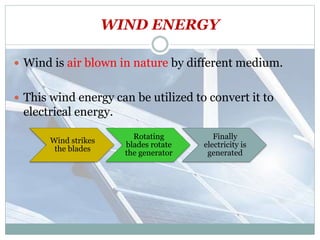
 Wind is air blown in nature by different medium.
 This wind energy can be utilized to convert it to
electrical energy.
Wind strikes
the blades
Rotating
blades rotate
the generator
Finally
electricity is
generated
SOLAR ENERGY
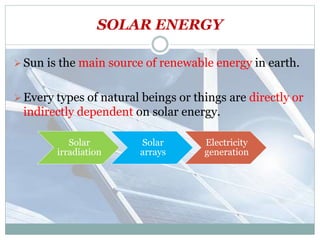
Sun is the main source of renewable energy in earth.
Every types of natural beings or things are directly or
indirectly dependent on solar energy.
Solar
irradiation
Solar
arrays
Electricity
generation
PROBLEM STATEMENT
Your logo here
Increasing power cut off due to over load demand.
Due to facing lots of problems during transmission
and distribution in rural areas.
OBJECTIVE
 To be completely different from traditional electricity labs and
to be fresh and interesting.
 To be intimately related to real world industrial power issues
such as power quality.
 To show a complex, interrelated system that is closer to the
“real world” than the usual simple systems covered in
educational labs.
 To motivate learning by introduction such elements as
environmental and economic concerns of practical interest to
the students.
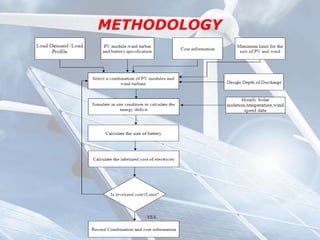
METHODOLOGY
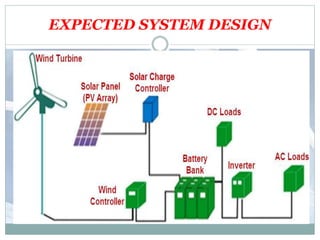
EXPECTED SYSTEM DESIGN
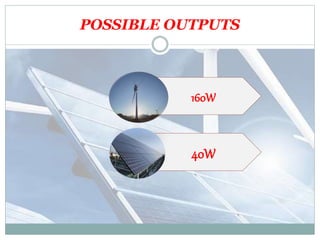
POSSIBLE OUTPUTS
160W
40W
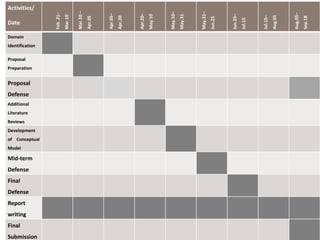
Activities/
Date
Feb.21–
Mar.10
Mar.10–
Apr.05
Apr.05–
Apr.20
Apr.20–
May.10
May.10–
May.31
May.31–
Jun.25
Jun.25–
Jul.15
Jul.15–
Aug.05
Aug.05–
Sep.18
Domain
Identification
Proposal
Preparation
Proposal
Defense
Additional
Literature
Reviews
Development
of Conceptual
Model
Mid-term
Defense
Final
Defense
Report
writing
Final
Submission
ADVANTAGES
It is standalone renewable electrical energy generation system.
Operation and maintenance cost is low.
Renewable energy sources like, sun, wind,. Are utilized so, no waste
production.
Producing clean, friendly to environment, renewable energy.
Once the system is designed and developed or manufactured, the installation
of system is easy.
No use of Microcontroller or microprocessor , hence, system testing and
understanding is easy.
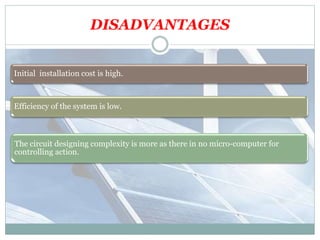
DISADVANTAGES
Initial installation cost is high.
Efficiency of the system is low.
The circuit designing complexity is more as there in no micro-computer for
controlling action.
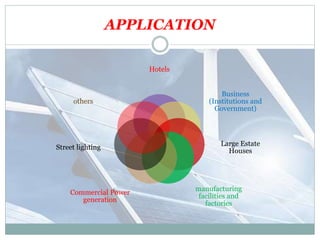
APPLICATION
Hotels
Business
(Institutions and
Government)
Large Estate
Houses
manufacturing
facilities and
factories
Commercial Power
generation
Street lighting
others
CONCLUSION
The main objective of this project was to give more
stable power from wind–solar hybrid system. The project
will be successfully designed & constructed, which will
be able to collect sun radiation and wind velocity all the
day to operate the system. It can be commercially
applicable in village and remote areas where air velocity
and sun radiation is perfectly available.
Wind & Solar Hybrid Power Generation System

Wind & Solar hybrid power generation