HIGHWAY DRAINAGE FACILITIES
Chap 6
DRAINAGE
 One of most important considerations in locating and
designing streets and HWYS
 Adequate and economical drainage will protect highway
structures and save people.
 About 25% of highway construction dollars are spent for
erosion control and drainage structures (culverts, bridges,
channels, and ditches).
 Inadequate drainage can result in:
 Serious damage to pavement.
 Traffic accidents due to hydroplaning and loss of
visibility from splash & spray of accumulate water
 Surface water:
 Rain,
 snow,
 melting ice, & artificial.
 Surface Drainage: Measures taken to control flow of
surface water.
 Under ground water.
 Subsurface drainage (Sub drainage): Measures taken to
control flow of underground water
ADEQUATE DRAINAGE
 Provision of adequate drainage is an essential part of
pavement design.
– Protection of pavement structure
– Improves road safety
• Can be categorically studied in two parts:
1. Surface Drainage
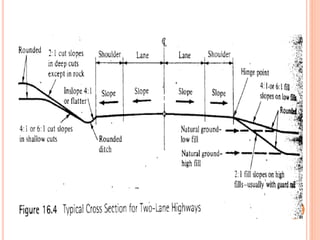
• Drainage on the adjoining land and roadway surface
• Side Drainage and Cross Drainage
2. Sub-surface Drainage
SURFACE WATER IN URBAN
 Cross Slopes
 Longitudinal slopes
 Curbs, and gutters (function as side ditches in addition to
preventing the violation of the vehicles on adjacent areas
and delineating pavement edges)
 Inlets and storm drains (Underground pipes in medians)
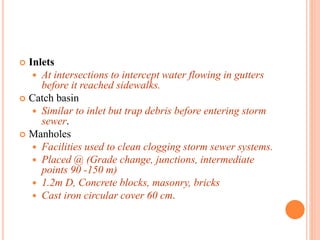
 Inlets
 At intersections to intercept water flowing in gutters
before it reached sidewalks.
 Catch basin
 Similar to inlet but trap debris before entering storm
sewer.
 Manholes
 Facilities used to clean clogging storm sewer systems.
 Placed @ (Grade change, junctions, intermediate
points 90 -150 m)
 1.2m D, Concrete blocks, masonry, bricks
 Cast iron circular cover 60 cm.
SUBSURFACE DRAINAGE
 Subsurface drainage systems are provided within the
pavement structure to drain water in one or more of
the following forms:
1. Water that has permeated through cracks and joints in the
pavement to the underlying strata.
2. Water that has moved upward through the underlying soil
strata as a result of capillary action.
3. Water that exist in the natural ground below the water table
(ground water).
 Effect of inadequate sub drainage:
 Poor pavement performance:
 Saturated sub-grade will be weak in resisting traffic loads
 Frost heave
 Instability of slopes:
 Reduce of shear strength of the embankment soil and
increase of stresses to be resisted which will result in
slope crumbling or failure
SUBSURFACE DRAINAGE
一. Control of groundwater encountered in highway locations.
二. Purpose: control seepage, lowering ground water table, base
and shallow subg-rade drains.
三. Circular pipes laid at suitable depth in a trench, which is
then backfilled with porous granular material.
四. Pipes materials: Porous concrete, perforated metal, or
vitrified clay
五. 6 – 8 inches reach up to 24inches.
六. Slope: steep enough to prevent deposition or setting of
materials entering the pipe through joints or perforations.
七. Intercepting drains, lowering water table, and base drainage.
SUBSURFACE DRAINAGE
 A subsurface drain is a make a hole in conduit, such as
tile, pipe or tubing, installed below the. ground surface to
intercept, collect, and/or convey drainage water.
Subsurface drains are. designed to remove excess water
from soil.
DRAINAGE
 Effects of water on the pavement structure Presence
一. reduction in the stability of the soil mass.
二. huge variation in volume of sub grade in clayey soils.
三. Waves and failure in flexible pavements.
四. strip failure in flexible pavements.
五. Mud pumping failure in rigid pavements. of moisture
causes
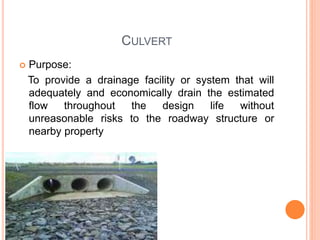
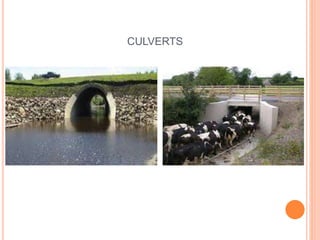
CULVERT
 Purpose:
To provide a drainage facility or system that will
adequately and economically drain the estimated
flow throughout the design life without
unreasonable risks to the roadway structure or
nearby property
culverts
一. Is a structure used to put across surface run off through
embankments
二. It may be rounded pipe ,
三. rectangular box,
四. arch,
五. ellipse,
六. bottomless,
七. or other shapes
 Important to select culvert location (Station no.), alignment, and
grade
 Location:
1. Bottom of depression where no natural water course exist.
2. Where natural stream intersect the roadway.
 Alignment:
1. Conform with natural stream
2. Cross roadway at right angles (economy)
3. Skew culverts are needed sometimes
 Grade:
1. Conform to existing grade of stream
2. Reduced grades through culverts…..velocity
reduction…..sediments deposition….reduce capacity
3. Increasing culvert grade…..velocity increase…..erosion at outlet
and beyond.
 Shapes
1. Circular
2. Box (rectangular)
3. Elliptical
4. Pipe Arch
5. Arch
6. Metal Box
 Materials:
1. Concrete (reinforced & unreinforced)
2. Corrugated metal (Steel & Aluminum)
 Inlet Types
1. Projecting barrel.
2. Cast in place concrete headwall & wing walls.
3. Precast end section.
4. End mitered to the slope.
CULVERTS
 Functions of culverts
The functions of culvert are:
 Collection and transport of water across the road so as to
not cause damage to the road bank or the stream bed by
clean.
 To provide sufficient waterway to prevent heading up of
water above the road surface.
parts of culverts
 A culvert consists of mainly 3 parts:
 Inlet structure
 Culvert barrel
 Outlet structure
 Culverts are laid depending on the type of the foundation
which may be sand bedding, PCC, RCC, etc. RCC is
used for weak soil conditions and sand bedding for pipe
culverts. All the other culverts are generally made of
PCC. precasting concrete culvert
A bridge is a structure built
to span physical obstacles without closing
the way underneath such as a body of
water, valley, or road, for the purpose of
providing passage over the obstacle. There
are many different designs that each serve
a particular purpose and apply to different
situations.
BRIDGES
 TYPES OF BRIDGES
 Bridges can be classified in various ways.
 On the basis of construction materials
 Steel bridges
 Concrete bridges
 Timber bridges, etc.
 On the basis of structural point of view
 Cantilever bridges
 Suspension bridges
 Moving bridges, etc.
 On the basis of span length
 Minor bridge (up to 30m)
 Major bridge (above 30m)
 Long bridge (above 120m)
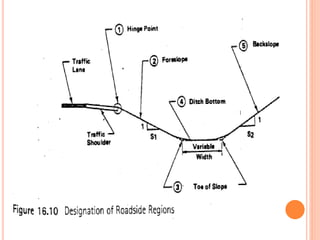
 A ditch is a small to reasonable depression created to
channel water. A ditch can be used for drainage, to drain
water from low-lying areas, alongside roadways or
fields, or to channel water from a more far-away source
for plant irrigation. A trench is a long narrow ditch.
DITCH
SURFACE DRAINAGE
 Surface drainage cover all means by which surface water is
removed from the pavement and right of way of the highway or
street. A properly designed highway surface drainage system
should effectively stop all surface and watershed runoff and
direct this water into adequately designed channels and gutters
for eventual discharge into the natural waterways.
CURBS AND GUTTERS
Subsurface drainage systems are provided within the pavement
structure to drain water in one or more of the following forms:
1. Water that has permeated through cracks and joints in the
pavement to the underlying strata.
2. Water that has moved upward through the underlying soil
strata as a result of capillary action.
3. Water that exist in the natural ground below the water table
(ground water).
DRAINAGE STRUCTURES
 Are constructed to carry traffic over natural waterways that
flow below the right of way of the highway.
 They also provide the flow of water below the highway, along
the natural channel without disturbing its course.
 Concern is always to provide adequate size structure (opening
is sufficiently large to discharge expected flow of water).
 Major Structures: Bridges
 Minor Structures: short-span bridges and culverts
HIGHWAY COMPONENTS
 Roads are the veins, arteries and lymphatic
system of cities. They provide the network for
the transport of resources and wastes, drainage,
the route for all services, water, sewerage,
electricity, gas and telephone etc
我们好啦
要个问题吗

chapt 6.pptx

  • 1.
  • 2.
    DRAINAGE  One ofmost important considerations in locating and designing streets and HWYS  Adequate and economical drainage will protect highway structures and save people.  About 25% of highway construction dollars are spent for erosion control and drainage structures (culverts, bridges, channels, and ditches).
  • 3.
     Inadequate drainagecan result in:  Serious damage to pavement.  Traffic accidents due to hydroplaning and loss of visibility from splash & spray of accumulate water
  • 4.
     Surface water: Rain,  snow,  melting ice, & artificial.  Surface Drainage: Measures taken to control flow of surface water.  Under ground water.  Subsurface drainage (Sub drainage): Measures taken to control flow of underground water
  • 5.
    ADEQUATE DRAINAGE  Provisionof adequate drainage is an essential part of pavement design. – Protection of pavement structure – Improves road safety • Can be categorically studied in two parts: 1. Surface Drainage • Drainage on the adjoining land and roadway surface • Side Drainage and Cross Drainage 2. Sub-surface Drainage
  • 8.
    SURFACE WATER INURBAN  Cross Slopes  Longitudinal slopes  Curbs, and gutters (function as side ditches in addition to preventing the violation of the vehicles on adjacent areas and delineating pavement edges)  Inlets and storm drains (Underground pipes in medians)
  • 9.
     Inlets  Atintersections to intercept water flowing in gutters before it reached sidewalks.  Catch basin  Similar to inlet but trap debris before entering storm sewer.  Manholes  Facilities used to clean clogging storm sewer systems.  Placed @ (Grade change, junctions, intermediate points 90 -150 m)  1.2m D, Concrete blocks, masonry, bricks  Cast iron circular cover 60 cm.
  • 10.
    SUBSURFACE DRAINAGE  Subsurfacedrainage systems are provided within the pavement structure to drain water in one or more of the following forms: 1. Water that has permeated through cracks and joints in the pavement to the underlying strata. 2. Water that has moved upward through the underlying soil strata as a result of capillary action. 3. Water that exist in the natural ground below the water table (ground water).
  • 11.
     Effect ofinadequate sub drainage:  Poor pavement performance:  Saturated sub-grade will be weak in resisting traffic loads  Frost heave  Instability of slopes:  Reduce of shear strength of the embankment soil and increase of stresses to be resisted which will result in slope crumbling or failure
  • 13.
    SUBSURFACE DRAINAGE 一. Controlof groundwater encountered in highway locations. 二. Purpose: control seepage, lowering ground water table, base and shallow subg-rade drains. 三. Circular pipes laid at suitable depth in a trench, which is then backfilled with porous granular material. 四. Pipes materials: Porous concrete, perforated metal, or vitrified clay 五. 6 – 8 inches reach up to 24inches. 六. Slope: steep enough to prevent deposition or setting of materials entering the pipe through joints or perforations. 七. Intercepting drains, lowering water table, and base drainage.
  • 14.
    SUBSURFACE DRAINAGE  Asubsurface drain is a make a hole in conduit, such as tile, pipe or tubing, installed below the. ground surface to intercept, collect, and/or convey drainage water. Subsurface drains are. designed to remove excess water from soil.
  • 15.
  • 16.
     Effects ofwater on the pavement structure Presence 一. reduction in the stability of the soil mass. 二. huge variation in volume of sub grade in clayey soils. 三. Waves and failure in flexible pavements. 四. strip failure in flexible pavements. 五. Mud pumping failure in rigid pavements. of moisture causes
  • 17.
    CULVERT  Purpose: To providea drainage facility or system that will adequately and economically drain the estimated flow throughout the design life without unreasonable risks to the roadway structure or nearby property
  • 18.
    culverts 一. Is astructure used to put across surface run off through embankments 二. It may be rounded pipe , 三. rectangular box, 四. arch, 五. ellipse, 六. bottomless, 七. or other shapes
  • 19.
     Important toselect culvert location (Station no.), alignment, and grade  Location: 1. Bottom of depression where no natural water course exist. 2. Where natural stream intersect the roadway.  Alignment: 1. Conform with natural stream 2. Cross roadway at right angles (economy) 3. Skew culverts are needed sometimes  Grade: 1. Conform to existing grade of stream 2. Reduced grades through culverts…..velocity reduction…..sediments deposition….reduce capacity 3. Increasing culvert grade…..velocity increase…..erosion at outlet and beyond.
  • 20.
     Shapes 1. Circular 2.Box (rectangular) 3. Elliptical 4. Pipe Arch 5. Arch 6. Metal Box  Materials: 1. Concrete (reinforced & unreinforced) 2. Corrugated metal (Steel & Aluminum)  Inlet Types 1. Projecting barrel. 2. Cast in place concrete headwall & wing walls. 3. Precast end section. 4. End mitered to the slope.
  • 21.
  • 23.
     Functions ofculverts The functions of culvert are:  Collection and transport of water across the road so as to not cause damage to the road bank or the stream bed by clean.  To provide sufficient waterway to prevent heading up of water above the road surface.
  • 24.
    parts of culverts A culvert consists of mainly 3 parts:  Inlet structure  Culvert barrel  Outlet structure  Culverts are laid depending on the type of the foundation which may be sand bedding, PCC, RCC, etc. RCC is used for weak soil conditions and sand bedding for pipe culverts. All the other culverts are generally made of PCC. precasting concrete culvert
  • 25.
    A bridge isa structure built to span physical obstacles without closing the way underneath such as a body of water, valley, or road, for the purpose of providing passage over the obstacle. There are many different designs that each serve a particular purpose and apply to different situations. BRIDGES
  • 26.
     TYPES OFBRIDGES  Bridges can be classified in various ways.  On the basis of construction materials  Steel bridges  Concrete bridges  Timber bridges, etc.  On the basis of structural point of view  Cantilever bridges  Suspension bridges  Moving bridges, etc.  On the basis of span length  Minor bridge (up to 30m)  Major bridge (above 30m)  Long bridge (above 120m)
  • 27.
     A ditchis a small to reasonable depression created to channel water. A ditch can be used for drainage, to drain water from low-lying areas, alongside roadways or fields, or to channel water from a more far-away source for plant irrigation. A trench is a long narrow ditch. DITCH
  • 28.
    SURFACE DRAINAGE  Surfacedrainage cover all means by which surface water is removed from the pavement and right of way of the highway or street. A properly designed highway surface drainage system should effectively stop all surface and watershed runoff and direct this water into adequately designed channels and gutters for eventual discharge into the natural waterways.
  • 29.
  • 30.
    Subsurface drainage systemsare provided within the pavement structure to drain water in one or more of the following forms: 1. Water that has permeated through cracks and joints in the pavement to the underlying strata. 2. Water that has moved upward through the underlying soil strata as a result of capillary action. 3. Water that exist in the natural ground below the water table (ground water).
  • 31.
    DRAINAGE STRUCTURES  Areconstructed to carry traffic over natural waterways that flow below the right of way of the highway.  They also provide the flow of water below the highway, along the natural channel without disturbing its course.  Concern is always to provide adequate size structure (opening is sufficiently large to discharge expected flow of water).  Major Structures: Bridges  Minor Structures: short-span bridges and culverts
  • 32.
  • 33.
     Roads arethe veins, arteries and lymphatic system of cities. They provide the network for the transport of resources and wastes, drainage, the route for all services, water, sewerage, electricity, gas and telephone etc
  • 34.