Partitioning and Number Sentences
What is Partitioning?
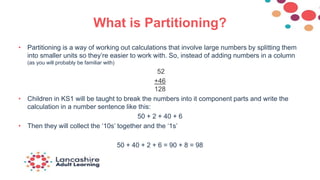
• Partitioning is a way of working out calculations that involve large numbers by splitting them
into smaller units so they’re easier to work with. So, instead of adding numbers in a column
(as you will probably be familiar with)
52
+46
128
• Children in KS1 will be taught to break the numbers into it component parts and write the
calculation in a number sentence like this:
50 + 2 + 40 + 6
• Then they will collect the ‘10s’ together and the ‘1s’
50 + 40 + 2 + 6 = 90 + 8 = 98
Why are children taught partitioning?
• Children are taught this method before they learn to add numbers in columns.
• Partitioning gives children a different way of visualising maths problems, and helps them
work out large sums in their head.
• By breaking numbers down into units that are easy for them to calculate mentally, they can
reach the correct answer without counting out tricky double or triple-digit numbers on their
fingers or trying to remember where a decimal point needs to be.
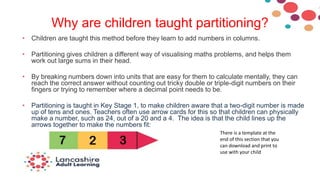
• Partitioning is taught in Key Stage 1, to make children aware that a two-digit number is made
up of tens and ones. Teachers often use arrow cards for this so that children can physically
make a number, such as 24, out of a 20 and a 4. The idea is that the child lines up the
arrows together to make the numbers fit:
There is a template at the
end of this section that you
can download and print to
use with your child
Look at this examples and then try some
for yourself
Addition
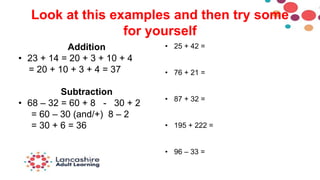
• 23 + 14 = 20 + 3 + 10 + 4
= 20 + 10 + 3 + 4 = 37
Subtraction
• 68 – 32 = 60 + 8 - 30 + 2
= 60 – 30 (and/+) 8 – 2
= 30 + 6 = 36
• 25 + 42 =
• 76 + 21 =
• 87 + 32 =
• 195 + 222 =
• 96 – 33 =
Link to next topic
• How did you find the partitioning calculations?
• You may have found that you got an incorrect answer to the subtraction calculation?
• Children often make a mistake when using partitioning for subtraction.
• This is because they have to add the partial sums which seems to be a contradiction. 90 - 30
(+) 6 – 3 = 60 + 3 = 63
• Due to this misconception partitioning is often not used for subtraction and children are
taught to use number lines instead.
• We will look at this method in the next topic.

Hycwmah partitioning

  • 1.
  • 2.
    What is Partitioning? •Partitioning is a way of working out calculations that involve large numbers by splitting them into smaller units so they’re easier to work with. So, instead of adding numbers in a column (as you will probably be familiar with) 52 +46 128 • Children in KS1 will be taught to break the numbers into it component parts and write the calculation in a number sentence like this: 50 + 2 + 40 + 6 • Then they will collect the ‘10s’ together and the ‘1s’ 50 + 40 + 2 + 6 = 90 + 8 = 98
  • 3.
    Why are childrentaught partitioning? • Children are taught this method before they learn to add numbers in columns. • Partitioning gives children a different way of visualising maths problems, and helps them work out large sums in their head. • By breaking numbers down into units that are easy for them to calculate mentally, they can reach the correct answer without counting out tricky double or triple-digit numbers on their fingers or trying to remember where a decimal point needs to be. • Partitioning is taught in Key Stage 1, to make children aware that a two-digit number is made up of tens and ones. Teachers often use arrow cards for this so that children can physically make a number, such as 24, out of a 20 and a 4. The idea is that the child lines up the arrows together to make the numbers fit: There is a template at the end of this section that you can download and print to use with your child
  • 4.
    Look at thisexamples and then try some for yourself Addition • 23 + 14 = 20 + 3 + 10 + 4 = 20 + 10 + 3 + 4 = 37 Subtraction • 68 – 32 = 60 + 8 - 30 + 2 = 60 – 30 (and/+) 8 – 2 = 30 + 6 = 36 • 25 + 42 = • 76 + 21 = • 87 + 32 = • 195 + 222 = • 96 – 33 =
  • 5.
    Link to nexttopic • How did you find the partitioning calculations? • You may have found that you got an incorrect answer to the subtraction calculation? • Children often make a mistake when using partitioning for subtraction. • This is because they have to add the partial sums which seems to be a contradiction. 90 - 30 (+) 6 – 3 = 60 + 3 = 63 • Due to this misconception partitioning is often not used for subtraction and children are taught to use number lines instead. • We will look at this method in the next topic.