“The problems of the future
are not going to be tidy or straight -
forward.
Therefore our children will need to
be…
resilient and brave,
resourceful,
creative and innovative
and patient.”
F. Gasson, 2015
When we were at school…
❏ We worked on our own.
❏ We feared making mistakes.
❏ We had to regurgitate the teacher’s
methods.
❏ We were sometimes punished for failing.
❏ We were labelled and ranked.
❏ There was very little application or
connection of maths to the real world.
Now it looks like this...
❖ We work with others.
❖ We celebrate mistakes
and learn from them.
❖ We discover our own methods.
❖ We fail and struggle and try harder.
❖ We identify our strengths and next steps
to work on.
❖ We discover maths in the world around us.
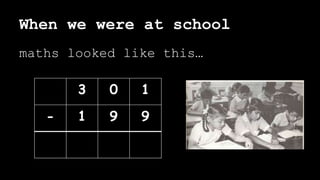
When we were at school
maths looked like this…
3 0 1
- 1 9 9
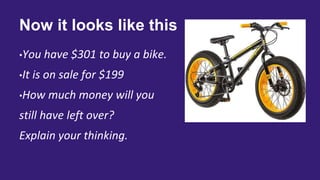
Now it looks like this
•You have $301 to buy a bike.
•It is on sale for $199
•How much money will you
still have left over?
Explain your thinking.
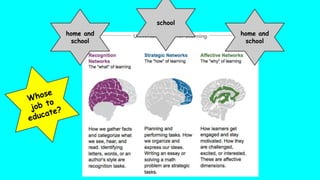
school
home and
school
home and
school
How can we support at home?
Support the “what” of learning... Basic facts, number
sense, mathematical language. (see next slide)
Develop interest in the “why” of learning maths.
It is everywhere in the world around us. It helps us to
describe and communicate about the world. It helps us
to make decisions that hopefully improve our lives and
the lives of others.
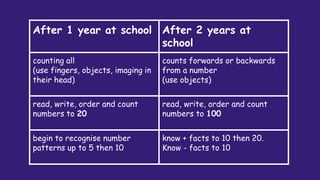
After 1 year at school After 2 years at
school
counting all
(use fingers, objects, imaging in
their head)
counts forwards or backwards
from a number
(use objects)
read, write, order and count
numbers to 20
read, write, order and count
numbers to 100
begin to recognise number
patterns up to 5 then 10
know + facts to 10 then 20.
Know - facts to 10
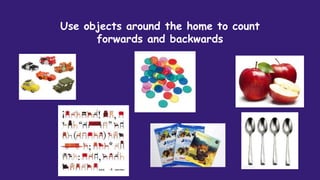
Use objects around the home to count
forwards and backwards
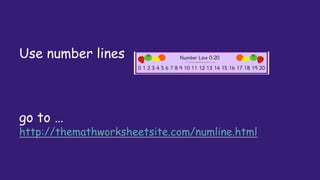
Use number lines
go to …
http://themathworksheetsite.com/numline.html
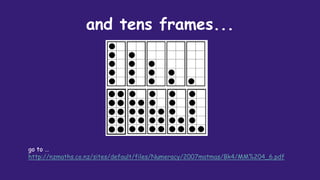
and tens frames...
go to …
http://nzmaths.co.nz/sites/default/files/Numeracy/2007matmas/Bk4/MM%204_6.pdf
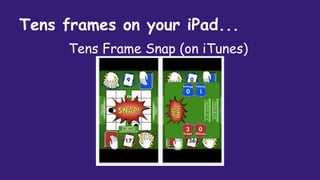
Tens frames on your iPad...
Tens Frame Snap (on iTunes)
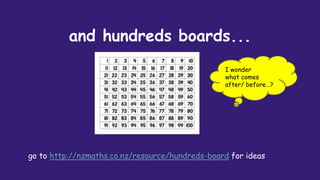
and hundreds boards...
go to http://nzmaths.co.nz/resource/hundreds-board for ideas
I wonder
what comes
after/ before…?
Advanced Counting: we count on from a
bigger number to add two numbers
together
e.g. 4 + 8 we go 8... 9, 10, 11, 12.
(number lines help us to learn this)
Adding and subtracting in year 2
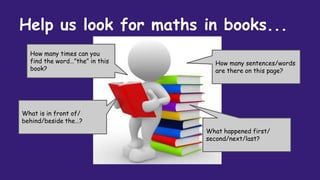
Help us look for maths in books...
How many times can you
find the word…”the” in this
book?
How many sentences/words
are there on this page?
What is in front of/
behind/beside the…?
What happened first/
second/next/last?
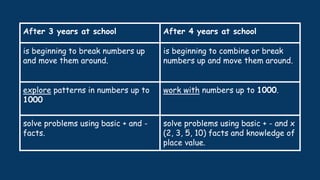
After 3 years at school After 4 years at school
is beginning to break numbers up
and move them around.
is beginning to combine or break
numbers up and move them around.
explore patterns in numbers up to
1000
work with numbers up to 1000.
solve problems using basic + and -
facts.
solve problems using basic + - and x
(2, 3, 5, 10) facts and knowledge of
place value.
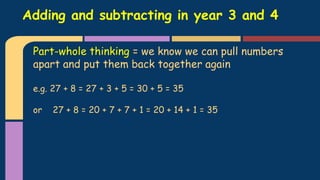
Part-whole thinking = we know we can pull numbers
apart and put them back together again
e.g. 27 + 8 = 27 + 3 + 5 = 30 + 5 = 35
or 27 + 8 = 20 + 7 + 7 + 1 = 20 + 14 + 1 = 35
Adding and subtracting in year 3 and 4
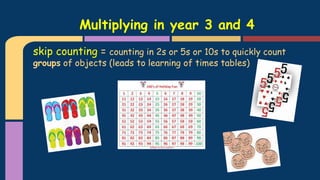
skip counting = counting in 2s or 5s or 10s to quickly count
groups of objects (leads to learning of times tables)
Multiplying in year 3 and 4
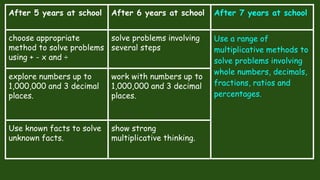
After 5 years at school After 6 years at school After 7 years at school
choose appropriate
method to solve problems
using + - x and ÷
solve problems involving
several steps
Use a range of
multiplicative methods to
solve problems involving
whole numbers, decimals,
fractions, ratios and
percentages.
explore numbers up to
1,000,000 and 3 decimal
places.
work with numbers up to
1,000,000 and 3 decimal
places.
Use known facts to solve
unknown facts.
show strong
multiplicative thinking.
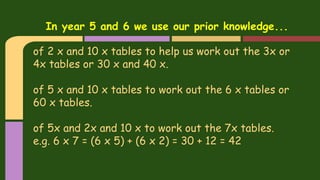
of 2 x and 10 x tables to help us work out the 3x or
4x tables or 30 x and 40 x.
of 5 x and 10 x tables to work out the 6 x tables or
60 x tables.
of 5x and 2x and 10 x to work out the 7x tables.
e.g. 6 x 7 = (6 x 5) + (6 x 2) = 30 + 12 = 42
In year 5 and 6 we use our prior knowledge...
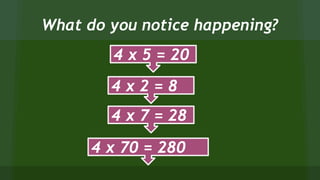
What do you notice happening?
4 x 5 = 20
4 x 2 = 8
4 x 7 = 28
4 x 70 = 280
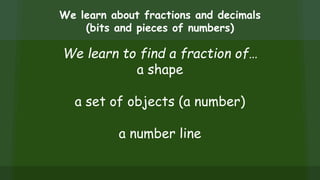
We learn about fractions and decimals
(bits and pieces of numbers)
We learn to find a fraction of…
a shape
a set of objects (a number)
a number line
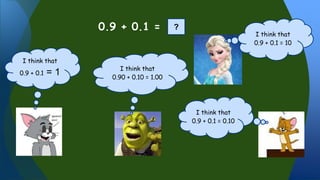
0.9 + 0.1 =
I think that
0.9 + 0.1 = 1
I think that
0.9 + 0.1 = 0.10
I think that
0.9 + 0.1 = 10
I think that
0.90 + 0.10 = 1.00
?
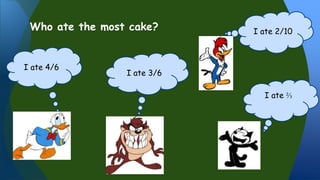
Who ate the most cake?
I ate 4/6
I ate ⅔
I ate 2/10
I ate 3/6
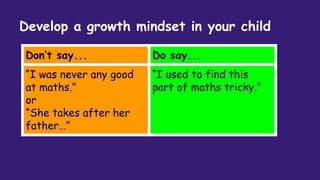
Develop a growth mindset in your child
Don’t say... Do say...
“I was never any good
at maths.”
or
“She takes after her
father…”
“I used to find this
part of maths tricky.”
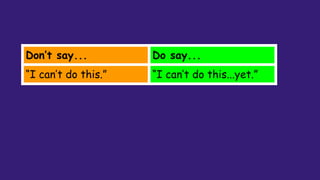
Don’t say... Do say...
“I can’t do this.” “I can’t do this...yet.”
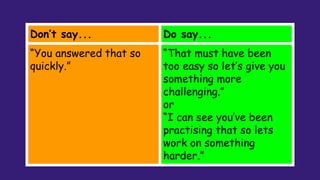
Don’t say... Do say...
“You answered that so
quickly.”
“That must have been
too easy so let’s give you
something more
challenging.”
or
“I can see you’ve been
practising that so lets
work on something
harder.”
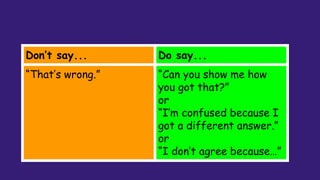
Don’t say... Do say...
“That’s wrong.” “Can you show me how
you got that?”
or
“I’m confused because I
got a different answer.”
or
“I don’t agree because…”
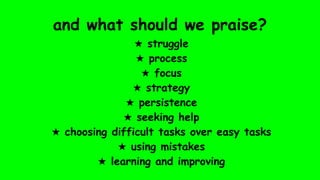
and what should we praise?
★ struggle
★ process
★ focus
★ strategy
★ persistence
★ seeking help
★ choosing difficult tasks over easy tasks
★ using mistakes
★ learning and improving
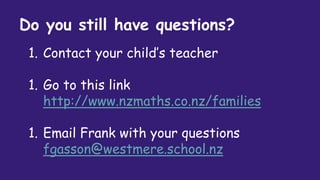
Do you still have questions?
1. Contact your child’s teacher
1. Go to this link
http://www.nzmaths.co.nz/families
1. Email Frank with your questions
fgasson@westmere.school.nz
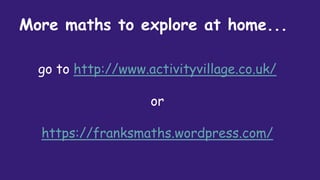
More maths to explore at home...
go to http://www.activityvillage.co.uk/
or
https://franksmaths.wordpress.com/
or start a maths conversation...
“What do you notice?”
“I wonder…
... What do you wonder?”
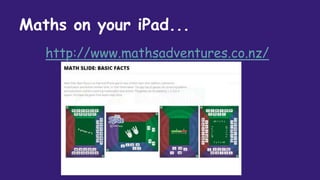
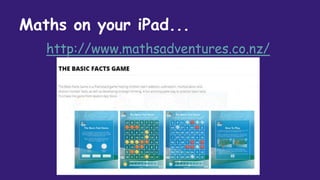
Maths on your iPad...
http://www.mathsadventures.co.nz/
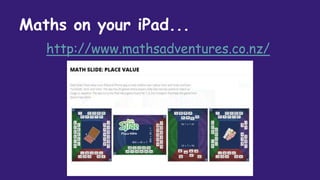
Maths on your iPad...
http://www.mathsadventures.co.nz/
Maths on your iPad...
http://www.mathsadventures.co.nz/
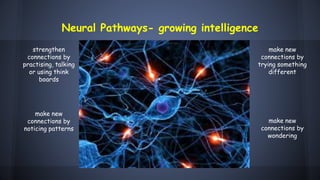
Neural Pathways- growing intelligence
strengthen
connections by
practising, talking
or using think
boards
make new
connections by
trying something
different
make new
connections by
noticing patterns
make new
connections by
wondering
tidy numbers = numbers ending in 0
number bonds = two numbers that add to make 10 or
100 or 1,000
number sense = an understanding of numbers, their
relationships, and the ability to apply this
understanding to solving increasingly complex
problems.
Language we now use at school...
place value = a number’s value changes depending
what place it sits e.g. the value of 2 in 324 is 20
place value partitioning = pulling a larger number
apart to simplify the problem.
e.g. 364 - 15 might be solved by
364 - 10 = 354
354 - 5 = 354 - 4 - 1 = 349
Language we now use at school...
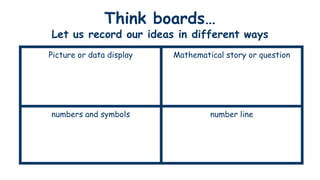
Think boards…
Let us record our ideas in different ways
Picture or data display Mathematical story or question
numbers and symbols number line
I have an idea / thought
whakaaro ake au, ka taka te kapa
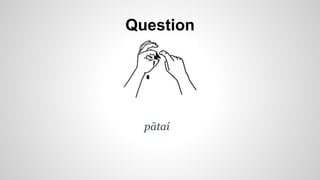
Question
pātai
Agree/ Agreement noun, verb
whakaae, whakaaetanga

Parent math session 2 and 3

  • 1.
    “The problems ofthe future are not going to be tidy or straight - forward. Therefore our children will need to be… resilient and brave, resourceful, creative and innovative and patient.” F. Gasson, 2015
  • 2.
    When we wereat school… ❏ We worked on our own. ❏ We feared making mistakes. ❏ We had to regurgitate the teacher’s methods. ❏ We were sometimes punished for failing. ❏ We were labelled and ranked. ❏ There was very little application or connection of maths to the real world.
  • 3.
    Now it lookslike this... ❖ We work with others. ❖ We celebrate mistakes and learn from them. ❖ We discover our own methods. ❖ We fail and struggle and try harder. ❖ We identify our strengths and next steps to work on. ❖ We discover maths in the world around us.
  • 4.
    When we wereat school maths looked like this… 3 0 1 - 1 9 9
  • 5.
    Now it lookslike this •You have $301 to buy a bike. •It is on sale for $199 •How much money will you still have left over? Explain your thinking.
  • 6.
  • 7.
    How can wesupport at home? Support the “what” of learning... Basic facts, number sense, mathematical language. (see next slide) Develop interest in the “why” of learning maths. It is everywhere in the world around us. It helps us to describe and communicate about the world. It helps us to make decisions that hopefully improve our lives and the lives of others.
  • 8.
    After 1 yearat school After 2 years at school counting all (use fingers, objects, imaging in their head) counts forwards or backwards from a number (use objects) read, write, order and count numbers to 20 read, write, order and count numbers to 100 begin to recognise number patterns up to 5 then 10 know + facts to 10 then 20. Know - facts to 10
  • 9.
    Use objects aroundthe home to count forwards and backwards
  • 10.
    Use number lines goto … http://themathworksheetsite.com/numline.html
  • 11.
    and tens frames... goto … http://nzmaths.co.nz/sites/default/files/Numeracy/2007matmas/Bk4/MM%204_6.pdf
  • 12.
    Tens frames onyour iPad... Tens Frame Snap (on iTunes)
  • 13.
    and hundreds boards... goto http://nzmaths.co.nz/resource/hundreds-board for ideas I wonder what comes after/ before…?
  • 14.
    Advanced Counting: wecount on from a bigger number to add two numbers together e.g. 4 + 8 we go 8... 9, 10, 11, 12. (number lines help us to learn this) Adding and subtracting in year 2
  • 15.
    Help us lookfor maths in books... How many times can you find the word…”the” in this book? How many sentences/words are there on this page? What is in front of/ behind/beside the…? What happened first/ second/next/last?
  • 16.
    After 3 yearsat school After 4 years at school is beginning to break numbers up and move them around. is beginning to combine or break numbers up and move them around. explore patterns in numbers up to 1000 work with numbers up to 1000. solve problems using basic + and - facts. solve problems using basic + - and x (2, 3, 5, 10) facts and knowledge of place value.
  • 17.
    Part-whole thinking =we know we can pull numbers apart and put them back together again e.g. 27 + 8 = 27 + 3 + 5 = 30 + 5 = 35 or 27 + 8 = 20 + 7 + 7 + 1 = 20 + 14 + 1 = 35 Adding and subtracting in year 3 and 4
  • 18.
    skip counting =counting in 2s or 5s or 10s to quickly count groups of objects (leads to learning of times tables) Multiplying in year 3 and 4
  • 19.
    After 5 yearsat school After 6 years at school After 7 years at school choose appropriate method to solve problems using + - x and ÷ solve problems involving several steps Use a range of multiplicative methods to solve problems involving whole numbers, decimals, fractions, ratios and percentages. explore numbers up to 1,000,000 and 3 decimal places. work with numbers up to 1,000,000 and 3 decimal places. Use known facts to solve unknown facts. show strong multiplicative thinking.
  • 20.
    of 2 xand 10 x tables to help us work out the 3x or 4x tables or 30 x and 40 x. of 5 x and 10 x tables to work out the 6 x tables or 60 x tables. of 5x and 2x and 10 x to work out the 7x tables. e.g. 6 x 7 = (6 x 5) + (6 x 2) = 30 + 12 = 42 In year 5 and 6 we use our prior knowledge...
  • 21.
    What do younotice happening? 4 x 5 = 20 4 x 2 = 8 4 x 7 = 28 4 x 70 = 280
  • 22.
    We learn aboutfractions and decimals (bits and pieces of numbers) We learn to find a fraction of… a shape a set of objects (a number) a number line
  • 23.
    0.9 + 0.1= I think that 0.9 + 0.1 = 1 I think that 0.9 + 0.1 = 0.10 I think that 0.9 + 0.1 = 10 I think that 0.90 + 0.10 = 1.00 ?
  • 24.
    Who ate themost cake? I ate 4/6 I ate ⅔ I ate 2/10 I ate 3/6
  • 25.
    Develop a growthmindset in your child Don’t say... Do say... “I was never any good at maths.” or “She takes after her father…” “I used to find this part of maths tricky.”
  • 26.
    Don’t say... Dosay... “I can’t do this.” “I can’t do this...yet.”
  • 27.
    Don’t say... Dosay... “You answered that so quickly.” “That must have been too easy so let’s give you something more challenging.” or “I can see you’ve been practising that so lets work on something harder.”
  • 28.
    Don’t say... Dosay... “That’s wrong.” “Can you show me how you got that?” or “I’m confused because I got a different answer.” or “I don’t agree because…”
  • 29.
    and what shouldwe praise? ★ struggle ★ process ★ focus ★ strategy ★ persistence ★ seeking help ★ choosing difficult tasks over easy tasks ★ using mistakes ★ learning and improving
  • 30.
    Do you stillhave questions? 1. Contact your child’s teacher 1. Go to this link http://www.nzmaths.co.nz/families 1. Email Frank with your questions fgasson@westmere.school.nz
  • 31.
    More maths toexplore at home... go to http://www.activityvillage.co.uk/ or https://franksmaths.wordpress.com/
  • 32.
    or start amaths conversation... “What do you notice?” “I wonder… ... What do you wonder?”
  • 33.
    Maths on youriPad... http://www.mathsadventures.co.nz/
  • 34.
    Maths on youriPad... http://www.mathsadventures.co.nz/
  • 35.
    Maths on youriPad... http://www.mathsadventures.co.nz/
  • 36.
    Neural Pathways- growingintelligence strengthen connections by practising, talking or using think boards make new connections by trying something different make new connections by noticing patterns make new connections by wondering
  • 37.
    tidy numbers =numbers ending in 0 number bonds = two numbers that add to make 10 or 100 or 1,000 number sense = an understanding of numbers, their relationships, and the ability to apply this understanding to solving increasingly complex problems. Language we now use at school...
  • 38.
    place value =a number’s value changes depending what place it sits e.g. the value of 2 in 324 is 20 place value partitioning = pulling a larger number apart to simplify the problem. e.g. 364 - 15 might be solved by 364 - 10 = 354 354 - 5 = 354 - 4 - 1 = 349 Language we now use at school...
  • 39.
    Think boards… Let usrecord our ideas in different ways Picture or data display Mathematical story or question numbers and symbols number line
  • 40.
    I have anidea / thought whakaaro ake au, ka taka te kapa
  • 41.
  • 42.
    Agree/ Agreement noun,verb whakaae, whakaaetanga

Editor's Notes

  • #28 Jo Boaler...maths without fear. Number sense versus rote memorisation