KS1 ADDITION AND
SUBTRACTION
20.3.19
Aims for this session
• Aims / Changes of the New Curriculum
• Progression in Addition and Subtraction
• Calculation Policy in Year 1 and 2
• Have fun!
Aims
The national curriculum for mathematics aims to ensure that all pupils:
• become fluent in the fundamentals of mathematics, including through
varied and frequent practice with increasingly complex problems over
time, so that pupils develop conceptual understanding and the ability to
recall and apply knowledge rapidly and accurately.
• reason mathematically by following a line of enquiry, conjecturing
relationships and generalisations, and developing an argument,
justification or proof using mathematical language
• can solve problems by applying their mathematics to a variety of
routine and non-routine problems with increasing sophistication,
including breaking down problems into a series of simpler steps and
persevering in seeking solutions
Written methods of calculations are based on mental strategies.
Each of the four operations builds on mental skills which provide the foundation for jottings
and informal written methods of recording.
Skills need to be taught, practised and reviewed constantly. These skills lead on to more
formal written methods of calculation.
Strategies for calculation need to be represented by models and images to support, develop
and secure understanding. This, in turn, builds fluency.
The transition between stages should not be hurried as not all children will be ready to
move on to the next stage at the same time; therefore, the progression in this document is
outlined in stages.
Previous stages may need to be revisited to consolidate understanding when introducing a
new strategy.
A sound understanding of the number system is essential for children to carry out
calculations efficiently and accurately.
Key Principles
The importance of fluency
Efficiency - this implies that children do not get bogged down in too many steps or lose
track of the logic of the strategy. An efficient strategy is one that the student can carry out
easily, keeping track of sub-problems and making use of intermediate results to solve the
problem.
Accuracy depends on several aspects of the problem-solving process, among them
careful recording, knowledge of number facts and other important number relationships,
and double-checking results.
Flexibility requires the knowledge of more than one approach to solving a particular kind
of problem, such as two-digit multiplication. Students need to be flexible in order to
choose an appropriate strategy for the numbers involved, and also be able to use one
method to solve a problem and another method to check the results.
What have been the main changes in the teaching and
learning of Maths?
Mastery of a content – no acceleration on to new / higher year group content
Reasoning - the expectation that children can explain their thinking and show their
understanding in multiple ways
Speaking in full sentences – children have to speak in full sentences throughout Maths
lessons and explain their reasoning
Perception of high ability – number crunchers are not necessarily the best
mathematicians
Context based and “stories” - understanding how to apply the Maths in different
contexts
The importance of knowing key number facts and then
slowing down and thinking
What do you notice?
What is the same?
What is different?
How has that changed?
What is the link between that?
Which one do you think is hardest/easiest – why?
What did you do to reach that solution?
Apparatus, resources and imagery for all
learners
SHOW IT
DRAW IT
EXPLAIN IT
TELL IT
Key language for addition: sum, total, parts and wholes, plus, add, altogether,
more, ‘is the same as’
Key language for subtraction: take away, subtract, find the difference, fewer,
less than
© Crown Copyright 2017
www.ncetm.org.uk/masterypd Autumn 2017 pilot
?
?
10
5
10
1 8
2
10
9
2
3
5
8
4
3
3
10
2
Using other structured models such as tens frames, part whole models or
bar models can help children to reason about mathematical relationships.
Connections between these models should be made, so that children understand the
same mathematics is represented in different ways. Asking the question “What’s the
same what’s different?” has the potential for children to draw out the connections.
What’s the same?
What’s different?
Can you write your own story
for each type of addition?
aggregation
augmentation
partitioned set
Augmentation
© Crown Copyright 2017
www.ncetm.org.uk/masterypd Autumn 2017 pilot
?
?
?
6
6
© Crown Copyright 2017
www.ncetm.org.uk/masterypd Autumn 2017 pilot
© Crown Copyright 2017
www.ncetm.org.uk/masterypd Autumn 2017 pilot
© Crown Copyright 2017
www.ncetm.org.uk/masterypd Autumn 2017 pilot
Can you write a story that ends with six children on the bus?
Making 10 and Bridging 10
Bridging 10
What is the Calculation?
How can we use
10 to solve the
addition
problem?
Adding 3 Numbers
■Place value and column value
34 = 30 and 4
34 = 3 tens and 4 ones
Using nouns to build
understanding
■ Why does 30+40 =70?
■ 3 tens plus 4 tens equals 7 tens
■ (3 flowers plus 4 flowers equals 7
flowers
■ 3 ones plus 4 ones equals 7 ones)
Part/Part/Whole Model
9
2
10
5
10
? 7
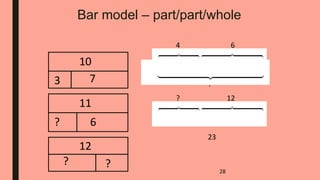
Bar model – part/part/whole
28
12
? ?
11
? 6
10
3 7
4 6
?
? 12
23
What’s the same?
What’s different?
aggregation
partition
150 cm
130 cm
take away
difference
Structures
• Take Away
• Difference
• Partitioning
This is a subtraction story
What do each of
the counters
represent?
Can you see
all three
structures in
this picture?
? = 90 – 30
Which strategy would you use?
Move between Concrete and Abstract
More Complex Number Sentences
■ What would be considered an efficient
calculation method to solve this calculation?
___ = 34 + 57
19 – 16 = ___
36 – 5 =
70 = 30 + ____
What is expected at the end of KS1?
Applying the Skills in Context
What is expected at the end of KS1?
Applying the Skills in Context
THANK YOU FOR COMING!

Addition&Subtraction.pptx

  • 1.
  • 2.
    Aims for thissession • Aims / Changes of the New Curriculum • Progression in Addition and Subtraction • Calculation Policy in Year 1 and 2 • Have fun!
  • 3.
    Aims The national curriculumfor mathematics aims to ensure that all pupils: • become fluent in the fundamentals of mathematics, including through varied and frequent practice with increasingly complex problems over time, so that pupils develop conceptual understanding and the ability to recall and apply knowledge rapidly and accurately. • reason mathematically by following a line of enquiry, conjecturing relationships and generalisations, and developing an argument, justification or proof using mathematical language • can solve problems by applying their mathematics to a variety of routine and non-routine problems with increasing sophistication, including breaking down problems into a series of simpler steps and persevering in seeking solutions
  • 4.
    Written methods ofcalculations are based on mental strategies. Each of the four operations builds on mental skills which provide the foundation for jottings and informal written methods of recording. Skills need to be taught, practised and reviewed constantly. These skills lead on to more formal written methods of calculation. Strategies for calculation need to be represented by models and images to support, develop and secure understanding. This, in turn, builds fluency. The transition between stages should not be hurried as not all children will be ready to move on to the next stage at the same time; therefore, the progression in this document is outlined in stages. Previous stages may need to be revisited to consolidate understanding when introducing a new strategy. A sound understanding of the number system is essential for children to carry out calculations efficiently and accurately. Key Principles
  • 5.
    The importance offluency Efficiency - this implies that children do not get bogged down in too many steps or lose track of the logic of the strategy. An efficient strategy is one that the student can carry out easily, keeping track of sub-problems and making use of intermediate results to solve the problem. Accuracy depends on several aspects of the problem-solving process, among them careful recording, knowledge of number facts and other important number relationships, and double-checking results. Flexibility requires the knowledge of more than one approach to solving a particular kind of problem, such as two-digit multiplication. Students need to be flexible in order to choose an appropriate strategy for the numbers involved, and also be able to use one method to solve a problem and another method to check the results.
  • 6.
    What have beenthe main changes in the teaching and learning of Maths? Mastery of a content – no acceleration on to new / higher year group content Reasoning - the expectation that children can explain their thinking and show their understanding in multiple ways Speaking in full sentences – children have to speak in full sentences throughout Maths lessons and explain their reasoning Perception of high ability – number crunchers are not necessarily the best mathematicians Context based and “stories” - understanding how to apply the Maths in different contexts
  • 8.
    The importance ofknowing key number facts and then slowing down and thinking What do you notice? What is the same? What is different? How has that changed? What is the link between that? Which one do you think is hardest/easiest – why? What did you do to reach that solution?
  • 10.
    Apparatus, resources andimagery for all learners SHOW IT DRAW IT EXPLAIN IT TELL IT
  • 11.
    Key language foraddition: sum, total, parts and wholes, plus, add, altogether, more, ‘is the same as’ Key language for subtraction: take away, subtract, find the difference, fewer, less than
  • 12.
    © Crown Copyright2017 www.ncetm.org.uk/masterypd Autumn 2017 pilot ? ?
  • 13.
  • 14.
    Using other structuredmodels such as tens frames, part whole models or bar models can help children to reason about mathematical relationships. Connections between these models should be made, so that children understand the same mathematics is represented in different ways. Asking the question “What’s the same what’s different?” has the potential for children to draw out the connections.
  • 15.
    What’s the same? What’sdifferent? Can you write your own story for each type of addition? aggregation augmentation partitioned set
  • 16.
  • 17.
    © Crown Copyright2017 www.ncetm.org.uk/masterypd Autumn 2017 pilot ? ? ? 6 6
  • 18.
    © Crown Copyright2017 www.ncetm.org.uk/masterypd Autumn 2017 pilot
  • 19.
    © Crown Copyright2017 www.ncetm.org.uk/masterypd Autumn 2017 pilot
  • 20.
    © Crown Copyright2017 www.ncetm.org.uk/masterypd Autumn 2017 pilot Can you write a story that ends with six children on the bus?
  • 21.
    Making 10 andBridging 10
  • 22.
    Bridging 10 What isthe Calculation? How can we use 10 to solve the addition problem?
  • 23.
  • 25.
    ■Place value andcolumn value 34 = 30 and 4 34 = 3 tens and 4 ones
  • 26.
    Using nouns tobuild understanding ■ Why does 30+40 =70? ■ 3 tens plus 4 tens equals 7 tens ■ (3 flowers plus 4 flowers equals 7 flowers ■ 3 ones plus 4 ones equals 7 ones)
  • 27.
  • 28.
    Bar model –part/part/whole 28 12 ? ? 11 ? 6 10 3 7 4 6 ? ? 12 23
  • 31.
    What’s the same? What’sdifferent? aggregation partition 150 cm 130 cm take away difference
  • 32.
    Structures • Take Away •Difference • Partitioning
  • 35.
    This is asubtraction story
  • 36.
    What do eachof the counters represent?
  • 38.
    Can you see allthree structures in this picture?
  • 39.
    ? = 90– 30 Which strategy would you use?
  • 40.
  • 41.
  • 45.
    ■ What wouldbe considered an efficient calculation method to solve this calculation? ___ = 34 + 57 19 – 16 = ___ 36 – 5 = 70 = 30 + ____
  • 46.
    What is expectedat the end of KS1?
  • 47.
    What is expectedat the end of KS1? Applying the Skills in Context
  • 48.
    What is expectedat the end of KS1? Applying the Skills in Context
  • 49.

Editor's Notes

  • #28 Try some Part/part/whole - partitioning